Check results fast using our powerful Rounding Calculator
Table of Contents
- Introduction
- What Is Scientific Notation?
- What Is a Scientific Notation Calculator?
- The Structure of Scientific Notation — Mantissa and Exponent
- How to Convert Decimal to Scientific Notation
- How to Convert Scientific Notation to Decimal
- Using the Scientific Notation Calculator Step by Step
- E-Notation — An Alternative Representation
- Precision and Significant Figures in the Scientific Notation Calculator
- Scientific Notation Calculator in Physics and Astronomy
- Scientific Notation Calculator in Chemistry and Biology
- Scientific Notation Calculator in Engineering and Technology
- Scientific Notation Calculator in Finance and Economics
- Scientific Notation Calculator in Education
- Arithmetic Operations in Scientific Notation
- Common Mistakes When Using the Scientific Notation Calculator
- Scientific Notation Examples
- How to Convert Large Numbers to Scientific Notation
- Frequently Asked Questions (FAQs)
- Conclusion
Introduction
Numbers in science, mathematics, engineering, and technology often reach scales that are impossibly large or infinitely small for everyday decimal notation to handle comfortably. How do you write the distance from Earth to the nearest star — 40,208,000,000,000 kilometers — without losing track of all those zeros? And how do you express the mass of a single proton — 0.000000000000000000000000001672 kilograms — without running out of space? The answer is scientific notation, and the Scientific Notation Calculator is the tool that makes working with it fast, effortless, and error-free.
Scientific notation is the universal language of large and small numbers across every quantitative discipline. From physics and chemistry to astronomy, biology, finance, and engineering, scientific notation allows scientists and professionals to express extreme values in a compact, standardized form — and to perform calculations on those values with precision. The Scientific Notation Calculator automates both directions of this conversion — from decimal to scientific notation and from scientific notation back to decimal — and provides a detailed step-by-step breakdown of every calculation, making it an invaluable tool for learning and professional use alike.
In this comprehensive guide, we will explore everything you need to know about the Scientific Notation Calculator — what scientific notation is, how the conversions work, what the mantissa and exponent represent, and where scientific notation is applied across disciplines. Whether you are a student encountering scientific notation for the first time or a professional who works with extreme-scale numbers daily, this guide will give you a complete, practical understanding of the Scientific Notation Calculator and how to use it with confidence.
What Is Scientific Notation?
Scientific notation is a standardized method of expressing very large or very small numbers in a compact, readable format using a combination of a decimal coefficient (the mantissa) and a power of 10 (the exponent). Instead of writing out all the digits of an extreme number, scientific notation condenses the value into two components that are easy to read, write, compare, and compute.
The general form of scientific notation is:
a × 10ⁿ
Where:
- a (the mantissa) is a number such that 1 ≤ |a| < 10
- n (the exponent) is an integer (positive, negative, or zero)
- 10ⁿ is a power of ten that scales the mantissa to the correct magnitude
Examples of scientific notation:
- 4,500 = 4.5 × 10³
- 0.0054 = 5.4 × 10⁻³
- 300,000,000 (speed of light in m/s) = 3.0 × 10⁸
- 0.000000000167 (gravitational constant factor) = 1.67 × 10⁻¹⁰
Scientific notation was developed by scientists to solve a real problem: extreme numbers are awkward to write, easy to misread (how many zeros were in that number?), and difficult to compare. In scientific notation, the exponent immediately tells you the order of magnitude — how big or small the number is — while the mantissa gives you its precise value within that magnitude.
What Is a Scientific Notation Calculator?
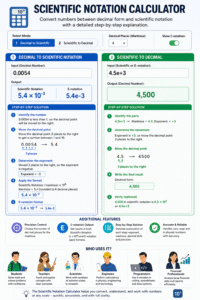
A Scientific Notation Calculator is a digital tool that converts numbers between decimal form and scientific notation, and displays a detailed step-by-step breakdown of the conversion process. It operates in two modes:
Mode 1 — Decimal to Scientific Notation You input a decimal number (e.g., 0.0054 or 4,500,000), and the Scientific Notation Calculator converts it to proper scientific notation (e.g., 5.4 × 10⁻³ or 4.5 × 10⁶), showing all steps of the conversion.
Mode 2 — Scientific Notation to Decimal You input a number in scientific or E-notation form (e.g., 4.5e+3), and the Scientific Notation Calculator expands it back to its full decimal representation (e.g., 4,500).
Additional features of the Scientific Notation Calculator:
- Precision control — you specify how many decimal places to include in the mantissa
- E-notation output — alongside standard scientific notation (a × 10ⁿ), the calculator displays E-notation format (e.g., 4.5e+3) used in programming and spreadsheet applications
- Step-by-step solution — the calculator explains every stage of the conversion, identifying the exponent, mantissa extraction, decimal shift direction, and precision application
The Scientific Notation Calculator is widely used by students, teachers, scientists, engineers, programmers, and financial professionals who regularly encounter numbers at extreme scales and need to convert between representations quickly and accurately.
The Structure of Scientific Notation — Mantissa and Exponent
Understanding the two components of scientific notation is essential for using the Scientific Notation Calculator effectively.
The Mantissa (Coefficient) The mantissa is the decimal part of the scientific notation expression — the number a in a × 10ⁿ. By definition, the mantissa must satisfy 1 ≤ |a| < 10, meaning it always has exactly one non-zero digit before the decimal point.
- For 6,700,000: mantissa = 6.7
- For 0.000043: mantissa = 4.3
- For 150: mantissa = 1.5
- For −0.0092: mantissa = −9.2
The mantissa carries all the significant digits of the number — it is where precision lives in scientific notation.
The Exponent The exponent (n) tells you how many places the decimal point must be moved to convert the mantissa back into the original number:
- Positive exponent → the original number is large (decimal point moves right)
- Negative exponent → the original number is small (decimal point moves left)
- Zero exponent → the number is between 1 and 10 (no movement needed)
For 6,700,000 = 6.7 × 10⁶: the exponent is +6, meaning the decimal moves 6 places to the right. For 0.000043 = 4.3 × 10⁻⁵: the exponent is −5, meaning the decimal moves 5 places to the left.
The Scientific Notation Calculator identifies both the mantissa and exponent automatically, displaying them clearly in its output so you can understand exactly how the conversion was performed.
How to Convert Decimal to Scientific Notation
Converting a decimal number to scientific notation manually follows a consistent four-step process — the same logic the Scientific Notation Calculator applies internally.
Step 1 — Identify the Significant Digits Find the first non-zero digit in the number. This is where your mantissa begins.
Step 2 — Place the Decimal Point Rewrite the number with the decimal point immediately after the first non-zero digit. This gives you the mantissa (a, where 1 ≤ |a| < 10).
Step 3 — Count the Decimal Shifts Count how many places the decimal point moved from its original position to its new position:
- If it moved left (large number), the exponent is positive
- If it moved right (small number), the exponent is negative
Step 4 — Write in Scientific Notation Express the result as: mantissa × 10^(exponent)
Worked Examples:
Example 1: 0.0054
- First non-zero digit: 5 → mantissa = 5.4
- Decimal moved 3 places right → exponent = −3
- Result: 5.4 × 10⁻³
Example 2: 7,250,000
- First non-zero digit: 7 → mantissa = 7.25
- Decimal moved 6 places left → exponent = +6
- Result: 7.25 × 10⁶
Example 3: 0.000000302
- Mantissa = 3.02
- Decimal moved 7 places right → exponent = −7
- Result: 3.02 × 10⁻⁷
The Scientific Notation Calculator performs all these steps instantly and displays them one by one for educational clarity.
How to Convert Scientific Notation to Decimal
Converting scientific notation back to decimal is the reverse process, and the Scientific Notation Calculator handles it with equal clarity.
Step 1 — Read the Mantissa and Exponent Identify a and n in the expression a × 10ⁿ.
Step 2 — Determine Shift Direction
- Positive exponent → move decimal right (making the number larger)
- Negative exponent → move decimal left (making the number smaller)
Step 3 — Shift the Decimal Point Move the decimal point |n| places in the appropriate direction, filling empty positions with zeros.
Step 4 — Write the Decimal Number The result is the full decimal representation.
Worked Examples:
Example 1: 4.5 × 10³
- Exponent = +3 → shift decimal 3 places right
- 4.5 → 4500
- Result: 4,500
Example 2: 2.71 × 10⁻⁴
- Exponent = −4 → shift decimal 4 places left
- 2.71 → 0.000271
- Result: 0.000271
Example 3: 9.8 × 10⁷
- Exponent = +7 → shift decimal 7 places right
- 9.8 → 98,000,000
- Result: 98,000,000
Using the Scientific Notation Calculator Step by Step
The Scientific Notation Calculator is simple to use and delivers instant, detailed results. Here is a complete walkthrough:
Step 1 — Select Conversion Mode Choose either “Decimal to Scientific” or “Scientific to Decimal” from the mode selector, depending on which direction you need to convert.
Step 2 — Enter Your Number Type your input into the number field. For decimal-to-scientific mode, enter any standard decimal number (e.g., 0.0054, 4500000). For scientific-to-decimal mode, enter a number in E-notation format (e.g., 4.5e+3, 5.4e-3).
Step 3 — Set Precision Choose how many decimal places you want in the mantissa. For example, precision 4 gives you a mantissa like 5.4000; precision 2 gives 5.40.
Step 4 — Click Calculate The Scientific Notation Calculator applies the conversion formula and displays:
- The converted result in standard scientific notation (a × 10ⁿ)
- The E-notation equivalent
- A numbered step-by-step breakdown of the entire calculation
Step 5 — Interpret the Results Review the standard form, E-notation, exponent, mantissa, decimal shift direction, and precision-adjusted output to fully understand the conversion.
Step 6 — Clear and Repeat Use the Clear button to reset the calculator for a new number.
E-Notation — An Alternative Representation
E-notation (also called engineering notation or exponential notation) is a computer-friendly alternative to standard scientific notation that replaces “× 10ⁿ” with the letter “e” followed by the exponent. It is the format used in programming languages, spreadsheets, calculators, and scientific software.
E-notation examples:
- 4.5 × 10³ = 4.5e+3
- 5.4 × 10⁻³ = 5.4e-3
- 3.0 × 10⁸ = 3.0e+8
- 1.67 × 10⁻²⁷ = 1.67e-27
The Scientific Notation Calculator outputs both formats simultaneously — the traditional a × 10ⁿ format for mathematical and educational use, and the E-notation format for programming and computational use.
E-notation is particularly important in:
- Programming — Languages like Python, JavaScript, C, and Java use E-notation for floating-point literals (e.g.,
1.67e-27) - Spreadsheets — Excel and Google Sheets display very large/small numbers in E-notation automatically
- Scientific computing — MATLAB, R, and NumPy use E-notation for scientific computations
- Electronic instruments — Oscilloscopes, multimeters, and spectrum analyzers display measurements in E-notation
Precision and Significant Figures in the Scientific Notation Calculator
Precision is one of the most important considerations when working with scientific notation, and the Scientific Notation Calculator gives you direct control over it through the precision (decimal places) setting.
Significant figures are the digits in a number that carry meaningful information about its precision. In scientific notation, the number of significant figures equals the number of digits in the mantissa (including the digit before the decimal point).
Examples:
- 5.4 × 10⁻³ → 2 significant figures
- 5.40 × 10⁻³ → 3 significant figures
- 5.4000 × 10⁻³ → 5 significant figures
The precision setting in the Scientific Notation Calculator controls the number of decimal places in the mantissa, which in turn determines the number of significant figures in your result. Choosing the right precision is critical in scientific work, where over-precision implies false accuracy and under-precision loses real information.
General guidelines:
- Experimental measurements — use the same number of significant figures as the least precise measurement in your dataset
- Theoretical calculations — maintain full precision throughout, then round the final result
- Engineering specifications — follow the tolerance requirements of the specific application
Scientific Notation Calculator in Physics and Astronomy
Physics and astronomy deal with the most extreme numbers in all of science, making the Scientific Notation Calculator an indispensable tool in these fields.
Examples of astronomical and physical quantities in scientific notation:
- Speed of light: 3.0 × 10⁸ m/s
- Mass of the Sun: 1.989 × 10³⁰ kg
- Mass of an electron: 9.109 × 10⁻³¹ kg
- Distance from Earth to the Moon: 3.84 × 10⁸ m
- Distance to the nearest star (Proxima Centauri): 4.02 × 10¹⁶ m
- Planck’s constant: 6.626 × 10⁻³⁴ J·s
- Avogadro’s number: 6.022 × 10²³ mol⁻¹
Without scientific notation, working with these numbers would be impractical. The Scientific Notation Calculator allows physicists and astronomers to quickly convert observed values into scientific notation for calculations, compare quantities of vastly different scales, and verify that computed results are in the correct order of magnitude.
Scientific Notation Calculator in Chemistry and Biology
Chemistry and biology involve quantities that range from the atomic scale to the macroscopic, making scientific notation essential in both fields.
Chemistry applications:
- Molar masses — Expressed in g/mol, typically small numbers, but molar quantities of molecules involve Avogadro’s number (6.022 × 10²³)
- Atomic radii — On the order of 10⁻¹⁰ m (angstroms)
- Reaction rate constants — Span many orders of magnitude across different reaction types
- Drug concentrations — Pharmaceutical concentrations like nanomolar (10⁻⁹ M) require scientific notation
Biology applications:
- Cell sizes — Bacterial cells are approximately 1–10 × 10⁻⁶ m (micrometers)
- DNA base pairs — The human genome contains approximately 3.2 × 10⁹ base pairs
- Virus sizes — Viruses range from about 2 × 10⁻⁸ m to 3 × 10⁻⁷ m in diameter
- Population ecology — Global population figures and ecological abundance data benefit from scientific notation
The Scientific Notation Calculator helps chemists and biologists convert measurement data between decimal and scientific notation formats, ensuring consistency across laboratory notebooks, publications, and computational models.
Scientific Notation Calculator in Engineering and Technology
Engineering requires extreme precision across extreme scales, and scientific notation — supported by the Scientific Notation Calculator — is fundamental to engineering work.
Electrical engineering:
- Capacitance values in picofarads (10⁻¹² F) and nanofarads (10⁻⁹ F)
- Resistance in megaohms (10⁶ Ω) and gigaohms (10⁹ Ω)
- Operating frequencies in gigahertz (10⁹ Hz) and terahertz (10¹² Hz)
- Signal amplitudes in microvolts (10⁻⁶ V) and millivolts (10⁻³ V)
Materials science:
- Grain sizes in nanometers (10⁻⁹ m)
- Young’s modulus values in gigapascals (10⁹ Pa)
- Thermal conductivity and diffusivity coefficients
Computing and data:
- Storage capacities in gigabytes (10⁹ bytes) and terabytes (10¹² bytes)
- Processor clock speeds in gigahertz (10⁹ Hz)
- Network data rates in megabits per second (10⁶ bps) to terabits per second (10¹² bps)
The Scientific Notation Calculator is particularly useful in electronics, where component specifications span many orders of magnitude and converting between unit prefixes (pico-, nano-, micro-, milli-, kilo-, mega-, giga-) is a daily task.
Scientific Notation Calculator in Finance and Economics
While less obvious than in physics or chemistry, scientific notation and the Scientific Notation Calculator have real applications in finance and economics, especially at the macro scale.
National and global economic metrics:
- World GDP — Approximately $1.05 × 10¹⁴ (105 trillion US dollars)
- US national debt — Over $3.0 × 10¹³ (30 trillion dollars)
- Global stock market capitalization — Approximately $1.0 × 10¹⁴
- Daily foreign exchange turnover — Over $7.5 × 10¹² per day
In quantitative finance, very small probabilities and very large transaction counts also benefit from scientific notation. Risk models in insurance, actuarial science, and derivatives pricing regularly involve probabilities on the order of 10⁻⁶ or smaller — and expressing these in scientific notation prevents the misreading of critical values.
Scientific Notation Calculator in Education
Scientific notation is a standard topic in mathematics and science curricula worldwide, and the Scientific Notation Calculator is an invaluable educational aid.
At the secondary school level, students learn scientific notation in mathematics, physics, and chemistry courses. The Scientific Notation Calculator supports learning by:
- Instantly verifying manual conversions students perform in exercises
- Showing the step-by-step process so students understand each stage, not just the answer
- Allowing exploration of many examples quickly, building pattern recognition
At the university and professional level, the Scientific Notation Calculator becomes a productivity tool — allowing scientists, engineers, and researchers to convert numbers rapidly without manual arithmetic, reducing errors in calculations that involve multiple steps of scientific notation manipulation.
Standardized tests including SAT, ACT, AP Physics, AP Chemistry, and various national science examinations regularly include questions involving scientific notation. Students who understand both the concept and the mechanics — supported by a Scientific Notation Calculator for practice — perform significantly better on these assessments.
Arithmetic Operations in Scientific Notation
The Scientific Notation Calculator handles individual number conversions, but it is also important to understand how arithmetic works in scientific notation for calculations involving multiple scientific notation values.
Multiplication:
(a × 10ⁿ) × (b × 10ᵐ) = (a × b) × 10^(n+m) Multiply the mantissas, add the exponents.
Example: (3.0 × 10⁸) × (2.0 × 10³) = 6.0 × 10¹¹
Division:
(a × 10ⁿ) ÷ (b × 10ᵐ) = (a ÷ b) × 10^(n−m) Divide the mantissas, subtract the exponents.
Example: (9.0 × 10⁶) ÷ (3.0 × 10²) = 3.0 × 10⁴
Addition and Subtraction: Requires matching exponents before combining mantissas. Convert both numbers to the same power of 10 first, then add or subtract the mantissas.
Example: (4.5 × 10³) + (2.3 × 10²) = (4.5 × 10³) + (0.23 × 10³) = 4.73 × 10³
Understanding these rules deepens your ability to use the Scientific Notation Calculator effectively — particularly when checking whether a calculated result is in the correct order of magnitude.
Common Mistakes When Using the Scientific Notation Calculator
The Scientific Notation Calculator delivers accurate results, but incorrect inputs or misread outputs can still lead to errors. Here are the most common mistakes to avoid:
- Entering numbers with commas — Many calculators, including digital tools, do not accept numbers with comma separators (e.g., 4,500,000). Enter as 4500000 without commas
- Confusing E-notation with the letter e (Euler’s number) — In scientific E-notation, “e” means “× 10^”, not the mathematical constant e ≈ 2.718
- Ignoring the sign of the exponent — A positive exponent means a large number; a negative exponent means a small number. Confusing the two produces results off by many orders of magnitude
- Setting precision too low — Insufficient decimal places in the mantissa can cause meaningful significant figures to be lost, reducing accuracy
- Forgetting that the mantissa must be between 1 and 10 — An expression like 54 × 10² is not in proper scientific notation; it should be 5.4 × 10³
- Misreading negative numbers — For negative values, the mantissa is negative (e.g., −5.4 × 10³ = −5,400), but the exponent is still positive
Scientific Notation Examples
Compare each standard number with its scientific notation form:
| Standard Number | Scientific Notation |
|---|---|
| 4,500 | 4.5 × 10³ |
| 72,000,000 | 7.2 × 10⁷ |
| 0.0054 | 5.4 × 10⁻³ |
| 0.000072 | 7.2 × 10⁻⁵ |
How to Convert Large Numbers to Scientific Notation
Scientific notation writes a very large or very small number in a shorter form: a × 10n. The first number, a, must be at least 1 and less than 10.
- Move the decimal point until only one non-zero digit remains on its left. For example, move the decimal in 4,500 to make 4.5.
- Count the places moved. In 4,500, the decimal moves 3 places to the left.
- Use the count as the exponent. Moving left creates a positive exponent, so 4,500 becomes 4.5 × 10³.
- Check the result. Multiplying 4.5 by 103 gives 4,500 again.
Frequently Asked Questions (FAQs)
What is a Scientific Notation Calculator? A Scientific Notation Calculator is a digital tool that converts numbers between standard decimal form and scientific notation (a × 10ⁿ), in both directions, with user-controlled precision and a step-by-step solution breakdown.
What is scientific notation? Scientific notation is a way of expressing numbers as a product of a mantissa (1 ≤ |a| < 10) and a power of 10. It is used to represent very large or very small numbers compactly and precisely.
What is E-notation? E-notation is a computer-friendly form of scientific notation where “× 10ⁿ” is written as “eⁿ” — for example, 4.5 × 10³ is written as 4.5e+3. The Scientific Notation Calculator outputs both formats.
How do I convert 0.0054 to scientific notation? Move the decimal point 3 places right to get 5.4, and use a negative exponent: 5.4 × 10⁻³. The Scientific Notation Calculator performs this instantly with step-by-step detail.
What is the mantissa in scientific notation? The mantissa is the decimal coefficient in the expression a × 10ⁿ — the number between 1 and 10 (in absolute value) that carries the significant digits of the number.
Can the Scientific Notation Calculator handle negative numbers? Yes. For negative numbers, the mantissa is negative. For example, −0.0054 = −5.4 × 10⁻³. The exponent represents the magnitude, not the sign of the number.
What does the precision setting do in the Scientific Notation Calculator? The precision setting controls how many decimal places appear in the mantissa. Higher precision preserves more significant figures; lower precision rounds the mantissa to fewer digits.
Why is scientific notation important in science? Scientific notation makes it practical to work with numbers that span many orders of magnitude — from subatomic particle masses (10⁻³¹ kg) to astronomical distances (10²⁶ m) — without errors caused by writing or reading many zeros.
What is the difference between scientific notation and standard form? In most contexts, “scientific notation” and “standard form” refer to the same thing: expressing a number as a × 10ⁿ. In some educational systems, “standard form” specifically refers to this representation.
Is the Scientific Notation Calculator suitable for school homework? Yes. The Scientific Notation Calculator is ideal for educational use — it not only gives the converted result but shows every step of the calculation, helping students understand the process, not just the answer.
Why does a decimal number use a negative exponent?
Numbers between 0 and 1 use a negative exponent because the decimal point moves to the right. For example, 0.0054 becomes 5.4 × 10⁻³.
How do I convert 0.00072 into scientific notation?
Move the decimal point 5 places to the right to get 7.2. Because the decimal moved right, the exponent is negative: 0.00072 = 7.2 × 10⁻⁵.
Can the number before 10 have a decimal?
Yes. The coefficient can be a decimal, but it must be at least 1 and less than 10. For example, 4.5 × 10³ is correctly normalized scientific notation.
Conclusion
Scientific notation is the universal language for expressing numbers at the extremes of scale, and the Scientific Notation Calculator is the tool that makes working with this language fast, accurate, and educational. From the mind-bogglingly large distances of cosmology to the unimaginably small scales of quantum physics, from the enormous figures of global finance to the nanoscale measurements of nanotechnology, scientific notation is the format that brings order and clarity to numbers that would otherwise be unmanageable.
The Scientific Notation Calculator handles every aspect of working with scientific notation — converting decimal to scientific, converting scientific to decimal, displaying E-notation equivalents, applying precision control, and explaining every step of the process with mathematical transparency. It is the ideal tool for students learning scientific notation, professionals who work with extreme-scale quantities, programmers who need E-notation formats, and scientists who require precision-controlled conversions in their research and analysis.
Understanding scientific notation is not just a mathematical skill — it is a literacy requirement for anyone working in a quantitative field. Numbers do not always cooperate with human-scale expectations, but with scientific notation and the Scientific Notation Calculator, no number is too large or too small to handle with confidence and precision.
Bookmark this guide, explore the Scientific Notation Calculator with numbers from your own field, and let the power of standardized exponential notation simplify even the most extreme values you encounter.