Bond Calculator
Bond Pricing Calculator
Make smarter car financing decisions with our Cash Back or Low Interest Calculator
Table of Contents- Introduction
- What Is a Savings Bond?
- What Is a Savings Bond Estimator?
- Why You Need a Savings Bond Estimator
- Key Inputs Used in the Tool
- How Bond Pricing Actually Works
- Understanding Yield, Coupon, and Maturity
- Day-Count Conventions Explained
- Dirty Price vs Clean Price vs Accrued Interest
- Step-by-Step: How to Use the Calculator
- Real-World Example Calculation
- Common Mistakes Investors Make
- Tips to Maximize Bond Returns
- Who Should Use This Tool
- Frequently Asked Questions
- Conclusion
Introduction
Bonds are one of the most trusted investment instruments in the world. Whether you are a long-term investor, a retiree looking for steady income, or a beginner trying to diversify your portfolio, understanding bond valuation is critical. This is exactly where a savings bond estimator becomes your best friend. Instead of solving complex present-value equations manually, you can plug in a few numbers and get an instant, accurate result.
In this detailed guide, we will explore everything about the savings bond estimator, including how it works, what inputs it needs, how pricing is calculated, and how you can use the output to make smarter financial decisions. By the end of this article, you will know not only how to operate the tool but also how to interpret the numbers like a professional bond analyst.
Managing your investments becomes easier when you know exactly how much your savings bonds are worth. A Savings Bond Estimator helps you quickly calculate the current value of your bond, estimated interest earned, and future maturity amount in just seconds. Whether you are planning for long-term savings, retirement, education expenses, or financial security, this tool gives you a clearer picture of your investment growth.
Savings bonds are designed to grow steadily over time, but manually calculating interest rates, maturity dates, and total returns can be confusing. That’s why an online estimator is the perfect solution for investors who want fast, accurate, and hassle-free calculations. Simply enter your bond details, and the calculator instantly provides estimated results without complicated formulas or paperwork.
What Is a Savings Bond?
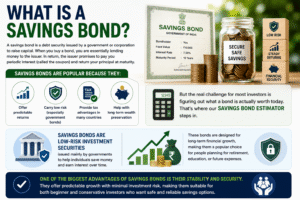
A savings bond is a debt security issued by a government or corporation to raise capital. When you buy a bond, you are essentially lending money to the issuer. In return, the issuer promises to pay you periodic interest (called the coupon) and return your principal at maturity.
Savings bonds are popular because they:
- Offer predictable returns
- Carry low risk (especially government bonds)
- Provide tax advantages in many countries
- Help with long-term wealth preservation
But the real challenge for most investors is figuring out what a bond is actually worth today. That’s where our savings bond estimator steps in.
Savings bonds are low-risk investment securities issued mainly by governments to help individuals save money and earn interest over time. These bonds are designed for long-term financial growth, making them a popular choice for people planning for retirement, education, or future expenses. When you purchase a savings bond, you are essentially lending money to the government in exchange for guaranteed returns after a specific period.
One of the biggest advantages of savings bonds is their stability and security. They offer predictable growth with minimal investment risk, making them suitable for both beginner and conservative investors who want safe and reliable savings options.
What Is a Savings Bond Estimator?
A savings bond estimator is an online financial calculator that helps investors determine the fair value, yield, accrued interest, and pricing of a bond. It removes the need for spreadsheets, formulas, and financial calculators.
With just a few inputs — such as face value, coupon rate, yield, maturity, and frequency — the savings bond estimator delivers:
- Dirty Price
- Clean Price
- Accrued Interest
- Days of Interest Accrued
This makes the savings bond estimator ideal for retail investors, financial advisors, students, and even professional traders who want quick and accurate results.
Why You Need a Savings Bond Estimator
Manual bond calculations involve discounting future cash flows, computing present values, and applying day-count conventions. One small mistake and your valuation can be off by hundreds of dollars. The savings bond estimator eliminates that risk by automating the math.
Here’s why this tool is essential:
- Saves time — get results in seconds.
- Reduces errors — no manual formula mistakes.
- Improves decisions — compare multiple bonds quickly.
- Educational — see how each variable affects price.
A reliable savings bond estimator is no longer a luxury — it’s a necessity in modern investing.
Key Inputs Used in the Tool
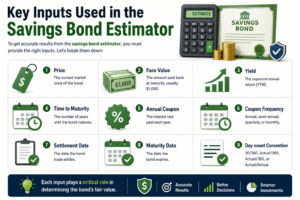
To get accurate results from the savings bond estimator, you must provide the right inputs. Let’s break them down:
- Price – The current market price of the bond.
- Face Value – The amount paid back at maturity, usually $1,000.
- Yield – The expected annual return (YTM).
- Time to Maturity – The number of years until the bond matures.
- Annual Coupon – The interest rate paid each year.
- Coupon Frequency – Annual, semi-annual, quarterly, or monthly.
- Settlement Date – The date the bond trade settles.
- Maturity Date – The date the bond expires.
- Day-count Convention – 30/360, Actual/360, Actual/365, or Actual/Actual.
Each input plays a critical role in determining the bond’s fair value.
How Bond Pricing Actually Works
Bond pricing is based on a simple but powerful idea: a bond is worth the present value of all its future cash flows. These cash flows include:
- Periodic coupon payments
- Final repayment of face value at maturity
The formula looks like this:
Price = Σ (Coupon / (1 + r)^t) + (Face Value / (1 + r)^n)
Where:
- r = yield per period
- t = each period
- n = total number of periods
The savings bond estimator automates this entire formula. Instead of crunching numbers, you simply review the clean price, dirty price, and accrued interest instantly.
Understanding Yield, Coupon, and Maturity
These three terms are the heart of bond investing.
- Coupon Rate – Fixed interest rate paid annually.
- Yield (YTM) – The actual return if held until maturity.
- Maturity – When the issuer repays your principal.
The relationship is simple:
- If yield > coupon, the bond trades at a discount.
- If yield < coupon, the bond trades at a premium.
- If yield = coupon, the bond trades at par.
The savings bond estimator highlights this difference clearly, so you immediately see whether a bond is overvalued or undervalued.
Day-Count Conventions Explained
Day-count conventions decide how interest accrues between two dates. The four most common are:
- 30/360 – Assumes 30 days per month and 360 days per year.
- Actual/360 – Uses actual days but a 360-day year.
- Actual/365 – Uses actual days and a 365-day year.
- Actual/Actual – Uses actual days in both numerator and denominator.
Different bonds use different conventions. US Treasuries typically use Actual/Actual, while corporate bonds often use 30/360. The savings bond estimator lets you choose the right convention so your results match real market behavior.
Dirty Price vs Clean Price vs Accrued Interest
When buying a bond between coupon dates, you pay the dirty price, which equals the clean price plus accrued interest.
- Clean Price – Quoted price without accrued interest.
- Accrued Interest – Interest earned since the last coupon.
- Dirty Price – What you actually pay.
For example, if the clean price is $97.33 and accrued interest is $0.04, the dirty price is $97.37. The savings bond estimator breaks all of this down clearly in the result panel.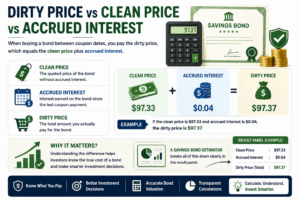
Step-by-Step: How to Use the Calculator
Using the savings bond estimator is incredibly easy. Just follow these steps:
- Enter the Face Value (e.g., $1,000).
- Enter the Yield (%) based on current market rates.
- Enter the Annual Coupon (%).
- Select Coupon Frequency (semi-annual is most common).
- Enter Maturity Date and Settlement Date.
- Choose Day-count Convention.
- Click Calculate Pricing.
In less than a second, you’ll see the dirty price, clean price, accrued interest, and number of accrued days.
Real-World Example Calculation
Let’s say you are evaluating a bond with:
- Face Value: $100
- Coupon: 5% annual
- Yield: 6%
- Frequency: Semi-annual
- Settlement: 3 days after last coupon
- Convention: 30/360
After entering these into the savings bond estimator, you might see:
- Dirty Price: $97.3743
- Clean Price: $97.3326
- Accrued Interest: $0.0417
- Days Accrued: 3
This means the bond is selling at a discount because the yield is higher than the coupon — a classic example the savings bond estimator can illustrate instantly.
Common Mistakes Investors Make
Even experienced investors slip up. Watch out for these:
- Confusing coupon rate with yield
- Ignoring day-count convention
- Forgetting settlement vs trade date
- Using wrong frequency (annual vs semi-annual)
- Not adjusting for accrued interest
The savings bond estimator prevents all of these mistakes by structuring inputs correctly.
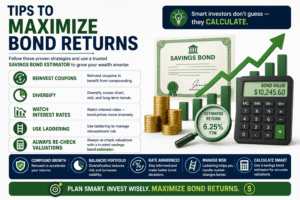
Tips to Maximize Bond Returns- Reinvest coupons to benefit from compounding.
- Diversify across short, mid, and long-term bonds.
- Watch interest rates — bond prices move inversely.
- Use laddering to manage reinvestment risk.
- Always re-check valuations with a trusted savings bond estimator.
Smart investors don’t guess — they calculate.
Who Should Use This Tool
The savings bond estimator is built for:
- Retail investors managing personal portfolios
- Students learning fixed-income concepts
- Financial advisors running quick client scenarios
- Traders verifying market quotes
- Retirees planning income streams
If bonds are part of your strategy, this tool belongs in your toolkit.
Frequently Asked Questions1. What is a Savings Bond Estimator?
A Savings Bond Estimator is an online tool that helps calculate the estimated value, earned interest, and future maturity amount of your savings bonds quickly and accurately.
2. How does a Savings Bond Estimator work?
The estimator uses bond details such as issue date, bond type, and interest rate to calculate the current and projected value of your investment.
3. Is a Savings Bond Estimator free to use?
Yes, most online Savings Bond Estimators are completely free and provide instant calculations without requiring registration.
4. Can I calculate future bond value with this tool?
Yes, the estimator can help predict how much your savings bond may be worth in the future based on interest growth and maturity period.
5. Are savings bonds a safe investment?
Savings bonds are considered low-risk investments because they are typically backed by government guarantees and offer stable returns over time.
6. What information is needed to estimate a bond value?
You usually need details like the bond amount, issue date, bond series, and interest rate to calculate accurate results.
7. Why should I use a Savings Bond Estimator?
Using an estimator saves time, reduces calculation errors, and helps investors make smarter financial decisions with accurate projections.
8. Can beginners use a Savings Bond Estimator easily?
Absolutely. Most estimators are designed with simple interfaces, making them easy for beginners and experienced investors alike.
9. Do savings bonds earn interest over time?
Yes, savings bonds accumulate interest over a fixed period, helping your investment grow steadily until maturity.
10. Can a Savings Bond Estimator help with financial planning?
Yes, it helps investors understand potential returns, track investment growth, and plan long-term financial goals more effectively.
Conclusion
Bond investing doesn’t have to be intimidating. With the right tools, anyone can evaluate bonds like a pro. The savings bond estimator turns complex bond math into simple, instant answers, helping you make confident financial decisions. Whether you’re comparing two bonds, checking a broker’s quote, or planning long-term income, this calculator gives you the clarity, accuracy, and speed you need.
Bookmark the savings bond estimator, use it before every bond purchase, and let smart math guide your investment journey. Informed investors win — and this tool helps you stay informed.
A Savings Bond Estimator is more than just a simple calculation tool — it is a smart way to understand the true value of your investment and prepare for a stronger financial future. Savings bonds are built to grow gradually over time, and knowing how much interest your bond can earn helps you make informed decisions with confidence. Instead of relying on complicated manual formulas, this estimator provides quick, accurate, and reliable results within seconds.
Whether you are saving for retirement, a child’s education, emergency funds, or long-term financial goals, tracking your bond performance is essential. A reliable estimator helps you visualize future returns, compare growth over different periods, and understand when your bond reaches maturity. This level of financial clarity can help investors plan smarter and avoid unnecessary guesswork.
A dependable Savings Bond Estimator also helps investors stay informed about changing bond values and interest growth over time. Having accurate estimates allows you to set realistic financial goals and monitor your progress more effectively. Whether you are managing a single bond or building a larger investment portfolio, understanding projected returns can improve your overall financial strategy. With fast calculations, user-friendly features, and reliable estimates, this tool makes long-term planning easier for everyone. Smart investing starts with clear financial insights, and a Savings Bond Estimator provides exactly that in a simple and efficient way.