Cash Back or Low Interest Calculator
Calculate your annual Required Minimum Distribution quickly with the RMD Calculator
Table of Contents- Introduction
- What Is a Cash Back Calculator
- Cash Back Rebate vs Low Interest Financing Explained
- Why You Should Never Decide Without a Calculator
- Inputs You Need Before You Start
- How the Calculator Works Step by Step
- Reading the Results the Right Way
- Real-World Example Scenarios
- State Sales Tax, Fees, and How They Change the Outcome
- Down Payment and Trade-In Strategy
- When Cash Back Wins
- When Low Interest Wins
- Common Mistakes Car Buyers Make
- Pro Tips to Maximize Savings
- Frequently Asked Questions
- Conclusion
Introduction
Buying a car is one of the largest financial decisions most households make, second only to buying a home. Dealers know this, which is why they package their promotions in ways that look equally appealing but rarely are. A Cash Back Calculator removes the marketing fog and gives you raw, comparable numbers. In just a few seconds, you can see the total loan amount, monthly payment, total interest, and final cost for both offers — side by side.
The goal of this guide is simple. By the time you finish reading, you will know exactly how to use a Cash Back Calculator, what each field means, and how to walk into any dealership with the confidence of a financial analyst.
What Is a Cash Back Calculator
A Cash Back Calculator is a financial tool that compares two competing auto loan offers: a manufacturer cash rebate combined with a higher interest rate, versus a lower promotional interest rate with no rebate. It calculates the true total cost of ownership for each option using your actual loan term, down payment, trade-in value, taxes, and dealer fees.
In short, the Cash Back Calculator answers one critical question: which offer actually costs less over the life of the loan? The answer is almost never obvious without running the numbers, because the rebate reduces your principal immediately while the lower interest rate saves money slowly month after month.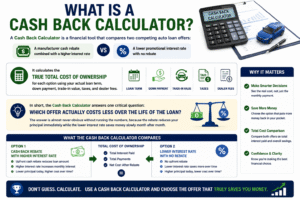
Cash Back Rebate vs Low Interest Financing Explained
Let us break down both offers in plain language.
Cash Back Rebate. The manufacturer gives you a lump sum — often $1,000 to $5,000 — that is applied directly to the vehicle price. Your loan principal is smaller, but your interest rate is at the standard market rate, which can be significantly higher.
Low Interest Financing. Instead of a rebate, the manufacturer subsidizes the interest rate, sometimes as low as 0% APR or 1.9% APR. You pay the full sticker price, but the interest you pay over the loan term is dramatically reduced.
This is precisely the trade-off a Cash Back Calculator is designed to evaluate. The right answer depends on the loan term length, the gap between the two interest rates, and the size of the rebate relative to the vehicle price.
Why You Should Never Decide Without a Calculator
Mental math will fail you here. The relationship between principal, APR, and term length is non-linear, meaning a small change in any one variable can flip the result. A buyer choosing between $3,000 cash back at 7% APR and 0% APR with no rebate on a 60-month loan might assume the 0% offer always wins. It usually does — but not always. On a shorter 36-month loan with a smaller vehicle price, the rebate frequently comes out ahead.
A reliable Cash Back Calculator removes that uncertainty. It runs the exact amortization schedule for both scenarios and reports the true bottom line.
Inputs You Need Before You Start
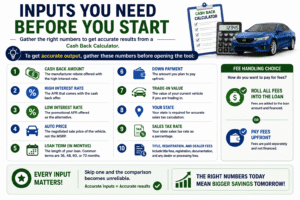
To get accurate output, gather these numbers before opening the tool:
- Cash back amount offered by the manufacturer
- High interest rate that comes with the cash back offer
- Low interest rate offered as the alternative
- Auto price (the negotiated sale price, not MSRP)
- Loan term in months (commonly 36, 48, 60, 72)
- Down payment in dollars
- Trade-in value if you are trading a vehicle
- Your state (for sales tax calculation)
- Sales tax rate as a percentage
- Title, registration, and dealer fees
- Whether you want to roll all fees into the loan or pay them upfront
Every one of these inputs matters. Skip one and the comparison becomes unreliable.
How the Calculator Works Step by Step
Behind the scenes, a quality calculator performs the following sequence for each offer:
- Calculates the taxable amount. This is the auto price minus the trade-in value, with cash back applied or not depending on state rules.
- Adds sales tax based on your state and the taxable base.
- Adds title, registration, and dealer fees.
- Subtracts down payment and trade-in from the total.
- Determines the loan principal, either including or excluding fees depending on your selection.
- Runs an amortization formula using the appropriate APR to compute the monthly payment.
- Multiplies the monthly payment by the term to compute the total of payments.
- Subtracts the principal from the total of payments to reveal the total interest paid.
- Sums upfront cash plus total of payments to deliver the true total cost.
The calculator then displays both offers side by side so you can spot the winner instantly.
Reading the Results the Right Way
A typical Cash Back Calculator result panel shows seven rows for each offer:
- Total Loan Amount — the financed principal
- Sales Tax — taxes assessed on the purchase
- Upfront Payment — what you pay at signing
- Monthly Pay — your recurring payment
- Total of Loan Payments — sum of all monthly payments
- Total Loan Interest — pure interest cost
- Total Cost — the real bottom line
Always compare the Total Cost row first. The lower number is the smarter financial choice. The Monthly Pay row matters for cash flow, but it should never override total cost in your decision.
Real-World Example Scenarios
Scenario A. Auto price $32,000, 60-month term, $3,000 cash back at 6.9% APR vs 0.9% APR with no rebate. The low interest offer typically wins by roughly $1,200 to $1,500 in total interest savings.
Scenario B. Auto price $22,000, 36-month term, $2,500 cash back at 5.9% vs 2.9% with no rebate. Because the term is short, the rebate often wins by a few hundred dollars.
Scenario C. Auto price $45,000, 72-month term, $4,000 cash back at 7.5% vs 1.9% with no rebate. The longer the term, the more the low interest offer dominates — savings can exceed $3,000.
These patterns are why running the numbers in the calculator is non-negotiable.
State Sales Tax, Fees, and How They Change the Outcome
Sales tax treatment differs by state. In many states, the trade-in value reduces the taxable amount, which can save you hundreds. In a few states, it does not. Some states tax the full sale price before rebate, while others tax the post-rebate price. A serious Cash Back Calculator lets you select your state and applies the correct rule automatically.
Title, registration, and dealer fees also vary widely. Rolling them into the loan keeps your upfront cost low but increases the interest you pay. Paying them upfront does the opposite. The calculator lets you toggle this so you see both sides of the trade-off.
Down Payment and Trade-In Strategy
A larger down payment reduces the principal for both offers equally, but it has a bigger relative impact on the high APR scenario because it removes more interest-bearing balance. Trade-in value behaves the same way and often comes with a tax advantage on top.
If you have flexibility, model two or three down payment levels in the calculator. You will quickly see the point where increasing the down payment stops meaningfully improving total cost.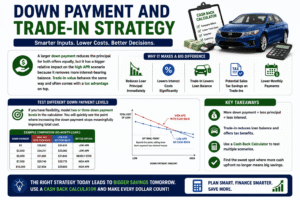
When Cash Back Wins
Cash back tends to be the better choice when:
- The loan term is short (36 months or less)
- The APR gap between the two offers is small (under 2 percentage points)
- The rebate is large relative to the vehicle price
- You plan to pay off the loan early
- You can invest the rebate at a higher return than the APR difference
When Low Interest Wins
Low interest financing usually wins when:
- The loan term is long (60 to 84 months)
- The APR gap is wide (3+ percentage points, especially against 0% offers)
- The vehicle price is high
- You plan to keep the loan for its full term
- You do not have a high-yield place to deploy the rebate
Common Mistakes Car Buyers Make- Comparing only monthly payments. A lower monthly payment can hide a much higher total cost.
- Ignoring fees. Dealer fees can add $500 to $2,000 that meaningfully shift the result.
- Forgetting tax rules in their state. This alone can swing the comparison by hundreds of dollars.
- Not modeling early payoff. If you plan to pay off in three years, a 72-month loan tells you very little.
- Skipping the calculator entirely and trusting the salesperson’s recommendation.
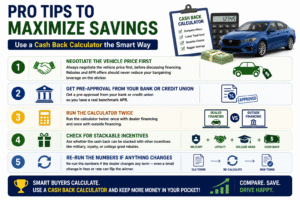
Pro Tips to Maximize Savings- Always negotiate the vehicle price first, before discussing financing. Rebates and APR offers should never reduce your bargaining leverage on the sticker.
- Get a pre-approval from your bank or credit union so you have a real benchmark APR.
- Run the calculator twice: once with dealer financing and once with outside financing.
- Ask whether the cash back can be stacked with other incentives like military, loyalty, or college grad rebates.
- Re-run the numbers if the dealer changes any term — even a small change in fees or rate can flip the winner.

Frequently Asked Questions
- Always negotiate the vehicle price first, before discussing financing. Rebates and APR offers should never reduce your bargaining leverage on the sticker.
- Get a pre-approval from your bank or credit union so you have a real benchmark APR.
- Run the calculator twice: once with dealer financing and once with outside financing.
- Ask whether the cash back can be stacked with other incentives like military, loyalty, or college grad rebates.
- Re-run the numbers if the dealer changes any term — even a small change in fees or rate can flip the winner.
Frequently Asked Questions
Is a Cash Back Calculator accurate?
Yes, when you enter accurate inputs. The math is identical to what the lender uses.
Does cash back reduce sales tax?
It depends on the state. The calculator handles this automatically when you select your state.
Can I take cash back and still get a low rate?
Rarely. Manufacturers usually force you to pick one or the other.
Should I always pick the lower monthly payment?
No. Always pick the lower total cost unless cash flow is the binding constraint.
Does a longer loan term help?
It lowers the monthly payment but increases total interest. Use the calculator to see the real impact.
Conclusion
The choice between a manufacturer rebate and a promotional low APR is not a coin flip — it is a math problem. A Cash Back Calculator solves that problem in seconds and gives you the confidence to choose the offer that genuinely saves you the most money over the life of your auto loan. By entering your real numbers — vehicle price, term, down payment, trade-in, state, taxes, and fees — you replace guesswork with clarity.
Use the calculator before you sit down with the finance manager, not after. Compare the total cost rows side by side, factor in your personal plans for early payoff or investing the rebate, and let the data drive your decision. Done correctly, this single tool can save you anywhere from a few hundred to several thousand dollars on your next vehicle purchase — which is exactly why every smart car buyer keeps a Cash Back Calculator in their toolkit.
Bonus Section: Advanced Strategies With a Cash Back Calculator
Most buyers stop at the basic comparison, but a Cash Back Calculator is far more powerful when you use it as a negotiation instrument rather than just a math tool. Below are advanced workflows that experienced buyers, fleet managers, and finance professionals quietly rely on.
Strategy 1: Stack and Re-Run
Manufacturers frequently allow rebates to be stacked with other incentives — military discount, recent college graduate program, loyalty bonus, or first-responder credit. Each time you discover an additional incentive, re-run the Cash Back Calculator with the updated rebate. A stacked rebate that grows from $2,000 to $4,500 can completely flip a comparison that previously favored low APR financing.
Strategy 2: Model Three Loan Terms
Run the Cash Back Calculator at 36 months, 48 months, and 60 months for the same vehicle. You will visually see the break-even point where low interest financing overtakes the rebate. This is gold during negotiation because it tells you exactly how short your loan needs to be for the rebate to win — which often becomes the term you actually choose.
Strategy 3: The Invest-the-Rebate Test
If you take cash back, that money is yours immediately. A disciplined buyer can deposit the rebate into a high-yield savings account or index fund. To compare fairly, take the total interest difference the Cash Back Calculator displays and ask: can I earn more than this by investing the rebate over the same loan term? If yes, cash back wins even when the calculator says low APR is cheaper on paper.
Strategy 4: The Early Payoff Scenario
If you historically pay loans off early, the long-term advantage of a low APR shrinks dramatically. Use the Cash Back Calculator to model a 60-month loan, then mentally cut the payoff at 30 months. The rebate — which hits day one — keeps its full value, while the low APR only delivered half its benefit. This is one of the most under-used insights the Cash Back Calculator can surface.
Strategy 5: Total Cost of Ownership Mindset
Pair the calculator output with insurance quotes, projected fuel costs, and expected maintenance. The financing decision is only one slice of the total ownership pie. A vehicle that wins on financing but loses on insurance and depreciation is still the wrong vehicle.
Checklist Before You Sign
Use this checklist immediately after running the Cash Back Calculator and before signing any paperwork:
- The total cost of your chosen offer matches what the dealer’s contract shows
- The APR on the contract matches what you entered in the calculator
- The rebate appears as a line item on the buyer’s order
- All fees disclosed verbally are itemized in writing
- The loan term in months matches your selection
- The monthly payment matches the calculator within a few dollars
- Your trade-in value is exactly what was promised
- There are no add-on products quietly inserted into the financed amount
If anything fails the checklist, pause the deal and re-run the calculator with the corrected numbers. A two-minute recalculation is cheaper than a six-year mistake.
Final Word
A Cash Back Calculator is not a gimmick or a marketing widget. It is a decision engine. It converts confusing dealership promotions into clear, comparable dollar figures so that your financial choice is driven by data, not pressure. Whether you ultimately choose the rebate or the promotional rate, the value of the Cash Back Calculator is that you will know — with certainty — that you made the right call. Bookmark the tool, learn the inputs, trust the total cost row, and you will negotiate every future vehicle purchase from a position of informed strength.
Extended Buyer Education
Understanding auto financing at a deeper level helps you squeeze even more value from the tool. Interest on a car loan is calculated using simple interest amortization, meaning every monthly payment splits between principal and interest. Early in the loan, most of your payment goes to interest. Later, most goes to principal. That is why a rebate applied at signing has an outsized effect — it removes principal from the period when interest is heaviest.
The APR, or annual percentage rate, includes the base interest rate plus mandatory finance charges. When a manufacturer advertises 0% APR, the cost of that subsidy is baked into the vehicle price, which is why they will not also give you the rebate. You are essentially choosing which form of discount to accept.
Credit score also matters. Promotional low APR offers usually require tier 1 credit — typically a FICO above 720. If your score sits lower, the advertised low rate may not actually be available to you, in which case the rebate becomes the obvious choice. Always confirm your tier before assuming the headline APR applies.
Finally, remember that the negotiated vehicle price is the single biggest lever in the entire equation. A $500 reduction in sale price beats a 0.5% APR improvement on most loans. Negotiate the price first, lock it in writing, and only then evaluate the financing offers using the calculator.
With these fundamentals in mind, the side-by-side output you see in the tool stops being a black box and becomes a transparent, trustworthy guide to one of the most important financial decisions you will make this year.