RMD Calculator
| Year | Age | Start Balance | RMD Amount | End Balance |
|---|
Plan smarter retirement savings using the free Roth IRA Calculator online
Table of Contents- Introduction
- What Is an RMD Calculator
- What Is an IRA Minimum Distribution?
- Why You Need an IRA Minimum Distribution Calculator
- How the IRA Minimum Distribution Calculator Works
- Key Inputs Explained
- Understanding the IRS Life Expectancy Tables
- RMD Age Rules Under SECURE Act 2.0
- How to Read Your Calculator Results
- Tax Implications of RMDs
- RMDs for Inherited IRAs
- Common Mistakes to Avoid
- Smart Strategies to Reduce RMD Tax Burden
- Who Should Use This Calculator
- Frequently Asked Questions
- Conclusion
Introduction
Retirement planning isn’t only about how much you save — it’s also about how much you must withdraw. Once you reach a certain age, the IRS requires you to start pulling money out of your traditional retirement accounts whether you need it or not. These mandatory withdrawals are called Required Minimum Distributions (RMDs), and miscalculating them can trigger one of the harshest penalties in the U.S. tax code.
That’s exactly why an IRA Minimum Distribution Calculator has become an essential tool for every retiree, pre-retiree, and financial planner. Instead of digging through IRS publications, life expectancy tables, and confusing formulas, you can get accurate, year-by-year withdrawal projections in seconds. This guide explains how the IRA Minimum Distribution Calculator works, what numbers to plug in, and how to use the results to protect your wealth, minimize taxes, and plan a confident retirement.
What is an RMD Calculator?
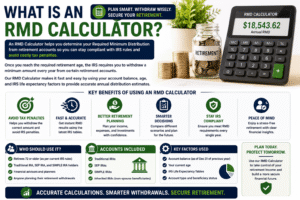
An RMD Calculator is a retirement planning tool designed to help individuals calculate their Required Minimum Distribution (RMD) from retirement accounts such as Traditional IRAs, SEP IRAs, SIMPLE IRAs, and other qualified retirement plans. Once a person reaches the required retirement age established by tax laws, they must begin withdrawing a minimum amount from these accounts every year. The IRA Minimum Distribution Calculator makes this process easier by providing quick and accurate estimates based on factors like account balance, current age, and life expectancy.
Using an IRA Minimum Distribution Calculator helps retirees avoid costly tax penalties caused by withdrawing less than the required minimum amount. Instead of manually calculating distributions using complicated IRS tables, users can instantly estimate how much money must be withdrawn annually. This allows individuals to better manage retirement income, create smarter budgets, and prepare for future financial expenses. The calculator is especially useful for retirees who want a simple and stress-free way to handle retirement withdrawals while protecting long-term savings.
Another major benefit of the IRA Minimum Distribution Calculator is that it improves overall retirement planning and financial confidence. By understanding estimated yearly withdrawals, retirees can make better decisions about spending, investing, and tax management. The tool also helps users compare different retirement account balances and future withdrawal scenarios for more organized financial planning. Whether someone is newly retired or already taking annual distributions, the IRA Minimum Distribution Calculator provides valuable insights that support a more secure retirement strategy. With its fast calculations, user-friendly interface, and accurate estimates, this calculator becomes an essential financial tool for anyone managing retirement accounts and required withdrawals.
What Is an IRA Minimum Distribution?
A Required Minimum Distribution (RMD) is the minimum amount the IRS forces you to withdraw each year from tax-deferred retirement accounts such as Traditional IRAs, SEP IRAs, SIMPLE IRAs, 401(k)s, 403(b)s, and 457(b) plans. The government allowed your money to grow tax-free for decades — now it wants its share.
Key facts about RMDs:
- They apply to pre-tax retirement accounts only.
- Roth IRAs are exempt during the original owner’s lifetime.
- The first IRA Minimum Distribution Calculator must be taken by April 1 of the year after you reach RMD age.
- Every subsequent RMD must be taken by December 31.
- Failing to take your RMD triggers an excise tax of up to 25% (reduced to 10% if corrected promptly).
The formula is simple in theory:
RMD = Prior Year-End Account Balance ÷ IRS Life Expectancy Factor
But in practice, balances change, life expectancy factors change every year, and tax brackets evolve. That’s where a dedicated IRA Minimum Distribution Calculator removes the guesswork.
Why You Need an IRA Minimum Distribution Calculator
Manual RMD math is risky. A single wrong factor can cost you thousands in penalties or push you into a higher tax bracket. A reliable IRA Minimum Distribution Calculator solves this by:
- Automatically applying the correct IRS table (Uniform Lifetime, Joint Life, or Single Life).
- Projecting decades of withdrawals, not just one year.
- Estimating taxes owed based on your bracket and other income.
- Adjusting for inflation so today’s dollars are comparable to tomorrow’s.
- Visualizing balance depletion with clear charts.
If you’re between ages 60 and 75, this tool should be part of your annual financial review.
How the IRA Minimum Distribution Calculator Works
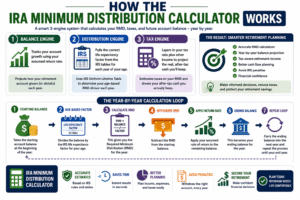
The IRA Minimum Distribution Calculator uses three core engines:
- Balance Engine – Tracks your account growth using your assumed return rate.
- Distribution Engine – Pulls the correct life expectancy factor from the IRS tables for each year of your age.
- Tax Engine – Layers in your tax rate plus other income to project the real, after-tax cash you’ll keep.
Each year, the calculator:
- Takes the starting balance,
- Divides it by the age-based factor,
- Subtracts the RMD,
- Applies the return rate,
- Then carries the ending balance into the next year — repeating this loop until your specified end year.

Key Inputs Explained
To get accurate results from any RMD distribution calculator, your inputs must reflect reality. Here’s what each field means:
Account Balance – Your prior year’s December 31 balance. This is the official figure the IRS uses.
Birth Year – Determines your current age and your RMD start year under SECURE Act 2.0 rules.
Return Rate (%) – The expected annual growth of your investments. A conservative range is 4%–7% for diversified retirement portfolios.
IRS Table – Choose the table that matches your situation:
- Uniform Lifetime – Default for most account owners.
- Joint Life – If your spouse is the sole beneficiary and more than 10 years younger.
- Single Life – Used by certain beneficiaries.
- Inherited – For non-spouse heirs subject to the 10-year rule.
Spouse Birth Year – Required only when using the Joint Life table.
Inflation (%) – Typically 2.5%–3.5%. Adjusts future dollars to present value.
Tax Rate (%) – Your marginal federal + state rate. For most retirees, this is between 12% and 32%.
Other Income – Social Security, pensions, dividends, or part-time wages. This helps the calculator estimate your true tax bracket.
End Year – How far into the future you want projections — usually age 90–95 for safety.
Understanding the IRS Life Expectancy Tables
The IRS publishes three primary tables, and the IRA Minimum Distribution Calculator automatically references them:
- Uniform Lifetime Table – Used by 95% of retirees. At age 73, the factor is 26.5; at age 80, it’s 20.2; at age 90, it’s 12.2.
- Joint and Last Survivor Table – Produces smaller RMDs when your spouse is significantly younger, preserving more wealth.
- Single Life Expectancy Table – Used by beneficiaries; produces larger RMDs because the factor is lower.
Smaller factors = larger withdrawals. Larger factors = smaller withdrawals. This is why selecting the right table inside the IRA Minimum Distribution Calculator is critical.
RMD Age Rules Under SECURE Act 2.0
The rules changed dramatically in recent years. Here’s the current breakdown:
- Born 1950 or earlier → RMDs began at age 70½ or 72.
- Born 1951–1959 → RMDs begin at age 73.
- Born 1960 or later → RMDs begin at age 75.
Pro tip: If you delay your first RMD until April 1 of the following year, you’ll be forced to take two RMDs in one tax year — often pushing you into a higher bracket. The calculator helps you visualize this trap before it happens.
How to Read Your Calculator Results
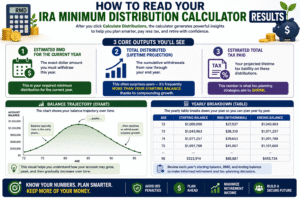
After clicking Calculate Distributions, you’ll see three core outputs:
Estimated RMD for the Current Year – The exact dollar amount you must withdraw this year.
Total Distributed (Lifetime Projection) – The cumulative withdrawals from now through your end year. This often surprises users — it’s frequently more than your starting balance thanks to compounding growth.
Estimated Total Tax Paid – Your projected lifetime tax liability on these distributions. This number is what tax-planning strategies aim to shrink.
The chart shows your balance trajectory — typically rising in the early years, peaking, then declining as withdrawals outpace growth. The yearly table breaks down age, starting balance, RMD, and ending balance so you can plan year by year.
Tax Implications of RMDs
Every dollar of an RMD from a traditional IRA is taxed as ordinary income. That means RMDs can:
- Push you into a higher federal tax bracket.
- Trigger taxation of up to 85% of your Social Security benefits.
- Increase your Medicare Part B and D premiums through IRMAA surcharges.
- Affect eligibility for certain deductions and credits.
Running scenarios in an IRA Minimum Distribution Calculator with different tax rates lets you see the real cost of waiting versus withdrawing strategically.
RMDs for Inherited IRAs
The SECURE Act eliminated the popular “stretch IRA” for most non-spouse beneficiaries. Today:
- Most non-spouse heirs must empty the inherited IRA within 10 years.
- Eligible designated beneficiaries (spouses, minor children, disabled individuals) can still stretch distributions over their life expectancy.
- Annual RMDs may also be required during those 10 years if the original owner had already started taking RMDs.
When using the calculator, select the Inherited option to apply the correct rules.
Common Mistakes to Avoid
Even careful retirees make these errors:
- Using the wrong year’s account balance – Always use the December 31 prior-year balance.
- Choosing the wrong IRS table – Especially for spouses more than 10 years younger.
- Forgetting workplace plans – 401(k) RMDs must usually be calculated separately per plan.
- Aggregating incorrectly – IRA RMDs can be aggregated, but 401(k) RMDs cannot.
- Missing the December 31 deadline – Triggers the 25% excise tax.
- Ignoring Roth conversions – Converting before RMD age can dramatically lower lifetime taxes.
The IRA Minimum Distribution Calculator prevents most of these by enforcing a structured input flow.
Smart Strategies to Reduce RMD Tax Burden
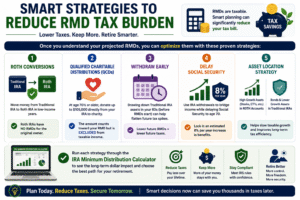
Once you understand your projected RMDs, you can optimize them:
Roth Conversions – Move money from traditional IRA to Roth IRA in low-income years. Roth IRAs have no RMDs for the original owner.
Qualified Charitable Distributions (QCDs) – At age 70½ or older, you can donate up to $105,000 directly from your IRA to charity. The amount counts toward your RMD but is excluded from taxable income.
Withdraw Early – Drawing down traditional IRA assets in your 60s (before RMDs start) can flatten future tax spikes.
Delay Social Security – Use IRA withdrawals to bridge income while delaying Social Security to age 70, locking in an 8% per year benefit increase.
Asset Location – Hold high-growth assets in Roth accounts and bonds in traditional IRAs to slow taxable growth.
Run each strategy through the IRA Minimum Distribution Calculator to see the long-term dollar impact.
Who Should Use This Calculator
This tool is built for:
- Anyone aged 60+ approaching RMD age.
- Current retirees verifying annual withdrawals.
- Beneficiaries of inherited retirement accounts.
- Financial advisors modeling client scenarios.
- High-net-worth savers planning Roth conversion ladders.
- Couples with significant age gaps benefiting from the Joint Life table.
If you have any tax-deferred retirement account, this calculator belongs in your toolkit.
Frequently Asked Questions
Q: At what age must I start taking RMDs? Under SECURE Act 2.0, RMDs begin at age 73 for those born 1951–1959 and age 75 for those born 1960 or later.
Q: Are Roth IRAs subject to RMDs? No. Roth IRAs have no RMDs during the original owner’s lifetime. Roth 401(k)s no longer require RMDs either, starting in 2024.
Q: What happens if I miss an RMD? The IRS imposes a 25% excise tax on the shortfall, reduced to 10% if you correct it within two years.
Q: Can I take more than the RMD? Yes. The RMD is a minimum, not a maximum. Excess withdrawals don’t count toward future years.
Q: Do RMDs apply to 401(k)s I’m still working at? Generally no, if you don’t own 5%+ of the company and your plan allows the “still working” exception.
Q: How often should I recalculate? Every year, because your prior year-end balance and life expectancy factor both change.
Conclusion
Required Minimum Distributions are one of the most misunderstood parts of retirement, yet they directly determine how much of your nest egg you keep — and how much goes to taxes. Guessing isn’t a strategy. Using a precise IRA Minimum Distribution Calculator turns a complex IRS rulebook into a clear, year-by-year roadmap of your withdrawals, taxes, and remaining balance.
Whether you’re five years from retirement or already taking distributions, this calculator gives you the clarity to withdraw smarter, pay less tax, and protect the wealth you spent decades building. Plug in your numbers, explore different scenarios, and let the data guide your next financial decision — your future self will thank you.