Calculate potential savings, lower payments, and refinancing benefits with our Refinance Calculator
Table of Contents
- Introduction
- What Is a Rental Property Calculator?
- Why Every Real Estate Investor Needs a Rental Property Calculator
- Understanding the Four Core Sections of the Calculator
- Purchase Analysis – Know Your True Buying Cost
- Income Analysis – Measuring What Your Property Earns
- Rental Income, Expenses and NOI Formulas
- Rental Cash Flow Example
- Expense Analysis – Tracking What Your Property Costs
- Sell Analysis – Planning Your Exit Strategy
- Key Real Estate Metrics You Must Understand
- How to Use Our Rental Property Calculator Step-by-Step
- Common Mistakes Investors Make Without a Calculator
- Tips to Improve Your Rental Property Returns
- Frequently Asked Questions (FAQs)
- Conclusion
Introduction
Real estate investing is one of the most proven paths to long-term wealth — but only when you make decisions based on accurate numbers, not gut feelings or guesswork. Whether you are a first-time landlord buying your first investment property or a seasoned investor managing a growing portfolio, the math behind every rental property determines whether it builds wealth or drains it.
That is exactly where a Rental Property Calculator becomes your most powerful financial tool. In just seconds, it crunches the numbers across purchase cost, rental income, ongoing expenses, and eventual sale — giving you a complete, multi-dimensional picture of your investment’s performance before you commit a single dollar.
In this comprehensive guide, we will cover everything you need to know to make the most of our free, easy-to-use Rental Property Calculator. You will learn what inputs matter, how each section of the calculator works, which metrics to focus on, and how to use the results to make smarter, more confident investment decisions.
By the time you finish reading this guide, you will have the knowledge to evaluate any rental property with the precision of a professional real estate analyst — no finance degree required.
What Is a Rental Property Calculator?
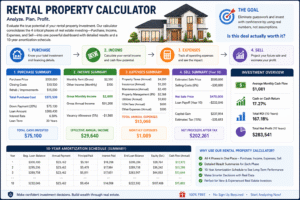
A Rental Property Calculator is a digital financial analysis tool that helps investors evaluate the profitability and viability of a rental property investment. It consolidates the four most critical phases of any real estate investment — purchasing, earning income, managing expenses, and eventually selling — into a single, easy-to-understand results dashboard.
Rather than juggling multiple spreadsheets or making rough estimates in your head, a Rental Property Calculator automates all the key calculations and presents them clearly. It shows you metrics like gross rental income, net cashflow, return on investment, total purchase cost, loan amount, expense breakdown, capital gains tax liability, and net profit from a future sale — all in one place.
The goal of a Rental Property Calculator is simple: to eliminate the guesswork from real estate investment and replace it with hard data. It helps you answer the most fundamental question in property investing: “Is this deal actually worth it?”
Our free Rental Property Calculator is divided into four specialized sections — Purchase, Income, Expenses, and Sell — each generating its own detailed result summary and a 10-year amortization schedule so you can see how your investment performs over time.
Why Every Real Estate Investor Needs a Rental Property Calculator
In real estate, emotion is expensive. Falling in love with a property and buying it without proper analysis is one of the most common and costly mistakes investors make. A Rental Property Calculator removes emotion from the equation and replaces it with objective financial analysis.
Here is why using a Rental Property Calculator is non-negotiable for serious investors:
Instant Financial Clarity: Instead of spending hours building spreadsheets, a Rental Property Calculator gives you instant results the moment you enter your numbers. You can evaluate multiple properties in minutes rather than days.
Prevents Costly Mistakes: Many properties that look attractive on the surface are actually cash-flow negative once all expenses are accounted for. A Rental Property Calculator reveals hidden costs and weak returns before you sign a contract.
Enables Accurate Comparison: When evaluating multiple investment properties, you can run each one through the calculator and compare the results side by side. This makes it easy to identify which deal offers the best return on your capital.
Supports Financing Decisions: The purchase section of the Rental Property Calculator shows you exactly how much equity you are bringing in, how much debt you are taking on, and whether the deal structure makes financial sense given the rental income.
Plans for the Future: Real estate is a long-term investment. A Rental Property Calculator does not just show you today’s numbers — it shows you projected returns over a 10-year horizon via an amortization schedule, helping you plan for the long term.
Builds Investor Credibility: When you use a Rental Property Calculator to present your analysis to lenders, partners, or financial advisors, it demonstrates professionalism and disciplined thinking — qualities that serious investors respect.
Understanding the Four Core Sections of the Calculator
Our Rental Property Calculator is structured around the four phases of any real estate investment. Understanding each section separately is the key to using the calculator effectively.
Purchase: Covers all costs related to acquiring the property, including the purchase price, down payment, closing costs, renovation expenses, and other upfront costs.
Income: Covers all revenue the property generates, including monthly rent, other income sources, vacancy rate, and management fees.
Expenses: Covers all ongoing operational costs, including property taxes, insurance, utilities, HOA dues, and maintenance reserves.
Sell: Covers the financial analysis of an eventual property sale, including future market value, selling costs, capital gains tax, and net profit.
Each section produces its own result summary and a 10-year amortization schedule, giving you both snapshot and long-term views of your investment’s financial health.
Purchase Analysis – Know Your True Buying Cost
The purchase phase is where most investors underestimate their true investment. A property listed at $200,000 does not cost $200,000 — it costs significantly more once closing costs, renovation expenses, and other upfront fees are added.
Our Rental Property Calculator helps you account for every purchase-related cost:
Purchase Price: The agreed-upon sale price of the property. This is the base figure from which your loan amount and equity are calculated.
Down Payment: The portion of the purchase price you pay upfront. A higher down payment means a smaller loan, lower monthly mortgage payments, and better cashflow — but it also means more capital tied up in the property.
Closing Costs: Lender fees, attorney fees, title insurance, appraisal fees, and other transaction costs typically range from 2% to 5% of the purchase price. Never overlook closing costs when evaluating a deal.
Renovation Budget: If the property needs repairs or upgrades before it can be rented, these costs must be included in your total investment calculation. A Rental Property Calculator helps you model renovation costs accurately so you know your real equity position from day one.
Other Costs: Any additional acquisition costs such as inspection fees, moving expenses, or furniture for furnished rentals.
The calculator outputs include your Total Cost, Loan Amount, Down Payment Percentage, Closing Costs summary, Total Equity, Remaining Debt, and Purchase Status — giving you a complete picture of your financial position at the time of purchase.
Income Analysis – Measuring What Your Property Earns
Revenue is the lifeblood of any rental property investment. Understanding exactly how much your property can realistically earn — and how much of that income you will actually keep — is critical to evaluating a deal’s true profitability.
The income section of our Rental Property Calculator accounts for:
Monthly Rent: The primary income source for most rental properties. Set this figure based on current market comparable rents (comps) in the neighborhood, not on wishful thinking. Overestimating rent is one of the most common mistakes new investors make.
Other Income: Additional revenue streams such as parking fees, laundry income, storage unit rentals, pet fees, or late payment fees can meaningfully boost your gross income.
Vacancy Rate: No property is rented 365 days a year. A realistic vacancy rate of 5% to 10% accounts for the time between tenants, during which you earn no rent but still pay all expenses. Our Rental Property Calculator factors this in automatically.
Management Fee: If you hire a property management company to handle tenant relations, maintenance coordination, and rent collection, they typically charge 8% to 12% of monthly rent. This is a real cost that dramatically affects your cashflow, and the calculator includes it precisely.
Results include Gross Income, Net Income, Vacancy Loss, Management Expenses, Annual Yield, Monthly Cashflow, and Income Status — the complete income picture for your investment.
Rental Income, Expenses and NOI Formulas
These formulas help you understand the main figures used in rental property analysis. Keep monthly and annual amounts consistent before comparing results.
NOI usually measures property performance before mortgage principal and interest. For a monthly analysis, convert annual tax or insurance into monthly amounts by dividing by 12.
Rental Cash Flow Example
Monthly rent: $2,000 | Other income: $200
Gross rental income: $2,000 + $200 = $2,200
Vacancy loss at 5%: $2,200 × 0.05 = $110
Management fee at 8%: $2,200 × 0.08 = $176
Effective rental income: $2,200 − $110 − $176 = $1,914
Monthly expenses: Tax $200 + Insurance $100 + Utilities $150 + HOA $50 + Maintenance $100 = $600
Estimated monthly NOI/cash flow before debt service: $1,914 − $600 = $1,314
If the property’s total investment is $200,000, annual NOI is $15,768 and the simple NOI-based ROI is ($15,768 ÷ $200,000) × 100 = 7.88%.
Expense Analysis – Tracking What Your Property Costs
Operating expenses are where many investors’ calculations fall apart. It is easy to focus on rental income and forget that a significant portion of it goes directly toward keeping the property functional, insured, and legally compliant.
Our Rental Property Calculator tracks five key ongoing expense categories:
Property Tax: Calculated annually and divided monthly. Property taxes vary significantly by location and can be a major drag on cashflow in high-tax municipalities. Always verify the current tax assessment before buying a property.
Insurance Premium: Landlord insurance (also called rental property insurance) is different from homeowner’s insurance and typically costs more. It covers the structure, liability, and sometimes loss of rental income.
Utilities: If you pay any utilities for tenants — such as water, trash, or gas in a multi-unit building — these are recurring monthly expenses that must be accounted for.
HOA Dues: Properties in homeowner associations carry monthly dues that can range from $50 to several hundred dollars. HOA dues are non-negotiable expenses that directly reduce your cashflow.
Maintenance Reserve: Even new properties require ongoing maintenance. A common rule of thumb is to budget 1% of the property’s value annually for repairs and upkeep. Our Rental Property Calculator includes a maintenance reserve field so this cost is never overlooked.
Results include Property Tax breakdown, Insurance Premium, Utility Bills, HOA Dues, Maintenance Reserve, Total Expenses, and Expense Status — ensuring you never underestimate what it actually costs to run your rental property.
Sell Analysis – Planning Your Exit Strategy
Every investment needs an exit strategy, and rental properties are no exception. Knowing when and how you will sell — and how much you will actually profit after taxes and selling costs — is a critical part of any complete investment analysis.
The sell section of our Rental Property Calculator evaluates:
Future Property Value: Based on your projected appreciation rate and time horizon. Real estate has historically appreciated at 3% to 5% annually in most U.S. markets, though this varies significantly by location.
Selling Costs: Real estate agent commissions (typically 5% to 6% of the sale price), closing costs, staging, repairs before listing, and any other transaction costs reduce your gross sale proceeds.
Capital Gains Tax: This is the tax most investors underestimate or forget entirely. If you sell a rental property for more than your adjusted cost basis, the profit is subject to capital gains tax. Long-term capital gains rates (for properties held more than one year) range from 0% to 20% depending on your taxable income.
Outputs include Sale Price, Selling Costs, Capital Gains Amount, Tax Liability, Net Profit, and Return on Sale — giving you a realistic picture of what you will walk away with after the deal is done.
Key Real Estate Metrics You Must Understand
A Rental Property Calculator produces a range of financial metrics. Understanding what each one means helps you interpret the results correctly and make better decisions:
Gross Rental Yield: Annual gross rent divided by the property purchase price, expressed as a percentage. A rough indicator of income potential before expenses.
Net Rental Yield: Annual net income (after all expenses) divided by the total investment. This is a more accurate measure of real-world return than gross yield.
Monthly Cashflow: The amount left over each month after all expenses (including mortgage payments) have been paid. Positive cashflow is the primary goal of most income-property investors.
Return on Investment (ROI): Net annual profit divided by total capital invested. This metric allows you to compare the performance of your rental property against other investments like stocks or bonds.
Debt-to-Income Ratio: The proportion of your gross income consumed by debt payments. Lenders use this to evaluate your creditworthiness for additional investment property loans.
Amortization Schedule: A year-by-year breakdown of how your loan principal decreases, how much interest you pay, and how additional principal payments affect your long-term position. Our Rental Property Calculator generates a 10-year amortization table automatically.
How to Use Our Rental Property Calculator Step-by-Step
Using our Rental Property Calculator is fast and straightforward. Here is exactly how to get the most accurate results:
Step One – Purchase Section: Enter the property’s purchase price, your planned down payment, estimated closing costs, renovation budget, and any other acquisition expenses. Click “Calculate” to see your total investment cost, loan amount, equity position, and more.
Step Two – Income Section: Enter your projected monthly rent, any additional income sources, your expected vacancy rate, and your property management fee percentage. Click “Calculate” to see your gross income, net income, vacancy loss, annual yield, and monthly cashflow.
Step Three – Expenses Section: Enter your monthly property tax, insurance premium, utility costs, HOA dues, and maintenance reserve. Click “Calculate” to see a full expense breakdown and your total monthly operating cost.
Step Four – Sell Section: Enter your projected future property value, anticipated selling costs, and expected capital gains tax rate. Click “Calculate” to see your projected net profit and return on sale.
Step Five – Review the Amortization Schedules: Each section generates a 10-year amortization table. Review these tables to understand how your investment evolves over time — particularly how principal paydown builds equity and how cashflow changes as rents and expenses shift.
Step Six – Adjust and Optimize: Experiment with different scenarios. What happens if vacancy rises to 10%? What if you increase rent by $200? What if you put more money down? Our Rental Property Calculator lets you model any scenario instantly, empowering you to make smarter decisions.
Common Mistakes Investors Make Without a Calculator
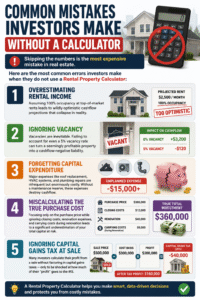
Skipping the numbers is the most expensive mistake in real estate. Here are the most common errors investors make when they do not use a Rental Property Calculator:
Overestimating Rental Income: Assuming 100% occupancy at top-of-market rents leads to wildly optimistic cashflow projections that collapse in reality.
Ignoring Vacancy: Vacancies are inevitable. Failing to account for even a 5% vacancy rate can turn a seemingly profitable property into a cashflow-negative liability.
Forgetting Capital Expenditure: Major expenses like roof replacement, HVAC systems, and plumbing repairs are infrequent but enormously costly. Without a maintenance reserve, these expenses destroy cashflow.
Miscalculating the True Purchase Cost: Focusing only on the purchase price while ignoring closing costs, renovation expenses, and carrying costs during renovation leads to a significant underestimation of your total capital at risk.
Ignoring Capital Gains Tax at Sale: Many investors calculate their profit from a sale without factoring in capital gains taxes — only to be shocked at how much of their “profit” goes to the IRS.
Tips to Improve Your Rental Property Returns
Beyond using a Rental Property Calculator to analyze deals, here are strategies to actively improve your returns:
Buy Below Market Value: Acquiring properties through foreclosures, short sales, or motivated sellers at below-market prices gives you instant equity and better cashflow from day one.
Reduce Vacancy Through Tenant Retention: Long-term tenants mean fewer vacancies and lower turnover costs. Treat tenants well, maintain the property, and respond to maintenance requests promptly.
Increase Rental Income Strategically: Small upgrades — modern appliances, fresh paint, updated fixtures — can justify meaningful rent increases that significantly improve annual cashflow.
Refinance at Lower Rates: When interest rates drop, refinancing your investment property mortgage can reduce monthly payments and boost cashflow without changing anything else about the deal.
Manage Taxes Wisely: Depreciation, mortgage interest deductions, and the ability to defer capital gains through a 1031 exchange are powerful tax tools that improve real-world returns. Consult a tax professional to maximize these benefits.
Review Your Numbers Regularly: Use the Rental Property Calculator at least annually to reassess your current property’s performance against your original projections. Markets change, expenses evolve, and your strategy should evolve with them.
Frequently Asked Questions (FAQs)
What is a Rental Property Calculator? A Rental Property Calculator is an online financial tool that analyzes the profitability of a rental property investment across four key areas: purchase cost, rental income, operating expenses, and eventual sale. It calculates key metrics like cashflow, yield, ROI, and net profit automatically.
Is the Rental Property Calculator free to use? Yes. Our Rental Property Calculator is completely free with no registration or subscription required. Simply enter your figures and get your results instantly.
What is a good monthly cashflow for a rental property? Most experienced investors target a minimum of $100 to $300 in positive monthly cashflow per unit after all expenses, including the mortgage payment. However, in high-cost markets, even breakeven cashflow can be acceptable if appreciation potential is strong.
What vacancy rate should I use in the calculator? A conservative vacancy rate of 5% to 10% is appropriate for most markets. In areas with strong rental demand and low vacancy, 5% is reasonable. In slower markets or seasonal rental areas, use 10% or higher.
How does the amortization schedule work? The amortization schedule generated by our Rental Property Calculator shows how principal, additional payments, and interest evolve over a 10-year period. It helps you visualize how equity builds over time as you pay down your loan.
What is a good gross rental yield? A gross rental yield of 7% to 10% is generally considered strong for residential rental properties in most U.S. markets. However, yields vary significantly by location, property type, and market conditions.
Can I use this calculator for commercial properties? Our Rental Property Calculator is optimized for residential investment properties but can provide useful estimates for commercial properties by adapting the income and expense inputs to reflect commercial lease structures.
How often should I recalculate my rental property performance? Review your property’s financial performance at least once a year using the Rental Property Calculator. Also recalculate whenever you raise rent, refinance your mortgage, experience significant expense changes, or consider selling.
What is a 1031 exchange and how does it affect my calculator results? A 1031 exchange allows you to defer capital gains taxes when you sell a rental property by reinvesting the proceeds into a like-kind property. If you plan to use a 1031 exchange, set your capital gains tax input to 0% to model a tax-deferred scenario.
Is positive cashflow the only measure of a good rental property? No. Cashflow is important, but it is only one of several value drivers in rental property investing. Appreciation, equity paydown through mortgage amortization, and tax benefits collectively contribute to total return. Use the full Rental Property Calculator to evaluate all dimensions of your investment.
What is the difference between NOI and cash flow?
NOI is the income left after normal operating expenses, such as maintenance, insurance, utilities, and management costs. Cash flow is what remains after NOI is also reduced by mortgage payments, debt service, and other financing-related cash costs.
How is rental property ROI calculated?
A simple NOI-based ROI is annual NOI divided by total property investment, multiplied by 100. A broader ROI calculation may also include loan principal paid, appreciation, selling costs, taxes, and the initial cash invested.
Does a higher rent always mean a higher property ROI?
Not necessarily. Higher rent can be offset by vacancy, management fees, maintenance, taxes, insurance, or other operating costs. Compare effective rental income and NOI—not rent alone—to evaluate the property.
Conclusion
Real estate investing rewards those who do their homework — and punishes those who do not. The difference between a profitable rental property and a money pit often comes down to one thing: accurate financial analysis before you buy.
Our free Rental Property Calculator gives you the analytical power to evaluate any rental property across all four critical dimensions — purchase cost, income potential, operating expenses, and exit value. It produces instant results, generates 10-year amortization schedules, and allows you to model different scenarios in seconds.
Whether you are analyzing your very first investment property or your fiftieth, using a Rental Property Calculator is the professional standard for disciplined real estate investing. It replaces guesswork with data, emotion with analysis, and uncertainty with clarity.
Stop investing on instinct. Start investing on insight. Use our Rental Property Calculator today, run the numbers on your next deal, and make the confident, informed decision that your financial future deserves.
Every great real estate portfolio starts with one good decision — and every good decision starts with a Rental Property Calculator.