Quadratic Formula Calculator
Calculate distance instantly with our fast and accurate Distance Calculator
Table of Contents
- Introduction
- What Is a Quadratic Equation?
- What Is the Quadratic Formula Calculator?
- The Quadratic Formula — Definition and Expression
- Understanding Coefficients a, b, and c
- The Discriminant — The Key to Understanding Roots
- Three Types of Roots — Real Distinct, Real Equal, and Complex
- How to Use the Quadratic Formula Calculator Step by Step
- Reading the Quadratic Formula Calculator’s Output
- Deriving the Quadratic Formula — Completing the Square
- The Quadratic Formula Calculator and the Parabola
- Sum and Product of Roots
- Quadratic Formula Calculator in Physics
- Quadratic Formula Calculator in Engineering
- Quadratic Formula Calculator in Economics and Finance
- Quadratic Formula Calculator in Computer Graphics and Games
- Alternative Methods of Solving Quadratic Equations
- Common Mistakes with the Quadratic Formula Calculator
- Frequently Asked Questions (FAQs)
- Conclusion
Introduction
Algebra is full of equations, but few are as fundamental, as frequently encountered, and as elegantly solved as the quadratic equation. A quadratic equation is any equation of the form ax² + bx + c = 0 — a polynomial equation of degree two, involving a squared variable and up to two additional terms. These equations appear in physics, engineering, economics, computer graphics, architecture, and virtually every branch of applied mathematics. Solving them manually — finding the values of x that satisfy the equation — requires applying the quadratic formula, one of the most important formulas in all of algebra. The Quadratic Formula Calculator makes this process instantaneous: enter the three coefficients, press Calculate, and receive the roots — with every step of the solution displayed clearly.
The Quadratic Formula Calculator is not merely a computational shortcut. It is an educational tool that shows the full solution process — the equation setup, the discriminant calculation, and the root computation — allowing students and professionals alike to understand exactly how quadratic equations are solved, rather than just seeing a final answer. Whether you are a student encountering quadratic equations for the first time, a teacher preparing worked examples, an engineer solving parabolic trajectory problems, or a programmer checking algorithm outputs, the Quadratic Formula Calculator provides the accuracy, speed, and clarity you need.
In this comprehensive guide, we will explore everything about the Quadratic Formula Calculator — the mathematics of quadratic equations, the quadratic formula itself, the role of the discriminant, all three types of roots, how to use the calculator step by step, and the wide range of contexts where quadratic equations and the Quadratic Formula Calculator are applied in the real world.
What Is a Quadratic Equation?
A quadratic equation is a polynomial equation of degree two — meaning the highest power of the variable (x) is exactly 2. The standard form of a quadratic equation is:
ax² + bx + c = 0
Where:
- a = the coefficient of x² (must not be zero — if a = 0, the equation becomes linear, not quadratic)
- b = the coefficient of x (can be zero)
- c = the constant term (can be zero)
- x = the variable whose value(s) satisfy the equation
Examples of quadratic equations:
- x² − 3x + 2 = 0 (a = 1, b = −3, c = 2)
- 2x² + 5x − 3 = 0 (a = 2, b = 5, c = −3)
- x² − 4 = 0 (a = 1, b = 0, c = −4)
- 3x² + 6x = 0 (a = 3, b = 6, c = 0)
- x² + 1 = 0 (a = 1, b = 0, c = 1) — complex roots
The solutions to a quadratic equation are called its roots or zeros — the values of x that make the equation equal zero. The Quadratic Formula Calculator finds these roots from the three coefficients a, b, and c using the quadratic formula.
Why are quadratic equations so important? Quadratic equations model any situation where a quantity depends on the square of a variable — parabolic trajectories, areas, profit optimization, signal shapes, and many other real-world phenomena. Mastering quadratic equations is one of the most important milestones in algebra, and the Quadratic Formula Calculator makes their solution accessible to everyone.
What Is the Quadratic Formula Calculator?
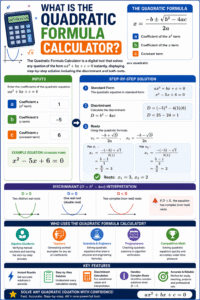
The Quadratic Formula Calculator is a digital tool that solves any quadratic equation of the form ax² + bx + c = 0 instantly, displaying the full step-by-step solution including the discriminant and both roots.
The Quadratic Formula Calculator accepts three inputs:
- Coefficient a — the coefficient of the x² term
- Coefficient b — the coefficient of the x term
- Coefficient c — the constant term
The Quadratic Formula Calculator displays:
- The equation in standard form: ax² + bx + c = 0
- The discriminant calculation: D = b² − 4ac (with substituted values)
- The roots: x₁ = (−b + √D) / 2a and x₂ = (−b − √D) / 2a
- A note when D < 0 indicating complex (non-real) roots
The Quadratic Formula Calculator is used by:
- Algebra students — verifying manual solutions and learning the step-by-step process
- Teachers — generating worked examples for any set of coefficients
- Scientists and engineers — solving quadratic equations that arise in physical and engineering formulas
- Programmers — checking quadratic solutions in algorithm verification
- Competitive mathematics participants — solving quadratic equations quickly and accurately under time pressure

The Quadratic Formula — Definition and Expression
The quadratic formula is the universal solution formula for any quadratic equation ax² + bx + c = 0. It gives both roots of the equation directly from the coefficients a, b, and c:
x = (−b ± √(b² − 4ac)) / 2a
This single formula produces both roots through the ± symbol:
x₁ = (−b + √(b² − 4ac)) / 2a (the “plus” root) x₂ = (−b − √(b² − 4ac)) / 2a (the “minus” root)
The quadratic formula is universal — it works for every quadratic equation with real coefficients a, b, c (provided a ≠ 0). The Quadratic Formula Calculator implements this formula exactly, substituting the entered coefficients and computing both roots.
The expression under the square root sign — b² − 4ac — is called the discriminant (D). It is the most important part of the quadratic formula because its sign determines the nature of the roots. The Quadratic Formula Calculator computes and displays the discriminant as the key intermediate step in the solution.
Why ± in the formula? A quadratic equation is degree 2, so by the Fundamental Theorem of Algebra, it has exactly 2 roots (counting multiplicity, and including complex roots). The ± in the quadratic formula produces both roots — one for + and one for −. The Quadratic Formula Calculator computes and displays both.
Understanding Coefficients a, b, and c
Correctly identifying the coefficients a, b, and c is the essential first step before using the Quadratic Formula Calculator. Errors in coefficient entry lead to incorrect roots.
Coefficient a (the leading coefficient) a is the coefficient of x². It determines the shape and direction of the parabola associated with the equation.
- a > 0: parabola opens upward
- a < 0: parabola opens downward
- a = 0: not a quadratic equation — enter a ≠ 0 into the Quadratic Formula Calculator
- Example: in 3x² − 5x + 2 = 0, a = 3
Coefficient b b is the coefficient of x. It controls the horizontal position of the parabola’s axis of symmetry: x = −b/(2a).
- b can be positive, negative, or zero
- Example: in 3x² − 5x + 2 = 0, b = −5
- Important: enter the sign of b correctly in the Quadratic Formula Calculator
Coefficient c (the constant term) c is the value of the equation when x = 0 — the y-intercept of the associated parabola y = ax² + bx + c.
- c can be positive, negative, or zero
- Example: in 3x² − 5x + 2 = 0, c = 2
Before using the Quadratic Formula Calculator, always rearrange the equation into standard form ax² + bx + c = 0 and read off a, b, and c carefully — especially noting the signs.
The Discriminant — The Key to Understanding Roots
The discriminant D = b² − 4ac is the single most important quantity computed by the Quadratic Formula Calculator. Its value — positive, zero, or negative — tells you everything about the nature of the roots before you even compute them.
The Quadratic Formula Calculator computes and displays D as step 2 of the solution, giving you immediate insight into the nature of the equation’s roots.
D > 0 — Two distinct real roots The equation has two different real number solutions. The parabola crosses the x-axis at two distinct points.
Example: x² − 5x + 6 = 0 → D = 25 − 24 = 1 > 0 → roots x₁ = 3, x₂ = 2
D = 0 — One repeated real root (double root) The equation has exactly one real solution, where both roots are equal. The parabola touches the x-axis at exactly one point (the vertex).
Example: x² − 4x + 4 = 0 → D = 16 − 16 = 0 → root x = 2 (double)
D < 0 — Two complex (non-real) roots The equation has no real solutions — the roots are complex numbers involving √(−1) = i. The parabola does not cross or touch the x-axis. The Quadratic Formula Calculator identifies this case and reports “Complex Roots (D < 0).”
Example: x² + x + 1 = 0 → D = 1 − 4 = −3 < 0 → complex roots
The discriminant’s role in the Quadratic Formula Calculator is to act as a diagnostic: before computing the roots, the calculator tells you how many real roots exist and what their nature is — an essential guide for interpreting results.
Three Types of Roots — Real Distinct, Real Equal, and Complex
Depending on the value of the discriminant, the Quadratic Formula Calculator produces one of three types of solutions.
Type 1 — Two Distinct Real Roots (D > 0) The most common case. The Quadratic Formula Calculator produces two different real numbers x₁ and x₂.
Quadratic Formula Calculator example: a = 1, b = −5, c = 6 D = 25 − 24 = 1 x₁ = (5 + 1) / 2 = 3 | x₂ = (5 − 1) / 2 = 2 Check: (x−3)(x−2) = x² − 5x + 6 ✓
Type 2 — One Repeated Real Root (D = 0) The equation has a “double root” — both solutions are the same value. The Quadratic Formula Calculator produces x₁ = x₂ = −b/(2a).
Quadratic Formula Calculator example: a = 1, b = −6, c = 9 D = 36 − 36 = 0 x₁ = x₂ = 6 / 2 = 3 Check: (x−3)² = x² − 6x + 9 ✓
Type 3 — Complex Conjugate Roots (D < 0) When the discriminant is negative, the roots involve imaginary numbers. The Quadratic Formula Calculator identifies this case.
Quadratic Formula Calculator example: a = 1, b = 2, c = 5 D = 4 − 20 = −16 < 0 Complex roots: x = (−2 ± √(−16)) / 2 = −1 ± 2i
Complex roots are always complex conjugates — they have the same real part and equal but opposite imaginary parts. They appear in pairs: if (−1 + 2i) is a root, then (−1 − 2i) is always the other.
How to Use the Quadratic Formula Calculator Step by Step
Using the Quadratic Formula Calculator is straightforward. Follow these steps for any quadratic equation:
Step 1 — Write the Equation in Standard Form Ensure your equation is in the form ax² + bx + c = 0. If it is not (e.g., 3x² = 5x − 2), rearrange it: 3x² − 5x + 2 = 0.
Step 2 — Identify Coefficients Read off a, b, and c from the standard form, paying careful attention to signs.
- 3x² − 5x + 2 = 0 → a = 3, b = −5, c = 2
Step 3 — Enter Values into the Quadratic Formula Calculator Type a = 3 into the “Coefficient a” field, b = −5 into “Coefficient b,” and c = 2 into “Coefficient c.”
Step 4 — Click Calculate The Quadratic Formula Calculator instantly applies the quadratic formula and displays:
- The equation: 3x² + (−5)x + 2 = 0
- D = (−5)² − 4(3)(2) = 25 − 24 = 1
- x₁ = (5 + 1) / 6 = 1.00 | x₂ = (5 − 1) / 6 = 0.67
Step 5 — Verify the Result Substitute each root back into the original equation to confirm:
- x = 1: 3(1) − 5(1) + 2 = 3 − 5 + 2 = 0 ✓
- x = 2/3: 3(4/9) − 5(2/3) + 2 = 4/3 − 10/3 + 6/3 = 0 ✓
Step 6 — Reset for a New Problem Click Clear to reset all inputs to zero and prepare the Quadratic Formula Calculator for a new equation.
Reading the Quadratic Formula Calculator’s Output
The Quadratic Formula Calculator presents a three-part solution that mirrors the manual solving process:
Line 1 — Equation Setup
“Eq: ax² + bx + c = 0” Confirms the equation as entered — verifying the coefficient signs before proceeding.
Lines 2–3 — Discriminant Calculation
“Discriminant (D) = b² − 4ac” “D = (b)² − 4×a×c = [value]” Shows the substituted discriminant calculation. This is the diagnostic step — a positive D means two real roots follow; zero means a double root; negative means complex roots.
Lines 4–6 — Roots (when D ≥ 0)
“Roots = (−b ± √D) / 2a” “x₁ = [value]” (displayed in red/accent color for emphasis) “x₂ = [value]” (displayed in red/accent color) Both roots are displayed to 2 decimal places. The Quadratic Formula Calculator applies full floating-point precision internally before rounding for display.
When D < 0:
“Complex Roots (D < 0)” The Quadratic Formula Calculator identifies that no real roots exist. For applications requiring complex root values, compute them manually: x = (−b ± i√|D|) / 2a.
Deriving the Quadratic Formula — Completing the Square
The quadratic formula is not arbitrary — it is derived from the standard form ax² + bx + c = 0 by completing the square, one of the most important algebraic techniques.
Step-by-step derivation:
Start: ax² + bx + c = 0
Divide by a: x² + (b/a)x + c/a = 0
Move constant: x² + (b/a)x = −c/a
Complete the square (add (b/2a)² to both sides):
x² + (b/a)x + (b/2a)² = (b/2a)² − c/a
Left side is a perfect square:
(x + b/2a)² = (b² − 4ac) / 4a²
Take square root:
x + b/2a = ± √(b² − 4ac) / 2a
Solve for x:
x = (−b ± √(b² − 4ac)) / 2a
This derivation shows exactly where every part of the quadratic formula comes from — the −b from moving the linear term, the √(b² − 4ac) from completing the square, and the 2a denominator from dividing by a. Understanding this derivation deepens appreciation for the Quadratic Formula Calculator by connecting the formula to its algebraic roots.
The Quadratic Formula Calculator and the Parabola
Every quadratic equation ax² + bx + c = 0 is associated with a parabola y = ax² + bx + c, and the roots found by the Quadratic Formula Calculator correspond to the x-intercepts of that parabola.
Geometric interpretation:
- Two distinct real roots (D > 0): the parabola crosses the x-axis at two different points — x₁ and x₂ from the Quadratic Formula Calculator
- One repeated root (D = 0): the parabola touches the x-axis at exactly one point — the vertex — where x = −b/2a
- Complex roots (D < 0): the parabola does not intersect the x-axis at all — it floats entirely above (a > 0) or below (a < 0) the x-axis
The vertex of the parabola is located at x = −b/2a, y = c − b²/(4a) — the axis of symmetry is exactly halfway between the two roots found by the Quadratic Formula Calculator.
Direction of opening:
- a > 0: parabola opens upward (U-shape) — minimum vertex
- a < 0: parabola opens downward (∩-shape) — maximum vertex
This geometric connection makes the Quadratic Formula Calculator useful not just for finding roots algebraically, but for understanding the shape, position, and behavior of the associated parabola.
Sum and Product of Roots
Two elegant relationships — Vieta’s formulas — connect the roots of a quadratic equation directly to its coefficients, providing a quick verification method for any result from the Quadratic Formula Calculator.
Sum of roots:
x₁ + x₂ = −b/a
Product of roots:
x₁ × x₂ = c/a
Example verification: For x² − 5x + 6 = 0 (a = 1, b = −5, c = 6):
Roots from Quadratic Formula Calculator: x₁ = 3, x₂ = 2 Sum: 3 + 2 = 5 = −(−5)/1 ✓ Product: 3 × 2 = 6 = 6/1 ✓
Vieta’s formulas provide an instant check of the Quadratic Formula Calculator’s output — if the sum and product of the displayed roots do not match −b/a and c/a respectively, an error has occurred (either in coefficient entry or calculation).
Vieta’s formulas also allow building quadratic equations from known roots:
If you want an equation with roots 4 and 7: sum = 11, product = 28 → x² − 11x + 28 = 0 Verify with Quadratic Formula Calculator: a = 1, b = −11, c = 28 → D = 121 − 112 = 9 → roots = (11 ± 3)/2 = 7 and 4 ✓
Quadratic Formula Calculator in Physics
Quadratic equations arise naturally in physics wherever motion, energy, or force involves a squared term, and the Quadratic Formula Calculator is a practical tool for solving these equations quickly.
Projectile Motion The height of a projectile under gravity follows a quadratic equation in time:
h(t) = −½gt² + v₀t + h₀
Setting h(t) = 0 and solving for t (the time when the projectile hits the ground) gives a quadratic equation in t. The Quadratic Formula Calculator solves it directly: a = −½g, b = v₀, c = h₀.
Kinetic Energy
KE = ½mv² → solving for v: v = √(2KE/m) This is a simple square root, but many physics problems combine kinetic energy constraints with other equations, producing quadratic equations in v — solved by the Quadratic Formula Calculator.
Optics — Lens Equation The thin lens equation 1/f = 1/do + 1/di can be rearranged for specific configurations into quadratic form, particularly in multi-lens systems. The Quadratic Formula Calculator provides the solution.
Electric Circuits Power equations P = I²R, combined with circuit constraints (Kirchhoff’s laws), often produce quadratic equations in current I. The Quadratic Formula Calculator solves for the current values that satisfy both power requirements and circuit constraints.
Quadratic Formula Calculator in Engineering
Engineers encounter quadratic equations across all disciplines, and the Quadratic Formula Calculator provides rapid, accurate solutions for design calculations.
Structural Engineering — Beam Deflection Maximum deflection of beams under distributed loads is governed by quadratic expressions. Finding zero-deflection points or critical load positions requires solving quadratic equations with the Quadratic Formula Calculator.
Mechanical Engineering — Gear and Cam Design The contact geometry of gears and cams involves quadratic equations in position variables. The Quadratic Formula Calculator determines critical positions — engagement points, pressure angles, and transition geometries.
Chemical Engineering — Reaction Equilibrium Equilibrium problems involving the equilibrium constant K produce quadratic equations in the equilibrium concentration x. The Quadratic Formula Calculator solves these — providing the physically meaningful root (the positive one in most cases).
Civil Engineering — Road Gradient Design Vertical alignment of roads (the smooth transition between ascending and descending grades) uses parabolic curves, whose design equations involve quadratic expressions solved by the Quadratic Formula Calculator.
Quadratic Formula Calculator in Economics and Finance
Economic and financial models frequently involve quadratic equations, particularly in optimization problems where revenue, cost, or profit is expressed as a quadratic function.
Profit Maximization If profit P = −2q² + 80q − 300 (where q is quantity), setting P = 0 and using the Quadratic Calculator (a = −2, b = 80, c = −300) finds the break-even quantities — the production levels where the business neither profits nor loses.
Break-Even Analysis Where total revenue TR = total cost TC, and if both are polynomial functions of quantity, the resulting equation is often quadratic. The Quadratic Calculator finds the break-even quantities.
Option Pricing Models Certain simplified versions of option pricing and financial derivative models involve quadratic equations in volatility or rate variables — solved with the Quadratic Calculator as a first approximation.
Auction Theory Optimal bidding strategies in certain auction formats involve quadratic equations in bid value. The Quadratic Calculator provides the optimal bid values that maximize expected profit.
Quadratic Formula Calculator in Computer Graphics and Games
Quadratic equations appear throughout 2D and 3D computer graphics, and the Quadratic Calculator illustrates the mathematical foundation of many graphical algorithms.
Ray-Sphere Intersection In ray tracing, determining where a ray intersects a sphere produces a quadratic equation in the ray parameter t. The discriminant from the Quadratic Calculator tells you whether the ray misses the sphere (D < 0), is tangent to it (D = 0), or intersects it at two points (D > 0).
Collision Detection Many game physics engines use quadratic equations to determine when and where moving objects will collide. The time-to-collision is found by solving a quadratic equation using the Quadratic Calculator approach.
Bezier Curve Rendering Quadratic Bezier curves — fundamental to font rendering, path drawing, and vector graphics — are defined by quadratic parametric equations. Finding points on these curves at specific positions involves quadratic solving.
Parabolic Trajectories in Games Game character jumps, thrown objects, and ballistic paths follow parabolic trajectories. The Quadratic Formula Calculator computes landing points, peak heights, and time-of-flight for any initial velocity and launch angle.
Alternative Methods of Solving Quadratic Equations
While the Quadratic Calculator applies the quadratic formula universally, several other methods exist for solving specific types of quadratic equations. Understanding alternatives helps choose the most efficient approach.
Factoring For equations with integer roots and small coefficients, factoring is often fastest. Write ax² + bx + c = (px + q)(rx + s) and find factors by inspection.
x² − 5x + 6 = (x−2)(x−3) → roots x = 2, 3 Works best for simple integer-coefficient equations — the Quadratic Formula Calculator is faster for all other cases.
Completing the Square The method from which the quadratic formula is derived — useful for converting to vertex form y = a(x−h)² + k.
Slower than the Quadratic Formula Calculator but teaches the underlying algebra.
Graphical Method Plotting y = ax² + bx + c and reading x-intercepts — gives approximate solutions only. The Quadratic Calculator provides exact values.
Numerical Methods (Newton’s Method) For equations that cannot be solved analytically, iterative numerical methods approximate roots. The Quadratic Calculator provides exact analytical solutions whenever they exist — making numerical approximation unnecessary for quadratic equations.
The Quadratic Calculator is always valid — it works for every quadratic equation regardless of coefficient values, while factoring and simple square root methods only work in special cases.
Common Mistakes with the Quadratic Formula Calculator
These errors frequently produce incorrect results when using the Quadratic Calculator:
- Sign errors in coefficient b — If the equation is x² − 3x + 2 = 0, then b = −3, not +3. Entering b = 3 produces wrong discriminant and roots. Always include the sign when entering coefficients into the Quadratic Calculator
- Not rearranging to standard form first — Equations like 3x² = 7x − 2 must be rearranged to 3x² − 7x + 2 = 0 before reading coefficients for the Quadratic Calculator
- Entering a = 0 — The Quadratic Calculator requires a ≠ 0 (otherwise the equation is linear, not quadratic). Division by a = 0 is undefined
- Ignoring complex roots — When D < 0, the Quadratic Calculator reports complex roots. In real-world physical problems, this often means the physical situation described has no real solution (e.g., a projectile that cannot reach the specified height)
- Misreading decimal roots as exact fractions — The Quadratic Calculator displays roots to 2 decimal places. For exact fractional forms, compute manually from the quadratic formula: x = (−b ± √D) / 2a
Frequently Asked Questions (FAQs)
What is the Quadratic Formula Calculator? The Quadratic Formula Calculator is a tool that solves any quadratic equation ax² + bx + c = 0 by applying the quadratic formula x = (−b ± √(b² − 4ac)) / 2a, displaying the discriminant, and producing both roots with the full step-by-step solution.
What is the quadratic formula? The quadratic formula is x = (−b ± √(b² − 4ac)) / 2a — the universal formula for finding the roots of any quadratic equation. The Quadratic Formula Calculator applies it automatically for any coefficients a, b, and c.
What is the discriminant? The discriminant is D = b² − 4ac — the expression under the square root in the quadratic formula. The Quadratic Formula Calculator computes D first: D > 0 means two distinct real roots, D = 0 means one repeated root, D < 0 means two complex roots.
What does it mean when the discriminant is negative? A negative discriminant means the quadratic equation has no real number solutions. The Quadratic Formula Calculator reports “Complex Roots (D < 0)” in this case — the roots involve the imaginary unit i = √(−1).
Can the Quadratic Calculator handle negative coefficients? Yes. Enter negative values directly into the coefficient fields — the Quadratic Calculator handles positive, negative, and zero values for b and c, and any non-zero value for a.
What happens if a = 0? If a = 0, the equation is no longer quadratic — it becomes linear (bx + c = 0). The Quadratic Formula Calculator requires a ≠ 0 since division by a is part of the formula. Enter a ≠ 0 for all quadratic problems.
How do I solve a quadratic equation with only x² and a constant (no x term)? Set b = 0 in the Quadratic Calculator. For example, x² − 9 = 0 (a = 1, b = 0, c = −9) → D = 0 + 36 = 36 → x₁ = 3, x₂ = −3.
What are the applications of the Quadratic Calculator in everyday life? The Quadratic Calculator is used in projectile motion (finding when something lands), engineering design (finding critical dimensions), economics (break-even analysis), and computer graphics (ray-sphere intersection and trajectory calculations).
Can I use the Quadratic Calculator for equations with decimal coefficients? Yes. The Quadratic Calculator accepts any numerical value including decimals. For example, a = 1.5, b = −3.7, c = 0.9 are all valid inputs.
How do I verify the roots from the Quadratic Calculator? Substitute each root back into the original equation and verify that ax² + bx + c = 0. Alternatively, use Vieta’s formulas: check that x₁ + x₂ = −b/a and x₁ × x₂ = c/a.
Conclusion
The quadratic equation is one of the cornerstones of algebra, and the Quadratic Calculator is the definitive tool for solving it — universally applicable, instant, accurate, and educational. From the elegant derivation of the quadratic formula through completing the square, to the diagnostic power of the discriminant, to the three distinct types of solutions that emerge from the relationship between the coefficients, the mathematics of quadratic equations is rich, beautiful, and deeply connected to the real world.
The Quadratic Calculator brings this mathematics to life — not just computing roots but displaying the full step-by-step solution that shows exactly how the quadratic formula is applied. Whether you are a student building your algebra skills, a teacher creating worked examples, a physicist modeling parabolic trajectories, an engineer solving design equations, or a programmer verifying code outputs, the Quadrati Calculator provides the speed, accuracy, and clarity that manual calculation cannot always match.
The discriminant remains the most powerful single piece of information in any quadratic problem — its sign tells you the entire story of the equation’s solutions before you compute a single root. The Quadratic Calculator makes this diagnostic step explicit and central, reinforcing the mathematical understanding that turns formula application into genuine algebraic mastery.
Bookmark this guide, use the Quadratic Calculator for every quadratic problem you encounter, and master the formula that has been at the heart of algebra for centuries — the elegant expression x = (−b ± √(b² − 4ac)) / 2a that solves every quadratic equation ever written.