Convert numbers instantly with our easy Scientific Notation Calculator
Table of Contents
- Introduction
- What Is a Prime Number?
- What Is Prime Factorization?
- The Fundamental Theorem of Arithmetic
- What Is a Prime Factorization Calculator?
- How the Prime Factorization Calculator Works — Trial Division Algorithm
- How to Use the Prime Factorization Calculator Step by Step
- Understanding the Step-by-Step Output
- Prime Factorization vs. Other Factorization Methods
- Prime Factorization Calculator in Mathematics Education
- Prime Factorization and Greatest Common Divisor (GCD)
- Prime Factorization and Least Common Multiple (LCM)
- Prime Factorization and Fraction Simplification
- Prime Factorization in Cryptography and Cybersecurity
- Prime Factorization in Computer Science and Algorithms
- Interesting Number Theory Results Using Prime Factorization
- Common Mistakes When Using a Prime Factorization Calculator
- Frequently Asked Questions (FAQs)
- Conclusion
Introduction
Every whole number greater than 1 is either a prime number or can be expressed as a unique product of prime numbers. This fundamental truth — known as the Fundamental Theorem of Arithmetic — is one of the most important results in all of number theory, and it is the principle that powers the Prime Factorization Calculator. Whether you are simplifying fractions, finding the greatest common divisor, computing the least common multiple, solving problems in cryptography, or exploring the deep structure of numbers, prime factorization is the essential first step. The Prime Factorization Calculator performs this operation instantly, breaking any integer greater than 1 into its prime components with a clear, step-by-step division process.
In this comprehensive guide, we will explore everything about the Prime Factorization Calculator — from the foundational concepts of prime numbers and factorization, to how the calculator works and how to use it, to the remarkable range of applications where prime factorization is indispensable. This guide is written for students, educators, mathematicians, and anyone curious about the hidden structure of numbers and the powerful tool that reveals it. By the end, you will have a thorough understanding of the Prime Factorization Calculator, the mathematics it applies, and why prime factorization matters across mathematics, cryptography, computing, and beyond.
What Is a Prime Number?
A prime number is a whole number greater than 1 that has exactly two distinct positive divisors — 1 and itself. In other words, a prime number cannot be divided evenly by any number other than 1 and the number itself.
Examples of prime numbers:
- 2 — divisible only by 1 and 2 (the only even prime)
- 3 — divisible only by 1 and 3
- 5 — divisible only by 1 and 5
- 7 — divisible only by 1 and 7
- 11, 13, 17, 19, 23, 29, 31, 37, 41, 43, 47…
Numbers that are NOT prime (called composite numbers):
- 4 = 2 × 2 (divisible by 1, 2, and 4)
- 6 = 2 × 3 (divisible by 1, 2, 3, and 6)
- 15 = 3 × 5 (divisible by 1, 3, 5, and 15)
- 100 = 2² × 5² (divisible by 1, 2, 4, 5, 10, 20, 25, 50, 100)
The number 1 is neither prime nor composite — it is a special case that is excluded from both categories by convention, because including 1 as a prime would break the uniqueness guaranteed by the Fundamental Theorem of Arithmetic.
Prime numbers are the building blocks of all integers — just as atoms are the building blocks of matter, primes are the irreducible elements of the number system. The Prime Factorization Calculator finds these building blocks for any integer you enter.
What Is Prime Factorization?
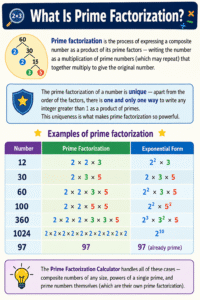
Prime factorization is the process of expressing a composite number as a product of its prime factors — writing the number as a multiplication of prime numbers (which may repeat) that together multiply to give the original number.
The prime factorization of a number is unique — apart from the order of the factors, there is one and only one way to write any integer greater than 1 as a product of primes. This uniqueness is what makes prime factorization so powerful.
Examples of prime factorization:
| Number | Prime Factorization | Exponential Form |
|---|---|---|
| 12 | 2 × 2 × 3 | 2² × 3 |
| 30 | 2 × 3 × 5 | 2 × 3 × 5 |
| 60 | 2 × 2 × 3 × 5 | 2² × 3 × 5 |
| 100 | 2 × 2 × 5 × 5 | 2² × 5² |
| 360 | 2 × 2 × 2 × 3 × 3 × 5 | 2³ × 3² × 5 |
| 1024 | 2 × 2 × 2 × 2 × 2 × 2 × 2 × 2 × 2 × 2 | 2¹⁰ |
| 97 | 97 | 97 (already prime) |
The Prime Factorization Calculator handles all of these cases — composite numbers of any size, powers of a single prime, and prime numbers themselves (which are their own prime factorization).
The Fundamental Theorem of Arithmetic
The Fundamental Theorem of Arithmetic states that every integer greater than 1 is either prime itself or can be represented as a unique product of prime numbers (unique up to the ordering of the factors).
This theorem has two parts:
- Existence — every integer greater than 1 has at least one prime factorization
- Uniqueness — every integer greater than 1 has exactly one prime factorization (ignoring order)
This uniqueness is what gives prime factorization its power as a mathematical tool. It means that the prime factorization of a number is as fundamental an identifier of that number as the number itself — two different products of primes always represent two different numbers.
Consequences of the Fundamental Theorem:
- The GCD of two numbers can be read directly from their prime factorizations
- The LCM of two numbers can be computed directly from their prime factorizations
- Divisibility questions become transparent once factorizations are known
- The number of divisors of n can be computed from its prime factorization
The Prime Factorization Calculator makes this theorem practical and accessible — transforming the abstract guarantee of unique factorization into a concrete, step-by-step computation you can perform on any integer.
What Is a Prime Factorization Calculator?
A Prime Factorization Calculator is a digital tool that breaks any integer greater than 1 into its complete list of prime factors, displaying the result in multiplication form along with a step-by-step division process showing exactly how each prime was extracted.
The Prime Factorization Calculator requires a single input:
- A whole number greater than 1 — any integer from 2 upward
From this input, the Prime Factorization Calculator returns:
- Prime Factors — the complete list of prime numbers, with repeats, that multiply together to give the input (e.g., 60 = 2 × 2 × 3 × 5)
- Step-by-step division — each division step shown explicitly (60 ÷ 2 = 30, 30 ÷ 2 = 15, 15 ÷ 3 = 5, 5 ÷ 5 = 1)
- Final form — the original number written as the product of its prime factors
The Prime Factorization Calculator is used by:
- Students — learning factorization, GCD, LCM, and fraction simplification
- Teachers — generating worked examples and verifying student answers
- Mathematicians — exploring number theory and divisibility relationships
- Programmers — understanding number-theoretic algorithms
- Puzzle solvers — working with divisibility, perfect numbers, and number challenges
- Cryptography students — understanding the basis of RSA encryption
How the Prime Factorization Calculator Works — Trial Division Algorithm
The Prime Factorization Calculator uses the trial division algorithm — the most straightforward method for finding prime factors, and ideal for integer inputs of moderate size.
The trial division algorithm works as follows:
- Start with a divisor d = 2 (the smallest prime)
- While the number n is greater than 1:
- While n is divisible by d (i.e., n mod d = 0):
- Record d as a prime factor
- Divide n by d (n = n ÷ d)
- Record the division step
- Increase d by 1 (try the next potential divisor)
- While n is divisible by d (i.e., n mod d = 0):
- When n reaches 1, all prime factors have been found
Key insight: This algorithm works because by the time d reaches a value that divides n, all smaller factors of d have already been divided out. Therefore, any d that divides the current n must itself be prime — because if d were composite, its prime factors would have been found and divided out already.
Example — Prime Factorization of 60:
- Start: n = 60, d = 2
- 60 ÷ 2 = 30 → factor: 2, step: 60 ÷ 2 = 30
- 30 ÷ 2 = 15 → factor: 2, step: 30 ÷ 2 = 15
- 15 is not divisible by 2 → increment d to 3
- 15 ÷ 3 = 5 → factor: 3, step: 15 ÷ 3 = 5
- 5 is not divisible by 3 → increment d to 4
- 5 is not divisible by 4 → increment d to 5
- 5 ÷ 5 = 1 → factor: 5, step: 5 ÷ 5 = 1
- n = 1, stop
Result: 60 = 2 × 2 × 3 × 5
The Prime Factorization Calculator executes this algorithm instantly for any input, displaying every division step so users can see exactly how the factorization was computed.
How to Use the Prime Factorization Calculator Step by Step
The Prime Factorization Calculator has the simplest possible interface — one input, one click, complete results. Here is the full usage guide:
Step 1 — Enter the Integer Type any whole number greater than 1 into the input field. The Prime Factorization Calculator accepts any positive integer — small numbers like 6, medium numbers like 360, and large numbers in the thousands and beyond.
Step 2 — Click “Calculate” Press the Calculate button. The Prime Factorization Calculator immediately runs the trial division algorithm on your input and generates the complete factorization.
Step 3 — Review the Prime Factors The results panel displays the complete set of prime factors in multiplication form — for example, “Prime Factors: 2 × 2 × 3 × 5” for the input 60.
Step 4 — Examine the Step-by-Step Division Below the factors, the Prime Factorization Calculator shows every division step:
- 60 ÷ 2 = 30
- 30 ÷ 2 = 15
- 15 ÷ 3 = 5
- 5 ÷ 5 = 1
Step 5 — Read the Final Form The final line presents the original number written as its prime factorization: 60 = 2 × 2 × 3 × 5
Step 6 — Clear and Repeat Use the Clear button to reset the field and calculate the prime factorization of a new number.
Understanding the Step-by-Step Output
The Prime Factorization Calculator’s step-by-step output is one of its most educational features, showing not just the answer but the complete process that produced it.
Reading the division steps: Each line of the form “n ÷ d = result” tells you:
- n — the current number being divided
- d — the prime divisor being extracted
- result — the quotient after dividing out one copy of d
Repeated factors: When the same prime appears multiple times (e.g., 2 × 2 in the factorization of 60), the division steps show it being extracted one occurrence at a time — 60 ÷ 2 = 30, then 30 ÷ 2 = 15. This makes the repetition visible and countable.
The final form: The Prime Factorization Calculator presents the result in its most communicative format — the original number written as an explicit product, such as “60 = 2 × 2 × 3 × 5.” This form can be immediately converted to exponential notation (2² × 3 × 5) for more compact expression.
Prime inputs: When you enter a prime number such as 97 or 101, the Prime Factorization Calculator correctly reports that number itself as its only prime factor, with a single division step (97 ÷ 97 = 1).
Prime Factorization vs. Other Factorization Methods
While the Prime Factorization Calculator uses trial division, several other methods exist for factoring numbers, each with different strengths and appropriate use cases.
Factor Tree Method The factor tree is a visual approach where a number is repeatedly split into any two factors (not necessarily prime) until all branches reach prime numbers. This method is excellent for teaching because of its branching, tree-like structure, but it is less systematic than trial division for large numbers.
Example factor tree for 60:
60 → 6 × 10 → (2 × 3) × (2 × 5) → 2 × 3 × 2 × 5
The Prime Factorization Calculator uses trial division, which is systematic and always produces the factors in ascending order.
Fermat’s Factorization Method For large numbers that are the product of two primes close in value, Fermat’s method can be faster than trial division. It expresses the number as a difference of two squares: n = a² − b² = (a+b)(a−b). However, for general use, trial division (as used by the Prime Factorization Calculator) is more practical.
Pollard’s Rho Algorithm A probabilistic algorithm used for factoring very large numbers — the basis of many computer implementations for cryptographic applications. For the practical integer ranges handled by the Prime Factorization Calculator, trial division is sufficient and more transparent.
Sieve of Eratosthenes Not a factorization method directly, but a technique for generating all primes up to a limit, which can then be used as candidate divisors in trial division — effectively what the Prime Factorization Calculator does implicitly.
Prime Factorization Calculator in Mathematics Education
Prime factorization is one of the foundational topics in middle school and secondary school mathematics, and the Prime Factorization Calculator is a valuable resource at every level.
Middle School Introduction Students first encounter prime factorization when learning about factors, multiples, GCD, and LCM. The Prime Factorization Calculator lets students:
- Check their manual factorization work instantly
- See the step-by-step process and compare it to their own working
- Explore patterns — for example, how powers of 2 (4, 8, 16, 32…) factorize
- Discover which numbers are prime (they return themselves as the only factor)
Secondary School Applications At higher levels, prime factorization connects to:
- Fraction simplification — dividing numerator and denominator by common prime factors
- GCD and LCM problems — directly readable from factorizations
- Exponent laws — exponential notation for repeated prime factors
- Modular arithmetic — divisibility behavior determined by prime structure
University Number Theory Advanced students use prime factorization concepts in:
- Proof of the Fundamental Theorem of Arithmetic
- Euler’s totient function (φ(n) calculated from prime factorization)
- Diophantine equations
- Distribution of primes (Prime Number Theorem)
The step-by-step output of the Prime Factorization Calculator makes it a teaching tool as much as a computing tool — showing students not just the result but the systematic process that produces it.
Prime Factorization and Greatest Common Divisor (GCD)
One of the most important applications of prime factorization is computing the Greatest Common Divisor (GCD) of two or more numbers. The GCD is the largest number that divides all of the given numbers evenly.
Method: Find the prime factorization of each number using the Prime Factorization Calculator, then multiply together the prime factors that appear in ALL factorizations, using the MINIMUM exponent for each.
Example — GCD of 180 and 252:
- 180 = 2² × 3² × 5
- 252 = 2² × 3² × 7
- Common primes: 2 (min power: 2) and 3 (min power: 2)
- GCD = 2² × 3² = 4 × 9 = 36
Verification: 180 ÷ 36 = 5 ✓ and 252 ÷ 36 = 7 ✓ — both are whole numbers, confirming GCD = 36.
Using the Prime Factorization Calculator, you can factorize each number separately and then identify the shared prime factors by inspection — a process that is transparent, reliable, and educational.
Prime Factorization and Least Common Multiple (LCM)
The Least Common Multiple (LCM) of two or more numbers is the smallest number that is a multiple of all of them — that is, the smallest number divisible by each of the given numbers.
Method: Find the prime factorization of each number using the Prime Factorization Calculator, then multiply together all prime factors that appear in ANY factorization, using the MAXIMUM exponent for each.
Example — LCM of 180 and 252:
- 180 = 2² × 3² × 5
- 252 = 2² × 3² × 7
- All primes: 2 (max: 2), 3 (max: 2), 5 (max: 1), 7 (max: 1)
- LCM = 2² × 3² × 5 × 7 = 4 × 9 × 5 × 7 = 1,260
The relationship GCD × LCM = a × b provides a useful check: 36 × 1260 = 45,360 = 180 × 252 ✓
The Prime Factorization Calculator is the essential first step in computing LCMs for complex numbers — especially when the numbers are large enough that mental factorization is impractical.
Prime Factorization and Fraction Simplification
Prime factorization is the most systematic method for simplifying fractions to their lowest terms. A fraction is fully simplified when its numerator and denominator share no common factors — that is, when their GCD is 1.
Step-by-step fraction simplification using the Prime Factorization Calculator:
- Use the Prime Factorization Calculator on the numerator
- Use the Prime Factorization Calculator on the denominator
- Identify all prime factors common to both
- Cancel (divide out) all common factors from both numerator and denominator
- Multiply the remaining factors in numerator and denominator
Example — Simplify 360/504:
- 360 = 2³ × 3² × 5
- 504 = 2³ × 3² × 7
- Common factors: 2³ × 3² = 8 × 9 = 72 (the GCD)
- 360 ÷ 72 = 5 (simplified numerator)
- 504 ÷ 72 = 7 (simplified denominator)
- Simplified fraction: 5/7
Using the Prime Factorization Calculator to factorize both numbers makes this process completely systematic and error-free — no guessing, no trial and error, just clear prime factorizations that reveal the common factors directly.
Prime Factorization in Cryptography and Cybersecurity
Prime factorization is the mathematical foundation of RSA encryption — the most widely used public-key cryptosystem in the world, securing everything from online banking to email encryption to digital signatures.
How RSA Relies on Prime Factorization RSA encryption works by choosing two large prime numbers p and q (each hundreds of digits long) and computing their product n = p × q. This product n is made public, but p and q are kept secret.
The security of RSA depends entirely on the computational difficulty of prime factorization: it is trivial to multiply two large primes to get n, but extraordinarily hard to reverse the process — to find p and q given only n.
Why is factorization hard for large numbers? The trial division algorithm used by the Prime Factorization Calculator works well for small numbers but becomes computationally infeasible for numbers with hundreds of digits. The best-known factorization algorithms (General Number Field Sieve) would require more computing time than the age of the universe for RSA-standard key sizes.
What the Prime Factorization Calculator teaches about cryptography: Using the Prime Factorization Calculator with small semiprime numbers (products of two primes, like 15 = 3 × 5 or 77 = 7 × 11) lets students directly observe the factorization process — and understand why scaling up to 2048-bit numbers makes this process computationally impossible with current technology.
Prime Factorization in Computer Science and Algorithms
Prime factorization connects to several important concepts in computer science and algorithm design.
Primality Testing Before the Prime Factorization Calculator can factorize a number, it effectively tests each candidate divisor for divisibility — a primality testing operation embedded within the factorization process. This connects to algorithms like Miller-Rabin primality testing used in cryptographic key generation.
Hash Functions Many hash functions involve multiplication by prime numbers. Understanding prime factorization helps programmers appreciate why primes are chosen for hash table sizes (to minimize collision clustering) and why the hash function distributes values evenly.
Euler’s Totient Function The function φ(n) — counting integers up to n that are coprime to n — is computable directly from the prime factorization: if n = p₁^a₁ × p₂^a₂ × … then φ(n) = n × (1 − 1/p₁) × (1 − 1/p₂) × … This function is central to RSA encryption and modular arithmetic in computer algorithms.
Number of Divisors If the prime factorization of n is p₁^a₁ × p₂^a₂ × p₃^a₃ × …, then the total number of divisors of n is (a₁+1)(a₂+1)(a₃+1)… The Prime Factorization Calculator gives you the factorization from which this formula immediately applies.
Interesting Number Theory Results Using Prime Factorization
Prime factorization reveals deep and beautiful patterns in number theory. Here are some fascinating results that become accessible through the Prime Factorization Calculator:
Perfect Numbers A perfect number equals the sum of its proper divisors. 28 = 2² × 7. Its divisors (excluding 28) are 1 + 2 + 4 + 7 + 14 = 28. The prime factorization reveals the structure underlying the perfection.
Highly Composite Numbers Numbers with more divisors than any smaller number (1, 2, 4, 6, 12, 24, 36, 48, 60, 120…) always have prime factorizations of the form 2^a × 3^b × 5^c × … with descending exponents. The Prime Factorization Calculator shows this pattern clearly for any highly composite number you examine.
Square Numbers A number is a perfect square if and only if all prime factors in its factorization appear with even exponents. The Prime Factorization Calculator lets you test squareness: if 36 = 2² × 3², all exponents are even — confirming 36 is a perfect square.
Cube Numbers Similarly, a number is a perfect cube if all prime factor exponents are divisible by 3. 216 = 2³ × 3³ — all exponents divisible by 3, confirming 216 = 6³. The Prime Factorization Calculator makes these tests immediate.
Common Mistakes When Using a Prime Factorization Calculator
While the Prime Factorization Calculator is straightforward, certain errors are worth knowing:
- Entering 1 as the input — 1 is neither prime nor composite and has no prime factorization. The Prime Factorization Calculator is designed for integers greater than 1 — entering 1 or numbers less than 2 will produce an error prompt
- Entering non-integer values — Prime factorization is defined only for positive whole numbers. Entering decimals (like 3.5) or fractions produces no valid factorization. Always enter a whole number
- Confusing prime factorization with general factorization — Finding that 12 = 3 × 4 is general factorization, not prime factorization. Prime factorization requires that every factor be prime: 12 = 2 × 2 × 3. The Prime Factorization Calculator always produces the fully prime factorization
- Expecting exponential notation — The Prime Factorization Calculator displays repeated factors as a product (e.g., 2 × 2 × 3), not in exponential form (2² × 3). Convert to exponents manually by counting repeated factors if the exponential form is needed
- Entering very large numbers — While the Prime Factorization Calculator handles large numbers, extremely large inputs (hundreds of digits) may require specialized algorithms. For standard educational and professional use, the calculator is fully sufficient
Frequently Asked Questions (FAQs)
What is a Prime Factorization Calculator? A Prime Factorization Calculator is a digital tool that breaks any integer greater than 1 into its unique product of prime numbers, showing both the prime factors and the step-by-step division process used to find them.
What is the prime factorization of a prime number? The prime factorization of a prime number is simply the number itself. For example, the prime factorization of 97 is just 97 — because 97 has no factors other than 1 and itself.
What is the Fundamental Theorem of Arithmetic? The Fundamental Theorem of Arithmetic states that every integer greater than 1 is either prime or can be written as a unique product of primes. This uniqueness is what makes prime factorization a reliable and powerful mathematical tool, and it is the principle underlying the Prime Factorization Calculator.
Can the Prime Factorization Calculator handle large numbers? Yes. The Prime Factorization Calculator uses trial division, which works efficiently for numbers of moderate size — easily handling inputs in the millions and beyond for most practical purposes.
What is a composite number? A composite number is any positive integer greater than 1 that is not prime — that is, a number that can be factored into smaller positive integers. All composite numbers have prime factorizations with two or more prime factors (counting multiplicity).
How do I find the GCD using the Prime Factorization Calculator? Factorize both numbers using the Prime Factorization Calculator, then multiply together the prime factors that appear in both factorizations, using the minimum exponent for each shared prime.
How do I find the LCM using the Prime Factorization Calculator? Factorize both numbers using the Prime Factorization Calculator, then multiply together all prime factors that appear in either factorization, using the maximum exponent for each prime.
Why does the Prime Factorization Calculator require numbers greater than 1? Because 1 is neither prime nor composite — it has no prime factorization. The Fundamental Theorem of Arithmetic applies to integers greater than 1 only.
Is the prime factorization of a number always unique? Yes. By the Fundamental Theorem of Arithmetic, the prime factorization of any integer greater than 1 is unique — apart from the order of the factors, there is exactly one way to write any integer as a product of primes.
How is prime factorization related to cryptography? RSA encryption — the most widely used public-key cryptosystem — relies on the mathematical difficulty of factorizing the product of two large prime numbers. The Prime Factorization Calculator demonstrates the factorization process for small numbers, illustrating why this operation becomes computationally infeasible at cryptographic scales.
Conclusion
Prime numbers are the atoms of arithmetic — the irreducible building blocks from which all whole numbers are constructed. Prime factorization is the process of breaking any composite number back into those building blocks, revealing the prime components that define its mathematical structure and govern its divisibility, its relationship to other numbers, and its behavior in algebraic and number-theoretic operations.
The Prime Factorization Calculator makes this process instant, accurate, and completely transparent. By breaking any integer into its prime factors and showing every step of the trial division process, the Prime Factorization Calculator serves as both a computational tool for quick results and an educational tool that builds deep understanding of why factorization works the way it does.
From simplifying fractions and computing GCDs and LCMs in elementary mathematics, to understanding the security of internet encryption in advanced cryptography, prime factorization is one of the most consequential operations in all of mathematics. The Prime Factorization Calculator brings this powerful operation within immediate reach of anyone who needs it — no manual division, no guessing, no errors.
Bookmark this guide, explore the Prime Factorization Calculator with numbers from your own mathematical work, and use the step-by-step output to develop genuine intuition for the prime structure of numbers — an understanding that will serve you well in every area of mathematics and computing where numbers, their factors, and their relationships matter.