Slope Calculator
Calculate half-life instantly with our fast and accurate Half-Life Calculator.
Table of Contents
- Introduction
- What Is a Slope Calculator?
- What Is the Point Slope Equation?
- The Point Slope Equation Formula Explained
- How the Point Slope Equation Differs from Other Line Equations
- How to Use the Point Slope Equation Step by Step
- How to Derive the Point Slope Equation from Two Points
- Converting the Point Slope Equation to Slope-Intercept Form
- Converting the Point Slope Equation to Standard Form
- Graphing a Line Using the Point Slope Equation
- Real-World Applications of the Point Slope Equation
- Point Slope Equation in Education
- Point Slope Equation in Engineering and Physics
- Point Slope Equation in Finance and Economics
- Common Mistakes When Using the Point Slope Equation
- Frequently Asked Questions (FAQs)
- Conclusion
Introduction
In mathematics, one of the most fundamental concepts in algebra and coordinate geometry is the Point Slope Equation. Whether you are a high school student learning about lines for the first time or a professional engineer working with linear models, the Point Slope Equation is an essential formula you will encounter repeatedly. It provides a direct and efficient method for writing the equation of a straight line when you know a single point on the line and its slope. In this comprehensive guide, we will explore everything about the Point Slope Equation — what it is, how to use it, how it relates to slope calculators, real-world applications, and much more.
This guide is carefully structured to help you master the Point Slope Equation from the ground up, with clear explanations, practical examples, and expert tips. By the end, you will have a complete understanding of this powerful mathematical tool and how to apply it confidently in academic and professional settings.
What Is a Slope Calculator?
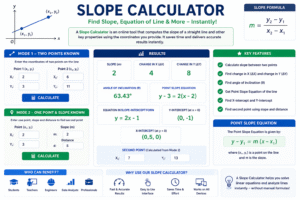
A Slope Calculator is an online mathematical tool that computes the slope of a straight line, as well as other key properties of that line, based on the coordinates you provide. It is designed to save users from tedious manual calculations and deliver accurate results instantly.
A Slope Calculator typically works in two modes:
Mode 1 — Two Points Known You enter the coordinates of two points on the line: (X₁, Y₁) and (X₂, Y₂). The Slope Calculator then computes:
- The slope (m)
- The change in X (ΔX) and change in Y (ΔY)
- The angle of inclination (θ)
- The full equation of the line using the Point Slope Equation
- The Y-intercept (when x = 0) and the X-intercept (when y = 0)
Mode 2 — One Point and Slope Known You provide one point (X₁, Y₁), the distance, and the slope (m). The Slope Calculator uses these values to find the second point (X₂, Y₂) and generates the Point Slope Equation of the line.
A Slope Calculator is especially valuable for students, teachers, engineers, and data analysts who regularly work with linear equations and need fast, reliable computations without manually applying formulas. At its core, every Slope Calculator relies on the Point Slope Equation to generate the equation of the line from the given inputs.
What Is the Point Slope Equation?
The Point Slope Equation is a form of the linear equation that defines a straight line in a coordinate plane. It is written using a known point on the line and the slope of the line, making it the most direct method for expressing the equation of a line when complete y-intercept information is not available.
The Point Slope Equation is one of three primary forms of a linear equation:
- Point Slope Equation → y − y₁ = m(x − x₁)
- Slope-Intercept Form → y = mx + b
- Standard Form → Ax + By = C
The Point Slope Equation is considered the most intuitive because it directly encodes a known geometric property of the line — the slope (m) — and a known location — the point (x₁, y₁) — without requiring you to first calculate the y-intercept.
In everyday terms, if you know that a line passes through the point (2, 3) and has a slope of 4, you can immediately write the Point Slope Equation as:
y − 3 = 4(x − 2)
This is faster and more direct than finding the y-intercept first.
The Point Slope Equation Formula Explained
The formula for the Point Slope Equation is:
y − y₁ = m(x − x₁)
Where:
- (x₁, y₁) is a known point on the line
- m is the slope of the line
- (x, y) represents any other point on the line
Breaking down the formula:
- y − y₁ represents the vertical change (rise) from the known point to any other point on the line
- x − x₁ represents the horizontal change (run) from the known point to any other point
- m is the ratio of rise to run — the slope
- The equation states that the ratio of vertical to horizontal change is constant throughout the line — which is the very definition of a straight line
The slope (m) itself is calculated as:
m = (y₂ − y₁) / (x₂ − x₁)
This is often called the “rise over run” formula. When the slope is positive, the line goes upward from left to right. When the slope is negative, the line goes downward. A slope of zero means the line is perfectly horizontal. An undefined slope means the line is perfectly vertical.
How the Point Slope Equation Differs from Other Line Equations
Many students wonder why there are multiple forms of the same linear equation. Each form of the linear equation has specific strengths and use cases.
Point Slope Equation (y − y₁ = m(x − x₁)) Best used when you know one point and the slope. This is the most direct form of the Point Slope Equation and requires the least preliminary calculation.
Slope-Intercept Form (y = mx + b) Best used when you know the slope and the y-intercept. It is the most commonly taught form in schools because it makes graphing straightforward — start at b on the y-axis, then apply the slope.
Standard Form (Ax + By = C) Best used in algebraic manipulations and systems of equations. It treats x and y symmetrically and is preferred in formal mathematical proofs and certain engineering contexts.
The Point Slope Equation is particularly powerful because it is the natural starting point when working with a Slope Calculator — you typically get a point and a slope from your data, and the Point Slope Equation immediately converts those two pieces of information into a full line equation.
How to Use the Point Slope Equation Step by Step
Using the Point Slope Equation is a simple three-step process:
Step 1 — Identify the Known Point and Slope Determine the coordinates of your known point (x₁, y₁) and the slope (m) of the line. If you have two points instead of a slope, first calculate m = (y₂ − y₁) / (x₂ − x₁).
Step 2 — Substitute into the Point Slope Equation Insert the values of x₁, y₁, and m into the formula:
y − y₁ = m(x − x₁)
For example, with point (3, 7) and slope m = 2:
y − 7 = 2(x − 3)
Step 3 — Simplify If Needed The Point Slope Equation in this form is already complete and valid. However, you can expand and simplify it into slope-intercept form if preferred:
y − 7 = 2x − 6 → y = 2x + 1
That is all it takes. The Point Slope Equation gives you the full equation of the line in just three steps, with no need to find the y-intercept separately.
How to Derive the Point Slope Equation from Two Points
When a Slope Calculator is used in “two points” mode, it automatically applies the derivation of the Point Slope Equation from two known coordinates. Here is how it works manually:
Given: Point 1 = (1, 1) and Point 2 = (5, 4)
Step 1 — Calculate the slope:
m = (4 − 1) / (5 − 1) = 3 / 4 = 0.75
Step 2 — Apply the Point Slope Equation using Point 1:
y − 1 = 0.75(x − 1)
Step 3 — Expand to verify:
y = 0.75x − 0.75 + 1 = 0.75x + 0.25
The Slope Calculator performs these exact steps internally, returning the Slope Equation, the line equation in y = mx + b form, and additional values like ΔX, ΔY, the angle θ, X-intercept, and Y-intercept.
Converting the Point Slope Equation to Slope-Intercept Form
One of the most useful skills in algebra is converting the Point Slope Equation into slope-intercept form (y = mx + b). Here is the process:
Starting from the Slope Equation:
y − y₁ = m(x − x₁)
Expand the right side:
y − y₁ = mx − mx₁
Add y₁ to both sides:
y = mx − mx₁ + y₁
This gives you:
y = mx + (y₁ − mx₁)
Where (y₁ − mx₁) = b, the y-intercept.
This conversion is performed automatically by every Slope Calculator, saving you the manual algebra. Understanding it conceptually, however, deepens your grasp of how the Point Slope Equation relates to other forms of the linear equation.
Converting the Point Slope Equation to Standard Form
Standard form (Ax + By = C) is sometimes required in academic or engineering settings. Converting the Point Slope Equation to standard form requires a few additional algebraic steps.
Starting from the Slope Equation:
y − y₁ = m(x − x₁)
Expand and rearrange:
y = mx − mx₁ + y₁
Move x terms to the left:
−mx + y = y₁ − mx₁
Multiply through by −1 (if a positive leading coefficient for x is preferred):
mx − y = mx₁ − y₁
Standard form is particularly useful in systems of equations, where you need to eliminate variables by addition or subtraction. The Point Slope Equation is the most natural starting point for this transformation.
Graphing a Line Using the Point Slope Equation
The Slope Equation makes graphing a line fast and intuitive. Here is how to graph a line using the Point Slope Equation:
Step 1 — Plot the Known Point Place a dot at the coordinates (x₁, y₁) on the coordinate plane.
Step 2 — Apply the Slope From the known point, use the slope to find a second point. If m = 3/4, move 4 units to the right and 3 units up (or any equivalent rise/run ratio).
Step 3 — Draw the Line Connect the two points with a straight line and extend it in both directions with arrows to indicate it continues infinitely.
Step 4 — Verify with the Equation Use the Slope Equation to check that both plotted points satisfy the equation. If they do, your graph is correct.
This graphing method using the Slope Equation is faster than the slope-intercept method when the y-intercept is not a convenient integer, because you do not need to find b first.
Real-World Applications of the Point Slope Equation
The Point Slope Equation is far more than a classroom exercise — it has widespread real-world applications.
Navigation and GPS Linear equations model straight-line paths between two geographic points. Navigation systems use the Slope Equation to calculate direction, distance, and travel angles between waypoints.
Construction and Architecture Builders use the Point Slope Equation to calculate ramp gradients, roof pitches, and staircase angles. Any structure with a defined slope between two known points relies on the Point Slope Equation for accurate design.
Computer Graphics In digital graphics and game development, rendering straight lines on a screen requires computing linear equations. The Point Slope Equation is used in algorithms that draw lines between pixel coordinates.
Economics and Finance Linear trend lines in financial charts and economic graphs are described by the Point Slope Equation. Analysts use it to project future values based on historical data points.
Point Slope Equation in Education
The Point Slope Equation is a cornerstone of algebra education at the middle school, high school, and college levels. Students first encounter it when learning about linear functions and continue using it throughout calculus, linear algebra, and statistics.
In standardized exams like the SAT, ACT, GRE, and GMAT, questions involving the equation of a line are extremely common. Students who master the Point Slope Equation gain a significant advantage in these tests, as they can quickly write the equation of any line given minimal information.
Teachers use Slope Calculators in classroom demonstrations to show how changing the slope or the known point affects the Slope Equation and the resulting line — making abstract concepts visually concrete.
Point Slope Equation in Engineering and Physics
In engineering and physics, the Slope Equation appears in contexts ranging from structural analysis to kinematics.
In physics, velocity-time and displacement-time graphs are linear when acceleration is constant. The Slope Equation defines the line: given a known velocity at a known time, and a constant acceleration (the slope), the full motion equation can be written immediately using the Slope Equation.
In civil and mechanical engineering, the Slope Equation is used to model stress-strain relationships in elastic materials (within Hooke’s Law limits), temperature gradients, and fluid pressure gradients — all linear relationships defined by a slope and a reference point.
Point Slope Equation in Finance and Economics
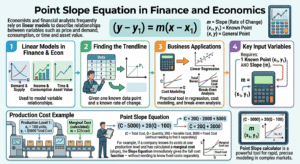
Economists and financial analysts frequently rely on linear models to describe relationships between variables such as price and demand, income and consumption, or time and asset value.
The Slope Equation allows analysts to quickly write the equation of a linear trend given one known data point (e.g., sales volume at a specific price) and a known rate of change (e.g., demand elasticity expressed as slope). This makes the Point Slope Equation a practical tool in linear regression analysis, cost modeling, and break-even analysis.
For example, if a company knows its costs at one production level and has calculated a marginal cost (slope), the Slope Equation immediately gives the full cost function — without needing to know fixed costs separately.
Common Mistakes When Using the Point Slope Equation
Even though the Slope Equation is straightforward, several common errors can lead to incorrect results:
- Mixing up x₁ and y₁ — Always ensure the x-coordinate is substituted for x₁ and the y-coordinate for y₁. Swapping them produces an incorrect equation.
- Using the wrong sign — The Point Slope Equation uses subtraction: y − y₁ = m(x − x₁). A frequent mistake is adding instead of subtracting the known coordinates.
- Calculating slope with x and y reversed — The slope formula is (y₂ − y₁) / (x₂ − x₁). Accidentally inverting the numerator and denominator gives the reciprocal of the correct slope.
- Using a decimal slope imprecisely — When the slope is a repeating decimal, use fractions in the Point Slope Equation to maintain precision throughout your calculation.
- Forgetting to distribute the slope — When expanding the Point Slope Equation, students sometimes forget to multiply m by x₁, writing m(x − x₁) as mx − x₁ instead of mx − mx₁.
Using a Slope Calculator eliminates all of these manual errors, making it the safest and most efficient way to apply the Slope Equation in practice.
Frequently Asked Questions (FAQs)
What is the Slope Equation? The Point Slope Equation is the linear equation y − y₁ = m(x − x₁), which defines a straight line using a known point (x₁, y₁) and the slope m of the line.
When should I use the Slope Equation? Use the Point Slope Equation when you know one point on the line and the slope, or when you have two points and want to write the line equation without first calculating the y-intercept.
How do I find the slope for the Slope Equation? If you have two points (x₁, y₁) and (x₂, y₂), calculate the slope as m = (y₂ − y₁) / (x₂ − x₁). A Slope Calculator can do this automatically.
Can the Slope Equation be used with a negative slope? Yes. The Point Slope Equation works for any real value of slope — positive, negative, zero (horizontal line), or undefined (vertical line, where the equation becomes x = x₁).
What is the difference between Slope Equation and Slope-Intercept Form? The Slope Equation (y − y₁ = m(x − x₁)) uses any known point on the line. Slope-Intercept Form (y = mx + b) specifically uses the y-intercept (where the line crosses the y-axis). You can convert between them algebraically.
How does a Slope Calculator use the Slope Equation? A Slope Calculator takes your input (two points or one point plus slope), computes the slope using rise/run, then applies the Slope Equation to generate the full line equation and additional properties like the angle, intercepts, and ΔX/ΔY values.
What does θ (theta) mean in the Slope Calculator results? θ is the angle of inclination — the angle the line makes with the positive x-axis. It is calculated as θ = arctan(m) in degrees. The Slope Calculator computes this alongside the Slope Equation to give you a complete geometric picture of the line.
Can the Slope Equation have more than one correct form? Yes. You can write the Slope Equation using any point on the line — not just a specific one. Different versions will look different but simplify to the same slope-intercept or standard form, confirming they represent the same line.
Is the Slope Equation used in calculus? Absolutely. In calculus, the Slope Equation is the basis for the equation of a tangent line to a curve at a given point, where the slope is determined by the derivative at that point.
How accurate is the Slope Calculator? A properly built Slope Calculator applies the Slope Equation and all related formulas with full floating-point precision, delivering results accurate to many decimal places — far more precise than manual calculation.
Conclusion
The Point Slope Equation is one of the most important and versatile formulas in all of mathematics. From writing the equation of a simple line in a school exercise to modeling complex engineering systems, financial trends, and physical phenomena, the Point Slope Equation is an indispensable tool that bridges theoretical algebra and practical problem-solving.
Its beauty lies in its simplicity — with just one point and a slope, the Point Slope Equation completely defines a unique straight line, giving you a full equation that can be graphed, converted, and applied in countless ways. Combined with a modern Slope Calculator, the Point Slope Equation becomes even more powerful — delivering instant, accurate, and detailed results for any linear problem you encounter.
Whether you are a student building your algebra foundation, a teacher crafting lesson plans, an engineer designing structures, or an analyst modeling trends, mastering the Point Slope Equation will serve you throughout your academic and professional career. Bookmark this guide, practice with your own points and slopes, and use the Slope Calculator to verify your work and deepen your understanding.
The line is always waiting to be defined — and the Point Slope Equation is the key to unlocking it.