Half-Life Calculator
Calculate binary numbers instantly with our fast and accurate Binary Calculator.
Table of Contents
- Introduction
- What Is a Half-Life Calculator?
- What Is the Half-Life Formula?
- The Mathematical Derivation of the Half-Life Formula
- Key Variables in the Half-Life Formula
- Decay Constant (λ) — Definition and Formula
- Mean Life (τ) — Definition and Relationship to Half-Life Formula
- How to Use the Half-Life Calculator Step by Step
- Understanding the Full Output of the Half-Life Calculator
- Half-Life Formula in Nuclear Physics and Radioactive Decay
- Half-Life Formula in Medicine and Pharmacokinetics
- Half-Life Formula in Chemistry and Environmental Science
- Half-Life Formula in Archaeology — Carbon Dating
- Half-Life Formula in Finance and Economics
- Common Mistakes When Applying the Half-Life Formula
- Frequently Asked Questions (FAQs)
- Conclusion
Introduction
Few concepts in science are as universally significant as the Half-Life Formula. From the decay of radioactive isotopes in nuclear physics to the elimination of drugs from the human body, from carbon dating ancient artifacts to modeling the decline of chemical concentrations, the Half-Life Formula is one of the most powerful and widely applied mathematical expressions in all of science. It describes the fundamental process by which any quantity that decreases at a constant proportional rate behaves over time — and that behavior turns out to be relevant in an extraordinary range of disciplines.
In this comprehensive guide, we will explore everything you need to know about the Half-Life Formula — what it means, how it is derived, what each component represents, and how to apply it in real-world calculations. We will also introduce the Half-Life Calculator, a digital tool that automates these calculations and delivers instant, precise results. Whether you are a student preparing for a physics or chemistry exam, a medical professional understanding drug pharmacokinetics, or a researcher working with radioactive materials, this guide will give you a complete, practical understanding of the Half-Life Formula and how to work with it confidently.
What Is a Half-Life Calculator?
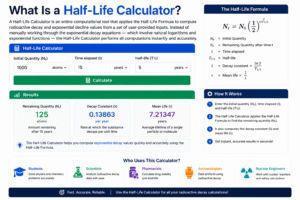
Half-Life Calculator is an online computational tool that applies the Half-Life Formula to compute radioactive decay and exponential decline values from a set of user-provided inputs. Instead of manually working through the exponential decay equations — which involve natural logarithms and exponential functions — the Half-Life Calculator performs all computations instantly and accurately.
A well-designed Half-Life Calculator accepts three inputs:
- Initial Quantity (N₀) — the starting amount of the substance
- Time elapsed (t) — how much time has passed
- Half-life (T½) — the time it takes for the quantity to reduce to half
From these three values, the Half-Life Calculator automatically derives:
- Remaining quantity (Nₜ) — how much of the substance remains after time t
- Decay constant (λ) — the rate at which the substance decays per unit time
- Mean life (τ) — the average lifetime of a single particle or molecule
The Half-Life Calculator is essential for students, scientists, pharmacists, archaeologists, and nuclear engineers who regularly work with exponential decay processes and need fast, accurate results without manual computation errors. At the core of every Half-Life Calculator is the Half-Life Formula — and understanding that formula is the key to using the calculator effectively.
What Is the Half-Life Formula?
The Half-Life Formula is a mathematical expression that describes how a quantity decreases over time at a constant proportional rate. In its most fundamental form, the Half-Life Formula defines the half-life (T½) as the time required for a quantity to reduce to exactly one-half of its initial value.
The primary expression of the Half-Life Formula for calculating the remaining quantity at any time t is:
Nₜ = N₀ × e^(−λt)
Where:
- Nₜ = the remaining quantity at time t
- N₀ = the initial quantity at time zero
- e = Euler’s number (approximately 2.71828)
- λ = the decay constant
- t = the elapsed time
The half-life itself is related to the decay constant by:
T½ = ln(2) / λ ≈ 0.693 / λ
This relationship is the heart of the Half-Life Formula — it links the half-life (an observable, measurable property) to the decay constant (a fundamental rate parameter of the process).
The Half-Life Formula is an expression of exponential decay — one of the most common mathematical patterns in nature, chemistry, physics, biology, and even economics.
The Mathematical Derivation of the Half-Life Formula
Understanding where the Half-Life Formula comes from gives you a deeper appreciation of why it works and how to apply it correctly.
Exponential decay occurs when a quantity decreases at a rate proportional to its current value. Mathematically, this is expressed as:
dN/dt = −λN
This differential equation states that the rate of change of N at any moment is proportional to the current value of N, with the proportionality constant being the negative decay constant (−λ).
Solving this differential equation by separating variables and integrating both sides gives:
N(t) = N₀ × e^(−λt)
This is the general exponential decay equation — and it is the foundation of the Half-Life Formula.
To derive T½ specifically, we set N(t) = N₀/2 (the point at which exactly half the original quantity remains):
N₀/2 = N₀ × e^(−λT½) 1/2 = e^(−λT½) ln(1/2) = −λT½ −ln(2) = −λT½ T½ = ln(2) / λ ≈ 0.693 / λ
This derivation shows that the Half-Life Formula emerges naturally from the mathematics of exponential decay — it is not an arbitrary definition but a precise consequence of how proportional decay processes work.
Key Variables in the Half-Life Formula
The Half-Life Formula involves several interconnected variables. Understanding each one is essential for correct application.
Initial Quantity (N₀) The starting amount of the decaying substance — expressed in grams, moles, atoms, milligrams, or any appropriate unit. N₀ is the reference point from which all decay calculations begin.
Elapsed Time (t) The amount of time that has passed since the measurement of N₀. The units of t must match the units in which T½ is expressed — if T½ is in years, t must also be in years.
Half-Life (T½) The half-life is the single most important parameter in the Half-Life Formula — it completely characterizes the rate of decay of a substance. Every radioactive isotope, every drug, and every decaying system has a characteristic half-life that is determined by its physical or chemical properties.
Remaining Quantity (Nₜ) The amount of the substance that remains after time t has elapsed. Computed directly from the Half-Life Formula: Nₜ = N₀ × e^(−λt).
Decay Constant (λ) — Definition and Formula
The decay constant (λ) is the probability per unit time that a single atom, molecule, or unit of a substance will undergo decay. It is a fundamental parameter of the Half-Life Formula and is related to the half-life by:
λ = ln(2) / T½ ≈ 0.693 / T½
A large λ means rapid decay — the substance has a short half-life and disappears quickly. A small λ means slow decay — the substance persists for a long time.
For example:
- Polonium-214 has a half-life of 0.000164 seconds → λ ≈ 4,228 per second (extremely fast decay)
- Uranium-238 has a half-life of 4.47 billion years → λ ≈ 4.91 × 10⁻¹⁸ per second (extremely slow decay)
The Half-Life Calculator computes λ automatically from your entered T½ value, displaying it as part of the results to give you a complete picture of the decay process.
Mean Life (τ) — Definition and Relationship to Half-Life Formula
The mean life (τ), also called the average lifetime, is the average amount of time a single atom or molecule exists before undergoing decay. It is related to the decay constant by:
τ = 1 / λ
And to the half-life by:
τ = T½ / ln(2) ≈ T½ / 0.693 ≈ 1.443 × T½
Mean life is always larger than the half-life — because while half the material decays in time T½, the remaining half takes progressively longer, and averaging over the entire decay process gives a longer average lifetime.
Mean life is particularly important in nuclear engineering and medical physics, where it characterizes the expected operational lifetime of radioactive sources. The Half-Life Calculator returns the mean life alongside the decay constant and remaining quantity, giving you the complete trio of decay parameters from a single calculation.
How to Use the Half-Life Calculator Step by Step
Using the Half-Life Calculator is straightforward and requires only three inputs. Here is a complete walkthrough:
Step 1 — Enter the Initial Quantity (N₀) Input the starting amount of the substance. This could be in grams, milligrams, moles, atoms, or any consistent unit.
Step 2 — Enter the Time Elapsed (t) Enter how much time has passed. Make sure the time unit matches the unit used for the half-life (both in days, years, hours, etc.).
Step 3 — Enter the Half-Life (T½) Input the characteristic half-life of the substance. This is the key parameter of the Half-Life Formula — it determines how quickly the substance decays.
Step 4 — Click Calculate The Half-Life Calculator applies the Half-Life Formula and instantly returns the decay constant (λ), the mean life (τ), and the remaining quantity (Nₜ), along with a full step-by-step solution.
Step 5 — Interpret the Results Review the output. The remaining quantity tells you how much of the substance persists after time t. The decay constant and mean life provide additional insight into the rate and duration of the decay process.
Step 6 — Clear and Repeat Use the Clear button to reset all fields for a new calculation.
Understanding the Full Output of the Half-Life Calculator
The Half-Life Calculator provides three primary outputs derived directly from the Half-Life Formula:
| Output | Formula | What It Tells You |
|---|---|---|
| Decay Constant (λ) | ln(2) / T½ | How rapidly the substance decays per unit time |
| Mean Life (τ) | 1 / λ | The average time a single particle or molecule exists |
| Remaining (Nₜ) | N₀ × e^(−λt) | How much of the substance remains after time t |
The step-by-step breakdown shown by the calculator makes it easy to follow each stage of the Half-Life Formula calculation, making it an excellent educational tool as well as a practical computation aid.
Half-Life Formula in Nuclear Physics and Radioactive Decay
The most classical application of the Half-Life Formula is in nuclear physics, where it describes the spontaneous radioactive decay of unstable atomic nuclei. Every radioactive isotope has a characteristic half-life — a fixed period after which exactly half of any given sample will have decayed into a different element or isotope.
Half-lives of radioactive isotopes span an extraordinary range:
- Polonium-215 — T½ = 0.0018 seconds
- Iodine-131 — T½ = 8.02 days (used in thyroid cancer treatment)
- Cobalt-60 — T½ = 5.27 years (used in radiation therapy)
- Carbon-14 — T½ = 5,730 years (used in archaeological dating)
- Uranium-238 — T½ = 4.47 billion years
The Half-Life Formula allows nuclear physicists and engineers to calculate exactly how much radioactive material will remain at any future point in time, which is essential for designing safe reactor fuel cycles, managing nuclear waste, planning radiation therapy treatments, and calibrating radiation detection instruments.
Half-Life Formula in Medicine and Pharmacokinetics
In medicine, the Half-Life Formula describes how drugs are eliminated from the human body. Pharmacokinetics — the study of how drugs move through the body — relies heavily on the concept of biological half-life: the time it takes for the concentration of a drug in the bloodstream to reduce by half.
Understanding drug half-life is critical for:
- Dosing intervals — A drug with a short half-life must be administered more frequently to maintain therapeutic levels
- Steady-state concentration — It takes approximately 4–5 half-lives for a drug to reach steady state in the body
- Drug elimination — It takes approximately 4–5 half-lives for a drug to be almost completely eliminated
- Overdose management — Calculating how long a toxic substance will remain in the body
Common drug half-lives:
- Aspirin — approximately 3–5 hours
- Diazepam (Valium) — 20–100 hours
- Fluoxetine (Prozac) — 1–6 days
- Amiodarone (heart medication) — 40–55 days
The Half-Life Formula is applied by pharmacists and physicians to calculate drug concentrations at any time point after administration — ensuring therapeutic effectiveness while minimizing toxicity.
Half-Life Formula in Chemistry and Environmental Science
In chemistry, the Half-Life Formula describes the rate at which chemical reactions proceed — particularly first-order reactions, where the reaction rate is proportional to the concentration of a single reactant.
For a first-order chemical reaction, the half-life is:
T½ = ln(2) / k
Where k is the rate constant of the reaction. This is mathematically identical to the nuclear decay Half-Life Formula, reflecting the deep connection between exponential decay and proportional rate processes.
In environmental science, the Half-Life Formula models the persistence of pollutants in ecosystems:
- Pesticide degradation — How long toxic agricultural chemicals remain active in soil
- Plastic breakdown — Modeling the extremely long half-lives of synthetic polymers in marine environments
- Atmospheric gas lifetimes — Tracking how long greenhouse gases remain in the atmosphere before chemical breakdown
Environmental regulators use the Half-Life Formula to set safe exposure limits, predict contamination timelines, and plan remediation strategies for polluted sites.
Half-Life Formula in Archaeology — Carbon Dating
One of the most celebrated applications of the Half-Life Formula is radiocarbon dating — the technique used by archaeologists and paleontologists to determine the age of organic materials up to approximately 50,000 years old.
Carbon-14 (¹⁴C) is a radioactive isotope of carbon with a half-life of 5,730 years. Living organisms continuously absorb ¹⁴C from the atmosphere. When an organism dies, it stops absorbing ¹⁴C and the isotope begins to decay according to the Half-Life Formula.
By measuring the ratio of ¹⁴C to stable ¹²C in a sample and applying the Half-Life Formula, scientists can calculate how many years have passed since the organism died:
t = −(T½ / ln(2)) × ln(Nₜ / N₀)
This technique has revolutionized archaeology, allowing scientists to date ancient wood, bone, cloth, charcoal, and other organic materials with remarkable precision. The Half-Life Formula is the mathematical engine behind every radiocarbon date reported in archaeological literature.
Half-Life Formula in Finance and Economics
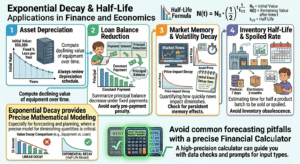
While it originates in physics, the concept embedded in the Half-Life Formula — exponential decay — appears throughout finance and economics. Any quantity that decreases at a constant proportional rate follows the same mathematics.
Financial applications include:
- Asset depreciation — The declining value of equipment or technology that loses a fixed percentage of its remaining value each year
- Loan balance reduction — Modeling how principal balances decline under constant payment schedules
- Market memory — Quantifying how quickly the impact of a news event on asset prices decays over time
- Inventory half-life — Estimating how long it takes for half of a product batch to be sold or spoiled
In each of these cases, the Half-Life Formula provides a precise mathematical model for how quickly a quantity diminishes — giving financial analysts and economists a powerful tool for forecasting and planning.
Common Mistakes When Applying the Half-Life Formula
Even a well-understood formula like the Half-Life Formula can produce errors if applied carelessly. Here are the most common mistakes to avoid:
- Mismatching time units — If T½ is in years but t is in days, the result will be completely wrong. Always ensure t and T½ use the same unit of time before applying the Half-Life Formula
- Confusing half-life with mean life — Half-life (T½ ≈ 0.693/λ) and mean life (τ = 1/λ) are different values; using one in place of the other introduces a systematic error of approximately 44%
- Using percentage remaining instead of fraction — The Half-Life Formula uses N₀ as an absolute quantity; if you input a percentage (like 100%), your result will be in percentage units
- Forgetting that half-life is substance-specific — Every substance has its own half-life; applying the half-life of one isotope to another will give entirely incorrect results
- Applying the Half-Life Formula to non-exponential decay — The Half-Life Formula assumes exponential (first-order) decay. Some processes follow different decay kinetics, for which different formulas apply
Frequently Asked Questions (FAQs)
What is the Half-Life Formula? The Half-Life Formula is the mathematical expression that describes exponential decay: Nₜ = N₀ × e^(−λt), where T½ = ln(2)/λ. It calculates how much of a quantity remains after a given time, based on the characteristic half-life of the decaying substance.
What does half-life mean physically? Half-life is the time it takes for exactly one half of an initial quantity to decay or be eliminated. After one half-life, 50% remains. After two half-lives, 25% remains. After ten half-lives, less than 0.1% remains.
Does the Half-Life Formula apply to all types of decay? The Half-Life Formula applies specifically to exponential (first-order) decay processes — including radioactive decay, drug elimination, and first-order chemical reactions. Processes with different kinetics (second-order, zero-order) have different half-life expressions.
What is the decay constant and how is it different from half-life? The decay constant (λ) is the probability per unit time that a single particle will decay. It is inversely related to the half-life: λ = ln(2)/T½. While half-life describes time in observable terms, the decay constant is the fundamental rate parameter used in the Half-Life Formula.
How many half-lives until a substance is completely gone? Theoretically, a substance never reaches absolute zero — it approaches zero asymptotically. In practice, after 7 half-lives approximately 0.78% remains, and after 10 half-lives less than 0.1% remains — considered negligible in most applications.
Can I use the Half-Life Formula for drug dosing? Yes. The Half-Life Formula is used in pharmacokinetics to calculate drug plasma concentrations at any time point. However, clinical dosing decisions should always involve a qualified healthcare professional.
Why is ln(2) used in the Half-Life Formula? Because the decay process is exponential (base e), and when Nₜ = N₀/2, solving for T½ requires taking the natural logarithm of 1/2, which equals −ln(2) ≈ −0.6931. This is why T½ = 0.693/λ appears throughout the Half-Life Formula.
What is the relationship between mean life and half-life? Mean life (τ) = T½ / ln(2) ≈ 1.443 × T½. Mean life is always longer than the half-life because it represents the average time to decay across all particles — not just the time at which half have decayed.
Can the Half-Life Calculator handle very large or very small half-lives? Yes. The Half-Life Calculator uses standard floating-point arithmetic and can handle half-lives ranging from fractions of a second (nuclear decay) to billions of years (geological isotopes) with equal accuracy.
Is the Half-Life Formula only used in physics? No. While it originates in nuclear physics, the Half-Life Formula is widely applied in chemistry, pharmacology, environmental science, archaeology, finance, and any field involving exponential decay processes.
Conclusion
The Half-Life Formula is one of the most elegant and universally applicable equations in all of science. In a single mathematical expression — Nₜ = N₀ × e^(−λt), with T½ = ln(2)/λ — it captures the entire behavior of any exponentially decaying system, from unstable atomic nuclei to pharmaceutical compounds to environmental pollutants and financial assets.
Understanding the Half-Life Formula equips you with a powerful analytical tool that transcends any single discipline. Whether you are calculating the remaining activity of a radioactive source, determining when a drug will be eliminated from a patient’s system, dating an ancient artifact with carbon-14, or modeling the depreciation of a business asset, the Half-Life Formula provides the mathematical foundation for precise, reliable answers.
The Half-Life Calculator makes applying this formula effortless — computing the decay constant, mean life, and remaining quantity instantly from just three inputs, with a full step-by-step solution that makes every calculation transparent and educational. It is the perfect companion for students, researchers, clinicians, and engineers who work with exponential decay in any form.
We encourage you to bookmark this guide and use the Half-Life Calculator regularly in your studies and professional work. With a firm grasp of the Half-Life Formula and a reliable calculator at your fingertips, you are fully equipped to tackle exponential decay problems in any context — accurately, efficiently, and with complete confidence.