Healthy Weight Calculator
Find Your Ideal Carb Target with the Carbohydrate Calculator
Table of Contents
- Introduction
- What Is a Healthy Weight Calculator?
- What Is Normal Body Index Mass?
- The History and Science Behind Normal Body Index Mass
- How the Healthy Weight Calculator Works
- The BMI Scale – Understanding Every Category
- What a Normal Body Index Mass Score Means for Your Health
- Underweight – Risks and Implications
- Overweight – What the Numbers Tell You
- Obesity – Health Risks and Action Steps
- The BMI Visual Meter Explained
- Metric vs. US Units in the Healthy Weight Calculator
- Healthy Weight Range – What Is Ideal for Your Height?
- Limitations of Normal Body Index Mass as a Measure
- How to Improve Your Normal Body Index Mass Score
- How to Use Our Healthy Weight Calculator Step-by-Step
- Frequently Asked Questions (FAQs)
- Conclusion
Introduction
Your body weight in isolation tells you very little about your health. A person who is 175cm tall and weighs 90kg may be a heavily muscled athlete in peak physical condition — or they may be carrying a dangerous level of excess body fat that significantly raises their risk of heart disease, type 2 diabetes, and stroke. The number on the scale means nothing without context. Normal Body Index Mass provides that context.
Normal Body Index Mass — commonly known as BMI — is the globally recognised standard measure of body weight relative to height. By calculating the ratio of your weight in kilograms to the square of your height in metres, it produces a single score that places you within one of four universally recognised categories: Underweight, Normal weight, Overweight, or Obese. This score provides an immediate, evidence-based indication of whether your current body weight is associated with optimal health outcomes or elevated health risks.
Our free Healthy Weight Calculator makes this assessment instant and accessible — supporting both Metric (kg and cm) and US Units (lbs, feet, and inches), displaying your Normal Body Index Mass score, weight status, and healthy weight range on a colour-coded visual meter. In this comprehensive guide, you will learn what Normal Body Index Mass is, how it is calculated, what every score range means for your health, and how to use the calculator’s results to make informed, motivated decisions about your weight and wellbeing.
Whether you are checking your BMI for the first time or monitoring ongoing progress toward a healthier weight, this guide and our Healthy Weight Calculator give you everything you need.
What Is a Healthy Weight Calculator?
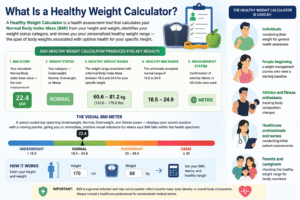
A Healthy Weight Calculator is a health assessment tool that calculates your Normal Body Index Mass (BMI) from your height and weight, identifies your weight status category, and shows you your personalised healthy weight range — the span of body weights associated with optimal health for your specific height.
Our Healthy Weight Calculator produces five key results:
- BMI Score: Your calculated Normal Body Index Mass value — the core measurement
- Weight Status: Your category — Underweight, Normal, Overweight, or Obese
- Healthy Weight Range: The weight range associated with a Normal Body Index Mass between 18.5 and 24.9 for your specific height
- Healthy BMI Range: The universally accepted normal range of 18.5 to 24.9
- Measurement System: Confirmation of whether Metric or US Units were used
The visual BMI meter — a colour-coded bar spanning Underweight, Normal, Overweight, and Obese zones — displays your score’s position with a moving pointer, giving you an immediate, intuitive visual reference for where your Normal Body Index Mass falls within the health spectrum.
The Healthy Weight Calculator is used by:
- Individuals monitoring their weight for general health awareness
- People beginning a weight management journey who need a starting baseline
- Athletes and fitness enthusiasts tracking body composition changes
- Healthcare professionals and nurses conducting initial patient assessments
- Parents and caregivers checking the healthy weight range for family members

What Is Normal Body Index Mass?
Normal Body Index Mass (BMI) is a numerical index derived from a person’s weight and height that is used to categorise them into internationally recognised weight status groups. The term “normal” in Normal Body Index Mass specifically refers to the healthy range — a score between 18.5 and 24.9 — that is associated with the lowest all-cause mortality and the lowest risk of weight-related chronic diseases.
The formula is elegantly simple:
Normal Body Index Mass = Weight (kg) ÷ Height (m²)
For a person 175cm tall and weighing 70kg: Height in metres = 1.75m Height squared = 1.75 × 1.75 = 3.0625 Normal Body Index Mass = 70 ÷ 3.0625 = 22.9 — a score squarely within the healthy Normal range.
Normal Body Index Mass is expressed as a pure number — not a percentage, not a measurement with units — making it universally comparable across populations, ages, and measurement systems. A Normal Body Index Mass of 22 means the same thing for a person in Tokyo as it does for a person in Toronto.
The four standard Normal Body Index Mass categories:
- Under 18.5: Underweight
- 18.5 to 24.9: Normal weight — the healthy range
- 25.0 to 29.9: Overweight
- 30.0 and above: Obese
These thresholds were established by the World Health Organisation based on extensive population research linking BMI ranges to health outcomes, disease risk, and mortality — making them the global standard for clinical weight assessment.
The History and Science Behind Normal Body Index Mass
Normal Body Index Mass has a surprisingly long history — and understanding its origins helps explain both its strengths and the limitations that are important to appreciate alongside its results.
The Original Formula: The weight-to-height-squared formula was first proposed by Belgian statistician Adolphe Quetelet in the 1830s — making it nearly 200 years old. Quetelet developed it as a statistical tool for describing population weight distributions, not as a clinical health assessment instrument.
The Modern BMI Framework: The term “Body Mass Index” and its current clinical application were popularised by American physiologist Ancel Keys in 1972, following a large study that demonstrated the ratio’s strong statistical correlation with body fat percentage across diverse populations. Keys himself acknowledged that BMI was intended as a population-level statistical measure, not an individual health diagnostic.
WHO Adoption: The World Health Organisation formally adopted the current Normal Body Index Mass classification thresholds (18.5/25/30) in the 1990s, making them the global standard for public health monitoring, clinical practice, and research. Today, Normal Body Index Mass is the most widely used weight assessment measure in medicine, epidemiology, and public health worldwide.
The Science Behind the Thresholds: Population studies consistently show that Normal Body Index Mass scores in the 18.5 to 24.9 range are associated with significantly lower risks of cardiovascular disease, type 2 diabetes, certain cancers, sleep apnoea, and osteoarthritis compared to scores outside this range. These statistical associations are why Normal Body Index Mass remains the standard measure despite its acknowledged limitations.
How the Healthy Weight Calculator Works
Our Healthy Weight Calculator implements the standard Normal Body Index Mass formula with full unit conversion support and a visual meter display. Here is the technical foundation:
Metric Calculation:
- Convert height from centimetres to metres: Height (m) = Height (cm) ÷ 100
- Square the height: Height² = Height (m) × Height (m)
- Divide weight by height squared: Normal Body Index Mass = Weight (kg) ÷ Height (m²)
US Units Calculation:
- Convert feet and inches to total inches: Total inches = (Feet × 12) + Inches
- Convert inches to metres: Height (m) = Total inches × 0.0254
- Convert pounds to kilograms: Weight (kg) = Pounds × 0.453592
- Apply standard formula: Normal Body Index Mass = Weight (kg) ÷ Height (m²)
The visual meter maps the calculated Normal Body Index Mass to a position on a bar spanning the BMI range from 15 to 35. The pointer moves to your score’s position, displaying clearly whether you fall in the red (Underweight), green (Normal), orange (Overweight), or dark red (Obese) zone.
The healthy weight range calculation:
- Minimum healthy weight = 18.5 × Height (m²) — the lower Normal Body Index Mass threshold
- Maximum healthy weight = 24.9 × Height (m²) — the upper Normal Body Index Mass threshold
This range is then converted back to your preferred unit (kg or lbs) and displayed alongside your BMI score.
The BMI Scale – Understanding Every Category
The Normal Body Index Mass scale is divided into four clinically significant categories, each associated with a distinct health profile and risk level:
Underweight (BMI under 18.5): A Normal Body Index Mass below 18.5 indicates that body weight is insufficient relative to height. Underweight status is associated with nutritional deficiencies, reduced immune function, bone density loss, and increased susceptibility to illness. In severe cases (BMI under 16), it can indicate eating disorders requiring urgent medical attention.
Normal Weight (BMI 18.5 to 24.9): The target range — the definition of “normal” in Normal Body Index Mass. A score in this range is associated with the lowest overall health risk and the best outcomes across most population-based health measures. Maintaining a Normal Body Index Mass in this range throughout adult life is one of the most evidence-backed strategies for reducing chronic disease risk.
Overweight (BMI 25.0 to 29.9): A Normal Body Index Mass between 25 and 29.9 indicates excess weight relative to height. Overweight status is associated with elevated but not yet high risk of type 2 diabetes, hypertension, cardiovascular disease, and joint problems. Many individuals in this range benefit significantly from moderate weight reduction.
Obese (BMI 30.0 and above): A Normal Body Index Mass of 30 or above indicates substantial excess weight relative to height. Obesity is one of the leading preventable causes of chronic disease and premature mortality globally. The health risks associated with a Normal Body Index Mass in the obese range include type 2 diabetes, cardiovascular disease, several cancers, sleep apnoea, and musculoskeletal disorders — all of which improve meaningfully with weight reduction.
What a Normal Body Index Mass Score Means for Your Health
A Normal Body Index Mass score in the 18.5 to 24.9 range is associated with optimal health outcomes across virtually every major health category. Here is what the research says about the health implications of your score:
Cardiovascular Health: Each unit increase in Normal Body Index Mass above 25 is associated with a 4% increase in cardiovascular disease risk. Conversely, achieving and maintaining a Normal Body Index Mass in the healthy range is associated with up to 50% lower risk of coronary heart disease compared to a BMI above 30.
Type 2 Diabetes: The relationship between Normal Body Index Mass and type 2 diabetes risk is one of the strongest in medical research. Individuals with a Normal Body Index Mass above 30 have approximately 7 times the type 2 diabetes risk of those with a healthy BMI. Even modest reductions in BMI (3 to 5 units) produce clinically significant improvements in blood glucose control.
Blood Pressure: Excess body weight directly increases the mechanical and metabolic load on the cardiovascular system, raising blood pressure. Reducing Normal Body Index Mass from the overweight or obese range toward the normal range produces measurable, often significant reductions in both systolic and diastolic blood pressure.
Joint Health: Excess body weight increases mechanical stress on weight-bearing joints — knees, hips, and ankles — accelerating cartilage degradation and increasing osteoarthritis risk. Reducing Normal Body Index Mass by even 5 to 10 units significantly reduces joint loading and symptom severity in established arthritis.
Mental Health: While the relationship is complex and bidirectional, population studies consistently show higher rates of depression, anxiety, and reduced quality of life at BMI extremes. Achieving a Normal Body Index Mass in the healthy range is associated with improved self-esteem, energy levels, and mental wellbeing.
Underweight – Risks and Implications
A Normal Body Index Mass below 18.5 carries significant health risks that are often underappreciated relative to the attention given to overweight and obesity:
Nutritional Deficiency: Underweight individuals often have insufficient intake of essential vitamins and minerals — iron, vitamin D, calcium, and B vitamins — leading to anaemia, bone density loss, and reduced immune function.
Muscle Loss (Sarcopenia): When caloric intake is insufficient, the body breaks down muscle tissue for energy. Reduced muscle mass lowers metabolic rate, increases fatigue, and reduces functional capacity — particularly significant in older adults.
Bone Density: Low body weight, particularly in women, is a major risk factor for osteoporosis and fracture risk. The Normal Body Index Mass-to-bone density relationship is well established — underweight individuals consistently show lower bone mineral density than those in the healthy range.
Immune Suppression: Adequate nutrition is essential for immune function. Underweight status impairs the production and function of immune cells, increasing vulnerability to infections, slowing wound healing, and reducing vaccine response.
If your Healthy Weight Calculator result shows Underweight status, consult a healthcare professional or registered dietitian before attempting to increase weight — to ensure any programme addresses underlying causes and optimises nutritional quality rather than simply adding calories.
Overweight – What the Numbers Tell You
A Normal Body Index Mass between 25 and 29.9 places you in the overweight category — a zone that warrants attention and moderate action, though not the same urgency as obesity.
The overweight range is the most populated BMI category in many developed countries, reflecting the widespread impact of sedentary lifestyles, processed food environments, and caloric surplus. For many people in this range, relatively modest lifestyle changes — increasing daily walking, reducing ultra-processed food intake, and improving sleep — are sufficient to return Normal Body Index Mass to the healthy range.
Health risks in the overweight range are real but manageable:
- Insulin resistance begins developing in the overweight range, increasing type 2 diabetes risk
- Blood pressure creep — gradual elevation of resting blood pressure — begins at BMI above 25
- Sleep quality often deteriorates as excess weight increases the likelihood of mild sleep apnoea
- Joint stress increases measurably, particularly in the knees
The good news: Moving from the overweight range back into the Normal Body Index Mass healthy range (25 → below 25) produces rapid and meaningful health improvements. Studies consistently show that even 5% to 10% weight loss in the overweight range reduces cardiovascular risk, improves blood glucose control, and reduces joint pain.
Obesity – Health Risks and Action Steps
A Normal Body Index Mass of 30 or above places you in the obese category — where health risks become substantially elevated and professional guidance becomes important.
Obesity is further subdivided:
- Class 1 Obesity: BMI 30.0 to 34.9 — elevated risk
- Class 2 Obesity: BMI 35.0 to 39.9 — high risk
- Class 3 Obesity (Severe/Morbid): BMI 40.0 and above — very high risk
The health implications of a Normal Body Index Mass in the obese range are extensive:
Cardiovascular: Significantly elevated risk of heart attack, stroke, and heart failure — driven by hypertension, dyslipidaemia, and chronic low-grade inflammation associated with excess adipose tissue.
Metabolic: The majority of type 2 diabetes cases are directly attributable to obesity. Restoring Normal Body Index Mass to the healthy range can reverse early-stage type 2 diabetes in a significant proportion of cases — one of medicine’s most powerful preventive interventions.
Respiratory: Obese individuals are significantly more likely to experience obstructive sleep apnoea, obesity hypoventilation syndrome, and reduced exercise capacity due to respiratory limitation.
Cancer: A Normal Body Index Mass in the obese range is associated with elevated risk of at least 13 types of cancer, including breast, colon, endometrial, kidney, and oesophageal cancer.
If your Healthy Weight Calculator result shows Obese status, seek professional medical guidance. A structured programme combining dietary modification, increased physical activity, and behavioural support produces the most sustainable results — and in some cases, medical or surgical interventions are appropriate and effective.
The BMI Visual Meter Explained
Our Healthy Weight Calculator includes a colour-coded visual BMI meter that provides an immediate, intuitive representation of where your Normal Body Index Mass score falls within the health spectrum.
The meter spans four colour zones:
Red (Left zone — Underweight): Covers BMI below 18.5. The pointer appearing in this zone indicates a Normal Body Index Mass below the healthy threshold.
Green (Second zone — Normal): Covers the healthy Normal Body Index Mass range of 18.5 to 24.9. A pointer in the green zone confirms your weight is within the optimal range for health and longevity.
Orange (Third zone — Overweight): Covers BMI 25.0 to 29.9. The pointer in this zone indicates excess weight that warrants lifestyle attention.
Dark Red (Right zone — Obese): Covers BMI 30.0 and above. A pointer in this zone indicates a health risk level that merits professional engagement.
The pointer moves smoothly to your exact position within the meter, providing not just a category label but a visual sense of how close you are to category boundaries — whether you are comfortably in the middle of the Normal range, near the upper edge, or just over the overweight threshold.
This visual representation is one of the most motivating features of our Healthy Weight Calculator — seeing your pointer position relative to the green zone creates a clear, compelling visual target that makes the concept of healthy weight concrete and personally relevant.
Metric vs. US Units in the Healthy Weight Calculator
Our Healthy Weight Calculator supports two measurement systems, making it accessible to users worldwide regardless of their local measurement convention:
Metric System: Accepts height in centimetres and weight in kilograms — the standard system used across most of Europe, Asia, Africa, Australia, and scientific contexts globally. The Normal Body Index Mass formula works natively in metric units, requiring only the simple cm-to-metres conversion before applying the formula.
US Units: Accepts height in feet and inches and weight in pounds — the system used in the United States and commonly understood in Canada and the UK alongside metric. The Healthy Weight Calculator converts these inputs to metric internally (using 0.0254 metres per inch and 0.453592 kg per pound) before calculating Normal Body Index Mass — ensuring the same mathematical accuracy regardless of which unit system you use.
The results and healthy weight range are displayed in your chosen system — kilograms for Metric users, pounds for US Units users — so your results are immediately actionable without any additional conversion.
Healthy Weight Range – What Is Ideal for Your Height?
One of the most practically useful outputs of our Healthy Weight Calculator is the personalised healthy weight range — the specific weight bracket that corresponds to a Normal Body Index Mass between 18.5 and 24.9 for your exact height.
This range answers the question most people actually want answered: not just “what is my BMI?” but “what should I weigh to be healthy?”
Sample healthy weight ranges by height:
| Height | Healthy Weight Range (Normal Body Index Mass 18.5–24.9) |
|---|---|
| 155 cm | 44 – 60 kg |
| 165 cm | 50 – 68 kg |
| 175 cm | 57 – 76 kg |
| 185 cm | 63 – 85 kg |
| 6 ft 0 in | 140 – 189 lbs |
| 5 ft 8 in | 122 – 164 lbs |
These ranges are calculated automatically by our Healthy Weight Calculator from your entered height — no manual lookup or table-reading required.
The range format is important: healthy weight is not a single point but a span. There is no single “perfect” weight — a Normal Body Index Mass anywhere from 18.5 to 24.9 is equally healthy. This range perspective is more realistic and motivating than targeting a single number.
Limitations of Normal Body Index Mass as a Measure
Normal Body Index Mass is a powerful, validated, and widely used health measure — but it has well-documented limitations that are important to understand when interpreting your Healthy Weight Calculator results:
Does Not Distinguish Fat from Muscle: BMI measures total mass relative to height, not body composition. A heavily muscled athlete may have a Normal Body Index Mass in the overweight or obese range despite having very low body fat — the result of high muscle mass, not unhealthy excess fat. Conversely, a “normal weight” person with low muscle mass and high fat (sometimes called “skinny fat”) may have a Normal Body Index Mass in the healthy range despite poor metabolic health.
Does Not Account for Fat Distribution: Where fat is stored matters as much as how much fat is present. Central adiposity (abdominal fat) is significantly more metabolically harmful than peripheral fat (hips, thighs). Two people with identical Normal Body Index Mass scores but different fat distribution patterns may have very different cardiovascular disease risks. Waist circumference is a valuable complement to Normal Body Index Mass for this reason.
Ethnic Variation: The WHO standard Normal Body Index Mass thresholds were derived primarily from studies on European populations. Research shows that people of Asian descent may experience metabolic complications at lower Normal Body Index Mass values — with some Asian health organisations recommending action at BMI 23 rather than 25.
Age Considerations: The relationship between Normal Body Index Mass and body fat percentage shifts with age. Older adults may have healthy Normal Body Index Mass scores despite having more fat and less muscle than younger adults with the same score. The Healthy Weight Calculator provides a useful starting point; healthcare providers use additional measures for a complete picture.
The key message: Use Normal Body Index Mass as an important health indicator and a starting point for health assessment — not as a complete or definitive verdict on your health status.
How to Improve Your Normal Body Index Mass Score
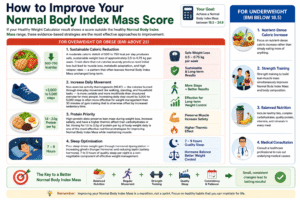
If your Healthy Weight Calculator result shows a score outside the healthy Normal Body Index Mass range, these evidence-based strategies are the most effective approaches to improvement:
For Overweight or Obese (BMI above 25):
Sustainable Caloric Reduction: A moderate caloric deficit of 500 to 750 kcal per day produces safe, sustainable weight loss of approximately 0.5 to 0.75 kg per week. Crash diets that cut calories severely produce rapid initial loss but lead to muscle loss, metabolic adaptation, and high relapse rates — a pattern that often leaves Normal Body Index Mass unchanged long-term.
Increase Daily Movement: Non-exercise activity thermogenesis (NEAT) — the calories burned through everyday movement like walking, standing, and household tasks — is more variable and more modifiable than structured exercise for most people. Increasing daily step count by 3,000 to 5,000 steps is often more effective for weight management than 30 minutes of gym training that is otherwise offset by increased sedentary time.
Protein Priority: High-protein diets preserve lean mass during weight loss, increase satiety, and have a higher thermic effect than carbohydrates or fat. Aiming for 1.6 to 2.0g of protein per kg of body weight daily is one of the most effective nutritional strategies for improving Normal Body Index Mass while maintaining muscle.
Sleep Optimisation: Poor sleep drives weight gain through hormonal dysregulation — increasing ghrelin (hunger hormone) and reducing leptin (satiety hormone). 7 to 9 hours of quality sleep per night is a non-negotiable component of effective weight management.
For Underweight (BMI below 18.5):
Focus on nutrient-dense caloric increase rather than simply eating more of anything. Strength training to build lean muscle mass simultaneously improves Normal Body Index Mass and body composition. Consult a healthcare professional to rule out underlying medical causes.
How to Use Our Healthy Weight Calculator Step-by-Step
Our free Healthy Weight Calculator is intuitive and produces instant results. Here is the complete process:
Step One – Select Your Unit System: Choose Metric (height in cm, weight in kg) or US Units (height in feet and inches, weight in lbs) depending on your preference.
Step Two – Enter Your Height: Input your current height accurately. Height accuracy is critical for Normal Body Index Mass calculation — even a 2 to 3 cm error shifts the score meaningfully at borderline values.
Step Three – Enter Your Current Weight: Input your current body weight. For the most accurate result, weigh yourself first thing in the morning after using the bathroom and before eating or drinking.
Step Four – Click Calculate: Instantly view your Normal Body Index Mass score, weight status, healthy weight range, the BMI meter pointer position, and your measurement system confirmation.
Step Five – Interpret Your Results: Compare your score against the 18.5 to 24.9 healthy Normal Body Index Mass range. Note both your current status and the healthy weight range for your height — the practical weight target to aim for.
Step Six – Track Over Time: Recalculate monthly to track progress. A consistent reduction in Normal Body Index Mass toward the healthy range confirms that your lifestyle changes are producing the intended results.
Frequently Asked Questions (FAQs)
What is Normal Body Index Mass? Normal Body Index Mass (BMI) is a measure of body weight relative to height, calculated as weight (kg) divided by height squared (m²). It categorises individuals as Underweight (under 18.5), Normal (18.5–24.9), Overweight (25–29.9), or Obese (30+).
What is a Healthy Weight Calculator? A Healthy Weight Calculator is a tool that computes your Normal Body Index Mass, identifies your weight status category, and displays your personalised healthy weight range — the weights corresponding to a healthy BMI for your specific height.
What is the healthy Normal Body Index Mass range? The healthy Normal Body Index Mass range is 18.5 to 24.9 — the scores associated with the lowest risk of weight-related chronic disease and the best overall health outcomes according to WHO research.
Is the Healthy Weight Calculator free? Yes. Our Healthy Weight Calculator is completely free with no registration required. Enter your height and weight and receive your Normal Body Index Mass result instantly.
Does Normal Body Index Mass apply equally to men and women? The same Normal Body Index Mass formula and thresholds apply to both sexes, though women typically have a higher body fat percentage at the same BMI than men due to physiological differences in fat distribution. Both sexes use the same healthy range of 18.5 to 24.9.
Can I have a healthy Normal Body Index Mass but still be unhealthy? Yes. As noted in the limitations section, Normal Body Index Mass does not measure body composition — a “normal weight” person with high body fat and low muscle (metabolically unhealthy despite normal BMI) exists. Waist circumference, body fat percentage, and blood markers provide a more complete health picture.
How quickly can I improve my Normal Body Index Mass? With a sustainable caloric deficit of 500 to 750 kcal/day, most people can reduce Normal Body Index Mass by 1 to 2 units per month. A move from BMI 28 to 24.9 (approximately 5 to 10 kg for most people) is achievable in 2 to 4 months with consistent effort.
What should I do if my Normal Body Index Mass is in the obese range? Seek professional medical guidance. A structured programme combining dietary change, physical activity, and behavioural support is most effective. For Normal Body Index Mass above 35 with comorbidities, medical or surgical options may be appropriate and evidence-based.
Is the Normal Body Index Mass formula the same worldwide? Yes — the formula is universal. However, some Asian health organisations use adjusted thresholds (action point at 23 rather than 25) based on research showing that metabolic complications occur at lower BMI values in Asian populations. Our Healthy Weight Calculator uses the standard WHO thresholds.
How often should I check my Normal Body Index Mass? Monthly tracking is appropriate for those actively managing weight. For weight-stable adults in the healthy range, an annual check is sufficient to confirm that Normal Body Index Mass remains within the healthy zone.
Conclusion
Your body weight’s relationship to your height is one of the most powerful predictors of long-term health outcomes available from a simple, free measurement. Normal Body Index Mass translates that relationship into a single, universally comparable score that tells you clearly — and scientifically — where your current weight stands relative to optimal health.
Our free Healthy Weight Calculator makes this assessment instant, accurate, and visually clear. Enter your height and weight in Metric or US Units, click Calculate, and receive your Normal Body Index Mass score, weight status category, healthy weight range, and a colour-coded visual meter that shows exactly where you stand on the health spectrum — and exactly how far you are from your target.
Whether your result places you in the healthy Normal Body Index Mass zone (a result to celebrate and maintain), the overweight range (a manageable situation with clear lifestyle solutions), or the obese range (a health priority requiring structured action), the Healthy Weight Calculator gives you the objective baseline every weight management journey needs. It removes guesswork, replaces vague impressions with precise data, and transforms the abstract concept of “healthy weight” into a specific, achievable target calibrated to your unique height.
Use our Healthy Weight Calculator today. Know your Normal Body Index Mass. Set your healthy weight target. Take the first measurable step toward the best version of your health.