Carbohydrate Calculator
Discover Your Best Pace with the Pace Calculator
Table of Contents
- Introduction
- What Is a Carbohydrate Calculator?
- What Is a Carbs Counter and Why Do You Need One?
- The Science of Carbohydrates – Fuel, Function, and Fat
- How Our Carbs Counter Calculates Your Daily Targets
- BMR and TDEE – The Energy Foundation of Your Carbs Counter
- The Six Activity Levels in Our Carbs Counter
- Understanding Your Carbs Counter Results
- The Four Carbohydrate Intake Targets Explained
- 40% Carbohydrate Diet – Low-Carb Approach
- 55% Carbohydrate Diet – The Balanced Approach
- 65% Carbohydrate Diet – Active and Athletic Fuelling
- 75% Carbohydrate Diet – Endurance and High-Performance Fuelling
- Three Unit Systems in the Carbs Counter
- Best Carbohydrate Food Sources to Hit Your Targets
- Common Carbs Counter Mistakes to Avoid
- Frequently Asked Questions (FAQs)
- Conclusion
Introduction
Carbohydrates are the most misunderstood macronutrient in modern nutrition. They have been blamed for weight gain, condemned in popular diet culture, stripped from meal plans, and at the same time celebrated as the primary fuel of athletic performance. The truth is more nuanced — and more practical — than either extreme suggests. Carbohydrates are neither the enemy nor the cure; they are a tool, and like any tool, their effectiveness depends entirely on how precisely you use them.
That precision begins with a Carbs Counter. Rather than guessing how many carbohydrates you need, or following generic guidelines that ignore your individual body metrics and activity level, a Carbs Counter calculates your personalised daily carbohydrate targets based on exactly who you are: your age, gender, weight, height, and how active you actually are. It then presents your targets across four scientifically grounded carbohydrate percentage tiers, giving you the flexibility to choose the level that best matches your goals — fat loss, weight maintenance, sports performance, or endurance fuelling.
In this comprehensive guide, you will learn what a Carbs Counter is, how our free Carbohydrate Calculator works, what each percentage tier means for your health and performance, and how to consistently hit your targets with the right food choices. Whether you are managing your weight, fuelling intensive training, or simply trying to understand your nutritional needs better, our Carbs Counter gives you the precise, personalised baseline your diet needs to deliver real results.
What Is a Carbohydrate Calculator?
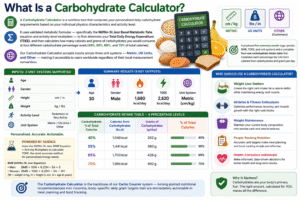
A Carbohydrate Calculator is a nutrition tool that computes your personalised daily carbohydrate requirements based on your individual physical characteristics and activity level. It uses validated metabolic formulas — specifically the Mifflin-St Jeor Basal Metabolic Rate equation and activity-level multipliers — to first determine your Total Daily Energy Expenditure (TDEE), and then calculates how many calories and grams of carbohydrates you would consume at four different carbohydrate percentage levels (40%, 55%, 65%, and 75% of total calories).
Our Carbohydrate Calculator accepts inputs across three unit systems — Metric, US Units, and Other — making it accessible to users worldwide regardless of their local measurement convention. It produces five summary results (age, gender, BMR, TDEE, and unit system) and a complete four-row carbohydrate intake table that translates each percentage tier into both calories from carbohydrates and grams per day.
The Carbohydrate Calculator is the backbone of our Carbs Counter system — turning abstract nutritional recommendations into concrete, body-specific daily gram targets that are immediately actionable in meal planning and food tracking.
What Is a Carbs Counter and Why Do You Need One?
A Carbs Counter is a practical nutritional tool that helps you track and plan your daily carbohydrate intake against a personalised target. While a carbohydrate calculator tells you what your target should be, a Carbs Counter is the ongoing practice of measuring, logging, and managing your actual intake relative to that target — ensuring that your daily carbohydrate consumption aligns with your health, weight, or performance goals.
Why do you need a Carbs Counter?
Carbohydrates are the most variable macronutrient in most people’s diets. Protein intake tends to be relatively consistent day to day; dietary fat varies moderately. But carbohydrate intake is highly sensitive to social eating, food choices, portion size, and meal frequency — swinging dramatically from day to day without conscious management. A Carbs Counter provides the awareness and structure that brings carbohydrate intake under intentional control.
The benefits of using a Carbs Counter consistently:
- Weight management: Carbohydrates, particularly refined carbohydrates and added sugars, are the primary dietary variable in most weight gain scenarios. A Carbs Counter makes surplus consumption visible and correctable before it accumulates.
- Blood sugar regulation: For individuals with insulin resistance, prediabetes, or type 2 diabetes, a Carbs Counter is a clinical management tool — tracking carbohydrate intake is the most direct dietary lever for blood glucose control.
- Sports performance: Both under-fuelling (insufficient carbohydrates for training demands) and over-fuelling (carbohydrate excess creating fat gain) impair athletic performance. A Carbs Counter calibrates carbohydrate intake to actual energy expenditure.
- Energy consistency: Many people experience midday energy crashes, mood instability, and cognitive fog caused by irregular carbohydrate intake — either too much at once (causing insulin spikes and crashes) or too little overall. A Carbs Counter promotes consistent daily intake that stabilises energy and focus.
The Science of Carbohydrates – Fuel, Function, and Fat
To use a Carbs Counter effectively, you need to understand what carbohydrates actually do in the body — and why both too much and too little produces problems.
Carbohydrates as Primary Fuel: Carbohydrates are digested into glucose, which enters the bloodstream and is transported to cells throughout the body. The brain alone consumes approximately 120 grams of glucose per day under normal conditions — making dietary carbohydrates essential for cognitive function. In the absence of dietary carbohydrates, the liver produces glucose from amino acids (gluconeogenesis), but this process is metabolically costly and insufficient to fully replace dietary glucose for high-intensity activities.
Glycogen – Your Stored Carbohydrate Reserve: Excess dietary glucose is stored as glycogen in the liver (approximately 100g) and muscles (approximately 300 to 500g). Muscle glycogen is the primary fuel source for moderate to high-intensity exercise — when muscle glycogen is depleted (typically after 60 to 90 minutes of sustained high-intensity effort), exercise capacity drops sharply. A Carbs Counter helps endurance athletes and high-volume trainers ensure glycogen stores are consistently replenished.
When Carbohydrates Become Fat: When total caloric intake exceeds total energy expenditure — regardless of the macronutrient composition of the excess — the surplus is converted to and stored as body fat. This is why a Carbs Counter is valuable for weight management: not because carbohydrates are uniquely fattening, but because they are frequently the source of excess calories in modern diets, particularly through liquid calories, ultra-processed foods, and oversized portions of refined starch.
Simple vs. Complex Carbohydrates: Not all carbohydrates behave identically. Simple carbohydrates (sugar, white flour, refined starch) digest rapidly, producing sharp glucose spikes followed by rapid drops. Complex carbohydrates (whole grains, legumes, vegetables) digest more slowly, producing gradual, sustained glucose release. A Carbs Counter tracks total grams regardless of source, but the source determines the quality, satiety, and glycaemic impact of the same gram target.
How Our Carbs Counter Calculates Your Daily Targets
Our Carbs Counter uses a two-stage metabolic calculation to translate your personal data into precise carbohydrate gram targets:
Stage 1 – BMR Calculation using Mifflin-St Jeor:
Male: BMR = (10 × Weight kg) + (6.25 × Height cm) − (5 × Age) + 5
Female: BMR = (10 × Weight kg) + (6.25 × Height cm) − (5 × Age) − 161
The Mifflin-St Jeor equation is the most accurate BMR formula validated for general use in adults, outperforming older equations (like Harris-Benedict) in independent studies. Our Carbs Counter applies this formula across all three unit systems after converting inputs to metric equivalents.
Stage 2 – TDEE Calculation:
TDEE = BMR × Activity Multiplier
The activity multiplier scales resting metabolic rate up to reflect actual daily energy expenditure including exercise, non-exercise activity thermogenesis (NEAT), and the thermic effect of food.
Stage 3 – Carbohydrate Allocation:
For each of the four percentage tiers, our Carbs Counter calculates:
- Calories from carbohydrates = TDEE × Carbohydrate percentage
- Grams of carbohydrates = Calories from carbohydrates ÷ 4
(Carbohydrates provide 4 kilocalories per gram — the same caloric density as protein, compared to 9 kcal/g for fat.)
The result is a complete four-tier carbohydrate target table showing you exactly how many grams of carbohydrates correspond to 40%, 55%, 65%, and 75% of your specific TDEE.
BMR and TDEE – The Energy Foundation of Your Carbs Counter
Every output of our Carbs Counter depends on the accuracy of your BMR and TDEE calculations, making it important to understand what these numbers represent and how they are derived.
Basal Metabolic Rate (BMR): BMR is the number of calories your body burns at complete rest — maintaining heartbeat, respiration, temperature regulation, cellular repair, and organ function. It represents your metabolic floor: the minimum energy your body requires to survive without any movement or activity. For most adults, BMR accounts for 60% to 70% of total daily energy expenditure.
BMR is primarily determined by lean body mass, age, gender, and height. Lean muscle tissue is metabolically active — each kilogram of muscle burns approximately 13 kcal per day at rest, compared to approximately 4.5 kcal/kg for fat tissue. This is why building and maintaining muscle mass is one of the most effective long-term metabolic strategies — it raises your BMR, allowing more total calories (and therefore more carbohydrates) to be consumed without creating a surplus.
Total Daily Energy Expenditure (TDEE): TDEE is the complete daily caloric cost of being you — incorporating your BMR plus all additional energy expended through movement, exercise, digestion, and thermal regulation. Your TDEE is the calorie total displayed in your Carbs Counter results and is the baseline from which all four carbohydrate intake targets are calculated.
Eating at TDEE = weight maintenance. Eating below TDEE = fat loss. Eating above TDEE = weight gain. Understanding this relationship contextualises your Carbs Counter results: your carbohydrate targets are not fixed prescriptions but starting points that you adjust upward or downward based on your specific weight and performance goals.
The Six Activity Levels in Our Carbs Counter
Our Carbs Counter offers six activity levels, more granular than the four-level systems used in many tools — allowing more accurate TDEE estimation for individuals with varied lifestyles:
Sedentary (1.2×): Office or desk job, minimal movement outside of essential daily activity. The Carbs Counter produces its lowest TDEE and smallest carbohydrate targets at this level. Honest self-assessment here is important — many people overestimate their activity level, leading to carbohydrate targets above their actual needs.
Lightly Active (1.375×): Light exercise 1 to 3 days per week — casual walking, recreational sport, light gym sessions with significant rest between sessions. Choosing this level in the Carbs Counter adds approximately 37.5% above BMR to account for the modest additional energy expenditure of light regular activity.
Moderately Active (1.55×): Exercise 3 to 5 days per week at moderate intensity — consistent gym training, cycling, swimming, or team sports. This is the most appropriate activity level for the majority of recreational athletes using the Carbs Counter, and produces meaningfully higher carbohydrate targets that support regular training.
Very Active (1.725×): Intense exercise 6 to 7 days per week or a physically demanding job. Athletes in active training blocks, manual labourers, and coaches who train alongside their clients typically fall into this category. The Carbs Counter produces substantially elevated carbohydrate targets at this level.
Extra Active (1.9×): Very intense daily exercise combined with a physically demanding job, or twice-daily training sessions. Competitive athletes in season, military personnel in high-activity postings, and construction workers who also train intensively select this level.
Professional (2.0×): The highest multiplier — reflecting elite athletic training loads, professional sports schedules, or sustained extreme physical demands. The Carbs Counter at this level produces the highest carbohydrate targets, appropriate for professional athletes with extraordinary daily energy expenditure.
Understanding Your Carbs Counter Results
Our Carbs Counter produces five summary results and a four-row carbohydrate table:
Age: Confirms the age used in BMR calculation. Age influences the −5 × Age component of the Mifflin-St Jeor formula — as age increases, BMR decreases, lowering TDEE and therefore the absolute gram quantity of carbohydrates in each tier.
Gender: Confirms whether the male (+5) or female (−161) BMR formula offset was applied. The gender offset in the Carbs Counter formula reflects the systematic difference in lean body mass and basal metabolic rate between biological males and females at equivalent weight and height.
Calculated BMR: Your resting metabolic rate in kilocalories per day. This is the energy foundation — the number from which TDEE and all carbohydrate targets are derived in the Carbs Counter.
Daily TDEE: Your total daily energy expenditure in kcal — the complete caloric cost of your current lifestyle. This is the number the Carbs Counter multiplies by carbohydrate percentages to produce the four-tier target table.
Unit System: Confirms which of the three input systems (Metric, US, Other) was used — important for verifying that inputs were entered correctly and that the internal unit conversions were applied appropriately.
The Four Carbohydrate Intake Targets Explained
The carbohydrate table generated by our Carbs Counter presents four percentage tiers, each corresponding to a different dietary philosophy and appropriate for different health and performance contexts:
The table shows, for each tier:
- Carbohydrate Percentage: The proportion of total daily calories coming from carbohydrates
- Calories: The number of calories allocated to carbohydrates at that percentage
- Grams: The gram weight of carbohydrates corresponding to those calories (calories ÷ 4)
The four tiers — 40%, 55%, 65%, and 75% — span from a moderately low-carbohydrate approach suitable for weight loss and metabolic management through to a high-carbohydrate approach appropriate for endurance athletes and high-performance sports contexts. Your Carbs Counter gives you all four options simultaneously, allowing you to select the tier that best matches your current goal rather than being locked into a single prescription.
40% Carbohydrate Diet – Low-Carb Approach
The 40% carbohydrate tier in the Carbs Counter represents a moderately low carbohydrate approach — well above ketogenic or very low-carb levels, but meaningfully below the typical high-carbohydrate modern diet.
Who benefits from the 40% tier:
- Individuals with insulin resistance or type 2 diabetes — reducing carbohydrate intake to 40% of TDEE significantly reduces glucose load, improving blood sugar control and insulin sensitivity
- People in a fat loss phase — the 40% tier leaves more caloric room for protein (the most satiating and metabolically active macronutrient) and fat, while still providing sufficient glucose for essential brain and body function
- Sedentary or lightly active individuals — those with lower TDEE values and minimal glycogen-depleting activity have lower carbohydrate requirements, making the 40% tier a natural fit
At 40% carbohydrates, the remaining 60% of calories is divided between protein and dietary fat. A common split is 30% protein and 30% fat (the “Zone Diet” approach), which the Carbs Counter makes easy to calculate by simply taking 30% of your TDEE for each.
Practical gram amounts: For a 2000 kcal TDEE, the 40% tier allocates 800 kcal to carbohydrates — equivalent to 200 grams of carbohydrates per day. This is comfortably achievable through whole-food sources without eliminating any major food category.
55% Carbohydrate Diet – The Balanced Approach
The 55% carbohydrate tier represents the “balanced” middle ground and aligns closely with the carbohydrate range recommended by most mainstream health authorities, including the World Health Organisation and national dietary guidelines.
Who benefits from the 55% tier:
- Moderately active adults with regular but not intensive exercise habits
- Weight maintenance seekers who want a sustainable, non-restrictive nutritional approach
- General health-conscious individuals who want to follow evidence-based dietary guidelines
The 55% tier from the Carbs Counter is the most versatile option — it provides sufficient carbohydrates to support regular physical activity without being so high that it becomes difficult to meet protein and fat targets simultaneously.
At a 2000 kcal TDEE, the 55% tier allocates 1,100 kcal to carbohydrates — approximately 275 grams per day. This level supports moderate training, everyday energy demands, and comfortable dietary variety.
65% Carbohydrate Diet – Active and Athletic Fuelling
The 65% carbohydrate tier is appropriate for regularly active and athletic individuals whose training demands consistent glycogen replenishment and whose total energy expenditure justifies a higher carbohydrate allocation.
Who benefits from the 65% tier:
- Gym athletes training 4 to 6 days per week — resistance and mixed-modality athletes whose multiple weekly training sessions deplete muscle glycogen regularly
- Team sport athletes — football, basketball, rugby, and similar sports combine aerobic and anaerobic demands that make glycogen availability critical for performance
- Individuals in the “Very Active” category of the Carbs Counter whose TDEE is high enough to support high carbohydrate intake without creating a surplus
At the 65% tier, the majority of calories come from carbohydrates, which aligns with the traditional sports nutrition recommendation for glycogen-dependent performance. Carb timing becomes particularly important at this tier — concentrating carbohydrate intake around training sessions (pre-workout for glycogen loading; post-workout for glycogen replenishment) maximises the performance and recovery benefits.
75% Carbohydrate Diet – Endurance and High-Performance Fuelling
The 75% carbohydrate tier represents the highest end of the Carbs Counter’s intake targets and is appropriate for endurance athletes and high-performance sports contexts where glycogen is the near-exclusive fuel source.
Who benefits from the 75% tier:
- Endurance athletes — marathon runners, cyclists, triathletes, and long-distance swimmers who sustain moderate to high-intensity aerobic exercise for 90 minutes or more per session
- Athletes in “carbohydrate loading” phases — the practice of maximising muscle glycogen stores before endurance events to delay fatigue onset
- Professional or extra-active individuals in the Carbs Counter’s highest activity categories, whose enormous TDEE creates space for high absolute carbohydrate intake without displacing protein and fat requirements
At the 75% tier with a 3000 kcal TDEE, carbohydrates would total 2250 kcal — approximately 562 grams per day. This level is not realistic or appropriate for sedentary or moderately active individuals; the Carbs Counter makes it immediately visible that this tier only makes sense at high TDEE values where absolute gram targets remain within physiological norms.
Three Unit Systems in the Carbs Counter
Our Carbs Counter supports three unit systems to accommodate the global diversity of measurement conventions:
Metric Units: Age, height in centimetres, weight in kilograms. The native format of the Mifflin-St Jeor formula — no internal conversion required. Recommended for users in metric-standard countries (Europe, Asia, Africa, Australia, South America).
US Units: Age, height in feet and inches, weight in pounds. The Carbs Counter converts these internally — pounds × 0.453592 = kilograms; ((feet × 12) + inches) × 2.54 = centimetres — before applying the Mifflin-St Jeor formula. Recommended for users in the United States.
Other Units: Age, weight in stones and pounds, height in centimetres. This system reflects the common UK and Irish convention of expressing body weight in stones (and fractional pounds) while measuring height in metric. The Carbs Counter converts stones and pounds to kilograms (stones × 6.35029 + additional pounds × 0.453592) before calculation. Appropriate for UK, Irish, and similar users.
All three unit systems produce identical mathematical accuracy — the only difference is the input format and the internal conversion step. Your carbohydrate gram targets will be the same regardless of which unit system you use, as long as your actual weight and height are entered correctly.
Best Carbohydrate Food Sources to Hit Your Targets
Once your Carbs Counter has established your daily gram target, the next step is meeting it with high-quality food sources that support health, satiety, and performance — not just filling the gram quota with refined sugars:
Oats: A slow-digesting, fibre-rich complex carbohydrate that provides sustained energy, reduces LDL cholesterol, and contributes significantly to daily gram targets with excellent nutritional density. 100g dry oats = approximately 60g carbohydrates.
Brown Rice and Whole Grain Rice: The staple carbohydrate source in many of the world’s healthiest diets. High glycaemic index white rice can be replaced with lower-GI brown rice for improved blood sugar management. A large cooked serving (200g) = approximately 50g carbohydrates.
Sweet Potato: A nutrient-dense complex carbohydrate packed with beta-carotene, fibre, and potassium. A medium sweet potato = approximately 30g carbohydrates — an ideal single-serving component of a Carbs Counter meal plan.
Legumes (Lentils, Chickpeas, Beans): Complex carbohydrates paired with significant protein content — making them doubly valuable in a balanced macronutrient plan. 100g cooked lentils = approximately 20g carbohydrates alongside 9g protein.
Whole Grain Bread and Pasta: Common, accessible sources of complex carbohydrates that fit naturally into most dietary patterns. Choose whole grain versions for higher fibre content and slower digestion. Two slices of whole grain bread = approximately 30g carbohydrates.
Fruit: Natural simple carbohydrates paired with fibre, vitamins, minerals, and antioxidants. The fibre in whole fruit significantly slows glucose absorption compared to fruit juice. A medium banana = approximately 25g carbohydrates — a convenient, portable Carbs Counter target contribution.
Vegetables: While lower in carbohydrates than grains and legumes, non-starchy vegetables contribute meaningful fibre and micronutrients. Starchy vegetables (corn, peas, butternut squash) contribute more significantly to carbohydrate gram targets.

Common Carbs Counter Mistakes to Avoid
Getting the most from your Carbs Counter requires avoiding the errors that undermine its accuracy and effectiveness:
Overestimating Activity Level: The most common and consequential mistake. If you work a desk job and exercise 3 times per week for 45 minutes, you are not “Very Active” — you are Moderately Active at most. Overestimating activity level causes the Carbs Counter to set a TDEE above your actual expenditure, producing carbohydrate targets that create a caloric surplus and unwanted weight gain.
Counting Net Carbs Instead of Total Carbs: The Carbs Counter provides total carbohydrate targets. If your food tracking app calculates “net carbs” (total carbs minus fibre), be consistent — either use total carbs in both the Carbs Counter and your tracking, or adjust your target to net carbs by subtracting typical daily fibre intake (25 to 35g).
Ignoring Liquid Carbohydrates: Fruit juice, soft drinks, sports drinks, sweetened coffee, and alcohol all contribute carbohydrate grams but are often omitted from food tracking. A single large glass of orange juice contains approximately 25g carbohydrates — potentially 10% or more of a day’s target in one overlooked drink.
Not Updating the Carbs Counter as Weight Changes: Since BMR is partly determined by body weight, your TDEE and carbohydrate targets change as your weight changes. Recalculate your Carbs Counter results every 4 to 6 weeks or whenever your weight changes by 3 to 5 kg — stale targets become progressively less accurate.
Treating All Carbohydrate Percentages as Equally Appropriate: The 40% and 75% tiers serve fundamentally different populations. Do not select the 75% tier because it gives you a higher gram target — use the tier that matches your actual activity level and goals, as confirmed by your Carbs Counter results in context.
Frequently Asked Questions (FAQs)
What is a Carbs Counter? A Carbs Counter is a nutritional tool that calculates and tracks your daily carbohydrate intake against a personalised target based on your age, gender, weight, height, and activity level.
What is a Carbohydrate Calculator? A Carbohydrate Calculator is the computational core of the Carbs Counter — the tool that processes your body metrics and activity data through BMR and TDEE formulas to produce personalised daily carbohydrate gram targets across four percentage tiers.
How many grams of carbohydrates should I eat per day? Your personalised carbohydrate gram target depends on your TDEE and chosen percentage tier. Our Carbs Counter calculates this precisely for your specific body and activity level — a sedentary 70kg adult might target 175g/day at 40%, while an active 85kg athlete might target 450g/day at 65%.
Is the Carbs Counter free? Yes. Our Carbs Counter is completely free with no registration required. Enter your metrics, select your activity level, and receive your personalised carbohydrate targets instantly.
Which carbohydrate percentage should I choose? Match the tier to your goal and activity level. Use 40% for fat loss or low-activity lifestyles, 55% for general health and moderate activity, 65% for regular athletic training, and 75% for endurance sport and very high activity. Your Carbs Counter TDEE provides the context for determining which tier is realistic for your lifestyle.
Can I use the Carbs Counter for a low-carb diet? Yes — the 40% tier represents a moderately low-carbohydrate approach. For very low-carb or ketogenic diets (typically under 50g carbohydrates per day), the Carbs Counter is still useful for establishing your TDEE baseline, but the percentage framework applies most naturally to moderate-to-high carbohydrate approaches.
Does the Carbs Counter work for both men and women? Yes. The Carbs Counter applies the gender-specific BMR formula (Mifflin-St Jeor) when Male or Female is selected, producing appropriately adjusted TDEE and carbohydrate targets for each biological sex.
How often should I recalculate with the Carbs Counter? Recalculate every 4 to 6 weeks or whenever your weight changes significantly. Since TDEE depends partly on body weight, your Carbs Counter targets shift as you gain or lose mass — regular recalculation keeps targets current and accurate.
What if my carbohydrate target seems very high? High carbohydrate targets from the Carbs Counter typically result from high TDEE (driven by high activity level) combined with a high percentage tier (65% or 75%). Verify your activity level is accurate — reducing from “Very Active” to “Moderately Active” significantly reduces TDEE and therefore carbohydrate gram targets.
Does counting carbohydrates work for weight loss? Yes — tracking carbohydrate intake with a Carbs Counter is particularly effective for weight management because carbohydrates are the most variable macronutrient in most diets. Managing carbohydrate intake alongside total calorie control is associated with improved weight loss outcomes, better blood sugar control, and greater dietary consistency.
Conclusion
Carbohydrates are not your enemy — but uncontrolled, unmeasured, and unmatched carbohydrate intake is one of the most common drivers of weight gain, poor energy management, and suboptimal athletic performance in the modern diet. The solution is not elimination — it is precision. And precision starts with knowing exactly how much your body needs.
Our free Carbs Counter delivers that precision instantly. By processing your age, gender, weight, height, and activity level through validated metabolic formulas, it calculates your personalised TDEE and translates it into four practical carbohydrate intake tiers — 40%, 55%, 65%, and 75% — giving you both the specific gram targets and the dietary framework to match those targets to your actual goals.
Whether you are a sedentary adult managing blood sugar, a recreational gym-goer fuelling three weekly sessions, a competitive athlete sustaining high training loads, or an endurance performer preparing for race day — our Carbs Counter provides the personalised, evidence-based carbohydrate targets that turn nutritional guesswork into structured, results-driven practice.
Use our Carbs Counter today. Know your numbers. Choose your tier. Fuel your body with the precision your goals demand.