Target Heart Rate Calculator
Track Your Calorie Burn Instantly with the Calories Burned Calculator
Table of Contents
- Introduction
- What Is a Target Heart Rate Calculator?
- What Is a Max Heart Rate Calculator?
- The Fox Formula – 220 Minus Age Explained
- Heart Rate Reserve and the Karvonen Method
- How Our Max Heart Rate Calculator Works Step by Step
- Understanding Every Result from the Target Heart Rate Calculator
- Fox MaxHR – Your Absolute Heart Rate Ceiling
- Calculated Target Heart Rate – Your Personalised Training BPM
- HR Reserve – The Training Range Between Rest and Maximum
- VO2 Max Estimate – Aerobic Capacity from Heart Rate Data
- The Three Intensity Training Zones in the Max Heart Rate Calculator
- Anaerobic Threshold – The Boundary Between Aerobic and Anaerobic
- Stress Load, Hydration, and Environmental Impact on Heart Rate
- BMR Estimate and Total Energy Load During Exercise
- Safety Ceiling – The Maximum Safe Training Heart Rate
- Recovery Time After High-Intensity Exercise
- Target Heart Rate Formula Explained
- Heart Rate Training Zones
- Frequently Asked Questions (FAQs)
- Conclusion
Introduction
Your heart rate is the most accessible, real-time window into your body’s physiological response to exercise. Every beat per minute tells a precise story — whether you are burning fat efficiently, building cardiovascular endurance, approaching your anaerobic threshold, or pushing into peak performance territory. Training without knowing your heart rate zones is like driving without a speedometer — you can make forward progress, but you have no way of knowing whether you are moving at the optimal pace for your goal, burning out too quickly, or barely challenging your cardiovascular system at all.
The Max Heart Rate Calculator is the foundational tool for evidence-based exercise intensity management — calculating your maximum heart rate, heart rate reserve, personalised target training BPM, all three intensity zones, anaerobic threshold, VO2 max estimate, safety ceiling, and recovery time from ten biometric and environmental inputs. Whether you are designing a fat-burning programme, building peak cardiovascular fitness, preparing for athletic competition, or simply making sure your workouts are safe and effective, the Max Heart Rate Calculator delivers the personalised cardiac data that transforms effort into results.
Our free Target Heart Rate Calculator and Max Heart Rate Calculator combines the Fox formula for maximum heart rate with the Karvonen method for target heart rate, adds environmental and physiological modifiers (stress load, hydration, ambient temperature), and produces twelve comprehensive result metrics alongside a three-zone intensity training table — all from a single calculation. This guide explains every formula, every result, and every training application — giving you the complete knowledge framework to use your heart rate data for maximum exercise effectiveness and safety.
What Is a Target Heart Rate Calculator?
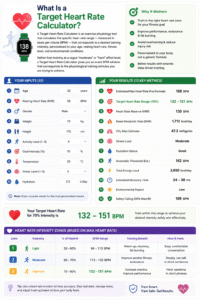
A Target Heart Rate Calculator is an exercise physiology tool that calculates the specific heart rate range — measured in beats per minute (BPM) — that corresponds to a desired training intensity, personalised to your age, resting heart rate, fitness level, and environmental conditions. Rather than training at a vague “moderate” or “hard” effort level, a Target Heart Rate Calculator gives you an exact BPM window that corresponds to the physiological training stimulus you are trying to achieve.
Our Target Heart Rate Calculator includes ten inputs:
- Age — the primary variable in maximum heart rate estimation
- Resting Heart Rate (RHR) — measured in BPM (morning resting HR, before getting out of bed)
- Gender — for BMR estimation component
- Weight (kg) — for BMR and energy load calculations
- Height (cm) — for BMR calculations
- Activity Level (1–5) — current fitness level for VO2 max estimation
- Goal Intensity (%) — the training intensity you want to achieve (e.g., 70% for moderate cardio)
- Temperature (°C) — ambient environmental temperature
- Stress Level (1–5) — current psychological stress level
- Hydration (L) — daily fluid intake
The Target Heart Rate Calculator produces twelve result metrics and a three-zone intensity table — covering Fox MaxHR, calculated target BPM, HR Reserve, BMR estimate, VO2 max estimate, stress load, hydration status, anaerobic threshold, total energy load, recovery time, environmental impact, and safety ceiling.
What Is a Max Heart Rate Calculator?
A Max Heart Rate Calculator is a cardiovascular fitness tool that estimates the maximum number of times your heart can beat per minute during maximal effort exercise — a physiological ceiling that is primarily determined by age and forms the reference point from which all training heart rate zones are derived. Your maximum heart rate (MaxHR) is the most fundamental measurement in exercise physiology — it establishes the upper boundary of your cardiac capacity and, through the heart rate reserve concept, defines the entire spectrum of intensities available for training.
The Max Heart Rate Calculator is the prerequisite for accurate:
- Target heart rate calculation (for any intensity percentage)
- Training zone definition (Fat Burn, Cardio, Peak)
- Anaerobic threshold estimation
- VO2 max estimation from cardiac data
- Safety ceiling calculation for exercise clearance
- Karvonen formula application for reserve-based heart rate targeting
Our Max Heart Rate Calculator uses the Fox formula (220 − age) as its primary MaxHR estimation method — the most widely used, validated, and clinically referenced maximum heart rate formula in exercise science. All twelve result metrics and the three-zone training table are derived from this single estimated MaxHR value combined with your resting heart rate and the nine additional biometric and environmental inputs.
The Fox Formula – 220 Minus Age Explained
The Fox formula is the foundation of the Max Heart Rate Calculator:
MaxHR = 220 − Age
Developed by Dr. Sam Fox and colleagues and popularised through widespread clinical use since the 1970s, this deceptively simple formula captures the most important single determinant of maximum heart rate — age. As we age, maximum heart rate declines at approximately 1 BPM per year, reflecting progressive changes in cardiac muscle contractility, sinoatrial node function, and autonomic nervous system regulation.
At age 20: MaxHR ≈ 200 BPM At age 30: MaxHR ≈ 190 BPM At age 40: MaxHR ≈ 180 BPM At age 50: MaxHR ≈ 170 BPM At age 60: MaxHR ≈ 160 BPM At age 70: MaxHR ≈ 150 BPM
The accuracy of the Fox formula in the Max Heart Rate Calculator: The Fox formula has a standard deviation of approximately ±10 to 12 BPM — meaning that for a 40-year-old with a predicted MaxHR of 180 BPM, the true MaxHR is likely between 168 and 192 BPM. This variability is clinically acceptable for training zone calculation — the zones derived from a ±10 BPM MaxHR error shift by only 6 to 8 BPM, which does not meaningfully change the training stimulus at any zone.
Alternative MaxHR formulas: While the Fox formula is standard in our Max Heart Rate Calculator, more recent formulas (Tanaka: 208 − 0.7 × Age; Gellish: 207 − 0.7 × Age) have shown slightly better accuracy in older adults and highly trained athletes. The Fox formula remains the clinical and public health standard because of its simplicity, widespread validation, and the decades of clinical data supporting its use.
Heart Rate Reserve and the Karvonen Method
The Karvonen method — used in our Max Heart Rate Calculator for target heart rate calculation — is the most physiologically accurate method for personalised exercise intensity prescribing:
Heart Rate Reserve (HRR) = MaxHR − Resting Heart Rate
Target Heart Rate (Karvonen) = (HRR × Intensity%) + Resting Heart Rate
Why the Karvonen method outperforms simple percentage-of-MaxHR: A simple 70% MaxHR calculation ignores resting heart rate entirely — producing the same target for a sedentary person with a resting HR of 80 BPM and a trained athlete with a resting HR of 45 BPM, despite their radically different cardiovascular fitness levels. The Karvonen method anchors the target to the usable cardiac range (HR Reserve) — the spectrum from resting to maximum — producing personalised targets that correctly reflect each individual’s fitness level.
Example comparison for a 35-year-old at 70% intensity:
Simple MaxHR method: MaxHR = 185 BPM; Target = 185 × 0.70 = 130 BPM (regardless of fitness)
Karvonen (sedentary, RHR 80): HRR = 185 − 80 = 105; Target = (105 × 0.70) + 80 = 153 BPM Karvonen (trained, RHR 50): HRR = 185 − 50 = 135; Target = (135 × 0.70) + 50 = 145 BPM
The Max Heart Rate Calculator uses the Karvonen method — ensuring your target heart rate is calibrated to your personal cardiac reserve, not just your age-predicted maximum.
How Our Max Heart Rate Calculator Works Step by Step
Using the Max Heart Rate Calculator takes approximately two minutes:
Step One – Enter Age: Your age is the primary determinant of MaxHR in the Fox formula. Enter your current age in whole years. For the most accurate Max Heart Rate Calculator results in older adults (above 60) or highly trained athletes (any age), consider using a laboratory-measured MaxHR from a graded exercise test as an alternative to the formula-estimated value.
Step Two – Enter Resting Heart Rate: Measure your resting heart rate first thing in the morning — before getting out of bed, after waking naturally (not from an alarm). Count your pulse for 60 seconds, or count for 15 seconds and multiply by four. The Max Heart Rate Calculator uses this value for HR Reserve calculation and Karvonen target HR. Normal resting HR ranges from 60 to 100 BPM; trained athletes often have resting HRs of 40 to 55 BPM.
Step Three – Select Gender and Enter Weight and Height: Gender, weight, and height feed the BMR (Basal Metabolic Rate) estimate and Total Energy Load calculations in the Max Heart Rate Calculator, using the Mifflin-St Jeor formula. These inputs do not affect the MaxHR or training zone calculations.
Step Four – Enter Activity Level (1–5): Rate your current fitness level from 1 (completely sedentary) to 5 (elite athlete or very high regular training volume). The Max Heart Rate Calculator uses activity level in the VO2 max estimate and anaerobic threshold calculation — higher activity levels produce higher VO2 max estimates and slightly higher anaerobic thresholds.
Step Five – Enter Goal Intensity (%): Enter the percentage of heart rate reserve you want to achieve in training (default: 70%). Common intensity targets:
- 50–60%: Active recovery, warm-up
- 60–70%: Fat burning, aerobic base building
- 70–80%: Moderate cardio, aerobic endurance
- 80–85%: High-intensity cardio, lactate threshold training
- 85–95%: Peak performance, interval training
Steps Six through Ten – Environmental and Physiological Modifiers: Enter ambient temperature (°C), stress level (1–5), and daily hydration (litres). The Max Heart Rate Calculator applies these as multipliers to the Karvonen target — reflecting the real-world physiological effect of heat, stress, and dehydration on cardiac output and heart rate.
Understanding Every Result from the Target Heart Rate Calculator
The Max Heart Rate Calculator produces twelve labelled result metrics:
Fox MaxHR: The estimated maximum heart rate from the Fox formula (220 − Age). This is the anchor value from which all other heart rate metrics in the Max Heart Rate Calculator are derived. Every zone, threshold, and safety ceiling is a percentage of this number.
Calculated Target: The Karvonen target heart rate — adjusted for stress load, temperature, and hydration status. This is your personalised training BPM for the selected goal intensity — the heart rate you should aim to maintain during the training phase of your workout for the desired physiological stimulus.
HR Reserve: MaxHR minus Resting HR — the total cardiac “working range” available for training. A higher HR Reserve indicates better cardiovascular fitness — a trained athlete with a low resting HR and the same MaxHR as a sedentary person has a much wider working range, which is why the Karvonen method accounts for this in the Max Heart Rate Calculator’s target calculation.
BMR Estimate: An estimate of your Basal Metabolic Rate calculated from age, gender, weight, and height using the Mifflin-St Jeor formula. This contextualises your resting caloric need alongside your exercise heart rate data — useful for planning pre- and post-workout nutrition relative to your training intensity.
VO2 Max Estimate: Estimated as (MaxHR ÷ Resting HR) × Activity Level. VO2 max is the gold-standard measure of cardiovascular fitness — the maximum rate at which your body can consume oxygen during maximal exercise. The Max Heart Rate Calculator’s estimate is a rough approximation (precise VO2 max requires laboratory testing), but it provides a useful relative indicator of aerobic capacity that can be tracked as fitness improves.
Stress Load: Calculated as Stress Level × 10, expressed as a percentage. Psychological stress elevates baseline cortisol and sympathetic nervous system activity, which increases resting and exercise heart rate above normal. The Max Heart Rate Calculator applies a stress multiplier to the target BPM — reflecting the fact that on high-stress days, your heart rate will run higher than usual at any given exercise intensity, and that reducing training intensity on high-stress days protects against overtraining and cardiovascular overload.
Hydration Status: Classified as Good (≥ 2 litres daily) or Low (< 2 litres). Dehydration is one of the most common and most impactful modifiers of exercise heart rate — even 2% dehydration increases heart rate by approximately 7 to 8 BPM at the same workload, reducing performance and increasing cardiac strain. The Max Heart Rate Calculator applies a 2% upward target adjustment when hydration is below 2 litres — reflecting this cardiac impact and implicitly recommending increased fluid intake before and during training.
Anaerobic Threshold: Calculated as MaxHR × (0.85 + Activity Level × 0.01). The anaerobic threshold (AT) — sometimes called the lactate threshold — is the exercise intensity above which lactate accumulates in the blood faster than it can be cleared, causing the “burning” sensation in muscles and the sharp increase in breathing rate. Training at or near the AT produces the most powerful cardiovascular adaptations — including increased lactate clearance capacity, improved mitochondrial density, and greater sustainable exercise intensity.
Total Energy Load: Calculated as Activity Level × Weight × 0.5. This estimate provides a rough daily caloric cost of activity — contextualising total energy expenditure relative to training intensity and body weight.
Recovery Time: Calculated as Resting HR × 0.5, expressed in minutes. This estimated recovery window reflects the time needed after a high-intensity session for heart rate to return to resting levels and for initial physiological recovery to begin. Higher resting HR produces longer estimated recovery times — reflecting the reduced cardiac efficiency of deconditioned individuals and the greater cardiovascular demand placed by each training session.
Environmental Impact: Calculated as Temperature × 0.2. Exercise in hot environments elevates heart rate through cutaneous vasodilation (blood redirected to the skin for cooling), reduced venous return, and increased sweat-driven dehydration. The Max Heart Rate Calculator’s Environmental Impact score quantifies this thermal cardiac load — providing a modifier value that explains why your heart rate runs higher on hot days at equivalent perceived effort.
Safety Ceiling: Calculated as MaxHR × 0.95 — 95% of estimated maximum heart rate. The Safety Ceiling is the maximum recommended training heart rate for most healthy adults without specific medical clearance for maximal-intensity exercise. Sustained training above the safety ceiling is unnecessary for most fitness goals and carries elevated cardiac risk — particularly for individuals with undiagnosed cardiovascular conditions.
Fox MaxHR – Your Absolute Heart Rate Ceiling
The Fox MaxHR result from the Max Heart Rate Calculator represents the estimated physiological ceiling of your cardiac output — the point at which your heart is contracting at its maximum possible rate and can no longer increase its output regardless of exercise demand:
What MaxHR represents physiologically: At MaxHR, cardiac output (the product of heart rate and stroke volume) is near its absolute limit. The cardiovascular system is delivering oxygen to working muscles at maximum capacity, and any further increase in exercise intensity can only be sustained briefly through anaerobic (oxygen-independent) energy pathways. The MaxHR is not a target to reach in normal training — it represents the upper limit that defines all training zones below it.
Individual variation around the Fox formula: The Fox formula predicts MaxHR with a standard deviation of ±10 to 12 BPM. This means that for any given person, their true MaxHR may be 10 to 12 BPM above or below the Max Heart Rate Calculator’s Fox estimate. For most training purposes, this variation is acceptable. However, highly trained athletes who notice that their zones feel too easy or too hard should consider a graded exercise test to confirm their actual MaxHR.
Calculated Target Heart Rate – Your Personalised Training BPM
The Calculated Target in the Max Heart Rate Calculator is your primary training number — the BPM you should aim to maintain during the main effort phase of your workout:
The full formula: Target = [(HRR × Goal%) + RHR] × (1 + Stress × 0.01) × (1 + Temperature × 0.001) × Hydration Factor
The stress modifier increases the target by 1% per stress level unit — acknowledging that on a stress level 4 day, the same perceived effort requires approximately 4% less heart rate to avoid cardiac overload.
The temperature modifier increases the target by 0.1% per degree Celsius above 0°C — reflecting the cardiovascular cost of heat dissipation.
The hydration factor applies a 2% upward adjustment to the target BPM when daily hydration is below 2 litres — reflecting the cardiovascular strain of mild dehydration.
Practical use: During your workout, aim to maintain heart rate within ±5 BPM of the Max Heart Rate Calculator’s Calculated Target for your goal intensity. Heart rate monitors, smartwatches, and chest strap monitors make this tracking straightforward in real time — converting the calculator’s number into actionable training guidance.
HR Reserve – The Training Range Between Rest and Maximum
Heart Rate Reserve is one of the most informative single numbers produced by the Max Heart Rate Calculator:
HR Reserve = MaxHR − Resting HR
For a 35-year-old with RHR 70: HRR = 185 − 70 = 115 BPM For a 35-year-old with RHR 50: HRR = 185 − 50 = 135 BPM
The 20 BPM difference in HRR between these two individuals reflects the greater cardiovascular efficiency of the trained person — their heart achieves the same cardiac output at lower resting rates, preserving more of the cardiac working range for exercise. Tracking HR Reserve over months of training in the Max Heart Rate Calculator reveals improving cardiovascular fitness — as resting HR falls with training adaptation, HRR increases, and the Karvonen target at any given intensity shifts slightly upward.
VO2 Max Estimate – Aerobic Capacity from Heart Rate Data
VO2 max — the maximum rate of oxygen consumption during maximal exercise — is the gold standard measure of cardiovascular fitness. The Max Heart Rate Calculator’s VO2 max estimate (MaxHR ÷ RHR × Activity Level) is a simplified approximation, but it provides directionally meaningful comparative data:
What VO2 max values indicate:
| VO2 Max (ml/kg/min) | Fitness Category |
|---|---|
| Below 25 | Poor |
| 25 to 33 | Below Average |
| 34 to 42 | Average |
| 43 to 52 | Above Average |
| 53 to 60 | Excellent |
| Above 60 | Elite/Athletic |
Improving VO2 max requires training that stresses the cardiovascular system at 80% to 95% of MaxHR — the zone that maximises cardiac output, stroke volume, and mitochondrial density adaptations. The Max Heart Rate Calculator’s anaerobic threshold and Peak zone calculations identify the heart rate ranges where VO2 max training is most effectively performed.
The Three Intensity Training Zones in the Max Heart Rate Calculator
The Intensity Zones table in the Max Heart Rate Calculator provides three personalised BPM ranges for targeted training, all calculated from your HR Reserve using the Karvonen method:
Fat Burn Zone (60% to 70% HRR): Calculated as:
- Lower boundary: (HRR × 0.60) + RHR
- Upper boundary: (HRR × 0.70) + RHR
The Fat Burn zone is the moderate aerobic training range — the intensity at which fat oxidation provides the highest absolute proportion of energy. At this intensity, your body preferentially mobilises and burns stored fat rather than relying predominantly on blood glucose and muscle glycogen. This zone is ideal for: long-duration steady-state cardio (30 to 90+ minutes), active recovery between hard training days, building aerobic base fitness, and beginners building cardiovascular endurance.
Cardio Zone (70% to 80% HRR): Calculated as:
- Lower boundary: (HRR × 0.70) + RHR
- Upper boundary: (HRR × 0.80) + RHR
The Cardio zone is the moderate-to-vigorous aerobic training range — the intensity at which cardiovascular endurance adaptations are most powerfully stimulated. Training in the Cardio zone improves stroke volume, cardiac output, aerobic enzyme activity, and capillary density — the fundamental physiological improvements associated with improved cardiovascular fitness. This zone is ideal for: steady-state runs, cycling, rowing, or swimming at a challenging but sustainable pace; tempo training; and general cardiovascular health improvement.
Peak Zone (80% HRR and above): Calculated as:
- Lower boundary: (HRR × 0.80) + RHR
- Upper boundary: Approaches MaxHR
The Peak zone is the high-intensity training range approaching the anaerobic threshold and above. At this intensity, carbohydrate becomes the dominant fuel source, lactate accumulates, and the cardiovascular system is operating at near-maximum capacity. This zone is ideal for: high-intensity interval training (HIIT), sport-specific performance training, VO2 max development, and anaerobic capacity building. Peak zone training should constitute a minority of total weekly training volume — typically 10% to 20% — with the remainder in Fat Burn and Cardio zones for sustainable adaptation without overtraining.
Anaerobic Threshold – The Boundary Between Aerobic and Anaerobic
The anaerobic threshold result from the Max Heart Rate Calculator identifies the most physiologically significant boundary in exercise physiology:
Formula: AT = MaxHR × (0.85 + Activity Level × 0.01)
For a 30-year-old with MaxHR 190 at Activity Level 3: AT = 190 × (0.85 + 0.03) = 190 × 0.88 = 167 BPM
What happens at the anaerobic threshold: Below the AT, the aerobic energy system provides the majority of ATP — burning fat and glucose with oxygen, producing only CO2 and water as byproducts. Above the AT, the glycolytic system begins contributing significantly, producing lactate (lactic acid) as a byproduct. When lactate production rate exceeds clearance rate, blood lactate rises, muscles acidify, breathing becomes laboured, and exercise cannot be sustained indefinitely.
Why training at the AT produces the most powerful adaptations: Sustained training at the AT — known as tempo training or lactate threshold training — raises the heart rate at which the threshold occurs. Over weeks and months of consistent AT training, the same heart rate produces less lactate, effectively making what was previously anaerobic effort feel aerobic. This is the primary mechanism by which endurance performance improves.
The Max Heart Rate Calculator’s AT estimate is higher for more active individuals (higher Activity Level input) — reflecting the documented fact that trained individuals have higher AT values relative to their MaxHR than sedentary individuals.
Stress Load, Hydration, and Environmental Impact on Heart Rate
Three inputs in the Max Heart Rate Calculator — Stress Level, Hydration, and Temperature — modify the Calculated Target BPM to reflect real-world physiological conditions that affect cardiac performance:
Stress Load (Stress Level × 10%): Psychological stress activates the hypothalamic-pituitary-adrenal (HPA) axis and sympathetic nervous system — elevating cortisol, adrenaline, and noradrenaline. These hormones directly increase heart rate and cardiac output, even without physical exertion. The Max Heart Rate Calculator’s stress load modifier prevents overtraining by acknowledging that on high-stress days, the cardiovascular system is already partially loaded before exercise begins — meaning that the same training heart rate represents a greater total physiological burden.
Hydration Status: The Max Heart Rate Calculator flags hydration below 2 litres as “Low” and applies a 2% upward target adjustment. Dehydration reduces plasma volume — less fluid in the blood means less volume per heartbeat, forcing the heart to beat faster to maintain the same cardiac output. A 2% body weight fluid deficit (approximately 1.4 litres for a 70 kg person) increases heart rate by approximately 7 to 8 BPM at submaximal exercise — a significant shift that pushes you into a higher training zone than intended. Drink adequately before and during training to train in your intended Max Heart Rate Calculator zone.
Environmental Impact (Temperature × 0.2): In hot environments, blood is redirected from working muscles to the skin for thermoregulation — reducing the amount of blood (and oxygen) available for exercise. The Max Heart Rate Calculator’s Environmental Impact score quantifies this thermal cardiac cost: at 30°C, the environmental impact score is 6.0 — indicating that cardiac strain is meaningfully elevated above cool-temperature training at equivalent intensity.
BMR Estimate and Total Energy Load During Exercise
Two energy-related results in the Max Heart Rate Calculator contextualise your resting and active caloric needs:
BMR Estimate: Calculated using the Mifflin-St Jeor formula from your gender, weight, height, and age. This resting caloric baseline, displayed alongside your Max Heart Rate Calculator training metrics, supports pre- and post-exercise nutrition planning — ensuring you are fuelling your cardiovascular training with sufficient caloric intake to support both performance and recovery.
Total Energy Load: Calculated as Activity Level × Weight × 0.5. This rough energy expenditure estimate reflects the additional caloric cost of your training activity above your BMR baseline. At Activity Level 3 and 70 kg body weight, the estimated exercise energy load is 105 kcal — a lower-bound estimate appropriate for a single moderate training session, not a full day’s activity.
Safety Ceiling – The Maximum Safe Training Heart Rate
The Safety Ceiling result from the Max Heart Rate Calculator — calculated as MaxHR × 0.95 — establishes the upper boundary of safe training intensity for most healthy adults:
Why 95% of MaxHR rather than 100%: Sustained training at true maximum heart rate (100% MaxHR) is physiologically unnecessary for any fitness goal short of maximal sprint performance and is potentially dangerous for individuals with undiagnosed cardiovascular conditions. At 95% MaxHR, you are training in the highest-intensity zone that produces meaningful performance adaptations while maintaining a modest safety buffer below absolute maximum cardiac output.
Who should train below the Safety Ceiling: The Max Heart Rate Calculator’s Safety Ceiling of 95% MaxHR is appropriate for healthy, fit adults with no known cardiovascular conditions. For individuals over 50 without a recent cardiac stress test, for anyone with cardiovascular risk factors (hypertension, diabetes, family history of heart disease), or for anyone returning to exercise after a period of inactivity, medical clearance is recommended before training above 85% MaxHR. In these populations, the effective safety ceiling may be lower than the Max Heart Rate Calculator’s formula-based estimate.
Recovery Time After High-Intensity Exercise
The Recovery Time result from the Max Heart Rate Calculator (Resting HR × 0.5, in minutes) provides an estimated post-exercise recovery window:
What determines recovery time: Heart rate recovery after exercise is driven by the balance between parasympathetic reactivation (the “rest and digest” nervous system) and residual sympathetic activation from the workout. Faster heart rate recovery is a marker of cardiovascular fitness — trained individuals show heart rate normalisation within 60 to 90 seconds of stopping exercise, while deconditioned individuals may take several minutes to reach resting levels.
A higher resting HR in the Max Heart Rate Calculator produces a longer estimated recovery time — reflecting the reduced cardiac efficiency and slower autonomic recovery of less conditioned cardiovascular systems. Tracking recovery time improvement over months of consistent training is one of the most sensitive and practically accessible indicators of cardiovascular fitness progress.
Target Heart Rate Formula Explained
The calculator begins with the commonly used estimated maximum heart rate formula:
- Enter your age: Subtract your age from 220 to estimate your maximum heart rate in beats per minute (BPM).
- Find your heart rate reserve: Maximum heart rate − resting heart rate.
- Calculate your target: (Heart Rate Reserve × goal intensity) + resting heart rate.
- Review the estimate: The calculator also displays workout zones and other entered metrics. Stress, temperature, and hydration inputs can adjust the target estimate shown by this tool.
For example, if you are 30 years old, your estimated maximum heart rate is 220 − 30 = 190 BPM. This is a general estimate, not a medical measurement.
Heart Rate Training Zones
These workout zones use the heart rate reserve method shown in the calculator. Replace HRR with your heart rate reserve and add your resting heart rate to estimate your personal BPM range.
| Zone | Typical Range | Common Workout Focus |
|---|---|---|
| Fat Burn | 60–70% of HRR + Resting HR | Easy to moderate, steady exercise |
| Cardio | 70–80% of HRR + Resting HR | Improving aerobic fitness and endurance |
| Peak | 80%+ of HRR + Resting HR | Short, challenging high-intensity efforts |
Frequently Asked Questions (FAQs)
What is a Max Heart Rate Calculator? A Max Heart Rate Calculator is an exercise physiology tool that estimates your maximum heart rate (using the Fox formula: 220 − Age) and calculates personalised training zones, target BPM, HR Reserve, anaerobic threshold, VO2 max estimate, and safety ceiling from your biometric and environmental data.
What is a Target Heart Rate Calculator? A Target Heart Rate Calculator determines the specific BPM you should aim for during exercise to achieve a desired training intensity. Our Max Heart Rate Calculator uses the Karvonen method — combining HR Reserve and resting heart rate — to produce a personalised target more accurate than simple percentage-of-maximum calculations.
What is a normal Max Heart Rate? The Fox formula in the Max Heart Rate Calculator estimates MaxHR as 220 minus age — producing approximately 200 BPM at age 20, 190 BPM at age 30, 180 BPM at age 40, and 170 BPM at age 50. Individual MaxHR varies by ±10 to 12 BPM around these estimates.
What heart rate zone burns the most fat? The Fat Burn zone (60–70% HR Reserve) in the Max Heart Rate Calculator produces the highest proportion of fat as fuel during exercise. However, higher intensity zones (Cardio, Peak) burn more total calories per minute — making them more efficient for total fat loss despite using a higher proportion of carbohydrate.
How often should I recalculate with the Max Heart Rate Calculator? Recalculate when your resting heart rate changes significantly (e.g., after 8 to 12 weeks of consistent training), when your activity level changes, or on a birthday (age affects the Fox MaxHR formula). Regular recalculation with the Max Heart Rate Calculator keeps your training zones current as your fitness improves.
Is the Fox formula accurate for everyone? The Fox formula (220 − Age) is accurate to within ±10 to 12 BPM for approximately 68% of the population. Athletes and very fit individuals often have higher MaxHR than the formula predicts; older adults often have slightly lower MaxHR. For precision training, a graded exercise test provides the most accurate MaxHR measurement.
What does high stress load mean in the Max Heart Rate Calculator? A high Stress Load result (from a high Stress Level input) indicates that psychological stress is significantly elevating your baseline cardiac output — meaning your heart rate will run higher than usual at equivalent exercise intensities. On high-stress days, consider reducing your Goal Intensity input in the Max Heart Rate Calculator and training at a lower target BPM to avoid unintended cardiovascular overload.
What is the Safety Ceiling and should I ever exceed it? The Safety Ceiling in the Max Heart Rate Calculator is 95% of estimated MaxHR — the upper limit of safe training for most healthy adults. Brief spikes above the safety ceiling during sprint intervals or maximal efforts are physiologically normal; sustained training above it without medical clearance is not recommended.
How accurate is the 220 − age formula?
The 220 − age formula provides a quick population-based estimate, but a person’s actual maximum heart rate can be higher or lower. Fitness level, genetics, medication, and testing conditions can affect the result, so do not treat it as an exact measurement.
Can I use this calculator if I have a heart condition?
If you have a heart or health condition, take medication that affects heart rate, are pregnant, or are returning to exercise after illness, ask a qualified healthcare professional for a safe target range before using these estimates.
What should I do if my heart rate feels unsafe during exercise?
Stop or reduce the intensity if you feel chest pain, faintness, unusual shortness of breath, or a concerning heartbeat. Seek medical advice for symptoms and use professional guidance rather than relying only on an estimated target.
This calculator is for general fitness education and is not a substitute for medical advice.
Conclusion
Your heart rate is not just a number — it is a real-time physiological dashboard that tells you exactly how hard your body is working, which energy systems are active, and whether your current exercise intensity is producing the training stimulus you intend. The Max Heart Rate Calculator translates this data into a personalised, evidence-based training framework — giving you your exact Fox MaxHR, Karvonen target BPM, HR Reserve, three training zones, anaerobic threshold, VO2 max estimate, and safety ceiling in a single calculation.
Our free Target Heart Rate Calculator and Max Heart Rate Calculator combines ten biometric and environmental inputs — including stress, hydration, and ambient temperature — to produce training recommendations that adapt to real-world conditions, not just ideal laboratory assumptions. Whether you are a beginner learning to train with purpose or an experienced athlete fine-tuning your intensity zones, the Max Heart Rate Calculator delivers the cardiac intelligence that makes every workout count.
Train in the right zone. Hit the right BPM. Build the fitness you are actually trying to build — not accidentally training too easy on days that should challenge you, or pushing dangerously hard on days your body needs recovery. Use our Max Heart Rate Calculator today. Know your zones. Train with precision. And make every heartbeat of every workout work as hard as it can for your goals.