Measure Muscle Mass Accurately with the Lean Body Mass Calculator
Table of Contents
- Introduction
- What Is a Calories Burned Calculator?
- How Does the Calories Burned Calculator Work?
- What Is MET and Why Does It Matter?
- The Role of BMR in Calorie Burn Calculations
- How Each Input Factor Affects Your Result
- Calories Burned by Popular Activities
- How Weight, Age, and Gender Affect Calorie Burn
- Using the Calories Burned Calculator for Weight Loss
- Using the Calories Burned Calculator for Athletic Performance
- Common Mistakes When Estimating Calories Burned
- Practical Tips to Maximise Your Calorie Burn
- Frequently Asked Questions (FAQs)
- Conclusion
Introduction
In the world of fitness and nutrition, very few numbers carry as much practical weight as the number of calories you burn during physical activity. This single figure sits at the intersection of your training effort, your metabolic rate, your body composition, and your dietary choices — and understanding it accurately is the key to unlocking consistent, measurable progress toward virtually any health or fitness goal.
Without knowing how many calories your workouts actually burn, you are essentially navigating your fitness journey without a map. You might be eating back more calories than you burn, unknowingly maintaining a surplus when you want a deficit. Or you might be under-fuelling your training, burning out, and wondering why your performance is declining despite consistent effort. A Calories Burned Calculator eliminates this uncertainty completely.
The challenge, however, is that calorie burn is not a fixed number. It is a highly dynamic value that depends on dozens of interacting variables — your weight, height, age, gender, the specific activity you are performing, how long you perform it, how hard you push yourself, your heart rate during exercise, the ambient temperature, how well you slept the night before, and your overall fitness level. A simple formula that ignores these variables will give you a number that may be off by hundreds of calories in either direction.
That is why our Calories Burned Calculator is built on a multi-variable framework that captures all of these factors simultaneously. The result is a calorie burn estimate that is not just fast and convenient — it is genuinely personalised to your body and your specific workout conditions, giving you a far more reliable foundation for making training and nutrition decisions than any generic chart or average-based formula could provide.
What Is a Calories Burned Calculator?
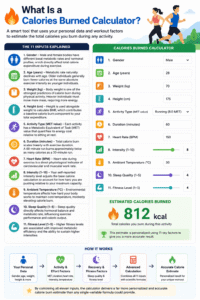
A Calories Burned Calculator is a digital fitness tool that estimates the total number of kilocalories (kcal) your body expends during a specific period of physical activity. It combines your personal biometric data with the metabolic demands of your chosen activity to generate a calorie expenditure figure that reflects your individual physiology rather than a population average.
Our Calories Burned Calculator processes the following inputs to generate your result:
- Gender — Male and female bodies have different basal metabolic rates and hormonal profiles, which directly affect total calorie expenditure during exercise. The calculator uses the Mifflin-St Jeor BMR formula, which produces gender-specific results.
- Age (years) — Metabolic rate naturally declines with age. Older individuals generally burn fewer calories at the same absolute exercise intensity as younger individuals due to changes in muscle mass, mitochondrial density, and hormonal output.
- Weight (kg) — Body weight is one of the strongest predictors of calorie burn during physical activity. Heavier individuals must move more mass against gravity, requiring more energy for the same movement — especially during weight-bearing activities like walking, running, and cycling.
- Height (cm) — Height is used alongside weight to calculate BMR, which contributes a baseline calorie burn component to your total expenditure during any activity of any duration.
- Activity Type (MET value) — Each activity has a Metabolic Equivalent of Task (MET) value that quantifies its energy cost relative to sitting at rest. Walking uses 3.5 MET, cycling 6.0 MET, and running 8.0 MET. The higher the MET, the more calories burned per unit of time.
- Duration (minutes) — Total calorie burn scales linearly with exercise duration. A 60-minute run burns approximately twice as many calories as a 30-minute run at the same intensity, all else being equal.
- Heart Rate (BPM) — Heart rate during exercise is a direct physiological indicator of cardiovascular and muscular work rate. Higher heart rates signal greater effort and higher caloric expenditure. The calculator uses your heart rate as a proportional modifier on the base calorie estimate.
- Intensity (1–10) — Your self-reported intensity level adjusts the base calorie calculation to account for how hard you are actually pushing relative to your maximum capacity. The same activity at different effort levels burns measurably different amounts of calories.
- Ambient Temperature (°C) — Environmental temperature affects how hard your body works to maintain core temperature during exercise. Exercising in hot conditions increases cardiovascular and thermoregulatory demands, modestly elevating calorie burn above what the same activity would require in mild conditions.
- Sleep Quality (1–5) — Sleep quality directly affects hormonal balance — particularly cortisol, ghrelin, and leptin — which in turn influences metabolic rate and exercise performance. Poor sleep reduces both the efficiency and the caloric output of your workouts.
- Fitness Level (1–5) — Higher fitness levels are associated with improved metabolic efficiency, which means fit individuals burn calories more efficiently during submaximal exercise. However, fit individuals also typically train at higher absolute intensities, which can offset the efficiency advantage.
By combining all eleven of these inputs, the Calories Burned Calculator generates a total calorie burn estimate that is far more personalised and accurate than any single-variable formula could produce.
How Does the Calories Burned Calculator Work?
The Calories Burned Calculator uses a three-stage calculation process that combines the MET-based activity energy formula with BMR contribution and a multi-factor physiological modifier. Here is a detailed breakdown of each stage:
Stage 1: Basal Metabolic Rate (BMR) Calculation
The calculator first computes your BMR using the Mifflin-St Jeor equation — the most clinically validated BMR formula currently in use:
For Women: BMR = (10 × weight) + (6.25 × height) − (5 × age) − 161
Your BMR contributes a baseline calorie burn to your total — calculated as BMR × (exercise duration ÷ 1440 minutes in a day).
Stage 2: MET-Based Activity Calorie Calculation
The base calorie burn from your chosen activity is calculated using the standard MET formula:
This formula gives the raw caloric cost of your chosen activity at its standard intensity level, based purely on your body weight and the duration of effort.
Stage 3: Multi-Factor Modifier Application
The Calories Burned Calculator then applies a composite physiological modifier to the base calorie figure. This modifier is calculated from your heart rate, intensity level, ambient temperature, sleep quality, and fitness level:
Final Calories = (Base Calories × Modifier) + BMR Contribution
This three-stage process is what distinguishes the Calories Burned Calculator from basic single-variable tools. It captures both the objective energy cost of your activity and the subjective physiological conditions under which you performed it — producing a result that genuinely reflects your specific workout scenario.
What Is MET and Why Does It Matter?
The Metabolic Equivalent of Task (MET) is one of the most important concepts underpinning every reliable Calories Burned Calculator. A MET value quantifies the energy cost of a physical activity relative to sitting quietly at rest. By definition, sitting at rest has a MET value of 1.0 — meaning it consumes approximately 1 kilocalorie per kilogram of body weight per hour. Any activity with a MET above 1.0 burns proportionally more calories than rest.
Here is how MET values compare across the activities supported by the Calories Burned Calculator:
| Activity | MET Value | Relative Intensity | Kcal/Hour (70kg person) |
|---|---|---|---|
| Sitting at rest | 1.0 | Sedentary | ~70 kcal/hr |
| Walking (moderate pace) | 3.5 | Light | ~245 kcal/hr |
| Swimming (general) | 4.0 | Moderate | ~280 kcal/hr |
| Cycling (moderate effort) | 6.0 | Moderate–Vigorous | ~420 kcal/hr |
| Weight Lifting (vigorous) | 7.0 | Vigorous | ~490 kcal/hr |
| Running (general pace) | 8.0 | Vigorous–High | ~560 kcal/hr |
Understanding your activity’s MET value helps you make informed decisions about which exercises deliver the highest calorie burn per unit of time. Running delivers more than double the calories-per-hour of walking — a critical insight for anyone designing a time-efficient fat-loss training plan using the Calories Burned Calculator.
The Role of BMR in Calorie Burn Calculations
Most people think about calorie burn only in terms of the calories their muscles consume during exercise. But your body never stops burning calories — even when you are sleeping, sitting, or recovering between sets. This baseline calorie expenditure is your Basal Metabolic Rate (BMR), and it represents 60–70% of most people’s total daily energy expenditure.
The Calories Burned Calculator includes your BMR contribution in the total calorie burn figure because ignoring it would systematically underestimate your true total energy expenditure during any given workout session. Even a 30-minute walk contributes a measurable BMR component on top of the MET-based activity calories — and for longer workouts, this BMR contribution can add a meaningful additional number of calories to your total burn.
Including BMR in the calculation also means that two people performing the exact same workout burn different total calories — not just because of weight differences in the MET formula, but because their different ages, heights, and genders produce different BMR baselines. This is one of the key reasons why a personalised Calories Burned Calculator that incorporates your individual BMR will always be more accurate than a generic activity calories chart.
How Each Input Factor Affects Your Result
The Calories Burned Calculator uses eleven distinct inputs to generate your result. Understanding how each one influences the final number helps you enter accurate data and interpret your results correctly:
| Input Factor | Effect on Calorie Burn | Direction |
|---|---|---|
| Higher body weight | More mass to move requires more energy | ↑ Increases burn |
| Higher MET activity | Greater metabolic demand per unit time | ↑ Increases burn |
| Longer duration | More total work performed | ↑ Increases burn |
| Higher heart rate | Greater cardiovascular and muscular output | ↑ Increases burn |
| Higher intensity (1–10) | Greater effort multiplied across base calories | ↑ Increases burn |
| Higher ambient temperature | Greater thermoregulatory work demand | ↑ Increases burn (modestly) |
| Higher age | Lower BMR due to reduced muscle mass and metabolism | ↓ Decreases burn |
| Poor sleep quality | Reduced metabolic efficiency and hormone output | ↓ Decreases burn |
| Higher fitness level | Greater metabolic efficiency at submaximal effort | ↓ Decreases burn (at same intensity) |
This multi-directional interaction of factors is precisely why two people doing the same 30-minute workout can have dramatically different calorie burns — and why a Calories Burned Calculator that captures all of them simultaneously will always outperform a simple one-size-fits-all formula.
Calories Burned by Popular Activities
To give you a practical reference point, here is a summary of approximate calorie burns for a 70 kg person across the five activity types supported by the Calories Burned Calculator, at different durations:
| Activity | 20 Minutes | 30 Minutes | 45 Minutes | 60 Minutes |
|---|---|---|---|---|
| Walking | ~82 kcal | ~123 kcal | ~184 kcal | ~245 kcal |
| Swimming | ~93 kcal | ~140 kcal | ~210 kcal | ~280 kcal |
| Cycling | ~140 kcal | ~210 kcal | ~315 kcal | ~420 kcal |
| Weight Lifting | ~163 kcal | ~245 kcal | ~368 kcal | ~490 kcal |
| Running | ~187 kcal | ~280 kcal | ~420 kcal | ~560 kcal |
Remember: these are baseline figures at standard MET values for a 70 kg individual under average physiological conditions. Your actual calorie burn will differ based on all the individual factors captured by the Calories Burned Calculator — which is exactly why using the calculator with your personal data always produces a more useful and actionable number than any generic reference table.
How Weight, Age, and Gender Affect Calorie Burn
Three of the most consistently influential variables in any Calories Burned Calculator are body weight, age, and biological gender. Understanding how each of these factors shapes your calorie burn helps you interpret your results and set realistic expectations for your fitness progress.
Body Weight
Body weight has a direct, proportional relationship with calorie burn during weight-bearing exercise. In the MET formula, calories burned scale linearly with body weight — which means a 90 kg person burns approximately 29% more calories walking the same distance at the same pace as a 70 kg person. This is why weight loss tends to plateau over time — as your weight decreases, the caloric cost of each workout decreases with it, and your deficit narrows unless you increase intensity or duration.
Age
Calorie burn tends to decline gradually with advancing age, primarily due to the natural reduction in lean muscle mass (sarcopenia) that occurs after age 30. Muscle tissue is metabolically active — it burns calories at rest and during exercise — so less muscle means a lower BMR and a reduced caloric contribution to your total burn during any given workout. The Calories Burned Calculator accounts for this through the age-dependent BMR formula, ensuring your baseline contribution is appropriately calibrated to your current age.
Gender
Biological males generally burn more calories than females at the same absolute body weight, height, age, and exercise intensity — primarily because males tend to have higher proportions of lean muscle mass and higher baseline testosterone levels. The Mifflin-St Jeor equation used by the Calories Burned Calculator applies a gender-specific correction factor (+5 for males, −161 for females) to the BMR calculation, producing appropriately differentiated results without requiring any additional inputs beyond your gender selection.
Using the Calories Burned Calculator for Weight Loss
For anyone pursuing fat loss, the Calories Burned Calculator is an essential daily tool. Here is how to use it strategically as part of a complete, evidence-based weight loss approach:
Establish Your Exercise Calorie Contribution
Every time you complete a workout, use the Calories Burned Calculator to get your personalised calorie burn estimate. Add this to your estimated daily BMR to get your total daily energy expenditure (TDEE) — the number you need to eat below in order to create a caloric deficit and lose body fat over time.
Create a Sustainable Caloric Deficit
The gold standard for sustainable fat loss is a daily caloric deficit of 300–500 kcal below your TDEE. Using the Calories Burned Calculator to accurately quantify your exercise burn means you can create this deficit with confidence rather than guesswork. Smaller deficits preserve muscle mass and energy levels; larger deficits can lead to muscle loss, metabolic adaptation, and burnout.
Avoid Compensatory Eating
One of the most common fat-loss mistakes is eating back more calories than the Calories Burned Calculator reports having burned. Many gym-goers overestimate their calorie burn — particularly on cardio machines, which are notoriously inaccurate — and reward themselves with post-workout meals that completely offset or even exceed the deficit they worked to create. Using a personalised Calories Burned Calculator gives you an honest, data-driven number that helps you avoid this trap.
Using the Calories Burned Calculator for Athletic Performance
For athletes and performance-focused individuals, the Calories Burned Calculator serves a different but equally important purpose: ensuring adequate fuelling to support training volume, power output, and recovery. In this context, the goal is not a caloric deficit but a precise match between energy consumed and energy expended.
Athletes who consistently under-fuel their training — a condition now formally known as Relative Energy Deficiency in Sport (RED-S) — risk hormonal disruption, stress fractures, immune suppression, and significant performance decline. By using the Calories Burned Calculator to accurately quantify the energy demand of each training session, athletes can ensure they are consuming enough calories to sustain the physiological adaptations that hard training is designed to produce.
The Burn Rate output (kcal per minute) from the Calories Burned Calculator is particularly useful for athletes who need to plan intra-workout fuelling strategies — such as consuming carbohydrate gels or sports drinks at specific intervals during prolonged endurance events lasting more than 60 to 90 minutes.
Common Mistakes When Estimating Calories Burned
Even with a reliable Calories Burned Calculator, certain patterns of incorrect data entry or result misinterpretation can lead to poor decisions. Here are the most common mistakes to avoid:
- Trusting gym machine calorie displays blindly: Treadmills, ellipticals, and stationary bikes are notoriously inaccurate — often overestimating calorie burn by 20–40%. Always cross-reference with the Calories Burned Calculator using your actual body weight and activity MET value for a more reliable estimate.
- Ignoring the impact of fitness level: As your fitness improves, your body becomes more efficient at performing the same tasks — meaning you burn fewer calories doing the same workout you did six months ago. Re-run the Calories Burned Calculator monthly and update your fitness level input to keep your estimates current.
- Forgetting to account for sleep quality: A night of poor sleep reduces your metabolic efficiency and increases perceived exertion, meaning a workout that would normally feel moderate feels harder and may actually burn fewer calories due to reduced physical output. Entering your actual sleep quality score into the Calories Burned Calculator ensures this variable is reflected in your result.
- Using only one variable to estimate burn: Single-variable calorie estimates — based purely on duration or on weight alone — can be off by hundreds of calories. The value of the Calories Burned Calculator is precisely its multi-variable approach.
- Not updating personal data over time: As your weight changes, your calorie burn changes with it. Always enter your current weight when using the Calories Burned Calculator — using outdated figures from months ago will steadily erode the accuracy of your estimates.
Practical Tips to Maximise Your Calorie Burn
Once the Calories Burned Calculator has given you your baseline numbers, here are the most evidence-backed strategies for increasing your calorie burn over time without increasing injury risk or training time:
Increase Exercise Intensity Progressively
The single most effective way to burn more calories in the same amount of time is to increase exercise intensity. Moving from a 5-intensity walk to a 7-intensity brisk walk, or from moderate-effort cycling to vigorous cycling, significantly elevates your heart rate, MET value, and total caloric expenditure. Use the Calories Burned Calculator to quantify exactly how much additional burn your intensity increase generates.
Incorporate High-Intensity Interval Training (HIIT)
HIIT workouts alternate between brief periods of maximum-effort exercise and short recovery intervals. Research consistently shows that HIIT burns significantly more calories per unit of time than steady-state cardio — and it also produces a meaningful Excess Post-exercise Oxygen Consumption (EPOC) effect that elevates your metabolic rate for hours after the workout ends. HIIT sessions at intensity levels of 8–9 out of 10 will produce some of the highest calorie burn outputs the Calories Burned Calculator can generate.
Prioritise Sleep Quality
As the Calories Burned Calculator reflects, poor sleep quality measurably reduces your calorie burn during exercise. Consistently sleeping 7–9 hours per night with high sleep quality not only maximises your calorie burn per workout session but also optimises the hormonal environment for fat metabolism, muscle retention, and performance recovery.
Build Lean Muscle Mass
Because muscle tissue is metabolically active, building more lean muscle increases your resting BMR — which means you burn more calories every hour of every day, including during sleep. Weight lifting, as reflected in the Calories Burned Calculator with its 7.0 MET value, is one of the most effective activities not just for in-session calorie burn but for long-term metabolic rate elevation through muscle hypertrophy.
Exercise in Appropriate Environmental Conditions
The ambient temperature input in the Calories Burned Calculator reflects the real physiological fact that exercising in warmer conditions modestly elevates calorie burn due to increased thermoregulatory demands. However, exercising in extreme heat also increases the risk of dehydration and heat exhaustion — so use this as a modest modifier rather than a strategy for significantly inflating your calorie burn numbers.
Frequently Asked Questions (FAQs)
What does a Calories Burned Calculator measure?
A Calories Burned Calculator estimates the total kilocalories (kcal) your body expends during a specific period of physical activity. It combines your personal biometric data — weight, height, age, gender — with activity type (MET value), duration, heart rate, intensity, ambient temperature, sleep quality, and fitness level to produce a personalised calorie burn estimate.
How accurate is a Calories Burned Calculator?
A multi-variable Calories Burned Calculator that incorporates MET, BMR, heart rate, intensity, and physiological modifiers is significantly more accurate than a single-variable formula. However, all estimated calorie burn figures — including those from wearable trackers — carry inherent uncertainty. Use the result as a reliable guide rather than an exact measurement.
What is a MET value and how does it affect my calorie burn?
MET (Metabolic Equivalent of Task) quantifies the energy cost of a physical activity relative to rest. An activity with MET 8.0 (like running) burns eight times as many calories per kilogram of body weight per hour as sitting at rest. The Calories Burned Calculator uses each activity’s established MET value as the primary driver of the base calorie burn calculation.
Why does my fitness level reduce my calorie burn estimate?
Higher fitness levels are associated with improved metabolic efficiency — meaning your body performs the same absolute workload using less energy. A highly trained runner burns fewer calories per kilometre than a sedentary beginner doing the same distance. The Calories Burned Calculator reflects this through the fitness level modifier in the multi-factor adjustment stage.
Does sleep quality really affect how many calories I burn during exercise?
Yes. Poor sleep elevates cortisol, disrupts leptin and ghrelin balance, and reduces both physical performance capacity and metabolic rate. These effects mean that the same workout performed on poor sleep will produce a modestly lower calorie burn than the same workout on high-quality sleep. The Calories Burned Calculator captures this through the sleep quality modifier.
What does the ‘High Burn’ vs ‘Normal’ status mean?
The status indicator in the Calories Burned Calculator shows ‘High Burn’ when your total estimated calorie expenditure exceeds 300 kcal — a threshold that indicates a meaningful contribution to your daily caloric deficit and fat loss goals. ‘Normal’ indicates that the session burned fewer than 300 kcal total.
How often should I update my data in the Calories Burned Calculator?
Update your weight input every 2–4 weeks or whenever your body weight changes by more than 2 kg. Update your fitness level every 6–8 weeks as your conditioning improves. Update your age once annually. Keeping your inputs current ensures your calorie burn estimates remain accurate as your body changes over time.
Can I use the Calories Burned Calculator for every type of exercise?
The current Calories Burned Calculator supports five activity types: Walking, Running, Cycling, Swimming, and Weight Lifting. These five activities cover the most common exercise categories. For unlisted activities, choose the activity most similar in intensity and movement pattern to your actual workout.
Should I eat back the calories shown in the Calories Burned Calculator?
For weight loss goals, eating back some but not all of your exercise calories is a common and effective strategy — typically eating back 50–70% of the exercise burn to maintain a partial deficit while adequately fuelling recovery. For maintenance or performance goals, matching your caloric intake to your total expenditure is the objective.
Does the Calories Burned Calculator account for the afterburn effect (EPOC)?
The current calculation does not explicitly model EPOC (Excess Post-exercise Oxygen Consumption) — the elevated metabolic rate that persists after exercise ends. High-intensity workouts with intensity scores of 8–10 and vigorous heart rates will produce the greatest EPOC effect. Consider the Calories Burned Calculator result as a conservative floor estimate for very high-intensity sessions.
Conclusion
Knowing exactly how many calories you burn during exercise is one of the most actionable pieces of data available in any fitness or weight management programme. It closes the feedback loop between your training effort and your nutritional choices, giving you the precise information you need to create the right caloric environment for your specific goal — whether that is a fat-burning deficit, a performance-sustaining maintenance, or a muscle-building surplus.
The Calories Burned Calculator takes all the complexity out of this calculation. By processing eleven individual physiological and environmental inputs through a three-stage formula that combines MET-based activity energy, BMR contribution, and a multi-factor modifier, it delivers a calorie burn estimate that is genuinely personalised — not a recycled population average or a rough chart approximation, but a number built specifically from your weight, height, age, gender, activity, and workout conditions.
Whether you are a beginner using the Calories Burned Calculator to understand your first gym session, an intermediate exerciser trying to break through a weight-loss plateau, or an experienced athlete optimising your fuelling strategy for peak performance, the numbers this tool produces will help you train smarter, eat better, and recover faster.
Use the Calories Burned Calculator after every workout, keep your personal data current, trust the numbers it produces, and watch your results accelerate. Your effort deserves to be measured accurately — and now it can be.