Reveal Your True Body Composition with the Body Fat Calculator
Table of Contents
- Introduction
- What Is a Lean Body Mass Calculator?
- Why Lean Body Mass Matters More Than Total Body Weight
- The US Navy Body Fat Formula – The Science Behind the Lean Body Mass Calculator
- How Our Lean Body Mass Calculator Works Step by Step
- Understanding Every Result from the Lean Body Mass Calculator
- Lean Body Mass – Your Metabolically Active Weight
- Body Fat Percentage – What the Numbers Mean for Men and Women
- Fat Mass – The Weight Beyond Your Lean Tissue
- Basal Metabolic Rate and Lean Body Mass – The Critical Connection
- Total Daily Energy Expenditure from the Lean Body Mass Calculator
- Water Weight Estimate – How Much of Your LBM Is Fluid
- Body Density – The Physiology Behind the Fat Percentage Formula
- Healthy Body Fat Ranges by Age and Gender
- How to Improve Your Lean Body Mass Calculator Results
- Body Composition vs. Body Weight – Why the Scale Misleads
- Frequently Asked Questions (FAQs)
- Conclusion
Introduction
The number on your bathroom scale tells you one thing — your total body weight. It does not tell you how much of that weight is metabolically active lean tissue (muscle, bone, organs, water) and how much is stored body fat. This distinction is not merely academic — it is the difference between a fitness strategy that actually works and one that produces the scale movement you want while damaging the metabolic foundation you need. Two people can weigh exactly the same amount and have body compositions that place one in a state of optimal metabolic health and the other at elevated metabolic risk — because their ratio of lean mass to fat mass is fundamentally different.
The Lean Body Mass Calculator resolves the ambiguity of total body weight by separating it into its two primary components — lean body mass and fat mass — using the US Navy body fat formula applied to your circumference measurements, height, and weight. Understanding your LBM from the Lean Body Mass Calculator gives you the foundation for every evidence-based fitness and nutrition decision — from calculating your true resting caloric needs to setting muscle-building targets, from measuring body recomposition progress to understanding why your metabolism responds the way it does to diet and exercise.
Our free Lean Body Mass Calculator is an advanced body composition tool that calculates body fat percentage, lean body mass, fat mass, basal metabolic rate, total daily energy expenditure, water weight estimate, and body density — all from eight biometric inputs including gender, age, height, weight, and circumference measurements of the neck, waist, and hip. This comprehensive guide explains every formula, every result, and every application — giving you the complete body composition knowledge framework to use your Lean Body Mass Calculator results for maximum health and fitness benefit.
What Is a Lean Body Mass Calculator?
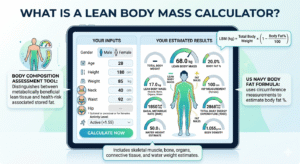
A Lean Body Mass Calculator is a body composition assessment tool that estimates the weight of all non-fat tissue in your body — including skeletal muscle, bone, organs, connective tissue, and body water — by subtracting estimated fat mass from total body weight. The Lean Body Mass Calculator produces a more physiologically complete picture of your body’s composition than BMI alone, distinguishing between the metabolically beneficial lean tissue and the excess stored fat that is associated with health risk.
Lean Body Mass (LBM) is calculated as: LBM (kg) = Total Body Weight × (1 − Body Fat% / 100)
Our Lean Body Mass Calculator uses the US Navy body fat formula to estimate body fat percentage from circumference measurements — then applies this percentage to total body weight to calculate LBM, fat mass, and all subsequent derived metrics.
Eight inputs are accepted by the Lean Body Mass Calculator:
- Gender — Male or Female (determines which circumference formula is applied)
- Age — Used for BMR calculation (Mifflin-St Jeor formula)
- Height (cm) — Critical denominator in the US Navy fat formula
- Weight (kg) — Total body weight from which LBM is derived
- Neck circumference (cm) — Lean tissue proxy; thicker neck reduces estimated fat percentage
- Waist circumference (cm) — Primary adiposity indicator; wider waist increases estimated fat percentage
- Hip circumference (cm) — Female-only fat distribution indicator (not used in male formula)
- Activity Level — Sedentary (×1.2) or Active (×1.55) for TDEE calculation
Eight result metrics are produced by the Lean Body Mass Calculator: Lean Body Mass, Body Fat %, Fat Mass, Hip Measurement, Basal Metabolic Rate, Total Daily Energy, Water Weight Estimate, and Body Density.
Why Lean Body Mass Matters More Than Total Body Weight
The fundamental reason the Lean Body Mass Calculator provides more useful information than a simple scale weight:
Lean Mass Is Metabolically Active — Fat Tissue Is Not: Skeletal muscle, the largest component of lean body mass, consumes approximately 13 kcal/kg/day at rest — the primary determinant of resting metabolic rate. Every kilogram of lean mass you carry requires more calories to maintain, directly elevating your BMR and making caloric balance management easier. Fat tissue, by contrast, consumes only approximately 4.5 kcal/kg/day — less than one-third the metabolic demand of lean tissue. The Lean Body Mass Calculator quantifies how much of your body weight is metabolically expensive lean tissue versus metabolically inert fat — a distinction with profound practical implications for caloric planning.
Scale Weight Confounds Muscle and Fat: A person who loses 5 kg of fat while gaining 2 kg of muscle has made significant health and fitness progress — but will show only 3 kg of scale weight loss. Without a Lean Body Mass Calculator, this progress is dramatically underrepresented. Conversely, a person who loses 5 kg of muscle (from crash dieting) while maintaining fat mass shows 5 kg of scale loss but has moved in the wrong direction metabolically. The Lean Body Mass Calculator separates these confounded changes, revealing actual body composition progress that scale weight alone obscures.
LBM Predicts Metabolic Health Better Than BMI: BMI (weight ÷ height²) cannot distinguish between a lean, muscular person and an overfat person of identical weight and height. A muscular athlete may have an “overweight” BMI while the Lean Body Mass Calculator reveals excellent body composition — high LBM, low fat mass, and body fat well within healthy ranges. Conversely, a “normal” BMI can coexist with very low lean mass and high fat mass in older adults with sarcopenic obesity — a condition the Lean Body Mass Calculator identifies that BMI entirely misses.
LBM Is the Anchor for Personalised Nutrition: Protein requirements, caloric needs, and macro targets are all more accurately based on LBM than total body weight. Using your Lean Body Mass Calculator result to calculate protein intake (1.6 to 2.2 g per kg LBM) produces a target that properly reflects the lean tissue you are trying to build or preserve — rather than including the body fat mass that has no protein requirement.
The US Navy Body Fat Formula – The Science Behind the Lean Body Mass Calculator
Our Lean Body Mass Calculator applies the US Navy body composition method — a validated, widely used circumference-based body fat estimation method developed by Hodgdon and Beckett (1984) for the US Navy Physical Readiness Programme:
Male Formula: Body Fat % = 495 / [1.0324 − (0.19077 × log₁₀(Waist − Neck)) + (0.15456 × log₁₀(Height))] − 450
Female Formula: Body Fat % = 495 / [1.29579 − (0.35004 × log₁₀(Waist + Hip − Neck)) + (0.22100 × log₁₀(Height))] − 450
Why the Lean Body Mass Calculator uses circumference measurements rather than skinfold calipers:
Skinfold-based body fat estimation (Jackson-Pollock method) requires trained assessors, precise caliper placement at multiple anatomical sites, and carries significant inter-rater variability. The US Navy method used in the Lean Body Mass Calculator requires only a tape measure — producing estimates that are accurate to within approximately 3% to 4% of DEXA (dual-energy X-ray absorptiometry) measurements when circumferences are taken correctly, with the significant practical advantage of being self-administered at any time without equipment.
The physiological logic of the formula inputs:
Waist circumference is the primary adiposity indicator — the waist is where most metabolically active visceral fat is stored, and a larger waist relative to height strongly predicts higher total and visceral body fat. The Lean Body Mass Calculator correctly gives waist circumference the dominant positive coefficient in the body fat formula — increasing estimated fat percentage as waist size increases.
Neck circumference is a lean mass proxy — a thicker neck reflects greater lean tissue development (particularly in the sternocleidomastoid and trapezius muscles) and inversely predicts body fat. The Lean Body Mass Calculator applies neck circumference as a negative contributor in the formula — a thicker neck reduces the estimated fat percentage for the same waist measurement.
Hip circumference (females only) captures the gynoid fat distribution pattern characteristic of female body composition — fat stored in the hips and thighs that the male formula does not account for. Including hip circumference in the female Lean Body Mass Calculator formula significantly improves accuracy for women by capturing a major fat storage depot not reflected in waist circumference alone.
How Our Lean Body Mass Calculator Works Step by Step
Using the Lean Body Mass Calculator requires eight measurements:
Step One – Select Gender: Choose Male or Female. Gender selection determines which US Navy formula variant the Lean Body Mass Calculator applies — the male formula uses waist and neck only, while the female formula includes hip circumference. Selecting the correct gender is essential; the male formula will significantly underestimate body fat in women if accidentally selected.
Step Two – Enter Age: Enter your age in whole years. Age is used exclusively in the Mifflin-St Jeor BMR formula — it does not affect the US Navy body fat calculation. Age affects the BMR result from the Lean Body Mass Calculator through the −5 × Age term in the Mifflin-St Jeor formula.
Step Three – Enter Height: Enter your height in centimetres. Height is a key denominator in the US Navy formula — taller individuals have a higher proportion of lean tissue for any given circumference measurement, and the formula accounts for this through the log₁₀(Height) term. Use your actual measured height, not an approximation.
Step Four – Enter Weight: Enter your current body weight in kilograms. Weight is the multiplier applied to the body fat percentage estimate to calculate lean body mass and fat mass — it is not directly used in the body fat formula itself, but determines the absolute values of both LBM and fat mass in the Lean Body Mass Calculator results.
Step Five – Take Circumference Measurements:
Neck: Measure around the neck just below the larynx (Adam’s apple), keeping the tape horizontal. Do not compress the soft tissue — maintain light tape contact.
Waist (male): Measure at the narrowest point of the abdomen — typically at or slightly above the navel. For the most accurate Lean Body Mass Calculator results, measure in the morning before eating, after exhaling normally (do not suck in the abdomen).
Waist (female): Measure at the narrowest point between the rib cage and hips — typically 1 to 2 inches above the navel.
Hip (female only): Measure at the widest point of the hips and buttocks — typically at the level of the greater trochanter (hip bone prominence). Keep the tape horizontal and parallel to the floor. This measurement is not used in the male Lean Body Mass Calculator formula.
Step Six – Select Activity Level: Choose Sedentary (×1.2) or Active (×1.55). This multiplier is applied to your BMR in the Lean Body Mass Calculator to calculate Total Daily Energy Expenditure — your practical daily calorie target. Sedentary covers desk jobs and minimal exercise; Active covers regular exercise three to five times per week.
Understanding Every Result from the Lean Body Mass Calculator
The Lean Body Mass Calculator produces eight result metrics, each providing a distinct body composition data point:
Lean Body Mass: The primary output of the Lean Body Mass Calculator — the weight of all non-fat tissue in kilograms. This single number is the most complete summary of your metabolically beneficial body composition, combining skeletal muscle, bone density, organ mass, and body water into one figure that determines your resting metabolic rate, protein requirement, and body recomposition progress potential.
Body Fat %: The estimated percentage of total body weight represented by fat tissue — calculated from the US Navy circumference formula. This is the context that gives your Lean Body Mass Calculator result meaning: a lean body mass of 55 kg in a 65 kg body (15.4% fat) represents very different physiology from 55 kg LBM in an 80 kg body (31.3% fat). Body fat percentage is the ratio that the Lean Body Mass Calculator provides to contextualise both the LBM and fat mass results.
Fat Mass: Calculated as Total Weight − Lean Body Mass. This is the absolute weight of body fat in kilograms — the component the Lean Body Mass Calculator subtracted from total weight to reveal LBM. Fat mass includes both essential fat (necessary for hormone production, organ cushioning, and insulation — approximately 3% to 5% in men, 10% to 13% in women) and storage fat (the excess deposited in adipose tissue beyond essential needs).
Hip Measurement: Your entered hip circumference displayed as a confirmed reference value. For female users, hip circumference is one of the three critical inputs that determine the accuracy of the Lean Body Mass Calculator’s body fat estimate — displayed here for verification that the correct measurement was entered.
Basal Metabolic Rate: Calculated using the Mifflin-St Jeor formula (10 × Weight + 6.25 × Height − 5 × Age ± gender offset). The BMR from the Lean Body Mass Calculator represents the calories your body burns per day at complete rest — the metabolic floor below which sustained caloric intake should not fall. Higher lean body mass produces a higher BMR, reflecting the elevated resting energy demand of greater metabolically active tissue.
Total Daily Energy: BMR × Activity Multiplier (1.2 for Sedentary, 1.55 for Active). This is your practical daily maintenance calorie target — the number of calories needed to maintain your current body weight at your current activity level. The Lean Body Mass Calculator provides this as a direct practical application of your body composition data — connecting LBM, BMR, and activity level into a single actionable caloric figure.
Water Weight Estimate: Calculated as LBM × 0.73. Approximately 73% of lean body mass is water — a physiological constant reflecting the water content of muscle tissue (approximately 75% water), bone (approximately 31% water), and organs (variable, averaging approximately 70% to 80% water). The water weight estimate from the Lean Body Mass Calculator shows how much of your total body weight is body water — contextualising the normal daily weight fluctuations (1 to 2 kg) that primarily reflect hydration changes rather than fat or muscle changes.
Body Density: Calculated as 1.1 − (Body Fat% / 100). Body density reflects the ratio of dense lean tissue to less dense fat tissue in your body composition. Lean tissue (muscle: ~1.06 g/cm³, bone: ~1.85 g/cm³) is denser than fat tissue (~0.9 g/cm³). The body density result from the Lean Body Mass Calculator is the underlying physical variable from which the Siri equation originally derived body fat percentage — with higher density indicating greater lean tissue proportion.
Lean Body Mass – Your Metabolically Active Weight
Lean body mass is the most important single number in body composition assessment — and understanding what it comprises helps you interpret your Lean Body Mass Calculator result:
Skeletal Muscle (approximately 40% to 50% of LBM): The largest single component of LBM and the one most responsive to training interventions. Each kilogram of skeletal muscle burns approximately 13 kcal/day at rest — making muscle the primary driver of resting metabolic rate. The Lean Body Mass Calculator provides the LBM foundation from which muscle-specific changes can be tracked over training programmes.
Bone Mineral Mass (approximately 15% of LBM): Bone contributes significantly to LBM — the skeleton of a 70 kg adult typically weighs 3 to 4 kg. Dense, mineralised bone reflects adequate calcium intake, vitamin D status, and mechanical loading through weight-bearing exercise. Changes in bone density affect the Lean Body Mass Calculator result — osteoporosis reduces LBM not through muscle loss but through reduced bone mineral content.
Organs (approximately 15% to 25% of LBM): The brain, liver, heart, kidneys, lungs, and intestines constitute a substantial proportion of lean mass. The liver alone — the most metabolically active organ — weighs approximately 1.5 kg and accounts for approximately 20% of resting metabolic rate. Organ mass changes relatively little with diet and exercise (except in cases of organ atrophy from severe malnutrition) — it is the skeletal muscle component that responds most dramatically to training and nutrition interventions tracked by the Lean Body Mass Calculator.
Body Water (approximately 60% to 70% of LBM): The largest single constituent of lean body mass. The Lean Body Mass Calculator’s Water Weight estimate (LBM × 0.73) reflects this dominant water content. Normal daily weight fluctuations of 1 to 2 kg primarily reflect changes in total body water — from sweat loss, food and fluid intake, glycogen fluctuation, and menstrual cycle changes — rather than changes in fat or muscle tissue.
Body Fat Percentage – What the Numbers Mean for Men and Women
The Body Fat % result from the Lean Body Mass Calculator should be interpreted against established clinical reference ranges:
Body Fat Reference Ranges for Men:
| Category | Body Fat % |
|---|---|
| Essential Fat | 3% to 5% |
| Athletic | 6% to 13% |
| Fitness | 14% to 17% |
| Average | 18% to 24% |
| Obese | 25% and above |
Body Fat Reference Ranges for Women:
| Category | Body Fat % |
|---|---|
| Essential Fat | 10% to 13% |
| Athletic | 14% to 20% |
| Fitness | 21% to 24% |
| Average | 25% to 31% |
| Obese | 32% and above |
Why women carry higher essential body fat: Women require 10% to 13% essential body fat (vs. 3% to 5% in men) to support reproductive function, hormonal regulation, and pregnancy energy reserves. This biological necessity means that the Lean Body Mass Calculator’s body fat results must be interpreted with sex-specific ranges — a woman at 22% body fat is in the Fitness category, while a man at 22% is in the Average category. The same number represents different physiological states across genders.
The most actionable body fat targets: For most adults, a body fat percentage in the Fitness or Athletic range from the Lean Body Mass Calculator represents the best combination of metabolic health, physical performance, and sustainability. Extremely low body fat (near essential levels) is appropriate only for competitive athletes during competition phases and carries health risks if maintained long-term.
Basal Metabolic Rate and Lean Body Mass – The Critical Connection
The BMR result from the Lean Body Mass Calculator reveals the direct, quantifiable relationship between your lean tissue and your resting caloric needs:
How LBM drives BMR: Every kilogram of skeletal muscle in your LBM burns approximately 13 kcal/day at rest. Every kilogram of body fat burns only approximately 4.5 kcal/day. For a person with 60 kg LBM and 15 kg fat mass, this translates to approximately (60 × 13) + (15 × 4.5) = 847.5 kcal/day from these two tissue components alone — before accounting for organ metabolic activity. The Lean Body Mass Calculator’s BMR output quantifies this resting metabolic demand in total.
The muscle-building metabolic dividend: Building 5 kg of additional lean muscle mass — achievable over 6 to 12 months of consistent resistance training — increases resting daily caloric expenditure by approximately 65 kcal/day (5 × 13). Over a year, this 65 kcal/day increase represents approximately 23,725 additional kcal burned at rest — equivalent to approximately 3 kg of fat loss through metabolic rate elevation alone. Tracking this BMR increase over time using the Lean Body Mass Calculator quantifies the long-term metabolic return on your investment in muscle building.
Why crash dieting destroys the LBM-BMR relationship: Sustained caloric restriction below BMR forces the body to catabolise lean tissue alongside fat stores for energy. A 5 kg loss of lean mass reduces BMR by approximately 65 kcal/day — creating a lower metabolic rate that makes future fat loss progressively harder and weight regain after dieting virtually inevitable. The Lean Body Mass Calculator should be used to monitor LBM preservation during any caloric deficit — confirming that weight lost is predominantly fat rather than metabolically valuable lean tissue.
Total Daily Energy Expenditure from the Lean Body Mass Calculator
The Total Daily Energy result from the Lean Body Mass Calculator (BMR × Activity Multiplier) provides the practical caloric target for daily nutrition planning:
Sedentary (BMR × 1.2): Appropriate for individuals with desk jobs who engage in minimal planned exercise. The Lean Body Mass Calculator’s Sedentary TDEE represents the lowest realistic daily maintenance calorie target — consuming below this level for extended periods creates a deficit that will cause progressive lean mass loss in addition to fat loss.
Active (BMR × 1.55): Appropriate for individuals who exercise three to five times per week at moderate to vigorous intensity. At the Active multiplier, the Lean Body Mass Calculator’s TDEE reflects the significantly higher daily energy demand of regular exercise — and confirms why people who train regularly can eat substantially more than sedentary individuals at the same body weight without gaining fat.
Practical applications of the Lean Body Mass Calculator TDEE:
For fat loss: Subtract 300 to 500 kcal from your TDEE — this creates a sustainable deficit without dropping below BMR.
For muscle gain: Add 250 to 400 kcal above your TDEE — this provides the surplus needed for muscle protein synthesis without excessive fat accumulation.
For maintenance: Eat at your TDEE — monitoring body weight and LBM over four to six weeks to confirm that the estimate is accurate for your individual metabolism.
Water Weight Estimate – How Much of Your LBM Is Fluid
The Water Weight result from the Lean Body Mass Calculator (LBM × 0.73) contextualises one of the most misunderstood aspects of body weight:
Why body water matters for Lean Body Mass Calculator interpretation: Normal body water fluctuates by 1 to 2 kg daily — and by up to 3 to 4 kg for women during the menstrual cycle (due to progesterone-driven fluid retention in the luteal phase). These fluctuations have no effect on fat mass or lean tissue mass — they are purely hydration changes. The Lean Body Mass Calculator provides the water weight estimate to help you understand that scale weight changes within this daily fluctuation range tell you nothing about fat or muscle changes.
Glycogen and water: Each gram of glycogen stored in muscle and liver binds approximately 3 to 4 grams of water. When carbohydrate intake is reduced (as in low-carbohydrate dieting), glycogen stores deplete and the associated water is excreted — producing rapid early weight loss of 1 to 3 kg that reflects water and glycogen loss, not fat loss. The Lean Body Mass Calculator’s water weight component helps quantify this glycogen-water component of lean body mass.
Body Density – The Physiology Behind the Fat Percentage Formula
The Body Density result from the Lean Body Mass Calculator (1.1 − Body Fat% / 100) provides the physical property underlying body fat estimation:
The Siri equation — the foundation of density-based fat estimation: The Siri two-compartment model (1956) established the mathematical relationship between body density and body fat percentage: Body Fat % = (4.95 ÷ Body Density − 4.50) × 100
This is precisely the formula structure used in the US Navy method (inverted) — where circumference measurements predict body density through the intervening logarithmic formula, and body density is then converted to body fat percentage. The Lean Body Mass Calculator’s body density output closes this calculation loop — showing the underlying density value that the fat percentage result was derived from.
Practical interpretation: A body density closer to 1.1 g/cm³ indicates high lean tissue proportion (muscle and bone are denser than fat). A lower body density (approaching 0.9 g/cm³) indicates higher fat proportion — since fat tissue at ~0.9 g/cm³ reduces overall body density toward its own value as its proportion of body composition increases.
Healthy Body Fat Ranges by Age and Gender
One important nuance of the Lean Body Mass Calculator results is that healthy body fat ranges shift with age:
Body fat increases with age at maintained body weight — even without dietary change or reduced exercise, body fat percentage typically increases by approximately 1% per decade after age 30, reflecting the gradual sarcopenia (age-related muscle loss) that occurs without resistance training intervention. The Lean Body Mass Calculator result at age 50 should be interpreted against age-adjusted reference ranges — slightly higher body fat percentages are physiologically normal and may even be protective (particularly in older women against osteoporosis risk).
Age-adjusted body fat interpretation guidance:
For adults over 60, the Lean Body Mass Calculator’s body fat results should be compared against senior reference ranges (typically 10% to 15% higher thresholds than younger adult ranges) — a 68-year-old woman with 35% body fat may be in the average range for her age cohort despite exceeding the standard adult threshold.
The most important age-related finding from the Lean Body Mass Calculator across all ages: a declining LBM over time is the primary concern, not a fixed body fat threshold — because sarcopenia is the metabolic risk that most affects quality of life, independence, and metabolic health in older adults.
How to Improve Your Lean Body Mass Calculator Results
Improving your Lean Body Mass Calculator results means increasing LBM and reducing fat mass simultaneously — a process known as body recomposition:
Resistance Training: Progressive resistance training (lifting progressively heavier loads) is the most powerful stimulus for lean muscle growth. Three to four resistance training sessions per week, targeting all major muscle groups, produces 0.5 to 1 kg of new LBM per month in untrained individuals — a rate that the Lean Body Mass Calculator can track and confirm through monthly measurements.
Protein Adequacy: Consume 1.6 to 2.2 grams of protein per kilogram of current LBM (using your Lean Body Mass Calculator result as the denominator) to support muscle protein synthesis. This protein target ensures that resistance training stimulus is matched by adequate building material for lean tissue growth.
Caloric Strategy: For body recomposition (simultaneous fat loss and muscle gain): eat at or slightly below TDEE (as calculated by the Lean Body Mass Calculator) with very high protein — this creates a modest fat-reducing deficit while providing adequate protein for muscle synthesis. For muscle-focused gaining: eat 250 to 400 kcal above TDEE. For fat-focused loss: eat 300 to 500 kcal below TDEE, maintaining high protein to preserve LBM.
Measurement Frequency: Retake circumference measurements and recalculate with the Lean Body Mass Calculator every four to six weeks during active body composition change. Monthly tracking reveals LBM trends that weekly scale weigh-ins cannot show — confirming progress, identifying plateaus, and validating whether your training and nutrition strategy is producing the intended body composition changes.
Body Composition vs. Body Weight – Why the Scale Misleads
The most common misapplication of body weight data — and the most important reason to use the Lean Body Mass Calculator:
The recomposition paradox: A person who starts a resistance training programme while slightly reducing calories may lose 2 kg of fat and gain 1.5 kg of muscle over six weeks — a dramatic improvement in body composition. Their scale weight drops only 0.5 kg. Without a Lean Body Mass Calculator assessment at the six-week mark, they might conclude the programme “isn’t working” and abandon it — losing the significant progress their body composition actually reflects.
The crash diet problem: A person who severely restricts calories for eight weeks may lose 6 kg — but the Lean Body Mass Calculator reveals that 3 kg is fat loss and 3 kg is lean muscle loss. Their scale shows impressive progress while their metabolism and body composition have deteriorated significantly. Their lower BMR (from lean mass loss) makes future fat loss harder and weight regain more likely — a cycle that the Lean Body Mass Calculator can identify before it becomes entrenched.
Use both together: Scale weight combined with Lean Body Mass Calculator results gives you the complete picture — total weight change contextualised by what is changing (fat, muscle, or water). This combination is the gold standard for intelligent body composition management and the reason the Lean Body Mass Calculator is an indispensable tool for anyone serious about fitness, health, or body composition improvement.
Frequently Asked Questions (FAQs)
What is a Lean Body Mass Calculator? A Lean Body Mass Calculator is a body composition tool that estimates lean body mass (total non-fat weight), body fat percentage, and fat mass using the US Navy circumference formula — providing a more complete picture of body composition than scale weight or BMI alone.
How accurate is the Lean Body Mass Calculator? The US Navy formula in our Lean Body Mass Calculator is accurate to within approximately 3% to 4% of DEXA scan measurements when circumferences are measured correctly. For most practical fitness and nutrition planning purposes, this level of accuracy is clinically adequate and significantly more informative than scale weight alone.
What is a healthy lean body mass? Healthy LBM varies with gender, height, and age. The Lean Body Mass Calculator’s body fat percentage result provides the most useful benchmark — compare it against the age and gender-specific ranges (Athletic 6–13% for men, 14–20% for women; Fitness 14–17% for men, 21–24% for women) rather than a fixed LBM weight.
How often should I use the Lean Body Mass Calculator? Every four to six weeks during active body composition change. Retaking measurements and recalculating with the Lean Body Mass Calculator monthly provides meaningful trend data — confirming whether training and nutrition are producing the intended LBM gains and fat reductions.
Why does the Lean Body Mass Calculator need neck and waist circumference? The US Navy formula uses these measurements as proxies for lean tissue (neck) and fat tissue (waist). A larger waist relative to height and neck circumference indicates higher body fat — the formula translates these anatomical proportions into body fat percentage estimates without requiring expensive equipment.
Can I improve my Lean Body Mass Calculator results without losing scale weight? Yes — body recomposition (simultaneous muscle gain and fat loss) can significantly improve Lean Body Mass Calculator results while keeping scale weight relatively stable. As fat mass decreases and lean mass increases, the LBM rises and body fat percentage falls even if total weight changes minimally.
Does the Lean Body Mass Calculator account for bone density? The US Navy formula in the Lean Body Mass Calculator assumes standard bone density for the two-compartment body composition model. Individuals with significantly above or below average bone density (elite athletes with higher bone density; individuals with osteoporosis) may see slightly less accurate results.
Conclusion
Your body weight is the sum of two very different things — lean tissue that sustains your metabolism, powers your movement, and supports your health, and fat mass that, in excess, creates metabolic risk and burdens the systems that lean tissue powers. The Lean Body Mass Calculator separates these two components with precision and provides the eight-metric body composition profile that gives every fitness and nutrition decision a scientifically valid foundation.
Our free Lean Body Mass Calculator combines the US Navy body fat formula, the Mifflin-St Jeor BMR equation, and body density calculations to produce lean body mass, body fat percentage, fat mass, BMR, TDEE, water weight estimate, body density, and hip measurement reference — all from eight accessible biometric inputs including circumference measurements you can take yourself with a tape measure.
Whether you are tracking muscle-building progress, managing a fat loss phase, assessing the effectiveness of a body recomposition programme, or simply trying to understand your body better than a scale number allows — the Lean Body Mass Calculator provides the body composition intelligence that transforms vague intentions into measurable, optimisable outcomes.
Use our Lean Body Mass Calculator today. Measure your LBM. Know your fat mass. Calculate your true metabolic needs. And build the lean, metabolically healthy body that scale weight alone could never show you.