Logarithm Calculator
Solve quadratic equations instantly with our fast and accurate Quadratic Formula Calculator
Table of Contents
- Introduction
- What Is a Log Calculator?
- Understanding Logarithms – The Basic Concept
- Types of Logarithms You Must Know
- The Logarithm Formula Explained
- How to Use a Log Calculator Step by Step
- Common Logarithm vs Natural Logarithm
- Real-Life Applications of a Log Calculator
- Properties of Logarithms You Should Remember
- Tips for Using a Log Calculator Effectively
- Common Mistakes to Avoid
- Why a Digital Log Calculator Is Better Than Manual Calculation
- Frequently Asked Questions (FAQs)
- Conclusion
Introduction
Logarithms are one of the most important and widely used concepts in mathematics, science, engineering, and technology. Yet for many students and professionals, they remain one of the trickiest topics to master. That is exactly why a Log Calculator is such an essential tool in today’s digital world. Whether you are a student solving exam problems, a scientist analyzing data, or an engineer working on complex calculations, a Log Calculator saves you time, eliminates errors, and delivers precise results instantly.
A Log Calculator takes away the burden of manual logarithmic computation and replaces it with a fast, accurate, and user-friendly experience. You simply enter the base and the number, press calculate, and get your answer along with a step-by-step breakdown of the formula used.
In this complete guide, we will cover everything you need to know about logarithms and how to use a Log Calculator like a professional. From the basic definition of a logarithm to advanced real-world applications, this article will give you a thorough understanding of why this tool is so valuable and how to make the most of it. Let us begin.
What Is a Log Calculator?
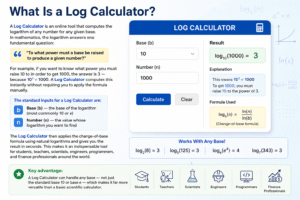
A Log Calculator is an online tool that computes the logarithm of any number for any given base. In mathematics, the logarithm answers one fundamental question: “To what power must a base be raised to produce a given number?”
For example, if you want to know what power you must raise 10 to in order to get 1000, the answer is 3 — because 10³ = 1000. A Log Calculator computes this instantly without requiring you to apply the formula manually.
The standard inputs for a Log Calculator are:
- Base (b) — the base of the logarithm (most commonly 10 or e)
- Number (n) — the value whose logarithm you want to find
The Log Calculator then applies the change-of-base formula using natural logarithms and gives you the result in seconds. This makes it an indispensable tool for students, teachers, scientists, engineers, programmers, and finance professionals around the world.
Key advantage: A Log Calculator can handle any base — not just the standard base 10 or base e — which makes it far more versatile than a basic scientific calculator.
Understanding Logarithms – The Basic Concept
Before using a Log Calculator, it is important to understand what a logarithm actually represents. The logarithm of a number is the exponent to which a fixed base must be raised to produce that number.
Written mathematically:
log_b(n) = x means b^x = n
In plain English: “The log base b of n equals x” simply means that b raised to the power x equals n.
For example:
- log₁₀(100) = 2 → because 10² = 100
- log₂(8) = 3 → because 2³ = 8
- log₅(25) = 2 → because 5² = 25
A Log Calculator handles all of these computations instantly, whether the base is 2, 5, 10, e, or any other valid positive number other than 1.
Important rule: The base must always be a positive number greater than zero and not equal to 1. The number you are taking the log of must also always be positive. Any Log Calculator will return an error if these conditions are not met.
Types of Logarithms You Must Know
When working with a Log Calculator, you will encounter three main types of logarithms. Understanding each type helps you choose the right mode and interpret your results correctly.
The common logarithm uses base 10 and is written simply as log(n) without explicitly stating the base. This is the most widely used logarithm in everyday mathematics, engineering, and the physical sciences.
- log(10) = 1
- log(100) = 2
- log(1000) = 3
The natural logarithm uses the mathematical constant e (approximately 2.71828) as its base and is written as ln(n). It is the most important logarithm in advanced mathematics, calculus, and scientific modeling.
- ln(1) = 0
- ln(e) = 1
- ln(e²) = 2
The binary logarithm uses base 2 and is written as log₂(n). It is extremely important in computer science, information theory, and digital systems.
- log₂(2) = 1
- log₂(4) = 2
- log₂(8) = 3
A powerful Log Calculator supports all three types and also allows you to enter any custom base, giving you complete control over your logarithmic computations.
The Logarithm Formula Explained
The Log Calculator uses the Change of Base Formula to compute logarithms for any base. This formula converts any logarithm into natural logarithms, which computers and calculators can calculate natively.
Change of Base Formula:
log_b(n) = ln(n) / ln(b)
Where:
- ln(n) is the natural logarithm of the number
- ln(b) is the natural logarithm of the base
Example: Calculate log₅(125)
- ln(125) ÷ ln(5) = 4.8283 ÷ 1.6094 = 3.0000
So log₅(125) = 3, which makes sense because 5³ = 125.
This is exactly the formula that every Log Calculator applies behind the scenes. When the calculator shows you its step-by-step breakdown, you will see this formula in action, which helps you understand and verify the result independently.
How to Use a Log Calculator Step by Step
Using a Log Calculator is simple and fast. Follow these steps for accurate results every time:
Type the base value into the first input field. The base must be a positive number greater than zero and must not equal 1. The default base in most calculators is 10 (common log). For natural log, change the base to e (2.71828).
Type the number whose logarithm you want to calculate into the second input field. This number must always be greater than zero. Logarithms of zero or negative numbers do not exist in the real number system.
Press the “Calculate” button. The Log Calculator will instantly apply the change-of-base formula and display:
- The formula used
- The step-by-step calculation
- The final result rounded to the required decimal places
Do not just read the final answer — study the steps. The step-by-step breakdown shows you exactly how the answer was derived. This is invaluable for learning and for verifying your own manual calculations.
If you want to perform a new calculation, press the “Clear” button to reset all fields and start fresh. A reliable Log Calculator resets everything cleanly so there is no confusion between different calculations.
Common Logarithm vs Natural Logarithm
One of the most frequently asked questions about the Log Calculator is the difference between common log and natural log. Here is a clear side-by-side comparison:
| Feature | Common Logarithm (log) | Natural Logarithm (ln) |
|---|---|---|
| Base | 10 | e ≈ 2.71828 |
| Notation | log(n) | ln(n) |
| Used in | Engineering, physics, everyday math | Calculus, growth/decay models, finance |
| log(1) | 0 | 0 |
| log(base itself) | log(10) = 1 | ln(e) = 1 |
| Most common in | Science and education | Advanced mathematics |
A good Log Calculator handles both types seamlessly — simply change the base between 10 and e to switch between common and natural logarithm calculations.
Real-Life Applications of a Log Calculator
The Log Calculator is not just a classroom tool — it has profound real-world applications across dozens of professional fields.
The pH scale is a direct application of logarithms. pH = -log[H⁺], where [H⁺] is the concentration of hydrogen ions. A Log Calculator helps chemists and biologists determine the acidity or alkalinity of a solution with precision.
The Richter scale uses base-10 logarithms to measure earthquake intensity. Each whole number increase on the Richter scale represents a tenfold increase in amplitude. Scientists use a Log Calculator to convert seismic wave data into Richter scale values.
Logarithms are essential in finance for calculating compound interest, doubling time, and investment growth. The formula t = ln(A/P) / (n × ln(1 + r/n)) uses natural logarithms to find the time required for an investment to reach a target value.
Binary logarithms (base 2) are fundamental in computer science. The time complexity of binary search is O(log n), meaning a Log Calculator is directly relevant when analyzing algorithm efficiency. Data scientists and software engineers use logarithmic calculations daily.
Sound intensity is measured in decibels using logarithms: dB = 10 × log(I/I₀). A Log Calculator helps audio engineers and acousticians convert between sound intensity and decibel levels quickly and accurately.
Astronomers measure the brightness of stars using the magnitude scale, which is logarithmic. A Log Calculator enables astronomers to compare stellar brightness values and convert flux measurements into magnitude differences.
Properties of Logarithms You Should Remember
Understanding the key properties of logarithms makes you a better user of the Log Calculator because you can simplify expressions before entering them.
- Product Rule: log_b(m × n) = log_b(m) + log_b(n)
- Quotient Rule: log_b(m ÷ n) = log_b(m) – log_b(n)
- Power Rule: log_b(m^p) = p × log_b(m)
- Identity Rule: log_b(b) = 1 always
- Zero Rule: log_b(1) = 0 always
- Change of Base: log_b(n) = log_c(n) / log_c(b)
Memorizing these six properties will help you break complex logarithmic expressions into simpler components that can each be evaluated individually using a Log Calculator.
Tips for Using a Log Calculator Effectively
To get the maximum benefit from a Log Calculator, keep these practical tips in mind:
- Always verify that your base is valid — it must be positive and not equal to 1. An invalid base will cause the calculator to return an error.
- Make sure your number is positive — logarithms of zero and negative numbers are undefined in the real number system.
- Use the step-by-step output to learn — do not just copy the answer. Understanding the process makes you a stronger mathematician.
- Simplify using log properties first — use the product, quotient, and power rules to simplify complex expressions before entering them into the Log Calculator.
- Switch between base 10 and base e freely — most calculators default to base 10, but changing to e instantly gives you the natural log.
- Double-check your inputs before pressing calculate, especially when working with large or decimal numbers.
Common Mistakes to Avoid
Even when using a reliable Log Calculator, users often make errors in setup or interpretation. Here are the most common mistakes and how to fix them:
The most common mistake is entering a zero or negative number as the input. Remember: logarithms are only defined for positive real numbers. If your answer seems wrong, check your number input first.
A base of 1 makes the logarithm undefined because 1 raised to any power always equals 1 — it can never produce a different number. A base must be a positive number not equal to 1. Any quality Log Calculator will flag this as invalid.
Many students mix up log (base 10) and ln (base e) and get answers that are off by a constant factor. Always confirm which base your problem requires before using the Log Calculator.
The result of a Log Calculator is an exponent, not a simple multiplier. If log₁₀(1000) = 3, this means 10 must be raised to the power of 3 to get 1000 — not that 1000 is 3 times something.
Skipping the step-by-step output is a wasted opportunity. The breakdown shows you the formula and the values plugged in, which helps you spot any input errors and reinforces your understanding of the calculation.
Why a Digital Log Calculator Is Better Than Manual Calculation
There are compelling reasons to always use a Log Calculator digitally rather than computing logarithms by hand:
- Speed — What takes minutes by hand is done in milliseconds by the calculator.
- Accuracy — Human errors in multi-step logarithmic arithmetic are eliminated completely.
- Handles any base — Unlike a basic scientific calculator that only does log₁₀ and ln, a dedicated Log Calculator accepts any custom base.
- Educational value — The step-by-step breakdown teaches you the process alongside delivering the result.
- Always available — A web-based Log Calculator works 24/7 on any device with no downloads or installation required.
- Handles extreme values — Very large or very small numbers that are impractical to compute manually are handled effortlessly.
Every student, engineer, scientist, and data professional should have a reliable Log Calculator bookmarked for instant access when logarithmic calculations arise.
Frequently Asked Questions (FAQs)
What is a Log Calculator used for?
A Log Calculator is used to compute the logarithm of any number for any given base. It is used in mathematics, science, engineering, finance, computer science, and many other fields where exponential relationships and logarithmic scales are involved.
What base should I use in the Log Calculator?
The base depends on your problem. Use base 10 for common logarithms (standard in science and education), use base e (2.71828) for natural logarithms (used in calculus and growth/decay models), and use base 2 for binary logarithms (used in computer science). The Log Calculator supports all these bases and any custom base you enter.
Why does the Log Calculator return an error for my input?
An error usually means one of three things: your base is less than or equal to zero, your base equals 1, or your number is less than or equal to zero. All three conditions make the logarithm undefined. Correct your inputs and the Log Calculator will compute the result normally.
Is the Log Calculator free to use?
Yes. Most online versions of the Log Calculator are completely free, require no registration or subscription, and work directly in any modern web browser on any device.
Can a Log Calculator handle decimal bases and decimal numbers?
Absolutely. A Log Calculator works with any valid positive decimal base and any positive decimal number. For example, you can calculate log₂.₅(7.3) without any issue — the calculator handles it using the change-of-base formula automatically.
What is the difference between log and ln?
log typically refers to base-10 logarithm (common log), while ln refers to the base-e natural logarithm. They are both logarithms — just with different bases. The Log Calculator allows you to switch between them by simply changing the base value.
Can I use the Log Calculator for exam preparation?
Yes, it is an excellent exam preparation tool. Students preparing for SAT, ACT, GRE, engineering entrance exams, or university-level mathematics can use the Log Calculator to practice problems, verify answers, and learn the step-by-step process used in logarithmic computation.
What is the Change of Base Formula?
The Change of Base Formula is: log_b(n) = ln(n) / ln(b). It converts any logarithm to natural logarithms, which calculators can compute natively. Every Log Calculator uses this formula internally to calculate logarithms for any base.
Conclusion
A Log Calculator is one of the most practical and powerful mathematical tools available online today. It transforms complex logarithmic calculations into instant, accurate, and easy-to-understand results. Whether you are computing the pH of a chemical solution, analyzing the time complexity of a sorting algorithm, calculating compound interest, or simply solving a textbook problem, the Log Calculator gives you a fast and reliable answer every time.
Logarithms appear everywhere in the real world — from earthquake measurements and sound intensity to population growth models and data compression algorithms. Having a dependable Log Calculator at your fingertips means you are always equipped to handle these calculations with confidence.
The step-by-step breakdown provided by the Calculator does more than just give you the answer — it teaches you the process, reinforces your understanding of the underlying mathematics, and helps you verify your own manual calculations. This makes it a learning tool as much as a computation tool.
Whether you are a beginner just learning what a logarithm is or an experienced professional who needs quick and precise logarithmic values, the Log Calculator is your most efficient and trustworthy companion. Use it regularly, understand the steps it shows you, and let it power your mathematical work with speed, precision, and clarity.