Solve right triangle problems instantly with our fast and easy Right Triangle Calculator
Table of Contents- Introduction
- What is Least Common Multiple (LCM)?
- What is a Least Common Multiple Calculator?
- Why Use a Least Common Multiple Calculator?
- Understanding the Input Field
- How the Least Common Multiple Calculator Works
- Step-by-Step Guide to Using the Calculator
- Mathematics Behind LCM
- Methods of Finding LCM
- LCM Using Prime Factorization
- LCM Using the GCD Relationship
- LCM of Two, Three, or More Numbers
- Difference Between LCM and HCF (GCD)
- Real-World Applications of LCM
- Common Mistakes to Avoid
- Tips for Teachers and Students
- Frequently Asked Questions
- Conclusion
Introduction
Mathematics is full of concepts that look complex at first but become simple once you understand the right tools. One such concept is finding the Least Common Multiple (LCM) of two or more numbers. Whether you are a student solving homework, a teacher preparing lessons, or a professional working with ratios, schedules, or fractions, the Least Common Multiple Calculator is one of the most useful tools you can have at your fingertips.
This article is a complete, in-depth guide that explains everything about LCM, the calculator that computes it, the math behind it, real-life uses, and step-by-step instructions. By the end of this guide, you will not only understand how the Least Common Multiple Calculator works but also how to apply LCM in real-world problems with confidence.
What is Least Common Multiple (LCM)?
The Least Common Multiple, often abbreviated as LCM, is the smallest positive number that is divisible by two or more given numbers. In simpler terms, it is the smallest number that appears in the multiplication tables of all the given numbers.
For example, the LCM of 4 and 6 is 12, because 12 is the smallest number that both 4 and 6 divide evenly into. Multiples of 4 are 4, 8, 12, 16, 20… and multiples of 6 are 6, 12, 18, 24… The first common number is 12, which is the LCM.
LCM is a foundational concept in arithmetic, algebra, number theory, and many real-life calculations like scheduling, fractions, and engineering.
What is a Least Common Multiple Calculator?
A Least Common Multiple Calculator is an online tool that automatically computes the LCM of two or more numbers within seconds. Instead of manually listing multiples or factoring numbers, the calculator does all the work instantly and accurately.
Our Least Common Multiple Calculator accepts numbers separated by commas, processes them using mathematical algorithms, and returns the smallest common multiple of the entered values. It eliminates the chances of human error and saves time, especially when working with large numbers or multiple values at once.
A Least Common Multiple Calculator is a mathematical tool that helps users quickly find the Least Common Multiple (LCM) of two or more numbers. The Least Common Multiple is the smallest positive number that is exactly divisible by all the given numbers without leaving a remainder. Instead of manually performing multiple calculations, a Least Common Multiple Calculator automatically determines the correct LCM and provides a clear, step-by-step explanation of the process.
Finding the Least Common Multiple is one of the most important concepts in arithmetic and number theory. It is commonly used when working with fractions, ratios, multiples, schedules, measurements, algebraic equations, and various real-world mathematical problems. Because calculating the LCM manually can become difficult when dealing with large numbers or multiple values, a Least Common Multiple Calculator offers a faster and more accurate solution.
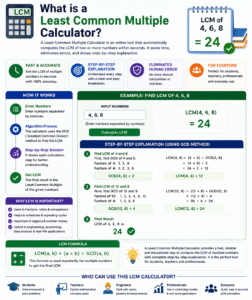
This Least Common Multiple Calculator allows users to enter multiple numbers separated by commas and instantly calculates their LCM. The calculator uses the Greatest Common Divisor (GCD) method to simplify the calculation process. By comparing numbers one at a time, determining their common divisors, and applying the LCM formula, the tool generates an accurate result while displaying each calculation step in an easy-to-understand format.
One of the most valuable features of this Least Common Multiple Calculator is its step-by-step breakdown. Rather than simply showing the final answer, the calculator explains how the result was obtained. Users can see the GCD calculation, intermediate LCM values, and the progression toward the final Least Common Multiple. This makes the tool particularly useful for students who want to learn the concept rather than just obtain an answer.
The calculator follows the standard mathematical formula:
LCM(a, b) = (a × b) ÷ GCD(a, b)
Using this formula repeatedly for multiple numbers, the Least Common Multiple Calculator efficiently computes the final LCM while ensuring maximum accuracy. This approach reduces calculation errors and saves significant time compared to performing the process manually.
A Least Common Multiple Calculator is widely used in educational, professional, and practical applications. Students use it to solve homework problems and prepare for mathematics exams. Teachers use it to demonstrate number theory concepts in the classroom. Engineers, accountants, data analysts, and other professionals may also use LCM calculations when working with repetitive cycles, scheduling tasks, or solving mathematical models.
Another major advantage of a Least Common Multiple Calculator is convenience. Manual LCM calculations often require creating multiplication tables, listing multiples, or performing repeated factorization. These methods can be time-consuming and confusing, especially when dealing with several numbers simultaneously. By automating the process, the calculator delivers accurate results within seconds and eliminates unnecessary effort.
This Least Common Multiple Calculator is ideal for anyone who wants fast, reliable, and educational mathematical solutions. Whether you are working with fractions, solving arithmetic problems, comparing repeating patterns, or studying number theory, the tool provides a simple and effective way to calculate the Least Common Multiple.
In today’s digital learning environment, tools that combine accuracy, speed, and educational value are essential. A Least Common Multiple Calculator transforms a traditionally complex mathematical task into a simple and user-friendly experience. By calculating the LCM instantly and displaying detailed calculation steps, it helps users understand mathematical relationships while ensuring precise results every time.
Whether you are a student learning multiples, a teacher explaining mathematical concepts, or a professional solving numerical problems, this Least Common Multiple Calculator provides a dependable and efficient solution for finding the Least Common Multiple of multiple numbers quickly and accurately.
Why Use a Least Common Multiple Calculator?
Manual LCM calculations can be time-consuming and error-prone, especially when dealing with three or more numbers, or large values. Here is why a Least Common Multiple Calculator is essential:
- Speed: Get results in less than a second.
- Accuracy: No risk of arithmetic mistakes.
- Convenience: Works on any device with a browser.
- Educational Value: Helps students verify their manual answers.
- Handles Multiple Numbers: Compute LCM of 2, 3, 5, or even 10 numbers at once.
- Free and Accessible: Available 24/7 without any installation.
For students preparing for exams, teachers checking student work, or professionals dealing with ratios, frequencies, or cycles, this calculator is a reliable companion.
Understanding the Input Field
The interface of the Least Common Multiple Calculator is designed to be simple and beginner-friendly. It contains only one main input field:
Enter Numbers (comma separated) – In this field, you type the numbers for which you want to find the LCM. For example, you can type 4, 6, 8 or 12, 18, 24, 36. The calculator automatically parses each number and processes them together.
There are two action buttons below the input:
- Calculate Button – Performs the LCM calculation.
- Clear Button – Resets the input field so you can start fresh.
The clean layout ensures that even users with no technical background can use the tool effortlessly.
How the Least Common Multiple Calculator Works
Behind its simple interface, the Least Common Multiple Calculator uses powerful mathematical logic. It typically follows this workflow:
- Reads the input numbers entered by the user.
- Validates the values to ensure they are positive integers.
- Computes the GCD (Greatest Common Divisor) of each pair using the Euclidean Algorithm.
- Applies the formula: LCM(a, b) = (a × b) / GCD(a, b)
- Extends the calculation to multiple numbers by computing LCM step by step: LCM(a, b, c) = LCM(LCM(a, b), c).
- Displays the final result in the results panel.
This algorithm makes the calculator lightning-fast and mathematically reliable, even for very large numbers.
Step-by-Step Guide to Using the Calculator
Using the Least Common Multiple Calculator is extremely easy. Follow these steps:
Step 1: Open the calculator on your browser.
Step 2: Locate the input field labeled Enter Numbers (comma separated).
Step 3: Type the numbers you want, separated by commas. Example: 5, 10, 15.
Step 4: Click the green Calculate button.
Step 5: The result will appear instantly in the Results panel on the right.
Step 6: To start a new calculation, click the Clear button and enter new numbers.
That is all — no sign-up, no downloads, no complicated settings.
Mathematics Behind LCM
LCM is rooted in the theory of divisibility. Every positive integer can be expressed as a product of prime numbers — this is called prime factorization. The LCM of two or more numbers is the product of the highest powers of all prime numbers that appear in their factorizations.
For example:
- 12 = 2² × 3
- 18 = 2 × 3²
- LCM = 2² × 3² = 36
This principle ensures that the LCM is divisible by every input number, while remaining the smallest such value.
Methods of Finding LCM
There are several traditional methods to calculate LCM manually. The Least Common Multiple Calculator uses the most efficient one internally, but it is helpful to know all the techniques.
1. Listing Multiples Method: Write out multiples of each number and pick the smallest common one. Useful for small numbers.
2. Prime Factorization Method: Break each number into prime factors, then multiply the highest powers.
3. Division Method (Ladder Method): Divide all numbers by common primes step by step until only 1s remain.
4. GCD Method: Use the formula LCM(a, b) = (a × b) / GCD(a, b).
The calculator typically uses the GCD method because it is the fastest and most efficient for computers.
LCM Using Prime Factorization
This is one of the most reliable methods taught in schools. Let us calculate the LCM of 20 and 30:
- 20 = 2² × 5
- 30 = 2 × 3 × 5
- LCM takes the highest power of each prime: 2² × 3 × 5 = 60
So, the LCM of 20 and 30 is 60. The Least Common Multiple Calculator performs this kind of analysis automatically — but in a more optimized way using the GCD.
LCM Using the GCD Relationship
There is a beautiful relationship between LCM and GCD:
LCM(a, b) × GCD(a, b) = a × b
So if we know the GCD, we can easily compute the LCM. For example:
- GCD(12, 18) = 6
- LCM(12, 18) = (12 × 18) / 6 = 36
This method works for any size of numbers and is the engine behind most digital LCM calculators.
LCM of Two, Three, or More Numbers
The Least Common Multiple Calculator is not limited to two numbers — it can handle as many as you want. The process for multiple numbers is:
LCM(a, b, c, d) = LCM(LCM(LCM(a, b), c), d)
For example, LCM of 4, 6, 8:
- LCM(4, 6) = 12
- LCM(12, 8) = 24
- Final LCM = 24
This step-by-step pairing approach scales easily to large lists of numbers.
Difference Between LCM and HCF (GCD)
Students often confuse LCM with HCF (Highest Common Factor), also known as GCD.
- LCM = Smallest number divisible by all given numbers.
- HCF/GCD = Largest number that divides all given numbers.
For example, for 12 and 18:
- LCM = 36
- HCF = 6
Both are linked through the formula: a × b = LCM × HCF. While the Least Common Multiple Calculator focuses on LCM, understanding GCD helps you appreciate how it works internally.
Real-World Applications of LCM
LCM is not just a textbook concept — it is used in many real-life scenarios:
- Scheduling Events: Finding when two repeating events will occur together (like buses arriving at the same stop).
- Adding or Subtracting Fractions: LCM is used to find a common denominator.
- Gear and Machine Cycles: Engineers use LCM to predict when rotating gears align.
- Music and Rhythm: Beats and patterns sync based on LCM cycles.
- Construction and Tiling: Determining tile sizes that fit perfectly.
- Computer Science: Used in algorithms involving cycles and modular arithmetic.
So whenever you need to find a common rhythm, cycle, or measurement, the Least Common Multiple Calculator can help.
Common Mistakes to Avoid
Even with a calculator, users sometimes make small mistakes that affect results. Watch out for these:
- Entering Decimals: LCM is defined only for positive integers, not decimals.
- Using Negative Numbers: Always input positive whole numbers.
- Wrong Separators: Use commas, not spaces or dashes.
- Including Zero: LCM with zero is undefined — never include 0.
- Confusing LCM with GCD: Remember, LCM is the smallest common multiple, not the largest common divisor.
Avoiding these mistakes ensures accurate and meaningful results every time.
Tips for Teachers and Students
The Least Common Multiple Calculator is a fantastic educational aid. Here is how to make the most of it:
- For Students: Use it to verify your manual answers, not to skip learning the method.
- For Teachers: Use it to demonstrate concepts during live classes or design quick practice problems.
- For Parents: Help your children check homework with confidence.
- For Self-Learners: Practice with various number sets to strengthen number sense.
Combine the calculator with manual practice for the best learning outcomes.
Frequently Asked Questions
Q1: What is the LCM of 1 and any number? The LCM of 1 and any number n is always n, because every number is a multiple of 1.
Q2: Can the LCM be smaller than the largest number? No. The LCM is always equal to or greater than the largest input number.
Q3: Is the LCM Calculator free? Yes, the Least Common Multiple Calculator is completely free and unlimited.
Q4: Can I calculate LCM of more than two numbers? Yes, you can enter as many numbers as you want, separated by commas.
Q5: Does the calculator work on mobile devices? Absolutely. It is fully responsive and works on smartphones, tablets, and desktops.
Q6: Why is LCM important in fractions? Because adding or subtracting fractions requires a common denominator, which is usually the LCM of the denominators.
Q7: What happens if I enter 0? Mathematically, LCM with 0 is undefined, so avoid using 0 as an input.
Conclusion
The Least Common Multiple Calculator is an essential tool for students, teachers, engineers, and anyone working with numbers. It simplifies what would otherwise be a tedious calculation into a one-click process. From solving school problems to handling real-world scheduling, fraction operations, and engineering cycles, knowing the LCM is incredibly valuable — and having an automated calculator makes the process effortless.
By understanding both the manual methods and the logic behind the calculator, you build strong mathematical skills while enjoying the convenience of modern technology. Bookmark this tool, share it with classmates or colleagues, and let the Least Common Multiple Calculator become your go-to math companion for fast, accurate, and reliable results.
Whether you are a beginner exploring number theory or an advanced learner tackling complex problems, mastering LCM through this calculator will save you time, boost accuracy, and deepen your understanding of mathematics