Home Equity Loan Calculator
Calculate FHA loan payments, affordability, and home buying costs with our FHA Loan Calculator
Table of Contents
- Introduction
- What Is a Home Equity Loan Calculator?
- How Home Equity Works and Why It Matters
- Why You Should Always Use a Home Equity Loan Calculator Before Borrowing
- Key Inputs in a Home Equity Loan Calculator
- Understanding Loan-to-Value and Combined LTV Ratios
- Fees and Closing Costs You Must Account For
- How the Amortization Schedule Helps You Plan
- Debt-to-Income Ratio and Why Lenders Care About It
- When Is a Home Equity Loan the Right Choice?
- Home Equity Loan vs. HELOC – What Is the Difference?
- How to Use Our Home Equity Loan Calculator Step-by-Step
- Tips to Qualify for the Best Home Equity Loan Terms
- Frequently Asked Questions (FAQs)
- Conclusion
Introduction
Your home is more than just a place to live — it is a financial asset that builds value over time. As you pay down your mortgage and property values rise, you accumulate equity: the portion of your home that you truly own. That equity represents real, accessible wealth that can be put to work when you need it most.
A Home Equity Loan Calculator is the essential tool that helps you understand exactly how much you can borrow against your home, what it will cost, and whether the financial structure of that borrowing makes sense for your situation. Without running the numbers first, homeowners risk taking on more debt than they can comfortably manage — or missing out on a legitimate financial opportunity they did not realize they had.
In this complete guide, we will walk you through everything you need to know about home equity loans and how to use our free Home Equity Loan Calculator to make smart, confident borrowing decisions. You will learn how equity is calculated, what inputs the calculator requires, how lenders evaluate your eligibility, what fees to expect, and how to read the amortization schedule to understand your long-term repayment picture.
Whether you are funding a major home renovation, consolidating high-interest debt, covering education expenses, or handling a medical emergency, understanding your equity position starts with a reliable Home Equity Loan Calculator.
What Is a Home Equity Loan Calculator?
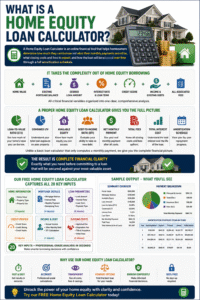
A Home Equity Loan Calculator is an online financial tool that helps homeowners determine how much they can borrow against the equity in their property, what their monthly payments would be, what closing costs and fees to expect, and how the loan will be repaid over time through a full amortization schedule.
It takes the complexity out of home equity borrowing by organizing all the critical financial variables — home value, existing mortgage balance, desired loan amount, interest rate, loan term, credit score, income, existing debts, and all associated fees — into one clear, comprehensive analysis.
Unlike a basic loan calculator that only computes a monthly payment, a proper Home Equity Loan Calculator gives you the full picture: your loan-to-value ratio, combined LTV, available equity, debt-to-income ratio, net monthly payment, total fees, total interest cost over the life of the loan, and year-by-year repayment progress through an amortization table.
The result is complete financial clarity — exactly what you need before committing to a loan that will be secured against your most valuable asset.
Our free Home Equity Loan Calculator captures all 20 key inputs across home value, mortgage details, loan parameters, credit profile, income, and closing costs — giving you a thorough, professional-grade analysis in seconds.
How Home Equity Works and Why It Matters
Before you can use a Home Equity Loan Calculator effectively, you need to understand what home equity actually is and how it is calculated.
Home equity is the difference between your home’s current market value and the total amount you still owe on any mortgages or liens against the property.
The formula is simple:
Home Equity = Current Home Value − Outstanding Mortgage Balance
For example, if your home is worth $400,000 and you have a remaining mortgage balance of $200,000, your home equity is $200,000. That is the pool of value you have built up and can potentially borrow against.
Equity grows in two ways: First, as you make mortgage payments, your principal balance decreases and your equity increases. Second, as your home appreciates in market value, the total gap between what the home is worth and what you owe expands — building equity even without making extra payments.
Lenders do not allow you to borrow 100% of your equity. Most lenders permit borrowing up to 80% to 85% of your home’s appraised value, minus your outstanding mortgage balance. This limit protects both the lender and the borrower from over-leveraging the property.
This is why a Home Equity Loan Calculator is essential — it computes exactly how much equity you have, how much of it lenders will allow you to access, and what borrowing that amount will actually cost.
Why You Should Always Use a Home Equity Loan Calculator Before Borrowing
Borrowing against your home is a serious financial decision with significant consequences if it goes wrong. Your home is collateral for the loan — meaning failure to repay can result in foreclosure. This is why thorough financial analysis before borrowing is not optional; it is essential.
Here is why a Home Equity Loan Calculator is the right first step:
Know Your Numbers Before Talking to Lenders: Walking into a lender conversation with a clear understanding of your equity position, estimated monthly payment, and total loan cost puts you in a position of knowledge and confidence — not vulnerability.
Avoid Borrowing More Than You Can Afford: The calculator shows your debt-to-income ratio and net monthly payment after adding the new loan. If the numbers show that the new payment would strain your budget, you know to borrow less or reconsider entirely.
Understand the Full Cost of Borrowing: Home equity loans come with closing costs, origination fees, appraisal fees, title fees, and other charges that significantly increase the true cost of the loan. A Home Equity Loan Calculator incorporates all of these fees so you see the real cost, not just the interest rate.
Plan Your Repayment Realistically: The amortization schedule generated by the Home Equity Loan Calculator shows you exactly how your balance decreases year by year, helping you plan your repayment timeline and understand your long-term financial commitment.
Compare Different Scenarios Instantly: Want to see how a 10-year term compares to a 15-year term? Or how borrowing $40,000 differs from borrowing $60,000? A Home Equity Loan Calculator lets you model multiple scenarios in seconds, making it easy to find the structure that works best for your financial situation.
Key Inputs in a Home Equity Loan Calculator
Accurate results start with accurate inputs. Our Home Equity Loan Calculator covers 20 essential data points across five categories:
Home and Mortgage Details:
Home Value: The current market value of your property. This should be based on a recent appraisal or comparable sales in your neighborhood — not your original purchase price or an estimate. Overestimating your home’s value will produce inaccurate results.
Existing Mortgage Balance: The total amount you still owe on your current first mortgage. This figure directly determines how much equity you have and how much you can borrow.
Loan Amount: The amount you want to borrow against your equity. The Home Equity Loan Calculator will verify whether this amount is within acceptable LTV limits given your home value and existing mortgage.
Loan Parameters:
Interest Rate: The annual interest rate on the home equity loan. Rates vary based on your credit score, lender, loan term, and current market conditions. Even a small difference in rate has a significant impact on total interest cost over a 15-year loan.
Loan Term: The number of years over which you will repay the loan. Common terms are 5, 10, or 15 years. Shorter terms mean higher monthly payments but less total interest paid.
Borrower Profile:
Credit Score: Lenders use your credit score to determine your interest rate and whether you qualify at all. Scores above 720 typically qualify for the best rates, while scores below 620 may face very limited options.
Annual Income: Your gross annual income is used to calculate your debt-to-income ratio — a critical qualifier for home equity loans.
Monthly Debts: All existing monthly debt obligations including your mortgage, car loans, credit cards, student loans, and any other recurring payments. This figure directly affects your debt-to-income ratio calculation.
Closing Costs and Fees: Our Home Equity Loan Calculator includes fields for origination fees, appraisal fees, title fees, credit report fees, recording fees, document preparation fees, flood certification, processing fees, underwriting fees, courier fees, notary fees, and miscellaneous costs — ensuring no expense is overlooked.
Understanding Loan-to-Value and Combined LTV Ratios
Two of the most important metrics produced by a Home Equity Loan Calculator are the Loan-to-Value (LTV) ratio and the Combined Loan-to-Value (CLTV) ratio. Understanding these figures is key to knowing whether you qualify and how much you can borrow.
Loan-to-Value (LTV) Ratio: This compares your existing mortgage balance to your home’s current market value.
LTV = Existing Mortgage Balance ÷ Home Value × 100
For example, a $200,000 mortgage on a $400,000 home equals an LTV of 50%. A lower LTV means more equity and more borrowing power.
Combined Loan-to-Value (CLTV) Ratio: This adds your existing mortgage balance and your proposed home equity loan amount together, then divides by the home value.
CLTV = (Existing Mortgage + Home Equity Loan) ÷ Home Value × 100
Most lenders require a CLTV of 85% or less to approve a home equity loan. Some lenders allow up to 90%, but at higher interest rates.
Our Home Equity Loan Calculator computes both ratios automatically based on your inputs, immediately showing you whether your desired loan amount falls within acceptable limits or whether you need to adjust.
These ratios also protect you as the borrower. Keeping your CLTV well below the maximum ensures you maintain a meaningful equity buffer — protecting you from going underwater on your property if market values decline.
Fees and Closing Costs You Must Account For
One of the biggest mistakes homeowners make when considering a home equity loan is focusing only on the interest rate and ignoring the fees. Closing costs and fees on a home equity loan can range from $2,000 to $5,000 or more, depending on the loan amount and your location — and they significantly affect the true cost of borrowing.
Our Home Equity Loan Calculator includes all the major fee categories so your analysis reflects the complete cost picture:
Origination Fee: Charged by the lender to process the loan. Typically 0.5% to 1% of the loan amount.
Appraisal Fee: A licensed appraiser must assess your home’s current market value. This typically costs $300 to $600 and is almost always required for home equity loans.
Title Fees: Title search and title insurance protect the lender against competing claims on the property.
Credit Report Fee: A small charge for pulling your credit report, typically $30 to $75.
Recording Fees: Government fees for recording the new lien against your property with the county recorder’s office.
Document Preparation Fee: Charged for preparing the legal loan documentation.
Flood Certification: A determination of whether the property is in a flood zone, required by federal law.
Processing Fee: An administrative fee charged by the lender for handling your application.
Underwriting Fee: Compensates the lender’s underwriter for evaluating your loan risk.
Courier, Notary, and Miscellaneous Fees: Small charges for document delivery, notarization, and other administrative services.
When you enter all of these fees into the Home Equity Loan Calculator, the Total Fees field shows you the complete upfront cost of taking this loan — critical information for evaluating whether the loan makes financial sense for your goals.
How the Amortization Schedule Helps You Plan
The amortization schedule is one of the most valuable outputs of our Home Equity Loan Calculator. It provides a year-by-year breakdown of exactly how your loan balance decreases over the full 15-year repayment period, showing how much of each year’s payments goes toward principal and how much goes toward interest.
Understanding the amortization schedule reveals several important insights:
Early Payments Are Interest-Heavy: Like all traditional installment loans, home equity loans follow an amortization structure where early payments are composed mostly of interest. As the loan matures, an increasing proportion of each payment reduces the principal balance.
Your Balance Decreases Predictably: Unlike a HELOC (which allows variable borrowing and repayment), a home equity loan has a fixed repayment schedule. The amortization table shows you exactly what your balance will be after any given year, making financial planning straightforward.
Extra Payments Have Maximum Impact Early On: Making additional principal payments in the early years of the loan saves significantly more in interest than the same extra payments made later. The Home Equity Loan Calculator’s amortization table helps you identify the highest-impact windows for extra payments.
You Can Track Equity Recovery: Each row of the amortization schedule shows your remaining loan balance. By comparing this to your estimated future home value, you can track when your available equity reaches levels that might support additional borrowing or a favorable refinance.
Debt-to-Income Ratio and Why Lenders Care About It
Your debt-to-income (DTI) ratio is one of the most critical qualifying factors for a home equity loan — and our Home Equity Loan Calculator computes it automatically based on your annual income, monthly debts, and the proposed new monthly payment.
DTI = Total Monthly Debt Payments ÷ Gross Monthly Income × 100
Most lenders require a DTI of 43% or lower to approve a home equity loan. Some lenders allow up to 50% DTI, but typically at higher interest rates and with stricter requirements.
Why does DTI matter so much? Because it measures your capacity to handle additional debt. A high DTI signals to lenders that you are already stretched financially — adding more debt increases the risk that you will struggle to make payments.
For borrowers, the DTI revealed by the Home Equity Loan Calculator is equally important as a self-check. If your DTI rises above 40% after adding the new loan payment, you should seriously reconsider the borrowing amount or work on paying down existing debts before applying.
The calculator’s Debt-to-Income and Net Monthly output fields give you immediate visibility into whether the proposed loan fits comfortably within your financial capacity — before you apply and before the lender pulls your credit.
When Is a Home Equity Loan the Right Choice?
A home equity loan is a powerful financial tool, but it is not the right solution in every situation. Here are the scenarios where a home equity loan — evaluated using a Home Equity Loan Calculator — typically makes the most financial sense:
Home Renovations: Using equity to fund improvements that increase your home’s value is one of the most strategically sound uses of a home equity loan. The improved property value may offset the borrowing cost and adds to your equity over time.
Debt Consolidation: If you have high-interest credit card debt or personal loans, consolidating them into a home equity loan at a significantly lower interest rate can save thousands in interest. Always run the numbers through the Home Equity Loan Calculator to confirm the actual savings after fees.
Education Expenses: Home equity loans can fund college tuition or other educational costs at rates typically lower than private student loans.
Medical Emergencies: When unexpected large medical expenses exceed your emergency fund or health insurance coverage, a home equity loan can provide needed liquidity at reasonable rates.
Major One-Time Purchases: A single large, defined expense — rather than ongoing borrowing needs — is the ideal use case for a home equity loan’s lump-sum structure.
What a home equity loan is NOT ideal for: Funding discretionary lifestyle expenses, vacations, or speculative investments — because the risk of defaulting on a loan secured by your home is simply too high.
Home Equity Loan vs. HELOC – What Is the Difference?
Homeowners often confuse home equity loans with HELOCs (Home Equity Lines of Credit). While both allow you to borrow against your equity, they work very differently — and a Home Equity Loan Calculator is specifically designed for the fixed-loan structure of a home equity loan.
Home Equity Loan: You receive a single lump sum disbursement at closing. The loan has a fixed interest rate and a fixed monthly payment over a set repayment term (typically 5 to 15 years). Your payment never changes, making budgeting straightforward. This is the structure our Home Equity Loan Calculator analyzes.
HELOC (Home Equity Line of Credit): This is a revolving credit line you draw from as needed during a defined draw period (typically 10 years). Interest is variable, and payments fluctuate based on how much you have drawn and current interest rates. After the draw period ends, repayment begins on the outstanding balance.
Key differences:
| Feature | Home Equity Loan | HELOC |
|---|---|---|
| Disbursement | Lump sum | Draw as needed |
| Rate Type | Fixed | Variable |
| Payment | Fixed monthly | Variable |
| Best For | Single large expense | Ongoing or uncertain needs |
| Predictability | High | Lower |
For any situation where you know the exact amount you need and want payment certainty, a home equity loan is typically the better choice — and the Home Equity Loan Calculator gives you the complete analysis to confirm it.
How to Use Our Home Equity Loan Calculator Step-by-Step
Our free Home Equity Loan Calculator is straightforward to use and produces comprehensive results instantly. Here is the complete step-by-step process:
Step One – Enter Home and Mortgage Details: Input your home’s current market value, your existing mortgage balance, and the loan amount you wish to borrow. These three figures establish your equity position and determine your LTV and CLTV ratios.
Step Two – Enter Loan Parameters: Input the interest rate being offered, your desired loan term in years, your credit score, gross annual income, and total monthly debt obligations. These inputs allow the calculator to determine your eligibility indicators and compute your debt-to-income ratio.
Step Three – Enter All Fees: Fill in the origination fee, appraisal fee, title fees, credit report fee, recording fees, document preparation fee, flood certification cost, processing fee, underwriting fee, courier fee, notary fee, and any miscellaneous costs. Every fee counts toward your total cost of borrowing.
Step Four – Click Calculate: Hit the Calculate button to generate your complete results summary including Loan-to-Value ratio, Combined LTV, Monthly Principal and Interest payment, Total Equity, Available Cash, Total Fees, Debt-to-Income ratio, Net Monthly Payment, Remaining Equity, Total Interest, Total Payable amount, and estimated Payoff Years.
Step Five – Review the Amortization Schedule: Examine the 15-year amortization table to see how your principal, interest, and remaining balance evolve year by year.
Step Six – Adjust and Optimize: Try different loan amounts, terms, or interest rates to find the scenario that delivers the best balance of monthly affordability and total cost. The Home Equity Loan Calculator makes it easy to model multiple scenarios quickly.

Tips to Qualify for the Best Home Equity Loan Terms
The terms you receive on a home equity loan — interest rate, fees, and maximum loan amount — depend heavily on your financial profile. Here are the most effective strategies to position yourself for the best possible deal:
Maximize Your Credit Score: A credit score above 740 typically qualifies you for the lowest available rates. Pay down credit card balances, correct any errors on your credit report, and avoid opening new accounts in the months before applying.
Build More Equity First: If your CLTV is close to the lender’s maximum, making extra mortgage payments or waiting for additional home appreciation can improve your position significantly — both in terms of qualifying and in terms of the rates offered.
Reduce Existing Debt: Lowering your monthly debt obligations before applying improves your DTI ratio, which is one of the primary qualifying factors. Paying off a car loan or reducing credit card balances can make a meaningful difference.
Get Multiple Quotes: Rates and fees vary significantly among lenders. Always compare offers from at least three different lenders — including banks, credit unions, and online mortgage lenders — and use the Home Equity Loan Calculator to compare the true total cost of each offer, not just the interest rate.
Negotiate Fees: Many closing costs and fees are negotiable. Do not accept the first fee schedule you are presented with. Ask lenders to waive or reduce origination fees, processing fees, or other charges.
Time Your Application Strategically: If interest rates are trending downward, waiting a few months could save you a meaningful amount over the life of the loan. Use the Home Equity Loan Calculator to model the impact of even a 0.25% rate improvement on your total interest cost.
Frequently Asked Questions (FAQs)
What is a Home Equity Loan Calculator? A Home Equity Loan Calculator is a free online tool that analyzes your home equity borrowing scenario by computing your loan eligibility, monthly payments, debt-to-income ratio, total fees, total interest cost, and year-by-year amortization schedule — all in one place.
How much equity can I borrow against? Most lenders allow you to borrow up to 80% to 85% of your home’s appraised value, minus your existing mortgage balance. Enter your specific figures into the Home Equity Loan Calculator to see your exact available borrowing limit.
Is a home equity loan tax-deductible? Interest on a home equity loan may be tax-deductible if the funds are used to buy, build, or substantially improve the home that secures the loan. Consult a qualified tax advisor to determine whether your specific use qualifies for this deduction.
What credit score do I need for a home equity loan? Most lenders require a minimum credit score of 620, with the best rates reserved for scores of 720 and above. Use the Home Equity Loan Calculator to model how your current score affects your estimated rate and monthly payment.
How long does it take to get a home equity loan? The process typically takes 2 to 6 weeks, depending on the lender and the speed of the appraisal and title search.
Can I use a home equity loan to pay off credit cards? Yes, and debt consolidation is one of the most common uses of home equity loans. Because home equity loan rates are typically much lower than credit card rates, this strategy can save thousands in interest — but it converts unsecured debt into debt secured by your home, which increases risk.
What happens if I cannot repay a home equity loan? Because the loan is secured by your home, defaulting can result in the lender initiating foreclosure proceedings. Always use the Home Equity Loan Calculator to confirm that the monthly payment fits comfortably within your budget before borrowing.
Can I get a home equity loan with a high DTI? Most lenders cap DTI at 43% for home equity loan approval. Some allow up to 50% with compensating factors. The Home Equity Loan Calculator computes your DTI automatically, helping you identify whether you are within qualifying range.
Are home equity loan rates fixed or variable? Home equity loans have fixed interest rates, meaning your monthly payment never changes for the life of the loan. This predictability makes them easier to budget for than HELOCs.
How do closing costs affect the total cost of my loan? Closing costs of $2,000 to $5,000 or more add significantly to the true cost of a home equity loan. Our Home Equity Loan Calculator adds all fees to your total payable figure, ensuring you see the full cost of borrowing — not just the interest.
Conclusion
The equity you have built in your home represents years of mortgage payments and smart ownership — it is real, tangible wealth that deserves to be used wisely. A home equity loan can be a powerful financial tool when used for the right purpose, at the right time, and in the right amount. But the only way to know whether that is true for your specific situation is to run the numbers.
Our free Home Equity Loan Calculator does exactly that. It takes all 20 critical inputs — from your home value and mortgage balance to every closing cost and fee — and produces a complete financial analysis: LTV ratios, monthly payment, DTI ratio, total fees, total interest, net monthly cost, and a full 15-year amortization schedule.
Before you speak to a lender, before you sign an application, and before you commit to borrowing against your home, use the Home Equity Loan Calculator to understand exactly what you are getting into. Know your numbers. Know your limits. Make a decision based on data, not assumptions.
Your home built your equity — make sure the way you access it is just as smart as the way you built it. Use our Home Equity Loan Calculator today, model your scenario, and take your next financial step with complete confidence.