Make better home decisions with our Rent vs Buy Calculator
Table of Contents
- Introduction
- What Is Future Value and Why Does It Matter?
- What Is a Future Value Calculator?
- The Future Value Formula Explained
- Types of Future Value Calculations
- How to Use a Future Value Calculator Step by Step
- Single Future Sum vs. Annuity Payments
- The Power of Compounding Frequency
- Real-Life Examples Using a Future Value Calculator
- Benefits of Using a Future Value Calculator
- Common Mistakes to Avoid
- Who Should Use a Future Value Calculator?
- Future Value vs. Present Value — Key Differences
- Advanced Tips for Maximizing Returns
- Frequently Asked Questions
- Conclusion
Introduction
Money today is worth more than money tomorrow — this is the fundamental truth of finance. Whether you are saving for retirement, planning an investment, or comparing loan options, you need to know exactly how much your money will grow over time. That is exactly where a Future Value Calculator becomes your most powerful financial companion.
This tool helps you determine what a sum of money invested today will be worth at a specific point in the future, given a fixed rate of return. Whether you are a beginner just starting your savings journey or a seasoned investor managing a large portfolio, understanding future value is not optional — it is essential.
In this guide, we will walk you through everything you need to know — from the basic concept and formula behind future value, to step-by-step instructions on using our tool, real-life examples, and advanced strategies that can maximize your wealth. By the end, you will have a complete, practical understanding of how to use a Future Value Calculator to make smarter, more confident money decisions.
What Is Future Value and Why Does It Matter?
Future value (FV) is the value of a current asset or investment at a specified date in the future, based on an assumed rate of growth. It answers a critical question: “If I invest this money today, how much will it be worth in 5, 10, or 20 years?”
Understanding future value matters because of a concept called the time value of money — one of the most important principles in finance. A rupee or dollar today is worth more than the same amount in the future because money has the potential to earn returns over time.
Why this matters for you:
- Retirement planning — knowing your future wealth helps you plan how much to save monthly
- Education funding — calculate how much to save today to cover future tuition fees
- Investment comparison — compare different investment options by their future returns
- Business decisions — evaluate capital investments using projected future returns
- Loan planning — understand the true cost of borrowing over time
Without understanding future value, financial planning is just guesswork. With the right tool, you hold a clear roadmap to your financial destination.
What Is a Future Value Calculator?
A Future Value Calculator is a digital tool that automatically computes the future worth of a current investment or series of payments using mathematical formulas. Instead of manually running complex calculations, you simply enter a few key inputs — principal amount, interest rate, time period, and compounding frequency — and it does all the heavy lifting in seconds.
Our tool is designed for both individuals and professionals. It handles two primary scenarios:
- Single lump sum — you invest one amount today and let it grow
- Annuity payments — you make regular periodic payments over time
What makes a good financial tool stand out?
- Simple, intuitive inputs
- Support for multiple compounding frequencies (monthly, quarterly, annually)
- Visual charts showing growth over time
- Year-by-year breakdown tables
- Instant, accurate results
A reliable Future Value Calculator removes the guesswork and gives you precise numbers, so you can plan with confidence rather than estimation.
The Future Value Formula Explained
Understanding the math behind this tool gives you deeper insight into your financial results.
For a Single Lump Sum:
FV = PV × (1 + r/n)^(n×t)
Where:
- FV = Future Value
- PV = Present Value (initial investment)
- r = Annual interest rate (as a decimal)
- n = Number of compounding periods per year
- t = Time in years
For an Annuity (Regular Payments):
FV = PMT × [((1 + r/n)^(n×t) − 1) / (r/n)]
Where:
- PMT = Regular payment amount
- Other variables remain the same as above
Example:
If you invest $10,000 at 6% annual interest, compounded monthly, for 10 years:
FV = 10,000 × (1 + 0.06/12)^(12×10) FV = 10,000 × (1.005)^120 FV ≈ $18,193.97
This means your $10,000 nearly doubles in 10 years — purely through the power of compound interest. Our Future Value Calculator handles this computation instantly with full precision.
Types of Future Value Calculations
A comprehensive tool covers several calculation types. Understanding each helps you pick the right one for your situation.
Single Future Sum (Lump Sum)
This is the simplest type. You invest a one-time amount and let it grow at a fixed interest rate over time. Best suited for:
- Savings accounts
- Fixed deposits
- One-time investments
Annuity (Regular Payments)
In this scenario, you make equal payments at regular intervals — monthly, quarterly, or annually. The tool adds up the future value of each individual payment. Best suited for:
- Monthly SIPs (Systematic Investment Plans)
- Retirement savings contributions
- EMI-based investment schemes
Ordinary Annuity vs. Annuity Due
- Ordinary Annuity — payments made at the end of each period
- Annuity Due — payments made at the beginning of each period (yields a slightly higher future value)
A smart tool accounts for all these variations, giving you precise results tailored to your actual payment structure.
How to Use a Future Value Calculator Step by Step
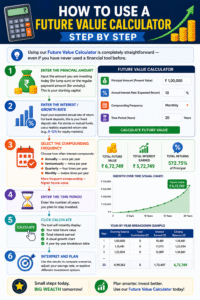
Using our Future Value Calculator is completely straightforward — even if you have never used a financial tool before. Here is a simple step-by-step guide:
Step 1: Enter the Principal Amount Input the amount you are investing today (for lump sum) or the regular payment amount (for annuity). This is your starting capital.
Step 2: Enter the Interest / Growth Rate Input your expected annual rate of return. For bank deposits, this is your fixed deposit rate. For stocks or mutual funds, use a realistic expected return rate (e.g., 8–12% for equity markets).
Step 3: Select the Compounding Frequency Choose how often interest compounds:
- Annually — once per year
- Semiannually — twice per year
- Quarterly — four times per year
- Monthly — twelve times per year
More frequent compounding = higher future value.
Step 4: Enter the Time Period Enter the number of years you plan to stay invested.
Step 5: Click Calculate The tool will instantly display:
- Your total future value
- Total interest earned
- A visual growth chart
- A year-by-year breakdown table
Step 6: Interpret and Plan Use the results to compare scenarios, adjust your savings rate, or explore different investment options.
Single Future Sum vs. Annuity Payments
One of the most common questions users ask when using a Future Value Calculator is: “Should I invest a lump sum or make regular payments?”
Here is a comparison:
| Factor | Lump Sum | Annuity |
|---|---|---|
| Initial Capital Required | High | Low |
| Growth Potential | Higher (full amount compounds from day one) | Moderate |
| Flexibility | Low | High |
| Best For | Windfall investments, bonuses | Regular savers |
| Risk Level | Slightly higher (timing risk) | Lower (rupee-cost averaging) |
The ideal strategy for most investors is a combination — invest a lump sum when you have surplus funds, and continue with regular monthly contributions. Our tool lets you model both scenarios so you can design your ideal investment strategy.
The Power of Compounding Frequency
Compounding is the engine of wealth building, and the frequency of compounding significantly impacts your final future value.
Let us look at a $10,000 investment at 8% annual rate for 20 years under different compounding frequencies:
| Compounding Frequency | Future Value |
|---|---|
| Annually | $46,610 |
| Semiannually | $47,446 |
| Quarterly | $47,911 |
| Monthly | $49,268 |
| Daily | $49,530 |
As you can see, monthly compounding adds over $2,600 compared to annual compounding — just by changing how often interest is applied. A quality Future Value Calculator shows you this difference clearly, empowering you to choose investments with more frequent compounding.
Remember: When comparing investment options, always check the compounding frequency — not just the headline interest rate.
Real-Life Examples Using a Future Value Calculator
Let us look at practical, real-world scenarios where this tool delivers tremendous value.
Example 1: Retirement Planning
Scenario: You are 30 years old and want to retire at 60. You invest $500/month in a mutual fund with an expected 10% annual return.
Inputs for the calculator:
- Monthly PMT: $500
- Annual Rate: 10%
- Compounding: Monthly
- Time: 30 years
- Result: $1,130,243
You could retire as a millionaire with just $500/month — starting today.
Example 2: Children’s Education Fund
Scenario: You want to save for your child’s college tuition, which you estimate will cost $80,000 in 15 years. How much should you invest today?
By running the numbers in reverse:
- Future Need: $80,000
- Annual Rate: 7%
- Time: 15 years
- Invest Today: ~$29,000
Example 3: Business Investment Evaluation
Scenario: Your business can invest $50,000 in equipment that generates $8,000 annually in savings for 8 years.
Our Future Value Calculator shows the accumulated value of those savings:
- Annual PMT: $8,000
- Rate: 0% (pure cash savings)
- Time: 8 years
- Total Value: $64,000 vs. $50,000 invested
ROI confirmed — the investment is worth making.

Benefits of Using a Future Value Calculator
Here are the top reasons why this is an indispensable tool for anyone serious about financial planning:
1. Saves Time Complex financial formulas that would take hours to compute manually are done in seconds.
2. Eliminates Errors Manual calculations introduce human error. A digital tool is 100% accurate every time.
3. Visual Clarity Charts and graphs make it easy to see how your money grows — not just the final number.
4. Scenario Planning Test multiple scenarios: What if I increase my monthly contribution by $100? What if the rate drops by 1%? What if I invest for 5 more years?
5. Goal Alignment Align your savings strategy with your financial goals — whether it is a house, retirement, education, or wealth building.
6. Completely Free Our Future Value Calculator is available online at no cost, with no registration required.
Common Mistakes to Avoid
Even with a great tool, users sometimes make errors in their inputs that lead to misleading results. Here are the most common mistakes and how to avoid them:
Mistake 1: Using Nominal Rate Instead of Real Rate Always account for inflation. A 10% return with 4% inflation gives you only a 6% real return.
Mistake 2: Ignoring Taxes Investment returns are often taxable. Factor in your tax bracket to get a realistic after-tax future value.
Mistake 3: Unrealistic Rate Assumptions Using a 20% return rate for a conservative savings plan will give you wildly inflated projections. Use realistic, conservative estimates.
Mistake 4: Forgetting Fees Mutual funds and investment accounts often charge management fees. Even a 1% annual fee can reduce your future value by thousands over time.
Mistake 5: Not Revisiting Your Plan Life changes — income increases, new expenses, emergencies. Run new projections at least once a year to keep your financial plan on track.
Who Should Use a Future Value Calculator?
Almost everyone can benefit from using a Future Value Calculator at some point in their financial journey. Here are the primary users:
- Young professionals starting to save and invest
- Parents planning for children’s education or marriage
- Business owners evaluating capital investments
- Retirees calculating how long their savings will last
- Students learning about finance and investment concepts
- Financial advisors preparing client presentations
- HR professionals designing employee benefit schemes
No matter your income level or financial goal, this tool helps you understand the math behind your money and make smarter, more deliberate decisions.
Future Value vs. Present Value — Key Differences
Understanding the difference between future value and present value is critical for complete financial literacy.
| Aspect | Future Value | Present Value |
|---|---|---|
| Question Answered | What will my money be worth later? | What is a future sum worth today? |
| Direction | Moves forward in time | Moves backward in time |
| Use Case | Investment planning, savings | Loan valuation, discount analysis |
| Formula | FV = PV × (1 + r)^t | PV = FV / (1 + r)^t |
Both calculations are two sides of the same coin. Many advanced financial tools combine both — helping you move fluidly between asking “how much will I have?” and “how much do I need today?” Our tool covers both directions, making it a complete financial planning solution.
Advanced Tips for Maximizing Returns
Now that you understand how to use this tool effectively, here are advanced strategies to maximize your results:
1. Start as Early as Possible Time is your most powerful variable. Investing $200/month from age 25 vs. age 35 at 8% return creates a difference of over $150,000 by retirement.
2. Increase Contributions Annually Even a 5–10% annual increase in your contribution amount can dramatically boost your future value. This is called a step-up SIP strategy.
3. Reinvest All Returns Never withdraw interest or dividends early. Let compounding do its full work by reinvesting every rupee or dollar earned.
4. Choose Monthly Compounding When comparing two investment options with the same stated rate, always choose the one with more frequent compounding.
5. Diversify Across Asset Classes Model returns for different asset classes — equities, bonds, real estate — and build a balanced portfolio that maximizes returns while managing risk.
6. Reduce Fees Aggressively A 1% lower fee might seem small, but over 30 years on a $100,000 investment, it can mean $70,000+ in additional wealth.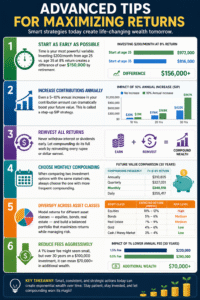
Frequently Asked Questions
Q: Is this tool accurate? Yes — it uses standard financial formulas and is mathematically precise. The accuracy of your results depends on the accuracy of your inputs, particularly the interest rate assumption.
Q: Can I use it for SIP calculations? Absolutely. Simply enter your monthly SIP amount as the regular payment (PMT), select monthly compounding, and enter your expected rate of return.
Q: What is a good expected rate of return to use? For conservative savings: 4–6%. For balanced funds: 7–9%. For aggressive equity investments: 10–12%. Always use realistic, conservative estimates for planning.
Q: Does the calculator account for inflation? The base tool uses nominal rates. To find the inflation-adjusted (real) return, subtract your expected inflation rate from the growth rate before entering it.
Q: How often should I recalculate? Revisit your projections at least once a year, or whenever your financial situation changes significantly — new job, large expense, or a change in interest rates.
Conclusion
A Future Value Calculator is not just a math tool — it is a window into your financial future. It transforms abstract numbers into a concrete roadmap: showing you exactly where your money is headed, how fast it will grow, and what you need to do today to reach tomorrow’s goals.
We covered the core formula behind future value, the difference between lump sum and annuity calculations, the power of compounding frequency, real-life examples across different life scenarios, common pitfalls to avoid, and advanced strategies to maximize your returns.
The single most important financial decision you can make is to start — today. Every day you delay costs you compound growth that you will never recover. Use our Future Value Calculator, enter your numbers, and take control of your financial destiny with confidence, clarity, and precision.
Your future wealth is not a matter of luck. It is a matter of math — and now you have the tool to do the math right.