Rent vs. Buy Calculator
Estimate Your Home Equity Line Today HELOC Calculator
Table of Contents
- Introduction
- What Is a Rent vs Buy Calculator?
- Why Every Homebuyer Needs a Rent vs Buy Calculator
- Key Factors the Rent vs Buy Calculator Analyzes
- How to Use the Rent vs Buy Calculator Step by Step
- Understanding the Financial Side of Buying a Home
- Understanding the Financial Side of Renting
- When Buying Makes More Financial Sense
- When Renting Is the Smarter Choice
- How Your Income Impacts the Rent vs Buy Decision
- Using a Pay Calculator Georgia for Better Financial Planning
- How a Calculator My Paycheck Tool Connects to Housing Decisions
- Common Mistakes People Make Without a Rent vs Buy Calculator
- Tips to Get the Most Accurate Results From Your Rent vs Buy Calculator
- Frequently Asked Questions
- Conclusion
Introduction
One of the most significant financial decisions you will ever make in your life is choosing between renting and buying a home. The stakes are incredibly high, and getting it wrong can cost you tens of thousands of dollars over time. That is why using a rent vs buy calculator is not just helpful — it is absolutely essential before you commit to either path.
Whether you are a first-time homebuyer, a young professional exploring your options, or someone relocating to a new city, the rent vs buy calculator gives you a data-driven answer instead of a gut-feeling guess. It strips away the emotion from the decision and replaces it with hard numbers, side-by-side comparisons, and long-term projections you can actually trust.
This guide covers everything you need to know about how the rent vs buy calculator works, what inputs it uses, what results it produces, and how to interpret those results in the context of your personal financial situation. We will also discuss how tools like the pay calculator georgia and the calculator my paycheck can help you understand your take-home income — a critical variable in any housing decision.
By the end of this article, you will have a thorough understanding of how to use the rent vs buy calculator to make the best possible choice for your financial future.
What Is a Rent vs Buy Calculator?
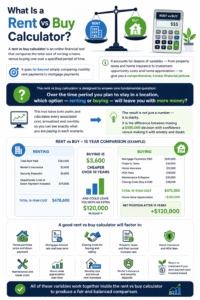
A rent vs buy calculator is an online financial tool that compares the total cost of renting a home versus buying one over a specified period of time. It goes far beyond simply comparing monthly rent payments to mortgage payments. It accounts for dozens of variables — from property taxes and home insurance to investment opportunity costs and home appreciation — to give you a comprehensive, honest financial picture.
The rent vs buy calculator is designed to answer one fundamental question: Over the time period you plan to stay in a location, which option — renting or buying — will leave you with more money?
This tool takes both paths and calculates every associated cost, annualized and monthly, so you can see exactly what you are paying in each scenario. The result is not just a number — it is clarity. It is the difference between making a $500,000 decision with confidence versus making it with anxiety and doubt.
A good rent vs buy calculator will factor in:
- Home purchase price and down payment
- Mortgage interest rate and loan term
- Closing costs for buying and selling
- Property taxes and their annual increase rate
- Home insurance and HOA fees
- Maintenance and repair costs
- Home value appreciation over time
- Monthly rent and annual rent increases
- Renter’s insurance and security deposits
- Return on investment if your down payment were invested instead
All of these variables work together inside the rent vs buy calculator to produce a fair and balanced comparison.
Why Every Homebuyer Needs a Rent vs Buy Calculator
Most people make their rent vs buy decision based on feelings, not facts. They hear phrases like “renting is throwing money away” or “owning builds equity,” and they take those statements at face value without running the numbers. The rent vs buy calculator exists to challenge those assumptions with real math.
Here is the truth: renting is not always “throwing money away,” and buying is not always “building wealth.” The correct answer depends entirely on your specific situation — your income, how long you plan to stay, local market conditions, interest rates, and dozens of other factors.
That is exactly why the rent vs buy calculator is so powerful. It does not have an opinion. It does not favor renting or buying. It just crunches the numbers you provide and shows you the result — often with surprising clarity.
Using a rent vs buy calculator before making your decision can:
- Save you thousands of dollars by revealing hidden costs you had not considered
- Prevent buyer’s remorse by confirming your decision with real data
- Help you time your purchase by showing you the break-even point — the year at which buying becomes cheaper than renting
- Give you negotiating power when discussing home prices or rent agreements
- Support long-term financial planning by projecting costs 5, 10, or even 30 years into the future
Key Factors the Rent vs Buy Calculator Analyzes
Understanding what the rent vs buy calculator is measuring helps you input accurate data and interpret results correctly. Here is a breakdown of the most important inputs:
Home Purchase Inputs
Home Price: The total purchase price of the property you are considering.
Down Payment: Typically expressed as a percentage. A 20% down payment on a $500,000 home means $100,000 upfront.
Interest Rate: The annual mortgage interest rate. Even a 0.5% difference in rate can mean tens of thousands of dollars over 30 years.
Loan Term: Usually 15 or 30 years. A shorter term means higher monthly payments but much less interest paid overall.
Buying Closing Costs: Typically 2–5% of the home price, covering appraisal fees, title insurance, attorney fees, and lender charges.
Property Tax: Usually expressed as a percentage of the home’s assessed value per year. This varies dramatically by state and county.
Home Insurance: Your annual premium for homeowner’s insurance.
HOA Fees: If applicable, homeowner’s association fees can add hundreds of dollars per month to your cost of ownership.
Maintenance Cost: Most financial experts recommend budgeting 1–2% of the home’s value per year for maintenance and repairs.
Home Value Appreciation: The expected annual increase in your home’s value. Historical averages hover around 3–4%, but this varies significantly by market.
Renting Inputs
Monthly Rent: Your current or expected monthly rental payment.
Annual Rent Increase: How much your rent is expected to rise each year.
Renter’s Insurance: A small but important annual cost for coverage on your personal belongings.
Security Deposit: The upfront deposit required when signing a lease.
Shared Financial Inputs
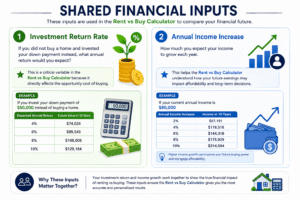
Investment Return Rate: If you did not buy a home and invested your down payment instead, what annual return would you expect? This is a critical variable in the rent vs buy calculator because it directly affects the opportunity cost of buying.
Annual Income Increase: How much you expect your income to grow each year.
How to Use the Rent vs Buy Calculator Step by Step
Using the rent vs buy calculator is straightforward, but accuracy in your inputs is everything. Here is a simple, step-by-step guide:
Step 1: Enter your home purchase details. Start with the home price you are considering, your expected down payment percentage, the current mortgage interest rate, and your preferred loan term. Use real numbers — not estimates.
Step 2: Add ownership costs. Enter your closing costs, property tax rate, insurance premium, HOA fee (if any), and expected maintenance costs. Do not skip maintenance — it is one of the most underestimated costs of homeownership.
Step 3: Set your appreciation and investment assumptions. Enter a realistic home appreciation rate and the investment return you would expect if you kept your money in the market instead.
Step 4: Enter your rental details. Input the monthly rent for a comparable property, your expected annual rent increase, and any renter’s insurance or deposit costs.
Step 5: Set your time horizon. Decide how many years you plan to stay in the home. This is arguably the most important variable in the entire rent vs buy calculator. The longer you stay, the more buying tends to make sense.
Step 6: Click calculate and review the results. The rent vs buy calculator will show you a year-by-year breakdown comparing the monthly and annual costs of renting versus buying. Look for the break-even year — the point where buying becomes cheaper than renting.
Understanding the Financial Side of Buying a Home
Buying a home is a major financial commitment that goes well beyond the mortgage payment. When you purchase a home, you are also responsible for property taxes, insurance, maintenance, and potentially HOA fees. You also have significant upfront costs in the form of a down payment and closing costs.
However, homeownership builds equity over time — a form of forced savings that renting does not provide. As you pay down your mortgage, you own a larger and larger share of the property. And if your home appreciates in value, your net worth grows even faster.
The rent vs buy calculator captures all of this and presents it as an average monthly and annual cost, making it easy to compare with what renting would cost you over the same period.
Understanding the Financial Side of Renting
Renting offers flexibility and lower upfront costs that buying simply cannot match. You do not need a down payment, you do not pay property taxes directly, and you are not responsible for expensive repairs. When the water heater breaks, you call the landlord — not a plumber with your credit card.
But renting also has a major downside: you build no equity. Every dollar you pay in rent goes to your landlord’s mortgage, not yours. And with annual rent increases, your monthly payment grows over time without any corresponding growth in your financial position.
The rent vs buy calculator accounts for both sides of this equation, showing you the true long-term cost of renting and comparing it fairly against the cost of buying.
When Buying Makes More Financial Sense
Based on what the rent vs buy calculator typically reveals, buying tends to be the better financial choice when:
- You plan to stay in the home for 5 or more years. The longer your time horizon, the more the upfront costs of buying are amortized.
- Mortgage payments are close to or lower than rent for a comparable home. This means you are building equity at essentially no extra cost.
- Home appreciation rates in your area are strong. A fast-appreciating market dramatically increases the long-term financial benefits of ownership.
- Interest rates are low. Lower rates mean lower monthly payments and less total interest paid over the life of the loan.
- You have a stable income and job security. Owning a home is a long-term commitment; instability can make it a liability rather than an asset.


When Renting Is the Smarter Choice
The rent vs buy calculator often reveals that renting is the wiser financial move when:
- You plan to move within 3 years. The transaction costs of buying and selling a home are significant; short time horizons rarely justify them.
- Home prices in your area are significantly higher than rent for a comparable property. High price-to-rent ratios often indicate an overheated market where buying is expensive relative to renting.
- You have limited savings for a down payment. A small down payment means private mortgage insurance (PMI) on top of your regular payment — an added cost the rent vs buy calculator will flag.
- Your career or lifestyle requires flexibility. If there is any chance you will need to relocate for work or personal reasons, renting gives you the freedom to move without the burden of selling.
How Your Income Impacts the Rent vs Buy Decision
Your monthly take-home income is the foundation of any rent vs buy analysis. Before you can accurately use the rent vs buy calculator, you need to know exactly what you are working with each month after taxes, benefits, and deductions.
A common financial guideline is the 28/36 rule: your housing costs should not exceed 28% of your gross monthly income, and total debt payments should not exceed 36%. Knowing your net income helps you determine how much house you can realistically afford.
This is where tools like the pay calculator georgia and calculator my paycheck become incredibly valuable. They help you compute your actual take-home pay based on your salary, filing status, and deductions — so you can feed that number directly into your housing budget and rent vs buy calculator analysis.
Using a Pay Calculator Georgia for Better Financial Planning
If you live or work in Georgia, the pay calculator georgia is a must-use tool before making any major housing decision. Georgia has its own state income tax structure, and your actual take-home pay may be different from what you expect based on your gross salary alone.
The pay calculator georgia accounts for:
- Federal income tax withholding based on your W-4 status
- Georgia state income tax, which ranges from 1% to 5.75% depending on your income bracket
- FICA taxes — Social Security (6.2%) and Medicare (1.45%)
- Pre-tax deductions like 401(k) contributions and health insurance premiums
- Post-tax deductions if applicable
Once you know your true monthly take-home pay using the pay calculator georgia, you can enter that figure into your budget alongside the results from the rent vs buy calculator. Together, these two tools give you a complete picture of your housing affordability — not just whether buying or renting is cheaper in isolation, but whether either option is actually within your financial means.
For example: If the rent vs buy calculator shows that buying costs $2,800 per month and renting costs $2,400, but your pay calculator georgia shows your take-home is only $4,000 per month, then neither option is particularly comfortable — and the rent vs buy analysis might lean strongly toward renting to preserve cash flow.
How a Calculator My Paycheck Tool Connects to Housing Decisions
The calculator my paycheck tool serves the same critical function as the pay calculator georgia but for users nationwide. It calculates your actual net pay after all federal and state taxes, deductions, and contributions are applied to your gross salary.
Why does this matter for the rent vs buy calculator?
Because your gross income and your net income can be dramatically different. A person earning $80,000 per year might only take home $58,000 to $62,000 after taxes and deductions — or roughly $4,800 to $5,200 per month. Running the rent vs buy calculator with your gross income instead of your net income leads to completely inaccurate results.
The calculator my paycheck tool eliminates this error by giving you the correct starting number. Once you know your real monthly take-home, you can:
- Set a realistic housing budget based on the 28% rule
- Use the rent vs buy calculator with accurate affordability constraints
- Plan for the down payment and closing costs you would need to save before buying
- Assess whether your current income supports homeownership or whether renting is the more responsible short-term choice
Using calculator my paycheck in combination with the rent vs buy calculator is one of the smartest financial planning moves you can make before committing to a lease or a mortgage.
Common Mistakes People Make Without a Rent vs Buy Calculator
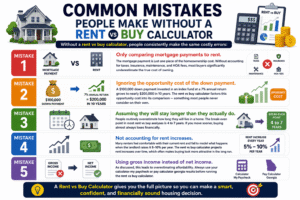
Without a rent vs buy calculator, people consistently make the same costly errors:
Mistake 1: Only comparing mortgage payments to rent. The mortgage payment is just one piece of the homeownership cost. Without accounting for taxes, insurance, maintenance, and HOA fees, most buyers significantly underestimate the true cost of owning.
Mistake 2: Ignoring the opportunity cost of the down payment. A $100,000 down payment invested in an index fund at a 7% annual return grows to nearly $200,000 in 10 years. The rent vs buy calculator factors this opportunity cost into its comparison — something most people never consider on their own.
Mistake 3: Assuming they will stay longer than they actually do. People routinely overestimate how long they will live in a home. The break-even point in most rent vs buy analyses is 4 to 7 years. If you move sooner, buying almost always loses financially.
Mistake 4: Not accounting for rent increases. Many renters feel comfortable with their current rent and fail to model what happens when the landlord raises it 5–10% per year. The rent vs buy calculator projects rent increases over time, which often makes buying look more attractive in the long run.
Mistake 5: Using gross income instead of net income. As discussed, this leads to overestimating affordability. Always use your calculator my paycheck or pay calculator georgia results before running the rent vs buy calculator.
Tips to Get the Most Accurate Results From Your Rent vs Buy Calculator
Getting accurate results from your rent vs buy calculator requires accurate inputs. Here are the key tips to make sure your analysis is as reliable as possible:
Use your real mortgage rate, not an estimate. Get pre-approved by a lender so you know exactly what rate you qualify for. Even a 0.25% difference in rate changes the monthly payment meaningfully.
Be honest about maintenance costs. Most buyers budget 1% of home value per year for maintenance, but older homes often require 2% or more. Be conservative here.
Use local property tax data. Property tax rates vary enormously by county and state. Look up the exact rate for the neighborhood you are considering.
Set a realistic time horizon. Be honest about how long you will actually stay. If you are uncertain, run the rent vs buy calculator with multiple time horizons — 3 years, 5 years, 10 years — and compare the results.
Use a conservative appreciation rate. While some markets have seen 8–10% annual appreciation, a long-term average of 3–4% is more realistic for most areas. Using inflated appreciation figures skews the results in favor of buying.
Update your income figures using the calculator my paycheck or pay calculator georgia first. Make sure the affordability analysis is grounded in your real take-home pay, not your gross salary.
Frequently Asked Questions
1. What does this calculator help me understand?
It helps you compare the long-term cost of owning a home versus renting, based on your inputs like price, rent, taxes, and interest rate.
2. How does the result get calculated?
It estimates yearly and monthly costs for both options by including mortgage payments, rent increases, property taxes, maintenance, and other expenses over time.
3. Why do results change when I adjust inputs?
Because every value like interest rate, rent growth, or property appreciation directly affects long-term cost projections and overall comparison.
4. Does this include home loan interest?
Yes, it calculates monthly loan payments based on interest rate, loan term, and loan amount.
5. Can I see costs for multiple years?
Yes, the results show a year-by-year breakdown so you can understand how costs change over time.
6. What happens if rent increases every year?
The calculator adds a yearly increase to rent, which reflects real-world rental market changes.
7. Does it consider maintenance and insurance?
Yes, it includes maintenance costs, home insurance, and other ownership-related expenses in the calculation.
8. Can I use it for any property value?
Yes, you can enter any home price and adjust all values to match your situation.
9. What is the result based on?
It compares total cost differences over time and shows which option becomes financially better depending on how long you stay.
10. Is this result exact or estimated?
It is an estimate based on the values you enter. Real-life costs may vary depending on market changes and personal conditions.
Conclusion
Making the rent vs buy decision without a rent vs buy calculator is like navigating a new city without a map. You might get somewhere, but you are leaving far too much to chance with far too much money on the line.
The rent vs buy calculator gives you the clarity, confidence, and data you need to make this enormous decision correctly. It accounts for every major cost on both sides of the equation — from closing costs and property taxes to rent increases and investment opportunity costs — and presents them in a clear, side-by-side comparison that anyone can understand.
Remember: the right answer is not the same for everyone. For one person, buying a home this year is absolutely the right financial move. For another — especially someone who plans to move within 3 years or who is just entering the workforce — renting may be the far smarter choice. The rent vs buy calculator tells you which category you fall into, without bias and without guesswork.
Before you use the rent vs buy calculator, make sure you know your real take-home income. Use the pay calculator georgia if you are based in Georgia, or the calculator my paycheck tool if you are located elsewhere. Your net income is the foundation of every housing decision you will ever make, and getting it right is the first step toward getting the rent vs buy analysis right as well.
Take the time to run the numbers. Use the rent vs buy calculator today. Your future financial self will thank you for it.