Area Calculator
Professional shape area computation
Rectangle Dimensions
L × WProfessional Area Calculator — All standard 2D shapes
Calculate probability instantly with our fast and accurate Probability Calculator.
Table of Contents
- Introduction
- What Is an Area Calculator?
- What Is a Cube?
- The Formula for Volume of a Cube — Explained
- Derivation of the Formula for Volume of a Cube
- How to Calculate the Volume of a Cube Step by Step
- Understanding Surface Area vs. Volume in a Cube
- The Relationship Between Side Length and Volume
- Formula for Volume of a Cube vs. Volume of a Rectangular Prism
- Formula for Volume of a Cube in Real-World Applications
- Formula for Volume of a Cube in Engineering and Architecture
- Formula for Volume of a Cube in Science and Research
- Formula for Volume of a Cube in Education
- How Area Formulas Connect to Volume Calculations
- Common Mistakes When Applying the Formula for Volume of a Cube
- Frequently Asked Questions (FAQs)
- Conclusion
Introduction
Geometry is the mathematical foundation of the physical world around us. Every object you see — a building, a box, a container, a room — occupies space, and calculating that space accurately is one of the most fundamental skills in mathematics, engineering, architecture, and science. At the center of three-dimensional geometry stands one of the simplest yet most important expressions in all of math: the Formula for Volume of a Cube. Whether you are a student working through geometry problems, a professional designing storage systems, or simply trying to figure out how much space a cubic object occupies, the Formula for Volume of a Cube gives you a fast, precise, and universally applicable answer.
In this comprehensive guide, we will cover everything you need to know about the Formula for Volume of a Cube — what a cube is, how the formula is derived, what each component means, how to apply it step by step, and how it connects to the broader world of area and volume calculations. We will also introduce the Area Calculator — a powerful tool for computing areas of all standard two-dimensional shapes — and show how 2D and 3D geometry work together in real-world applications. This guide is designed for learners at every level, from students encountering the Formula for Volume of a Cube for the first time to professionals refreshing their geometry knowledge for practical applications.
What Is an Area Calculator?
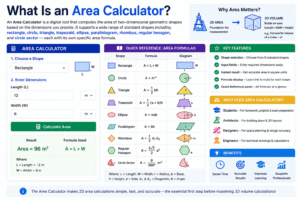
An Area Calculator is a digital tool that computes the area of two-dimensional geometric shapes based on the dimensions you provide. It supports a wide range of standard shapes including rectangle, circle, triangle, trapezoid, ellipse, parallelogram, rhombus, regular hexagon, and circle sector — each with its own specific area formula.
Key features of the Area Calculator include:
- Shape selection — Choose from primary shapes (rectangle, circle, triangle, trapezoid) or expanded shapes (ellipse, parallelogram, rhombus, hexagon, sector)
- Input fields — Enter the required dimensions (length, width, radius, base, height, diagonals, or angle)
- Instant result — The Area Calculator applies the correct formula and displays the computed area in square units
- Formula display — Each shape shows its formula (e.g., L × W for rectangle, π × r² for circle) for educational clarity
- Quick Reference panel — All shapes and their formulas are listed for easy lookup
The Area Calculator is an indispensable tool for students, architects, designers, and engineers who regularly work with two-dimensional measurements. Understanding 2D area is also the essential prerequisite for understanding 3D volume — which is where the Formula for Volume of a Cube becomes central.
What Is a Cube?
A cube is a three-dimensional geometric solid in which all six faces are equal squares, all twelve edges are equal in length, and all eight angles are right angles (90°). It is one of the five Platonic solids — the most regular and symmetric three-dimensional shapes in geometry.
Key properties of a cube:
- Faces: 6 (all square and congruent)
- Edges: 12 (all equal in length)
- Vertices (corners): 8
- All interior angles: 90°
- All face diagonals equal: s√2
- Space diagonal: s√3
Because all edges of a cube are identical, the cube is fully defined by a single measurement: its side length (s). This is what makes the Formula for Volume of a Cube so remarkably simple — unlike more complex 3D shapes, you only need one number to compute the cube’s volume, surface area, and diagonals.
Examples of cube-shaped objects in everyday life:
- Dice
- Ice cubes
- Sugar cubes
- Rubik’s Cubes
- Storage boxes with equal dimensions
- Cubic meters (the standard unit of volume)
The Formula for Volume of a Cube — Explained
The Formula for Volume of a Cube is one of the most elegant and straightforward expressions in all of geometry:
V = s³
Where:
- V = the volume of the cube (in cubic units)
- s = the side length of the cube (in any consistent unit of length)
Reading the Formula for Volume of a Cube aloud: “Volume equals side length cubed” — or equivalently, “Volume equals side length to the third power.”
This means you simply multiply the side length by itself three times:
V = s × s × s
Example: If a cube has a side length of 5 cm:
V = 5³ = 5 × 5 × 5 = 125 cubic centimeters (cm³)
The result is always expressed in cubic units — cubic centimeters (cm³), cubic meters (m³), cubic inches (in³), cubic feet (ft³) — because volume is a three-dimensional measurement.
Derivation of the Formula for Volume of a Cube
Understanding where the Formula for Volume of a Cube comes from gives you a deeper appreciation of its mathematical elegance and makes it far easier to remember.
Volume as stacked layers: Think of filling a cube with unit cubes (cubes with side length 1). If the cube has side length s:
- The bottom layer is an s × s square grid → contains s² unit cubes
- There are s such layers stacked on top of each other
- Total unit cubes = s² × s = s³
This is precisely the Formula for Volume of a Cube — it counts how many unit cubes fit inside the larger cube.
Connection to area: The base of a cube is a square with side length s, so its base area is:
Base Area = s × s = s²
Volume is simply base area multiplied by height. Since the height of a cube equals s:
V = Base Area × Height = s² × s = s³
This derivation reveals a key principle: the Formula for Volume of a Cube is a natural extension of the area formula for a square (A = s²) into three dimensions by multiplying by the third dimension (also s).
How to Calculate the Volume of a Cube Step by Step
Applying the Formula for Volume of a Cube is a simple three-step process:
Step 1 — Identify the Side Length Determine the length of one edge of the cube. Since all edges are equal, you only need one measurement. Make sure you note the unit (cm, m, inches, feet, etc.).
Step 2 — Apply the Formula Cube the side length: V = s³ = s × s × s
Step 3 — State the Answer with Cubic Units The volume is always expressed in cubic units that match your input. If s is in meters, V is in m³.
Worked Examples:
Example 1: s = 3 cm
V = 3³ = 27 cm³
Example 2: s = 7 m
V = 7³ = 343 m³
Example 3: s = 2.5 inches
V = 2.5³ = 2.5 × 2.5 × 2.5 = 15.625 in³
Example 4: s = 10 ft
V = 10³ = 1,000 ft³ (one cubic yard of space)
The Formula for Volume of a Cube produces exact results as long as the side length is measured accurately. There are no irrational numbers or approximations involved — just straightforward multiplication.
Understanding Surface Area vs. Volume in a Cube
The Formula for Volume of a Cube is often taught alongside the formula for surface area. Understanding both helps you describe a cube completely — volume tells you how much space it contains; surface area tells you how much material covers its exterior.
Surface Area of a Cube:
SA = 6s²
Since a cube has 6 identical square faces, each with area s², the total surface area is simply 6 times s².
Comparison:
| Measurement | Formula | Units |
|---|---|---|
| Volume | V = s³ | Cubic units (cm³, m³) |
| Surface Area | SA = 6s² | Square units (cm², m²) |
| Face Diagonal | d = s√2 | Linear units (cm, m) |
| Space Diagonal | D = s√3 | Linear units (cm, m) |
Example with s = 4 cm:
- Volume: V = 4³ = 64 cm³
- Surface Area: SA = 6 × 4² = 6 × 16 = 96 cm²
Notice that volume grows much faster than surface area as side length increases — this is a fundamental principle in biology, engineering, and physics known as the “surface area to volume ratio,” and it has profound implications in cell biology, heat transfer, and chemical reaction rates.
The Relationship Between Side Length and Volume
One of the most important properties of the Formula for Volume of a Cube is how dramatically volume scales with side length. Because volume is proportional to the cube (third power) of the side length, even small changes in s produce large changes in V.
| Side Length (s) | Volume (V = s³) |
|---|---|
| 1 unit | 1 cubic unit |
| 2 units | 8 cubic units |
| 3 units | 27 cubic units |
| 5 units | 125 cubic units |
| 10 units | 1,000 cubic units |
| 20 units | 8,000 cubic units |
Doubling the side length multiplies the volume by 8 (2³ = 8). Tripling the side length multiplies the volume by 27 (3³ = 27).
This cubic scaling relationship is why the Formula for Volume of a Cube is so important in engineering and architecture — a small increase in the dimensions of a storage tank, building, or container results in a disproportionately large increase in its internal volume. Understanding this scaling behavior prevents costly design errors in real-world applications.
Formula for Volume of a Cube vs. Volume of a Rectangular Prism
The Formula for Volume of a Cube is a special case of the more general formula for the volume of a rectangular prism (also called a cuboid):
V (rectangular prism) = L × W × H
Where L = length, W = width, H = height.
When L = W = H = s, all three dimensions are equal, and the formula simplifies to:
V = s × s × s = s³
This is precisely the Formula for Volume of a Cube — confirming that a cube is simply a rectangular prism with all three dimensions equal.
Key differences:
| Property | Cube | Rectangular Prism |
|---|---|---|
| Dimensions needed | 1 (side s) | 3 (L, W, H) |
| Volume formula | s³ | L × W × H |
| All faces equal? | Yes | Not necessarily |
| Defined by one number? | Yes | No |
The simplicity of the Formula for Volume of a Cube — needing just one dimension instead of three — makes it one of the most user-friendly formulas in all of geometry.
Formula for Volume of a Cube in Real-World Applications
The Formula for Volume of a Cube is not merely an academic exercise — it has direct, practical applications across a wide range of everyday and professional contexts.
Shipping and Packaging Manufacturers and logistics companies use the Formula for Volume of a Cube to calculate the volume of cubic containers, boxes, and crates. Knowing the volume determines how much product fits in a shipment, how many boxes stack in a warehouse, and what shipping costs apply based on dimensional weight.
Storage and Space Planning When designing storage rooms, warehouses, or shipping containers, planners apply the Formula for Volume of a Cube to determine total storage capacity. Cubic meters and cubic feet are standard units in commercial storage, and both are derived directly from the formula.
Cooking and Food Science Ice cubes, sugar cubes, gelatin molds, and many food portions are cubic or approximately cubic. The Formula for Volume of a Cube helps food scientists and chefs calculate exact quantities of ingredients in cubic units, especially when working with molds or standardized portions.
Architecture and Construction Concrete, soil, sand, and other building materials are often ordered and priced by the cubic yard or cubic meter. Builders use the Formula for Volume of a Cube to estimate material quantities for cubic-shaped structural elements like foundation piers, column footings, and retaining wall sections.
Formula for Volume of a Cube in Engineering and Architecture
In engineering and architecture, the Formula for Volume of a Cube forms the foundation of three-dimensional design and material estimation. Engineers working on structural systems, fluid mechanics, thermal systems, and manufacturing all encounter cubic volumes regularly.
Structural Engineering When calculating the weight of a concrete block, steel cube, or any solid cubic component, engineers first compute the volume using the Formula for Volume of a Cube, then multiply by the material’s density:
Mass = Volume × Density = s³ × ρ
This calculation is critical for load analysis, foundation design, and structural safety assessments.
Fluid Volume in Cubic Tanks Cubic tanks and reservoirs have volumes computed directly from the Formula for Volume of a Cube. For a cubic tank with side s = 3 m, the volume is 27 m³ = 27,000 liters — an important calculation for water supply systems, chemical storage, and industrial processing.
HVAC and Ventilation Building engineers calculate the volume of cubic rooms to size heating, ventilation, and air conditioning (HVAC) systems. The air change requirements, heating loads, and cooling capacity are all directly proportional to the cubic volume of the space — computed using the Formula for Volume of a Cube for cuboid rooms.
Formula for Volume of a Cube in Science and Research
Science relies heavily on cubic volume calculations across many disciplines.
Physics — Density and Mass The Formula for Volume of a Cube is central to density calculations in physics:
Density = Mass / Volume = Mass / s³
Materials scientists use this relationship to determine the density of crystalline materials, metal alloys, and polymers from cubic unit cell dimensions measured by X-ray crystallography.
Chemistry — Molar Volume At the molecular scale, the unit cell of many crystal structures is cubic. The volume of the unit cell — computed using the Formula for Volume of a Cube — determines how many atoms or molecules are packed into a given space, which is fundamental to understanding material properties and chemical reactivity.
Environmental Science The Formula for Volume of a Cube is used to estimate the volume of cubic-shaped environmental features such as soil sampling blocks, sediment cores, and air sampling chambers.
Formula for Volume of a Cube in Education
The Formula for Volume of a Cube is introduced in mathematics education at the elementary and middle school levels and continues to appear throughout high school geometry, physics, chemistry, and engineering curricula.
It is typically one of the first 3D formulas students learn, immediately after mastering 2D area formulas. Teachers use physical cube models, unit cubes, and interactive calculators to help students visualize what “cubing” a number means and why the formula works.
The Formula for Volume of a Cube appears in standardized tests including school exams, national assessments, the SAT, ACT, GRE, and engineering entrance examinations. Students who understand the derivation — not just the formula itself — are far better equipped to handle related problems involving density, surface area, scale factors, and three-dimensional geometry.
How Area Formulas Connect to Volume Calculations
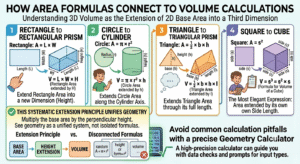
Two-dimensional area formulas and three-dimensional volume formulas are deeply interconnected. Understanding this connection helps you see geometry as a unified system rather than a collection of isolated formulas.
The Area Calculator computes the area of 2D shapes using formulas such as:
- Rectangle: A = L × W
- Circle: A = π × r²
- Triangle: A = ½ × b × h
- Square: A = s²
Volume formulas extend these 2D areas into the third dimension by multiplying by height or depth:
- Rectangular prism: V = L × W × H (extends rectangle area by H)
- Cylinder: V = π × r² × h (extends circle area by h)
- Triangular prism: V = ½ × b × h × l (extends triangle area by l)
- Cube: V = s³ = s² × s (extends square area by s — the Formula for Volume of a Cube)
This systematic extension principle — multiply the base area by the perpendicular height — unifies 2D and 3D geometry and makes the Formula for Volume of a Cube the most elegant expression in the family, because height equals the same value as the side length.
Common Mistakes When Applying the Formula for Volume of a Cube
Even a simple formula like the Formula for Volume of a Cube can produce errors without careful attention. Here are the most frequent mistakes to avoid:
- Confusing area with volume — S² gives the area of one face; s³ gives the volume. Always use three multiplications for volume, not two
- Mixing units — If side length is measured in centimeters, the volume is in cm³, not cm². Never mix linear and cubic units
- Applying the cube formula to non-cube rectangular prisms — If the three dimensions are not all equal, you must use V = L × W × H instead of the Formula for Volume of a Cube
- Forgetting to cube — not square — the side length — A very common student error is writing V = s² (area formula) when the Formula for Volume of a Cube requires V = s³
- Using diameter instead of side length — The formula uses the edge length, not the face diagonal or space diagonal
Frequently Asked Questions (FAQs)
What is the Formula for Volume of a Cube? The Formula for Volume of a Cube is V = s³, where s is the length of any one edge of the cube. Volume equals the side length raised to the third power.
Why is the Formula for Volume of a Cube s³ and not 3s? Because volume is three-dimensional — you are measuring how many unit cubes fit inside the shape. You multiply s by itself three times (once for each dimension: length, width, and height), giving s × s × s = s³.
What units does the Formula for Volume of a Cube use? Volume is always expressed in cubic units. If the side length is in centimeters, the volume is in cm³. If it is in meters, the volume is in m³. If it is in inches, the volume is in in³.
What is the surface area formula for a cube? The surface area of a cube is SA = 6s² — since it has 6 equal square faces, each with area s².
What is the difference between the Formula for Volume of a Cube and the volume of a rectangular prism? The Formula for Volume of a Cube (V = s³) is a special case of the rectangular prism formula (V = L × W × H) that applies when all three dimensions are equal.
How do I find the side length if I know the volume? Rearrange the Formula for Volume of a Cube: s = ∛V (the cube root of the volume). For example, if V = 125 cm³, then s = ∛125 = 5 cm.
Can the Formula for Volume of a Cube be used for non-perfect cubes? If an object has three equal dimensions, the Formula for Volume of a Cube applies regardless of whether the number is a “perfect cube.” For example, a cube with s = 2.7 cm has V = 2.7³ = 19.683 cm³.
What is the Area Calculator used for? The Area Calculator computes the area of 2D geometric shapes — including rectangle, circle, triangle, trapezoid, ellipse, parallelogram, rhombus, hexagon, and sector — from user-entered dimensions. It is used in education, construction, design, and engineering.
How is the Area Calculator related to the Formula for Volume of a Cube? The Area Calculator computes 2D base areas (like the square face of a cube, A = s²). The Formula for Volume of a Cube extends this to 3D by multiplying the base area by the height (also s), giving V = s² × s = s³.
Is the Formula for Volume of a Cube the same as cubing a number? Yes — mathematically, applying the Formula for Volume of a Cube (V = s³) is identical to cubing the number s. This is precisely why “cubing” a number is named after the geometric shape.
Conclusion
The Formula for Volume of a Cube — V = s³ — is one of the most fundamental and universally applicable formulas in all of mathematics. Its elegance lies in its simplicity: a single measurement, the side length, is all you need to completely describe the volume of any cube. Yet despite its simplicity, the Formula for Volume of a Cube underpins a vast range of real-world applications — from packaging and architecture to physics, chemistry, environmental science, and engineering.
Understanding the Formula for Volume of a Cube also deepens your comprehension of three-dimensional geometry as a whole, revealing how 2D area formulas naturally extend into 3D volume formulas, how side length and volume scale cubically, and how volume relates to surface area and density in practical calculations.
Combined with the Area Calculator — which handles the full spectrum of 2D geometric shapes — the Formula for Volume of a Cube gives you a complete foundation for both two-dimensional and three-dimensional spatial reasoning. Whether you are solving a homework problem, designing a structure, estimating material quantities, or analyzing a physical system, these tools and formulas give you the mathematical precision you need to work confidently and accurately.
Bookmark this guide, practice with real measurements, and use the Area Calculator to explore the full range of geometric computations available at your fingertips. Geometry is not just a school subject — it is the mathematical language of the physical world, and the Formula for Volume of a Cube is one of its clearest, most powerful expressions.