Engine Horsepower Calculator
Calculate Your Vehicle’s Fuel Efficiency and MPG in Seconds with Our Free Gas Mileage Calculator
Table of Contents
- Introduction
- What Is an Engine Horsepower Calculator?
- How an Engine Horsepower Calculator Works
- Key Formulas Used in an Engine Horsepower Calculator
- Engine Horsepower Calculator for Car Enthusiasts
- Engine Horsepower Calculator Based on Torque and RPM
- How Vehicle Weight Affects Engine Horsepower Results
- Engine Horsepower Calculator for Performance Upgrades
- Dyno Testing vs. Engine Horsepower Calculator Estimates
- Common Engine Horsepower Calculation Mistakes to Avoid
- Engine Horsepower Calculator for Different Engine Types
- FAQs
- Conclusion
Introduction
Power is the language of engines — and horsepower is the word every driver, enthusiast, and engineer speaks first. Whether you are tuning a performance vehicle, evaluating a used car purchase, planning an engine swap, or simply trying to understand what your machine is truly capable of, knowing your engine’s actual output is essential. That is exactly what an Engine Horsepower Calculator is built to deliver.
An Engine Horsepower Calculator gives you a fast, data-based estimate of your engine’s power output without requiring expensive dyno testing equipment or specialized mechanical knowledge. By entering measurable values — torque, RPM, elapsed time, vehicle weight, or trap speed — it returns a horsepower figure that reflects your engine’s real performance potential.
This guide covers everything you need to know about the Engine Horsepower Calculator: the formulas it uses, the different input methods available, how to interpret your results, and how to apply those results to performance upgrades, vehicle comparisons, and engine diagnostics. Whether you are a weekend enthusiast, a professional tuner, or a curious driver who wants to understand the number on the spec sheet, an Engine Horsepower Calculator is your starting point.
What Is an Engine Horsepower Calculator?
An Engine Horsepower Calculator is a digital tool that estimates the power output of an engine based on measurable mechanical or performance inputs. Horsepower (hp) is the standard unit for expressing engine power in the United States and many other countries — defined historically as the equivalent of 550 foot-pounds of work per second.
An Engine Horsepower Calculator does not measure horsepower directly (that requires a dynamometer). Instead, it uses established physics formulas to calculate power from related quantities that are easier to measure — most commonly torque and RPM, or vehicle performance data such as quarter-mile elapsed time and trap speed.
An Engine Horsepower Calculator is used by:
- Car enthusiasts and hobbyists estimating the output of modified or stock engines
- Performance tuners tracking power gains after modifications
- Mechanics diagnosing power loss and comparing before/after performance
- Buyers and sellers of used performance vehicles
- Engineers and students studying powertrain dynamics and engine theory
- Racers estimating power-to-weight ratios for competition planning
Understanding your engine’s horsepower is useful at every stage of vehicle ownership — from purchase evaluation through modification planning to performance diagnostics. An Engine Horsepower Calculator makes that understanding accessible without expensive equipment or specialized expertise.
How an Engine Horsepower Calculator Works
An Engine Horsepower Calculator works by applying established mechanical and automotive physics formulas to the inputs you provide. The specific formula used depends on which type of data you have available — torque and RPM data from a dynamometer or OBD reader, or real-world performance data from a quarter-mile run or acceleration test.
The most fundamental relationship in engine power calculation is:
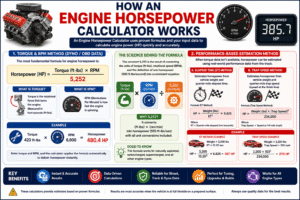
Horsepower = (Torque × RPM) ÷ 5,252
This formula is derived from the definition of horsepower and the relationship between rotational force (torque) and rotational speed (RPM). The constant 5,252 is the result of converting the units of torque (foot-pounds), rotational speed (RPM), and the definition of one horsepower (550 ft-lbs/second) into a consistent equation.
An Engine Horsepower Calculator applies this formula automatically — you enter torque and RPM, and the tool returns horsepower instantly without any manual calculation required.
For performance-based estimation, an power output tool can use quarter-mile data:
- Elapsed Time (ET) Method: Estimates horsepower from vehicle weight and quarter-mile elapsed time
- Trap Speed Method: Estimates horsepower from vehicle weight and quarter-mile trap speed (the vehicle’s speed at the finish line)
Both methods use empirical formulas developed from decades of motorsport data and provide reliable estimates for vehicles running near their mechanical limits on a prepared track surface.
Key Formulas Used in an HP estimator
An power calculator draws on several established formulas, each suited to different types of available data. Understanding which formula applies to your situation helps you choose the right input method and interpret your results correctly.
Formula 1 – Torque and RPM Method
HP = (Torque × RPM) ÷ 5,252
This is the most mechanically precise formula and the one used by professional dynamometers. Torque is measured in foot-pounds (ft-lbs) and RPM is the engine speed at which that torque figure was recorded. Because torque varies across the RPM range, peak horsepower occurs at the RPM where the torque-RPM product is highest — which may not be the same as peak torque RPM.
Formula 2 – Elapsed Time (ET) Method
HP = Weight ÷ (ET ÷ 5.825)³
This formula, known as the Hollander formula, estimates horsepower from a vehicle’s weight (in pounds) and quarter-mile elapsed time (in seconds). It is best suited for purpose-built race vehicles that are running close to their mechanical potential, with minimal traction or driver error affecting the run.
Formula 3 – Trap Speed Method
HP = (Weight × (Trap Speed ÷ 234)³)
This formula estimates horsepower from vehicle weight and quarter-mile trap speed (in mph). It is generally considered more reliable than the ET method because trap speed is less sensitive to traction conditions, reaction time, and driver technique at the start line.
Formula 4 – Wheel Horsepower to Crank Horsepower Conversion
Dynamometer readings typically measure wheel horsepower (whp) — the power delivered to the wheels after drivetrain losses. To estimate engine (crank) horsepower from a wheel horsepower figure, apply an estimated drivetrain loss:
- Rear-wheel drive: approximately 15–17% drivetrain loss
- Front-wheel drive: approximately 12–15% drivetrain loss
- All-wheel drive: approximately 18–22% drivetrain loss
An performance estimator that includes a whp-to-crank conversion is particularly useful for interpreting dyno results in the context of manufacturer-quoted horsepower ratings, which are always expressed at the crank.
Engine Horsepower Calculator for Car Enthusiasts
For car enthusiasts, an Engine Horsepower Calculator is one of the most frequently used tools in the performance toolbox. Whether you are building a project car, tracking modifications, or simply comparing your vehicle’s output against others in your class, knowing your horsepower number is central to virtually every performance conversation.
Common enthusiast use cases for an horsepower tool:
- Estimating stock output: Verify that your vehicle’s engine is performing at or near its factory-rated horsepower using torque data from an OBD scanner.
- Measuring modification gains: Run the calculation before and after an intake, exhaust, tune, or forced induction upgrade to quantify the power gain.
- Planning power-to-weight ratios: Divide your estimated horsepower by your vehicle’s curb weight to calculate hp-per-pound — a key metric for predicting acceleration performance.
- Quarter-mile prediction: Use your estimated horsepower and vehicle weight to predict expected quarter-mile ET and trap speed using established performance formulas.
- Comparing builds: Apply the same formula to different builds to produce comparable horsepower estimates for head-to-head comparison.
A power-to-weight ratio below 8 lbs/hp is generally considered fast for a street car, while serious track cars often target 5 lbs/hp or lower. An power output tool lets you model these ratios with different horsepower targets to plan your build toward a specific performance goal.
Engine Horsepower Calculator Based on Torque and RPM
The torque-and-RPM method is the most accurate and widely applicable approach in any Engine Horsepower Calculator. It is the method used by professional dynamometers, published in manufacturer specification sheets, and referenced in virtually every serious performance discussion.
Understanding the torque-HPM relationship:
- At 5,252 RPM, torque and horsepower are always equal (this is a mathematical property of the formula, not a coincidence).
- Below 5,252 RPM, torque is always higher than horsepower.
- Above 5,252 RPM, horsepower is always higher than torque.
This relationship has important practical implications. A diesel engine that produces 400 ft-lbs of torque at 2,000 RPM produces:
(400 × 2,000) ÷ 5,252 = 152 hp
The same torque figure at 4,000 RPM would produce:
(400 × 4,000) ÷ 5,252 = 305 hp
This is why high-revving engines — like those in sports cars and motorcycles — can produce high horsepower figures despite modest torque ratings. An HP estimator makes this relationship immediately visible, helping enthusiasts and engineers understand why peak power and peak torque occur at different RPM points.
For accurate torque-based calculations, use torque figures measured at the specific RPM you enter. OBD-II diagnostic tools, aftermarket ECU software, and professional dynamometer runs all provide torque-versus-RPM data that feeds directly into an power calculator for precise power output estimation across the full RPM range.
How Vehicle Weight Affects Engine Horsepower Results
Vehicle weight is the second critical variable in performance-based performance estimator methods, particularly when using the ET or trap speed formulas. Understanding how weight interacts with power output is essential for interpreting results correctly.
Power-to-weight ratio is the single most predictive metric for straight-line acceleration performance. A lighter vehicle with less horsepower can outperform a heavier vehicle with more horsepower if the power-to-weight ratio is more favorable.
Practical examples:
| Vehicle | Weight (lbs) | HP | HP/lb | 0–60 mph (est.) |
|---|---|---|---|---|
| Economy car | 3,000 | 150 | 0.050 | ~8.5 sec |
| Sports car | 3,200 | 300 | 0.094 | ~5.0 sec |
| Muscle car | 3,800 | 450 | 0.118 | ~4.2 sec |
| Supercar | 3,000 | 600 | 0.200 | ~2.8 sec |
When using an horsepower tool with the ET or trap speed method, always use the total vehicle weight at the time of the run — including the driver, passenger, fuel load, and any ballast. Inaccurate weight inputs are one of the most common sources of error in performance-based horsepower estimates.
Engine Horsepower Calculator for Performance Upgrades
One of the most valuable applications of an Engine Horsepower Calculator is planning and verifying performance upgrades. Whether you are adding a cold air intake, a performance exhaust, a supercharger, or a custom ECU tune, knowing your baseline horsepower and measuring the gain after each modification is the foundation of systematic performance building.
A structured approach to upgrade planning with an power output tool:
- Establish a baseline: Run the calculation with your current torque and RPM data to establish your starting horsepower figure.
- Estimate projected gains: Research the typical horsepower gains associated with each planned modification.
- Model the cumulative result: Use an HP estimator to project your expected output after stacking multiple modifications.
- Verify after each upgrade: After each modification, recalculate to measure the actual gain against the projected figure.
- Track power-to-weight ratio: As horsepower increases, recalculate your power-to-weight ratio to understand the real-world impact on performance.
Common performance modifications and their typical horsepower gains:
- Cold air intake: +5–15 hp
- Performance exhaust: +5–20 hp
- ECU tune (naturally aspirated): +10–30 hp
- Forced induction (supercharger/turbocharger): +50–200+ hp
- Camshaft upgrade: +20–60 hp
An power calculator used before and after each modification creates an objective record of build progress — far more reliable than subjective “seat of the pants” impressions of power change.
Dyno Testing vs. Engine Horsepower Calculator Estimates
A dynamometer (dyno) is the gold standard for measuring engine power output. It measures actual torque and RPM at the wheels under load, producing a precise power curve across the full RPM range. How does this compare to an Engine Horsepower Calculator estimate?
| Method | Accuracy | Cost | Equipment Needed | Best Use |
|---|---|---|---|---|
| performance estimator (torque/RPM) | Good (±5–10%) | Free | OBD scanner or spec data | Planning, estimation, comparison |
| horsepower tool (ET/trap speed) | Moderate (±8–15%) | Free | Track time | Race-based estimation |
| Chassis dynamometer | Very high (±1–2%) | $50–$150/session | Dyno facility | Official measurement, tuning |
| Engine dynamometer | Highest (±0.5%) | High | Specialist facility | Engine build validation |
An Engine Horsepower Calculator is the right tool for most planning, estimation, and comparison tasks. When a precise, certified measurement is required — for competition classification, insurance purposes, or professional tuning — a professional dyno session provides the definitive number.
The most effective approach combines both: use an power output tool for ongoing monitoring and planning, and schedule periodic dyno sessions at key build milestones to validate results with a certified measurement.
Common Engine Horsepower Calculation Mistakes to Avoid
Even with an accurate HP estimator, common input errors can produce misleading results. Knowing these pitfalls ensures your calculations are reliable.
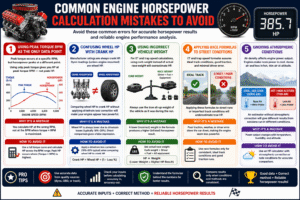
Using Peak Torque RPM as the Only Data Point Peak torque occurs at a specific RPM, but horsepower peaks at a different point. Using only peak torque in your power calculator gives you horsepower at peak torque RPM — not peak horsepower. For peak horsepower, you need torque data at the RPM where the torque × RPM product is maximized.
Confusing Wheel Horsepower with Crank Horsepower Manufacturer ratings are always crank horsepower. Dyno readings (unless engine-mounted) are wheel horsepower. Comparing wheel horsepower from a dyno against crank horsepower from a spec sheet without applying a drivetrain loss correction will make your engine appear less powerful than it is.
Using Incorrect Vehicle Weight For ET and trap speed calculations, using curb weight instead of actual race weight — including driver, fuel, and any added equipment — will produce an overestimated horsepower figure. Always use the true all-up weight of the vehicle as it was during the run.
Applying Race Formulas to Street Conditions The ET and trap speed formulas assume ideal track conditions, good traction, and minimal driver error. Applying these formulas to street runs or imperfect track conditions will underestimate your engine’s true horsepower, because the vehicle’s performance was limited by conditions rather than engine output.
Ignoring Atmospheric Conditions Air density affects engine power output — engines produce more power in cool, dense air and less in hot, thin air at altitude. An performance estimator that does not account for atmospheric correction will produce slightly different results from sessions run in different conditions, even with the same engine configuration.
Engine Horsepower Calculator for Different Engine Types
The core horsepower formula works universally — but different engine types have characteristics that affect how you interpret and apply horsepower tool results.
Naturally Aspirated (NA) Engines NA engines draw air through atmospheric pressure alone. Their power output is directly tied to displacement, compression ratio, cam profile, and breathing efficiency. An power output tool for NA engines typically uses torque and RPM data — the ET method is less reliable because NA engines are more sensitive to atmospheric conditions.
Turbocharged Engines Forced induction dramatically increases air density in the intake, allowing more fuel to be burned per cycle. Turbocharged engines can produce far more horsepower per liter of displacement than NA engines. The torque-RPM method is equally applicable, but be aware that turbocharged engines often show a significant torque plateau in the mid-RPM range, which affects where peak horsepower occurs.
Supercharged Engines Superchargers are driven by the engine itself (unlike turbochargers, which use exhaust gases). They provide more consistent power delivery across the RPM range. An HP estimator shows supercharged engines producing broad, flat power curves rather than the peaked curves typical of high-revving NA engines.
Diesel Engines Diesel engines produce very high torque at low RPM but typically redline at much lower RPM than gasoline engines. An power calculator for a diesel will show high torque figures but relatively modest peak horsepower compared to a gasoline engine of similar displacement — reflecting the diesel’s strength in towing and low-speed work rather than high-RPM performance.
Electric Motors Electric motors produce maximum torque at zero RPM, making the traditional torque-RPM formula less applicable for performance estimation. However, an performance estimator can still be used with trap speed or ET data to estimate the effective power output of an electric drivetrain from real-world performance measurements.
FAQs
What is an Engine Horsepower Calculator used for? An Engine Horsepower Calculator estimates the power output of an engine using measurable inputs such as torque and RPM, or real-world performance data like quarter-mile elapsed time and trap speed. It is used by enthusiasts, tuners, mechanics, and engineers to understand, compare, and optimize engine performance.
How accurate is an horsepower tool? Accuracy depends on the method used and the quality of the inputs. The torque-RPM method is typically accurate to within 5–10% of a professional dyno reading when using precise torque data. The ET and trap speed methods are accurate to within 8–15% for vehicles running near their mechanical limits on a prepared surface.
What is the difference between horsepower and torque? Torque is rotational force — the twisting power the engine exerts on the crankshaft, measured in foot-pounds. Horsepower is the rate at which that force does work over time. An power output tool converts between the two using the formula HP = (Torque × RPM) ÷ 5,252. High torque at low RPM characterizes diesel and towing engines; high horsepower at high RPM characterizes sports and racing engines.
What is wheel horsepower vs. crank horsepower? Crank horsepower is measured at the engine output shaft — the figure manufacturers quote. Wheel horsepower is measured at the wheels after drivetrain losses (friction in the transmission, driveshaft, and differential). An HP estimator can convert between the two by applying estimated drivetrain loss percentages (typically 12–22% depending on drivetrain type).
Can I use an power calculator without a dyno? Yes. An performance estimator using the torque-RPM method requires torque data, which can be obtained from an OBD-II scanner, aftermarket ECU software, or manufacturer specification sheets. The ET and trap speed methods require only a quarter-mile run and a timing system — no dyno needed.
Why does my horsepower tool result differ from my car’s advertised horsepower? Several factors can cause a difference: manufacturer ratings are measured at the crank under optimal conditions, while real-world conditions include drivetrain losses, air temperature, altitude, and engine wear. A result within 10–15% of the advertised figure is generally expected for a stock vehicle in normal operating condition.
How do I find the torque value to enter into an power output tool? Torque data is available from your vehicle’s owner manual or manufacturer specification sheet. More precise real-world data can be obtained from a professional dyno run, an OBD-II scanner with live torque output, or aftermarket ECU software. Always note the RPM at which the torque figure was recorded, as the RPM input is equally important in the calculation.
Can an HP estimator detect engine problems? Indirectly, yes. If your power calculator result falls significantly below your vehicle’s expected output, it can signal issues such as a clogged air filter, worn spark plugs, low compression, fuel delivery problems, or a failing sensor. A sustained 15–20% drop from baseline is a strong signal that diagnostic inspection is warranted.
Conclusion
An Engine Horsepower Calculator is an indispensable tool for anyone who cares about engine performance — from the weekend enthusiast building a project car to the professional tuner optimizing a race vehicle for competition. It transforms measurable mechanical data into the single most universally understood measure of engine capability — horsepower — without requiring expensive equipment or specialist expertise.
The formulas an performance estimator applies are the same ones used by engineers, dynamometer operators, and motorsport professionals. Understanding them — and using them correctly with accurate inputs — gives you a reliable, physics-based picture of what your engine is truly capable of, where its performance stands relative to expectations, and what modifications will produce the greatest gains.
Whether you are estimating the output of a stock engine, planning a performance build, diagnosing a power loss, or comparing two vehicles before a purchase, an horsepower tool delivers the data you need instantly and accurately. The investment is zero; the insight is invaluable.
Use an power output tool at every key stage of your vehicle’s performance journey — at baseline, after each modification, and whenever performance seems to change unexpectedly. The combination of accurate inputs, correct formula selection, and consistent tracking — powered by a reliable Engine Horsepower Calculator — is the foundation of informed, data-driven engine performance management for every type of vehicle and every level of enthusiast.