Discover Your Love Compatibility and Match Percentage in Seconds with Our Free Love Calculator
Table of Contents
- Introduction
- What Is a Gas Mileage Calculator?
- How a Gas Mileage Calculator Works
- Key Inputs for Accurate Gas Mileage Results
- Gas Mileage Calculator for Road Trips and Long Drives
- How to Improve the MPG Your Gas Mileage Calculator Reveals
- Gas Mileage Calculator for Comparing Vehicles
- City vs. Highway MPG – What Your Gas Mileage Calculator Shows
- Gas Mileage Calculator for Fleet and Business Vehicles
- Common Gas Mileage Calculation Mistakes to Avoid
- Gas Mileage Calculator vs. On-Board Trip Computer
- FAQs
- Conclusion
Introduction
Every driver pays for fuel — but very few drivers know exactly how efficiently their vehicle is using it. Whether you are planning a road trip, trying to reduce your monthly fuel bill, comparing two vehicles before a purchase, or simply curious about how your car stacks up against its rated efficiency, you need one essential tool: a Gas Mileage Calculator.
A Gas Mileage Calculator gives you a precise, data-based view of your vehicle’s fuel efficiency. By entering the miles driven and the gallons of fuel consumed, it calculates your actual miles per gallon (MPG) — the real-world figure that reflects how your driving habits, vehicle condition, and route characteristics combine to determine what you spend at the pump.
This guide covers everything you need to know about the Gas Mileage Calculator: how it works, what inputs it requires, how to use your results to reduce fuel costs, and how to compare it against manufacturer ratings and on-board computer readings. Whether you drive a compact car, an SUV, a truck, or a hybrid, a Gas Mileage Calculator is the starting point for smarter, more cost-efficient driving.
What Is a Gas Mileage Calculator?
A Gas Mileage Calculator is a digital tool that calculates how many miles your vehicle travels per gallon of fuel consumed. It takes two straightforward inputs — the distance driven and the amount of fuel used — and produces your fuel efficiency in miles per gallon (MPG) or, for metric users, liters per 100 kilometers (L/100km).
The output of a Gas Mileage Calculator is the single most important figure for understanding your vehicle’s running cost. Once you know your real-world MPG, you can:
- Calculate exactly what a specific trip will cost in fuel
- Compare your actual efficiency against the manufacturer’s EPA rating
- Track changes in efficiency over time to detect mechanical issues
- Evaluate whether driving habits or route changes are saving or costing fuel
- Make an informed comparison between two vehicles you are considering
A Gas Mileage Calculator is used by:
- Daily commuters tracking fuel cost against their monthly budget
- Road trip planners estimating fuel expenses before departure
- Car buyers comparing real-world efficiency of different models
- Fleet managers monitoring fuel performance across multiple vehicles
- Eco-conscious drivers measuring the impact of efficiency improvements
- Mechanics and technicians identifying declining efficiency as a diagnostic signal
The simplicity of a Gas Mileage Calculator is part of its power. Two inputs, one essential output — and from that output, a complete picture of your vehicle’s fuel performance and running cost.
How a Gas Mileage Calculator Works
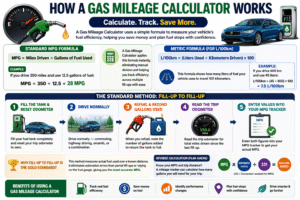
The formula at the heart of every Gas Mileage Calculator is straightforward:
MPG = Miles Driven ÷ Gallons of Fuel Used
For example, if you drive 350 miles and use 12.5 gallons of fuel:
MPG = 350 ÷ 12.5 = 28 MPG
A Gas Mileage Calculator applies this formula instantly, eliminating the need for manual division and allowing you to track efficiency across multiple fill-ups with ease.
For metric users, the equivalent calculation is:
L/100km = (Liters Used ÷ Kilometers Driven) × 100
The standard method for using a fuel efficiency tool with a physical vehicle:
- Fill your fuel tank completely and reset your trip odometer to zero.
- Drive normally — commuting, highway driving, errands, or a combination.
- When you refuel, note the number of gallons added to return the tank to full.
- Read the trip odometer for total miles driven since the last fill-up.
- Enter both figures into your MPG tracker to get your actual MPG.
This fill-up-to-fill-up method is the gold standard for accurate fuel efficiency measurement. It eliminates the estimation errors that come from partial fill-ups or relying on the fuel gauge.
A mileage tracker can also work in reverse — if you know your MPG and your trip distance, it calculates how many gallons you will need, which is essential for fuel stop planning on long drives.
Key Inputs for Accurate Gas Mileage Results
The accuracy of any fuel calculator depends entirely on the precision of the inputs you provide. Small measurement errors compound into significant inaccuracies in the final MPG figure.
Miles Driven Use your vehicle’s trip odometer, not an estimate. The trip odometer measures actual wheel rotation distance, making it the most accurate source of distance data available to a driver. GPS navigation apps can also provide reliable distance figures for planned or completed routes.
Gallons Used The most accurate fuel measurement comes from a complete fill-up at the pump. Fill the tank to the automatic shutoff point each time, and use the pump display to read the exact gallons added. Avoid topping off, as this adds fuel beyond the shutoff point and can distort your calculation.
Fuel Type Consistency If your vehicle accepts different fuel grades (regular, midgrade, premium), use the same grade consistently across measurements to isolate efficiency differences caused by driving behavior rather than fuel type.
Consistent Conditions For the most meaningful comparison between fill-ups, try to measure under similar conditions — similar routes, similar loads, and similar weather. Dramatic changes in temperature, terrain, or load between fill-ups can make efficiency comparisons misleading, even when the efficiency calculator arithmetic is correct.
Multiple Fill-Up Averaging A single fill-up measurement can be skewed by an unusually efficient or inefficient driving session. For the most reliable MPG figure, track three to five consecutive fill-ups and average the results in your fuel efficiency tool. This smooths out the natural variation between individual driving sessions.
Gas Mileage Calculator for Road Trips and Long Drives
Road trip planning is one of the most valuable applications of a Gas Mileage Calculator. Knowing your vehicle’s real-world MPG before departure allows you to estimate total fuel cost, plan fuel stops, and budget accurately for the journey.
To use a MPG tracker for road trip planning:
- Confirm your vehicle’s actual MPG from recent fill-up data.
- Measure the total route distance using a navigation app.
- Research fuel prices at your origin, destination, and major stops along the route.
- Enter distance and MPG into your mileage tracker to find total gallons needed.
- Multiply gallons needed by average fuel price for total estimated fuel cost.
For multi-day or multi-destination road trips, break the journey into legs and calculate each segment separately. Different legs may have different efficiency characteristics — a mountain crossing will use more fuel per mile than flat interstate driving, and a fuel calculator lets you account for this by using terrain-appropriate MPG estimates for each segment.
A efficiency calculator also helps you plan fuel stops on long drives. If your vehicle has a 15-gallon tank and you get 30 MPG, your maximum range on a full tank is 450 miles. Use your fuel efficiency tool to identify the longest possible intervals between fuel stops, and cross-reference with available fuel stations along your planned route to avoid running low in remote areas.
How to Improve the MPG Your Gas Mileage Calculator Reveals
Once your Gas Mileage Calculator shows you your real-world MPG, you have a baseline to improve from. The difference between your actual MPG and your vehicle’s rated MPG represents potential fuel savings — and most of it is recoverable through driving behavior and vehicle maintenance.
Maintain Proper Tire Pressure Under-inflated tires increase rolling resistance, reducing fuel efficiency. Each 1 PSI drop below the recommended pressure reduces MPG by approximately 0.2%. Check tire pressure monthly and before long trips. Run a MPG tracker comparison before and after correcting tire pressure to measure the improvement.
Drive at Steady Speeds Aggressive acceleration and hard braking waste the energy gained from fuel. Smooth, progressive acceleration and anticipatory braking — coasting to a stop rather than braking hard — can improve MPG by 15–30% in urban driving conditions.
Reduce Highway Speed Aerodynamic drag increases with the square of speed. Driving at 65 mph instead of 75 mph can improve highway MPG by 10–15%. This is consistently one of the most impactful changes visible in a mileage tracker comparison between driving sessions.
Reduce Unnecessary Weight Every 100 pounds of extra weight reduces fuel efficiency by approximately 1–2%. Remove roof racks, cargo carriers, and any unnecessary items from your trunk when they are not needed. The improvement may seem small but accumulates meaningfully over thousands of miles.
Service Your Vehicle Regularly A clogged air filter, worn spark plugs, dirty fuel injectors, or degraded engine oil all reduce combustion efficiency. Regular servicing keeps your real-world MPG aligned with your vehicle’s potential, and a drop in your fuel calculator readings is often the first signal that maintenance is overdue.
Use Cruise Control on Highways Cruise control maintains a constant speed more consistently than a human driver, eliminating the minor speed fluctuations that cost fuel. On flat highway sections, cruise control typically improves MPG by 3–7% — a consistent improvement visible in fill-up-to-fill-up efficiency calculator tracking.
Gas Mileage Calculator for Comparing Vehicles
A Gas Mileage Calculator is one of the most powerful tools for making an informed vehicle purchase decision. Manufacturer MPG ratings provide a starting point, but real-world efficiency depends on driving patterns, climate, and vehicle condition. Calculating the actual fuel cost difference between two vehicles over your expected annual mileage can reveal thousands of dollars in savings or costs.
How to compare two vehicles with a fuel efficiency tool:
- Enter your expected annual mileage (e.g., 15,000 miles per year)
- Enter the MPG of Vehicle A and Vehicle B
- Enter your local fuel price
- Calculate annual fuel cost for each vehicle
Example comparison:
- Vehicle A: 25 MPG × 15,000 miles = 600 gallons × $4.00 = $2,400/year
- Vehicle B: 35 MPG × 15,000 miles = 429 gallons × $4.00 = $1,716/year
- Annual savings with Vehicle B: $684
Over five years, that difference amounts to $3,420 in fuel savings — a significant factor in the total cost of ownership that many buyers overlook when comparing sticker prices alone. A MPG tracker makes this lifetime cost difference immediately visible and concrete.
City vs. Highway MPG – What Your mileage tracker Shows
One of the most common surprises new drivers encounter is the significant difference between city and highway fuel efficiency. Understanding this difference makes your fuel calculator results more interpretable and your efficiency targets more realistic.
City driving characteristics that reduce MPG:
- Frequent acceleration and braking at traffic lights and intersections
- Low average speeds that keep the engine in less efficient operating ranges
- More idling time at traffic signals and in congestion
- Shorter trips that do not allow the engine to fully warm up to optimal temperature
Highway driving characteristics that improve MPG:
- Steady speeds in the most efficient engine operating range
- Minimal braking and acceleration events
- Longer continuous driving that allows the engine to run at optimal temperature
- Reduced idling time
Most vehicles achieve 20–35% better fuel efficiency on the highway than in city driving. A vehicle rated at 22 MPG city and 32 MPG highway will show dramatically different figures in a efficiency calculator depending on whether the fill-up period was dominated by city or highway miles.
For mixed driving, the EPA combined rating (a weighted average of city and highway) is the best comparison benchmark. Track your MPG over several fill-ups that include a representative mix of city and highway driving for the most realistic average figure.
Gas Mileage Calculator for Fleet and Business Vehicles
For businesses that operate vehicles — from delivery flans and service teams to sales fleets and construction companies — a Gas Mileage Calculator is a critical financial management tool.
Key business applications include:
- Fuel budget forecasting: Use MPG data and planned mileage to project monthly and annual fuel costs
- Driver performance monitoring: Identify drivers whose MPG consistently falls below fleet averages — often a sign of aggressive driving habits
- Vehicle health tracking: A sudden drop in a vehicle’s MPG reading on a fuel efficiency tool frequently signals a maintenance issue before it becomes a breakdown
- Route optimization: Compare the fuel cost of different routes to identify the most cost-effective paths for regular runs
- Replacement decisions: Calculate the fuel cost savings of replacing an aging, low-efficiency vehicle with a newer, more efficient model
Consistent MPG tracker tracking across a fleet produces a dataset that reveals patterns invisible in single-vehicle snapshots. Fleet managers who track MPG fill-up by fill-up can identify and address efficiency problems weeks or months before they escalate into costly breakdowns or unexplained fuel budget overruns.
Common Gas Mileage Calculation Mistakes to Avoid
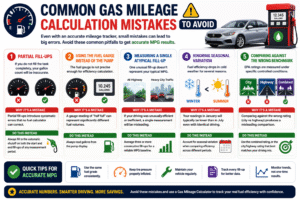
Even with an accurate mileage tracker, certain common errors can produce misleading results.
Partial Fill-Ups If you do not fill the tank completely at each measurement point, your gallon count will be inaccurate. Always fill to the automatic shutoff on both the start and end fill-ups of any measurement period. Partial fill-ups introduce systematic errors that no fuel calculator can correct.
Using the Fuel Gauge Instead of the Pump The fuel gauge is not precise enough for efficiency calculation. A gauge reading of “half full” can represent significantly different fuel volumes depending on tank shape and gauge calibration. Always read gallons from the pump display.
Measuring a Single Atypical Fill-Up If your most recent driving period was unusually efficient (all highway) or unusually inefficient (all city traffic with heavy load), a single fill-up measurement will not represent your typical MPG. Average three or more consecutive fill-ups for a reliable baseline.
Ignoring Seasonal Variation Fuel efficiency drops in cold weather due to increased engine warm-up time, thicker lubricants, and cold-weather gasoline blends. Your efficiency calculator readings in January will typically be lower than in July even with identical driving behavior. Account for seasonal variation when comparing efficiency across different time periods.
Comparing Against the Wrong Benchmark EPA ratings are measured under specific controlled conditions. Comparing your fuel efficiency tool result directly against the city rating when you drive mostly highway — or vice versa — produces a misleading comparison. Use the combined rating, or compare against the city or highway rating that best matches your driving mix.
Gas Mileage Calculator vs. On-Board Trip Computer
Most modern vehicles include an on-board trip computer that displays a real-time or average MPG reading. How does this compare to a manual Gas Mileage Calculator based on fill-up data?
| Method | Accuracy | Update Frequency | Best Use |
|---|---|---|---|
| On-board trip computer | Moderate (±5–10%) | Continuous | Real-time feedback |
| MPG tracker (fill-up) | High (±1–2%) | Each fill-up | True baseline measurement |
On-board computers are useful for real-time driving feedback — they show you immediately when your driving style is hurting efficiency. However, they are calibrated from fuel injector pulse data and can be off by 5–10% compared to actual pump measurements.
A mileage tracker based on fill-up data is consistently more accurate because it measures the actual volume of fuel consumed and the actual distance driven — both directly measured rather than estimated by sensors. Use the on-board computer for moment-to-moment guidance and your fuel calculator for true baseline accuracy.
FAQs
What is a Gas Mileage Calculator used for? A Gas Mileage Calculator calculates your vehicle’s fuel efficiency in miles per gallon (MPG) based on the distance driven and the fuel consumed. It is used to track efficiency, estimate trip fuel costs, compare vehicles, and identify changes in performance over time.
How do I calculate gas mileage accurately? Fill your tank completely and reset your trip odometer. Drive normally until your next fill-up. Record the exact gallons added and miles driven, then enter both into a efficiency calculator. The result is your actual real-world MPG for that driving period.
Why is my fuel efficiency tool result lower than the EPA rating? EPA ratings are produced under controlled laboratory conditions. Real-world driving involves varying speeds, traffic, temperature, vehicle load, and driving style — all of which reduce efficiency. A MPG tracker result 10–20% below the EPA rating is normal for most drivers in typical conditions.
Can a mileage tracker help me save money on fuel? Yes. By tracking your MPG consistently with a fuel calculator, you establish a baseline and can measure the impact of changes — slower highway speeds, better tire pressure, smoother acceleration — in real fuel savings terms. Knowing your exact MPG makes efficiency improvements concrete and measurable.
What causes sudden drops in gas mileage? Sudden efficiency drops detected by a efficiency calculator can indicate low tire pressure, a clogged air filter, dirty fuel injectors, worn spark plugs, a failing oxygen sensor, or a change in driving conditions. A sustained drop of more than 10–15% from your normal baseline warrants a vehicle inspection.
How often should I track my gas mileage? Tracking every fill-up gives you the richest dataset and the earliest warning of efficiency changes. At minimum, use a fuel efficiency tool once per month to monitor your vehicle’s performance and catch any emerging issues before they become expensive problems.
Does the type of gasoline affect MPG tracker results? Yes. Premium fuel has slightly higher energy density than regular, but the improvement is minimal in vehicles designed for regular fuel. Using premium fuel in a vehicle that requires only regular does not meaningfully improve MPG and simply increases fuel cost. Always use the grade your manufacturer recommends.
Can I use a mileage tracker for electric or hybrid vehicles? Standard MPG-based fuel calculator tools are designed for gasoline and diesel vehicles. Electric vehicles use miles per kWh (or MPGe) as their efficiency metric. Hybrid vehicles can use a standard efficiency calculator for their gasoline consumption, but the calculation will not capture the contribution of the electric drivetrain to overall efficiency.
Conclusion
A Gas Mileage Calculator is one of the most practically powerful tools available to any driver, fleet manager, or vehicle owner who wants to understand, track, and improve their fuel efficiency. It takes two simple inputs and returns the single most important figure for managing your vehicle’s running cost — your actual miles per gallon.
The real-world MPG a fuel efficiency tool reveals is almost always different from the manufacturer’s rating — and the gap between them is a direct measure of the savings available through better driving habits, proper vehicle maintenance, and smarter route planning. Closing that gap with the insights a MPG tracker provides can save hundreds or thousands of dollars per year in fuel costs.
Whether you drive a single vehicle for personal use, manage a fleet of work vehicles, or are comparing options before your next car purchase, consistent use of a mileage tracker gives you the data you need to make smarter, more cost-effective decisions at every stage of vehicle ownership.
Use a fuel calculator at every fill-up, track your results over time, and act on the patterns you discover. The combination of accurate measurement, consistent tracking, and data-driven improvement — supported by a reliable Gas Mileage Calculator — is the foundation of efficient, cost-conscious driving for every vehicle and every driver.