Discount Calculator
Calculate monthly lease payments, lease costs, and savings instantly with our Auto Lease Calculator
Table of Contents
- Introduction
- What Is a Discount Calculator?
- Why Everyone Needs a Discount Calculator
- How a Discount Calculator Works — The Math Behind the Savings
- Key Inputs in a Discount Calculator Explained
- How to Use a Discount Calculator Step by Step
- Understanding Your Discount Calculator Results
- Percentage Discounts vs. Fixed Dollar Discounts — Which Saves More?
- How Retailers Use Discounts — And How a Discount Calculator Protects You
- Practical Uses of a Discount Calculator in Everyday Life
- Business Applications of a Discount Calculator
- Common Mistakes to Avoid When Using a Discount Calculator
- Frequently Asked Questions (FAQs)
- Conclusion
Introduction
Discounts are everywhere — but not all discounts are what they appear to be.
A “30% off” sign feels exciting. A “$20 off” coupon feels valuable. But without calculating the exact savings, you can never be fully certain whether a deal is genuinely good — or just marketing designed to look that way.
That is exactly why a Discount Calculator is one of the most useful, practical tools you can have at your fingertips.
A Discount Calculator instantly tells you the final price after a discount, the exact dollar amount you are saving, and the real value of any deal — whether the discount is expressed as a percentage or a fixed dollar amount.
It is a tool for shoppers who want to stretch their budgets further. It is a tool for businesses that need to price promotions accurately. It is a tool for students, travelers, investors, and anyone who encounters discounts in daily life.
This complete guide covers everything — how a Discount Calculator works, how to use it for maximum benefit, and how to avoid the common pricing traps that make discounts look better than they really are.
What Is a Discount Calculator?
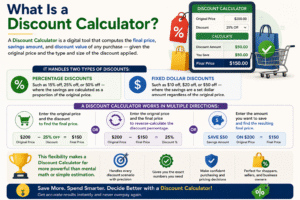
A Discount Calculator is a digital tool that computes the final price, savings amount, and discount value of any purchase — given the original price and the type and size of the discount applied.
It handles two types of discounts:
- Percentage discounts — such as 15% off, 25% off, or 50% off — where the savings are calculated as a proportion of the original price.
- Fixed dollar discounts — such as $10 off, $20 off, or $50 off — where the savings are a set dollar amount regardless of the original price.
A Discount Calculator works in multiple directions. You can enter the original price and the discount to find the final price. Or you can enter the original price and the final price to reverse-calculate the discount percentage. Or you can enter the amount you want to save and find the resulting final price.
This flexibility makes a Discount Calculator far more powerful than mental math or simple estimation. It handles every discount scenario with precision — giving you the exact numbers you need to make confident purchasing and pricing decisions.
Why Everyone Needs a Discount Calculator
Mental math is unreliable — and retailers know it.
When you see a “$200 jacket marked down by 35%,” calculating the exact savings in your head under shopping pressure is genuinely difficult. You might estimate $60 to $70 — but the exact answer is $70. That $10 gap might matter to your budget.
A Discount Calculator eliminates estimation error completely.
Here is exactly why a Discount Calculator belongs on every shopper’s phone and every business owner’s desk:
It gives you the exact savings — not an approximation. Whether the discount is a clean round number or a complex percentage like 17.5% on an irregular price, the Discount Calculator delivers a precise result every time.
It prevents impulse buying disguised as savings. Just because a product is “on sale” does not mean you are getting a good deal. A Discount Calculator shows you the actual dollar amount saved — which may or may not justify the purchase depending on your budget and priorities.
It helps you compare deals across different stores. Store A offers 25% off a $120 item. Store B offers $28 off the same item at $125. Which is the better deal? A Discount Calculator answers that question in seconds — revealing which offer puts more money back in your pocket.
It protects you from misleading “original price” claims. Many retailers inflate the stated original price to make the discount look bigger. A Discount Calculator lets you verify whether the discounted price is genuinely competitive by checking what percentage of the original price you are saving.
It makes coupon stacking and multi-discount scenarios easy. When combining a percentage discount with a coupon dollar amount, the Discount Calculator lets you model each layer of discount in sequence — so you always know your true final price.
How a Discount Calculator Works — The Math Behind the Savings
Understanding the mathematics behind a Discount Calculator helps you use it more effectively and catch errors in retailer calculations.
Calculating a Percentage Discount:
To find the savings amount from a percentage discount:
Savings = Original Price × (Discount % ÷ 100)
To find the final price after a percentage discount:
Final Price = Original Price − Savings
Example: A $59.99 item with a 15% discount.
- Savings = $59.99 × 0.15 = $9.00
- Final Price = $59.99 − $9.00 = $50.99
Calculating a Fixed Dollar Discount:
Savings = Dollar Discount Amount
Final Price = Original Price − Dollar Discount
Example: A $59.99 item with a $12 off coupon.
- Savings = $12.00
- Final Price = $59.99 − $12.00 = $47.99
Reverse-Calculating the Discount Percentage:
When you know the original price and final price but want to know the discount percentage:
Discount % = ((Original Price − Final Price) ÷ Original Price) × 100
Example: Original price $80, sale price $60.
- Discount % = (($80 − $60) ÷ $80) × 100 = 25%
A Discount Calculator performs all three of these calculations automatically — choosing the appropriate formula based on which fields you have filled in. This makes it far faster and more reliable than manual calculation in any shopping, pricing, or budgeting scenario.
Key Inputs in a Discount Calculator Explained
The Discount Calculator has four flexible input fields. You do not need to fill all four — the calculator intelligently determines which inputs to use based on what you provide.
Price Before Discount ($)
The original selling price of the item — the price before any discount, coupon, or promotion is applied.
Always enter the actual listed original price — not the marked-down price, not an assumed original price, and not a guess. If the original price is not clearly displayed, use a Discount Calculator in reverse to compute it from the final price and discount percentage.
Discount (% or $)
The discount amount — expressed either as a percentage or as a fixed dollar amount, depending on which type selector you choose.
Select % for percentage discounts — where the savings scale proportionally with the original price. For example, 20% off a $50 item saves $10, but 20% off a $200 item saves $40.
Select $ for fixed dollar discounts — where the savings are the same regardless of the original price. A $15 off coupon saves $15 whether the item costs $50 or $500.
Understanding this distinction is critical for comparing deals accurately. The Discount Calculator handles both types with equal precision — simply select the correct type from the dropdown before entering the discount amount.
Price After Discount ($)
The final price you will actually pay after the discount is applied.
If you already know the final sale price but want to calculate your savings and the implied discount percentage, enter it here. The Discount Calculator will work backward from the final price and original price to determine how much you are saving and what discount rate that represents.
Leave this field at zero if you want the Discount Calculator to compute the final price for you based on the original price and discount amount.
You Saved ($)
The exact dollar amount you want to save — used when you have a specific savings target in mind.
If you know how much you want to save but need to know the resulting final price, enter your target savings here. The Discount Calculator will deduct that savings from the original price to show you the final amount payable.
This field is especially useful for budgeting scenarios — for example, when you know you can only spend $45 on an item and want to know how much you need to save from a $60 original price.
How to Use a Discount Calculator Step by Step
The Discount Calculator is designed to be fast and flexible. Here is how to use it for the most common scenarios:
Scenario 1 — Calculate the Final Price from a Percentage Discount:
- Enter the original price in the Price Before Discount field.
- Enter the discount percentage in the Discount field.
- Make sure % is selected in the type dropdown.
- Leave Price After Discount and You Saved at zero.
- Click Calculate.
- The Discount Calculator shows your final price and the exact dollar amount saved.
Scenario 2 — Calculate the Final Price from a Fixed Dollar Discount:
- Enter the original price in the Price Before Discount field.
- Enter the dollar discount amount in the Discount field.
- Select $ in the type dropdown.
- Leave the other fields at zero.
- Click Calculate.
- The Discount Calculator shows your final price and confirms the savings amount.
Scenario 3 — Find the Discount Percentage When You Know Both Prices:
- Enter the original price in the Price Before Discount field.
- Enter the actual sale price in the Price After Discount field.
- Leave the Discount and You Saved fields at zero.
- Click Calculate.
- The Discount Calculator shows you how much you are saving in dollar terms — and you can compute the percentage using the savings divided by original price.
Scenario 4 — Find the Final Price When You Know Your Target Savings:
- Enter the original price in the Price Before Discount field.
- Enter your desired savings amount in the You Saved field.
- Leave the Discount and Price After fields at zero.
- Click Calculate.
- The Discount Calculator deducts your target savings from the original price to show the final payable amount.
Understanding Your Discount Calculator Results
Every result from the Discount Calculator is clear, direct, and immediately actionable:
Original Price confirms the starting price you entered — the pre-discount baseline for the entire calculation. Always verify this number matches what is actually displayed on the price tag — some retailers list misleading original prices designed to make discounts appear larger than they are.
Saved ($) is the exact dollar amount you will save by purchasing the item at the discounted price. This is the most important number the Discount Calculator produces — because it tells you the concrete real-world value of the deal in money you keep in your pocket. A 40% discount sounds impressive — but a Discount Calculator instantly shows you whether that percentage translates to $8 in savings (on a $20 item) or $400 in savings (on a $1,000 item).
Price After Discount is the actual amount you will pay at the register. This is the number that matters for your budget. Knowing this exact figure — rather than estimating it — lets you plan your spending with precision and avoids unpleasant surprises at checkout.
Percentage Discounts vs. Fixed Dollar Discounts — Which Saves More?
This is one of the most common and important questions the Discount Calculator can answer instantly.
The winner depends entirely on the original price.
For high-priced items, percentage discounts almost always save more. A 25% discount on a $500 item saves $125. A $50 off coupon on the same item saves only $50. Use the Discount Calculator to enter both scenarios and compare.
For low-priced items, fixed dollar discounts often save a higher percentage of the total price. A $10 off coupon on a $25 item saves 40% of the purchase price. A 25% discount on the same item saves only $6.25. The Discount Calculator reveals this instantly — which is why it matters to check both options when both are available.
The key insight: never assume a larger discount percentage automatically means more dollars saved. A Discount Calculator removes the assumption and replaces it with exact dollar figures — so you always know which deal puts more money back in your pocket.
Practical tip: When a store offers you a choice between “15% off your entire purchase” and “$20 off any purchase over $100,” use the Discount Calculator to enter your cart total and compare the actual savings from both options. The option that saves the most dollars — not the one with the bigger-sounding percentage — is always the better deal.
How Retailers Use Discounts — And How a Discount Calculator Protects You
Understanding retail discount psychology makes you a smarter, more protected shopper.
Retailers use several well-documented tactics to make discounts appear more valuable than they are. A Discount Calculator helps you see through every one of them.
Inflated original prices: The most common tactic. A $40 item is briefly listed at $80, then “discounted” to $40 — appearing to be a 50% off deal but actually selling at the normal market price. Use the Discount Calculator in reverse — enter the original and sale prices to see if the implied discount is consistent with what you can find at other retailers.
Anchoring with large discount percentages on low-priced items: “70% off!” sounds extraordinary — but on a $5 item, 70% off saves only $3.50. A Discount Calculator instantly converts impressive-sounding percentages into real dollar savings, making it easy to see whether the deal is genuinely significant.
Confusing percentage and dollar discounts on multi-item deals: “Buy two and get 30% off the second item” is harder to compute mentally than it seems, especially with different prices. Run the full cart through a Discount Calculator to find the true per-item cost and actual total savings.
Stacking discounts incorrectly: When two percentage discounts are applied sequentially — for example, 20% off followed by an additional 10% off — many people add them to get 30%. But sequential percentage discounts do not add up that way. A Discount Calculator handles sequential discounts correctly — 20% off then 10% off on a $100 item equals $28 saved, not $30.
Practical Uses of a Discount Calculator in Everyday Life
The Discount Calculator is not just a shopping tool — it has practical applications across dozens of everyday financial scenarios:
Grocery shopping and coupon stacking: Compare multiple coupon offers against percentage sales to find the maximum savings on your weekly grocery budget. A Discount Calculator helps you determine which combination of discounts to use first to maximize your total savings.
Online shopping and promo codes: Before applying a promo code at checkout, use the Discount Calculator to estimate your savings and verify that the discount applied by the retailer matches what you expected.
Seasonal sale shopping: During Black Friday, end-of-season, or clearance sales, you often face rapid decisions across multiple items. A Discount Calculator lets you quickly verify each deal — ensuring you are buying because the savings are genuine, not just because the marketing is compelling.
Restaurant and entertainment discounts: When a dining deal offers “25% off your total bill” or a streaming service offers “3 months at 40% off,” the Discount Calculator converts these percentages into real dollar amounts that help you decide whether the deal fits your budget.
Travel and hotel booking: Percentage discounts on hotels and flights can represent hundreds of dollars in savings — or surprisingly small amounts depending on the base price. Always run travel discounts through the Discount Calculator to confirm the actual dollar savings before committing to a booking.
Personal finance and budgeting: When planning purchases months in advance — electronics, appliances, furniture — use the Discount Calculator to model expected sale prices at common discount percentages, helping you budget accurately for upcoming spending.
Business Applications of a Discount Calculator
For business owners, the Discount Calculator is an essential pricing and promotion management tool.
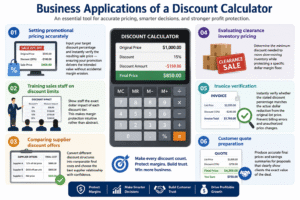
Setting promotional pricing accurately: When planning a sale, a Discount Calculator lets you input your target discount percentage and instantly verify the resulting sale price — ensuring your promotion delivers the intended value to customers without accidental margin erosion.
Training sales staff on discount limits: Rather than empowering staff to offer “up to X% off” without oversight, use a Discount Calculator to show them the exact dollar impact of each discount tier. This makes margin protection intuitive rather than abstract.
Comparing supplier discount offers: When multiple suppliers offer different discount structures — 12% off list price versus $450 off per unit versus net pricing at a specific level — a Discount Calculator converts every offer into comparable final costs, making the best supplier relationship easy to identify.
Evaluating clearance inventory pricing: When marking down slow-moving inventory, a Discount Calculator helps you quickly determine the minimum discount needed to move the product while protecting a specific dollar margin floor.
Invoice verification: When receiving supplier invoices that claim specific discount amounts, the Discount Calculator instantly verifies whether the stated discount percentage matches the actual dollar reduction from the original list price. This prevents billing errors and unauthorized price changes from going undetected.
Customer quote preparation: When preparing discount quotes for B2B customers, a Discount Calculator produces accurate final prices and savings summaries that can be included directly in proposals — showing clients the exact value of the deal you are offering in clear dollar terms.
Common Mistakes to Avoid When Using a Discount Calculator
Avoid these frequent errors to ensure your Discount Calculator results are accurate and actionable:
Mistake 1 — Entering the sale price instead of the original price. The “Price Before Discount” field must contain the original pre-discount price — not the sale price. Entering the sale price as the starting point and then applying the discount again will double-count the discount, producing an incorrect final result.
Mistake 2 — Adding sequential percentage discounts instead of calculating them sequentially. If a store offers 20% off and then an additional 10% off the already-discounted price, do not enter 30% as the combined discount. Use the Discount Calculator twice — first apply the 20% discount to get the intermediate price, then apply the 10% discount to that intermediate price. Sequential discounts must always be calculated in sequence.
Mistake 3 — Assuming a higher discount percentage always means more savings. A 40% discount on a $25 item saves $10. A 20% discount on a $100 item saves $20. The Discount Calculator removes this confusion instantly — always check the dollar savings, not just the percentage, before declaring one deal superior to another.
Mistake 4 — Forgetting to account for taxes after the discount. The Discount Calculator computes your price after discount — but in most jurisdictions, sales tax is applied to the discounted final price, not the original price. After getting your discounted price from the Discount Calculator, factor in your local sales tax rate to find your true register total.
Mistake 5 — Not verifying the retailer’s stated original price. The Discount Calculator can only be as accurate as the original price you enter. If the retailer has inflated the stated original price to make the discount look larger, your Discount Calculator result will reflect that inflated baseline. Always verify original prices against independent sources before assuming the stated original price is genuine.
Frequently Asked Questions (FAQs)
Q1: What does a Discount Calculator calculate?
A Discount Calculator computes three key outputs: the exact dollar amount saved from a discount, the final price you will pay after the discount is applied, and — when you provide both the original and final prices — the implied discount percentage. It handles both percentage-based discounts and fixed dollar discounts, and can work in multiple directions depending on which information you already have.
Q2: How do I calculate a percentage discount without a Discount Calculator?
To manually calculate a percentage discount: multiply the original price by the discount percentage divided by 100 to get the savings, then subtract the savings from the original price to get the final price. For example, 15% off $60: savings = $60 × 0.15 = $9; final price = $60 − $9 = $51. However, using a Discount Calculator is always faster, eliminates arithmetic errors, and handles complex scenarios instantly without manual steps.
Q3: What is the difference between a percentage discount and a dollar discount in the Discount Calculator?
A percentage discount scales with the original price — 20% off a $100 item saves $20, while 20% off a $500 item saves $100. A dollar discount is fixed regardless of price — a $20 off coupon saves $20 whether the item costs $50 or $500. Use the Discount Calculator’s type selector (% or $) to choose the correct mode and enter your discount amount accordingly. For high-value items, percentage discounts almost always deliver greater dollar savings.
Q4: Can I use the Discount Calculator to find the original price from a sale price?
Yes — enter the sale price in the “Price After Discount” field and the discount percentage in the Discount field. The Discount Calculator will work backward to determine your savings, which you can use along with the final price to infer the original price. Alternatively, the reverse formula is: Original Price = Sale Price ÷ (1 − Discount %). For example, if the sale price is $85 and the discount is 15%, the original price = $85 ÷ 0.85 = $100.
Q5: How do I handle two discounts applied one after the other?
Apply each discount sequentially using the Discount Calculator — not by adding the percentages together. Step 1: Enter the original price and the first discount percentage, calculate the intermediate price. Step 2: Enter that intermediate price as the new “Price Before Discount” and apply the second discount. Two sequential discounts of 20% and 10% on a $100 item produce savings of $28 — not $30 — because the second discount applies to the already-reduced price, not the original.
Q6: Is a bigger discount percentage always a better deal?
Not always — and this is exactly why a Discount Calculator is so valuable. A 50% discount on a $10 item saves $5. A 20% discount on a $50 item saves $10. Always use the Discount Calculator to convert the discount percentage into a dollar savings amount — the deal that saves you more actual dollars is always the better financial choice, regardless of which percentage sounds more impressive.
Q7: Can businesses use a Discount Calculator for pricing promotions?
Absolutely — it is one of the most practical business applications of the Discount Calculator. Business owners can use it to set promotion prices that deliver specific discount percentages, verify supplier discount invoices, calculate sale prices across product ranges, evaluate the dollar margin impact of different discount tiers, and prepare accurate customer discount proposals. A Discount Calculator ensures promotional pricing is always precise, intentional, and aligned with profitability goals.
Q8: How accurate is a Discount Calculator?
A Discount Calculator is mathematically exact — it applies the precise formulas for percentage and dollar discount calculations without rounding errors or mental arithmetic mistakes. The accuracy of the output depends entirely on the accuracy of the inputs you enter. As long as you enter the correct original price and the correct discount amount, the Discount Calculator will produce a perfectly accurate final price and savings figure every single time.
Conclusion
Discounts are one of the most powerful financial tools available to shoppers and businesses alike — but only when you understand exactly what they are worth.
A deal that looks like 40% off might save you $8 or $400 depending on the item. A “$25 off” coupon might be better or worse than a percentage discount depending on your cart total. A “50% off sale” might be a genuine bargain or a marketing illusion built on an inflated original price.
A Discount Calculator cuts through all of that ambiguity in seconds.
It gives you the exact dollar savings — not an estimate. It shows you the precise final price — not a rounded guess. It lets you compare percentage and fixed dollar discounts side by side — so you always choose the option that saves you more.
For shoppers, a Discount Calculator is budget protection. For businesses, it is a pricing precision tool. For anyone who deals with discounts in daily life — which is everyone — it is simply the fastest, most accurate way to know the real value of any deal.
Stop estimating. Stop guessing. Stop letting attractive-sounding percentages cloud your judgment.
Use a Discount Calculator every time a discount is involved — and always know exactly what you are saving.