Auto Lease Calculator
Calculate VAT instantly, add or remove tax, and get accurate results with our VAT Calculator
Table of Contents
- Introduction
- What Is an Auto Lease Calculator?
- Why You Need an Auto Lease Calculator Before Signing Any Lease
- Key Inputs in an Auto Lease Calculator — Total Price Section
- Key Inputs in an Auto Lease Calculator — Monthly Payment Section
- How to Use an Auto Lease Calculator Step by Step
- Understanding Your Auto Lease Calculator Results
- Leasing vs. Buying — What the Auto Lease Calculator Reveals
- How Money Factor and Residual Value Drive Your Monthly Payment
- Smart Leasing Strategies Using an Auto Lease Calculator
- Common Mistakes to Avoid When Using an Auto Lease Calculator
- Frequently Asked Questions (FAQs)
- Conclusion
Introduction
Leasing a car seems simple on the surface — until you look at the numbers.
Dealerships quote attractive monthly payments that hide a web of fees, charges, residual values, and money factors that most consumers never fully understand.
An Auto Lease Calculator changes that completely.
It puts every single cost on the table — the net capitalized cost, acquisition fees, disposition fees, money factor, residual value, excess mileage charges, document fees, registration, insurance, and taxes — and computes your true total cost and monthly payment with complete transparency.
Without an Auto Lease Calculator, you are negotiating blind. With one, you walk into the dealership knowing exactly what every number should be — and what to push back on.
This complete guide covers everything you need — from understanding every input field to reading every result, comparing leasing against buying, and using proven strategies to minimize your total lease cost.
What Is an Auto Lease Calculator?
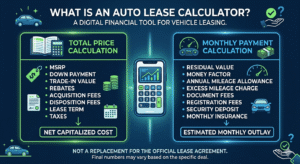
An Auto Lease Calculator is a digital financial tool that computes the complete cost of leasing a vehicle — both the total price breakdown and the detailed monthly payment estimate.
Unlike the simple lease payment quotes dealerships provide, an Auto Lease Calculator shows you every fee, charge, and cost component in a transparent, organized format. It separates your costs into two key categories:
Total Price calculation — covering the MSRP, down payment, trade-in value, rebates, acquisition fees, disposition fees, lease term, and taxes to produce your net capitalized cost.
Monthly Payment calculation — covering the residual value, money factor, annual mileage allowance, excess mileage charge, document fees, registration fees, security deposit, and monthly insurance to produce your estimated monthly outlay.
An Auto Lease Calculator is not a replacement for the official lease agreement. Final numbers may vary based on the specific deal structured by the leasing company. But it is the most powerful tool available for understanding, validating, and negotiating the terms of any car lease before you sign a single document.
Every car shopper considering a lease should use an Auto Lease Calculator before entering a dealership — and again before signing the final paperwork.
Why You Need an Auto Lease Calculator Before Signing Any Lease
Car leases are among the most financially complex consumer transactions most people will ever complete.
Dealerships are skilled at presenting monthly payment numbers that look attractive while obscuring the true total cost hidden in fees, residual values, and money factors.
An Auto Lease Calculator levels the playing field.
Here is exactly why using an Auto Lease Calculator before any lease is non-negotiable:
It reveals the real total cost of the lease. The monthly payment is not the total cost — it is a fraction of it. An Auto Lease Calculator adds acquisition fees, disposition fees, taxes, registration, document fees, and insurance to show you the actual total financial commitment you are making.
It exposes high money factors immediately. The money factor is the lease equivalent of an interest rate — but most dealerships present it as a tiny decimal like 0.002 rather than its equivalent annual interest rate of 4.8%. An Auto Lease Calculator makes the money factor’s true impact visible by showing you the finance charge it generates.
It validates or challenges the residual value. The residual value is the projected worth of the vehicle at lease end. A higher residual value lowers your monthly depreciation charge. Dealerships sometimes set artificially low residual values to inflate monthly payments. Running the numbers through an Auto Lease Calculator immediately shows whether the residual value makes financial sense.
It quantifies the cost of excess mileage. Most leases include 10,000 to 15,000 miles per year. Excess mileage fees of $0.15 to $0.30 per mile over the limit can be extremely costly. An Auto Lease Calculator lets you model realistic mileage scenarios so you never face surprise charges at lease end.
It empowers you to negotiate. When you arrive at the dealership with your own Auto Lease Calculator results, you know what the numbers should look like. Any significant deviation is a negotiating signal — and knowing the difference between a fair deal and an overpriced one is worth hundreds or thousands of dollars in savings.
Key Inputs in an Auto Lease Calculator — Total Price Section
The Total Price section of the Auto Lease Calculator establishes your net capitalized cost — the adjusted vehicle price that forms the basis of your lease payment calculations.
MSRP ($)
The Manufacturer’s Suggested Retail Price — the sticker price of the vehicle before any negotiation, discounts, or rebates.
MSRP is not necessarily what you should pay. Many vehicles can be negotiated below MSRP, which directly reduces your net capitalized cost and your monthly lease payment. Enter the MSRP into the Auto Lease Calculator first, then model a negotiated price below MSRP to see the monthly payment difference — it is often significant.
Down Payment ($)
The upfront cash you pay at lease signing to reduce the amount financed.
Down payments on leases are financially different from down payments on car purchases. In a purchase, a down payment reduces your loan balance and builds equity. In a lease, a down payment simply reduces your capitalized cost — you build no equity and never own the vehicle.
Most financial advisors recommend minimizing your down payment on a lease. If the vehicle is totaled or stolen, you typically lose your down payment — while still owing the remaining lease payments. The Auto Lease Calculator lets you compare lease scenarios with different down payment amounts to find the optimal balance.
Trade-In Value ($)
The value the dealer assigns to your current vehicle, applied as a credit against your new lease cost.
Trade-in value directly reduces your net capitalized cost — the lower that cost, the lower your monthly payment. Always research your vehicle’s trade-in value independently using third-party tools before accepting a dealer’s offer. Enter the fair market trade-in value into the Auto Lease Calculator to see its full impact on your payment.
Rebates ($)
Manufacturer or dealer cash rebates applied to reduce the cost of the lease.
Rebates are free money that directly reduce your capitalized cost. Always research current manufacturer lease incentives and rebates before visiting the dealership. Enter all applicable rebates into the Auto Lease Calculator to ensure they are fully accounted for in your net cost calculation.
Acquisition Fee ($)
A fee charged by the leasing company (usually the manufacturer’s financial arm) to set up the lease.
Acquisition fees typically range from $300 to $1,000 and are almost always non-negotiable. They are added to your capitalized cost — meaning you effectively finance this fee and pay interest on it throughout the lease term. Always include this fee in your Auto Lease Calculator so your net capitalized cost is accurate.
Disposition Fee ($)
A fee charged at the end of the lease if you return the vehicle rather than purchasing it or leasing another from the same manufacturer.
Disposition fees typically range from $200 to $500. Some manufacturers waive this fee if you immediately lease or purchase another vehicle from them. The Auto Lease Calculator includes this fee in your total cost projection so you have a complete picture of your end-of-lease financial obligations from day one.
Lease Term (Months)
The duration of your lease — typically 24, 36, or 48 months.
Lease term affects both your monthly payment and your total cost. Shorter terms generally mean higher monthly payments but lower total fees. Use the Auto Lease Calculator to compare 24-month, 36-month, and 48-month terms to find the sweet spot between monthly affordability and total cost efficiency.
Tax Rate (%)
Your local and state sales tax rate applied to the lease transaction.
Tax treatment of leases varies by state. Some states tax the full selling price of the vehicle upfront. Others tax only each individual monthly payment. Enter your applicable tax rate into the Auto Lease Calculator to estimate your tax obligation — and confirm the method with your dealer or tax advisor for your specific state.
Key Inputs in an Auto Lease Calculator — Monthly Payment Section
The Monthly Payment section of the Auto Lease Calculator determines your actual recurring monthly cost — covering the core lease charge plus all additional monthly and one-time costs.
Residual Value ($)
The projected market value of the vehicle at the end of the lease term — set by the leasing company.
Residual value is the single most important driver of your monthly payment. The higher the residual value, the smaller the difference between the vehicle’s starting cost and its ending value — meaning you are financing less depreciation, and your monthly payment is lower.
Research the expected residual value percentage for the specific vehicle before leasing. Vehicles with strong residual values — certain SUVs, luxury brands, and popular models — cost significantly less to lease than vehicles with weak residuals. Enter the residual value into the Auto Lease Calculator to see its direct impact on your monthly payment.
Money Factor
The lease equivalent of an interest rate — expressed as a tiny decimal (e.g., 0.002).
To convert a money factor to an approximate APR, multiply it by 2,400. A money factor of 0.002 equals approximately 4.8% APR. A money factor of 0.003 equals approximately 7.2% APR.
Always research the current buy rate money factor for the vehicle you are leasing — this is the base money factor the manufacturer charges dealers, which is publicly available from lease resources and enthusiast forums. Dealers sometimes mark up the money factor above the buy rate, which they are not required to disclose. The Auto Lease Calculator shows you the finance charge this generates, making inflated money factors immediately visible.
Annual Mileage
The total miles per year included in the standard lease allowance.
Most leases include 10,000, 12,000, or 15,000 miles per year. Choosing a higher mileage allowance increases your monthly payment — but it is almost always cheaper than paying excess mileage charges at lease end. Use the Auto Lease Calculator to model your realistic annual mileage and choose an allowance that covers it comfortably.
Excess Mileage Cost ($ per mile)
The per-mile charge for exceeding your mileage allowance at lease end.
Excess mileage fees typically range from $0.10 to $0.30 per mile depending on the vehicle and leasing company. On a 36-month lease, exceeding your mileage by just 5,000 miles at $0.25 per mile costs $1,250 — payable all at once when you return the vehicle. Enter your realistic mileage into the Auto Lease Calculator to see whether upgrading your annual allowance upfront is cheaper than risking excess mileage charges.
Document Fee ($)
The administrative fee charged for processing the lease paperwork.
Document fees vary by state — some states cap them while others allow dealers to charge whatever the market will bear. This fee is typically non-negotiable but is sometimes included in a dealer’s incentive package.
Registration Fee ($)
The state registration and license plate fee for the leased vehicle.
Registration fees vary significantly by state and vehicle value. They are typically paid upfront at lease signing or rolled into the monthly payment. The Auto Lease Calculator includes registration in your total payment calculation to ensure your budget reflects the complete cost of driving the vehicle legally.
Security Deposit ($)
A refundable deposit some leasing companies require — typically equal to one monthly payment.
Many manufacturers have eliminated security deposits, but some still require them for lower credit score lessees. Enter your actual security deposit requirement — if any — into the Auto Lease Calculator to understand your upfront cash requirement at signing.
Monthly Insurance ($)
Your estimated monthly vehicle insurance premium for the leased vehicle.
Leased vehicles typically require higher insurance coverage than owned vehicles — most leasing companies mandate comprehensive and collision coverage with specific minimum limits. Insurance is one of the most overlooked components of total lease cost. Including it in the Auto Lease Calculator gives you a realistic monthly budget number — not just the base lease payment.
How to Use an Auto Lease Calculator Step by Step
Follow these steps for accurate, complete results before you visit any dealership:
Step 1 — Research the vehicle thoroughly before entering any numbers. Before opening the Auto Lease Calculator, research the MSRP of the trim level you want, current manufacturer incentives and rebates, the residual value percentage for your target vehicle and lease term, the current buy rate money factor, and your state’s applicable tax treatment for leases.
Step 2 — Enter all Total Price section inputs accurately. Input your MSRP, planned down payment, trade-in value estimate, available rebates, and the standard acquisition and disposition fees for the vehicle’s leasing company. Set your preferred lease term and your local tax rate.
Step 3 — Calculate the Total Price and review the net capitalized cost. The Auto Lease Calculator will display your net capitalized cost — this is the core number that determines your monthly depreciation charge. If the net capitalized cost looks higher than expected, review each component — check whether the acquisition fee has been added correctly and whether your rebates and trade-in value have been properly applied.
Step 4 — Enter all Monthly Payment section inputs. Input the residual value (convert the residual percentage to a dollar amount by multiplying by MSRP), the money factor, your planned annual mileage, the excess mileage rate, document fee, registration fee, security deposit, and monthly insurance estimate.
Step 5 — Calculate the Monthly Payment and review every line item. The Auto Lease Calculator generates a detailed monthly payment breakdown. Review every component — particularly the finance charge (derived from the money factor), the monthly depreciation, and the total of all additional fees. Compare this against any dealership quote you have received.
Step 6 — Run scenario comparisons. Increase or decrease the down payment. Try a higher mileage allowance. Test a shorter or longer lease term. Reduce the money factor to the known buy rate. Each scenario run through the Auto Lease Calculator reveals the financial impact of each variable — giving you the knowledge to negotiate with precision.
Understanding Your Auto Lease Calculator Results
Each result from the Auto Lease Calculator tells an important part of your leasing financial picture:
Net Capitalized Cost is the adjusted vehicle price after applying your down payment, trade-in value, and rebates, and adding the acquisition fee. This is the amount you are effectively financing through the lease — the lower this number, the lower your monthly payment.
Estimated Tax shows the tax amount applied to the capitalized cost based on your entered tax rate. Understanding this number helps you budget for the upfront cash required at signing.
Grand Total represents your complete cost commitment across the full lease term — the sum of all payments, fees, taxes, and charges. This is the true apples-to-apples comparison number when evaluating leasing against purchasing.
Monthly Depreciation is the portion of your monthly payment covering the vehicle’s loss in value during the lease — calculated as the difference between the net capitalized cost and the residual value, divided by the number of lease months. This is typically the largest component of your monthly payment.
Finance Charge is the monthly interest cost generated by the money factor — the leasing equivalent of the interest portion of a loan payment. A higher money factor means a higher monthly finance charge. The Auto Lease Calculator makes this cost visible so you can immediately see the impact of money factor negotiation.
Total Monthly Payment is the complete monthly cost including base lease payment plus document fees, registration fees, insurance, and taxes — the number that must fit comfortably within your monthly budget.
Leasing vs. Buying — What the Auto Lease Calculator Reveals
The Auto Lease Calculator makes the leasing versus buying comparison concrete and financial — not just philosophical.
When leasing makes sense:
You prefer driving a new vehicle every 2 to 3 years. You drive within predictable annual mileage limits. You want lower monthly payments for the same vehicle versus a purchase loan. You use the vehicle for business and can deduct lease payments as expenses. The Auto Lease Calculator can show monthly lease payments that are 20% to 30% lower than equivalent loan payments for the same vehicle.
When buying makes more financial sense:
You drive high annual mileage. You keep vehicles for 6 to 10 years or longer. You want to build equity and eventually own the vehicle outright. You modify vehicles or have pets or children that create wear-and-tear concerns. The Auto Lease Calculator’s grand total over multiple successive leases will exceed the cost of ownership for long-term vehicle holders — making buying the financially superior choice.
The Auto Lease Calculator gives you the total lease cost number that you can directly compare against the total cost of purchasing — making the right decision for your specific situation clear and data-driven rather than based on monthly payment alone.
How Money Factor and Residual Value Drive Your Monthly Payment
No two variables in the Auto Lease Calculator have more impact on your monthly payment than the money factor and residual value.
Money Factor — the lease’s interest rate in disguise:
A money factor of 0.00150 = 3.6% APR equivalent. A money factor of 0.00250 = 6.0% APR equivalent. A money factor of 0.00350 = 8.4% APR equivalent.
On a $30,000 lease, the difference between a 0.00150 and 0.00350 money factor translates to approximately $40 to $60 more per month — or $1,440 to $2,160 more over a 36-month lease term.
Always negotiate the money factor down to the buy rate — the base rate the manufacturer charges dealers. Enter both the dealer-quoted money factor and the known buy rate into the Auto Lease Calculator to see exactly how much the markup is costing you monthly.
Residual Value — the depreciation gatekeeper:
A vehicle with a 55% residual value on a $30,000 MSRP has a residual of $16,500. Your monthly depreciation covers only $13,500 in vehicle value loss over the lease term. A vehicle with a 45% residual has a residual of $13,500 — meaning your monthly depreciation covers $16,500 in value loss. That difference in residual translates directly into a meaningfully higher monthly payment.
Use the Auto Lease Calculator to compare different vehicles side by side using their actual residual value percentages. The vehicle with the highest residual value percentage is the most cost-efficient to lease — even if it has a higher MSRP.
Smart Leasing Strategies Using an Auto Lease Calculator
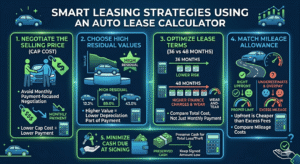
These proven strategies — all quantifiable with an Auto Lease Calculator — can save you thousands of dollars:
Negotiate the selling price, not the monthly payment. Dealerships prefer to negotiate on monthly payment because it obscures the actual vehicle price and fee structure. Always negotiate the selling price (capitalized cost) first, then verify the resulting monthly payment matches what the Auto Lease Calculator projects.
Choose vehicles with high residual values. Before deciding which vehicle to lease, research residual values across comparable models. Enter each vehicle’s residual into the Auto Lease Calculator with the same MSRP and money factor. The vehicle with the higher residual delivers a significantly lower monthly payment.
Avoid long lease terms unless strategically warranted. A 48-month lease may offer a lower monthly payment than a 36-month lease — but the total cost is often higher due to additional months of finance charges and increased wear-and-tear risk near lease end. Run both scenarios in the Auto Lease Calculator and compare the grand total, not just the monthly payment.
Match mileage allowance to your actual driving habits. Underestimating your annual mileage creates painful excess mileage charges at lease end. Use the Auto Lease Calculator to compare the cost of a higher mileage allowance upfront versus the projected cost of excess mileage based on your realistic driving habits. In most cases, buying more miles upfront is significantly cheaper.
Minimize cash due at signing. From a financial risk perspective, minimizing your down payment and drive-off fees preserves your cash in case the vehicle is totaled or stolen early in the lease. The Auto Lease Calculator helps you model lease scenarios with minimal upfront cash — finding the lowest possible signing amount without dramatically increasing monthly payments.
Common Mistakes to Avoid When Using an Auto Lease Calculator
Avoid these frequent errors to ensure your Auto Lease Calculator results are accurate and actionable:
Mistake 1 — Using the MSRP as the capitalized cost without negotiating. The MSRP is a starting point, not a fixed price. Many vehicles can be leased below MSRP — especially at the end of a model year or when manufacturer incentives are strong. Always enter a negotiated selling price into the Auto Lease Calculator, not just the sticker MSRP.
Mistake 2 — Forgetting to include the acquisition fee in the capitalized cost. Acquisition fees of $500 to $1,000 are added to — not subtracted from — your capitalized cost. Forgetting to include them makes your Auto Lease Calculator result look more favorable than the actual lease terms. Always include every dealer-charged fee in your capitalized cost.
Mistake 3 — Not calculating the excess mileage cost realistically. Enter your honest annual mileage — not an optimistic number. If you drive 18,000 miles per year and model a 12,000-mile-per-year lease in the Auto Lease Calculator, you are setting yourself up for a $1,500+ surprise bill at lease end.
Mistake 4 — Ignoring insurance in the monthly total. The base lease payment is not your true monthly cost. Insurance on a leased vehicle — with the higher coverage requirements leasing companies mandate — can add $100 to $200 or more per month to your actual out-of-pocket cost. Always include insurance in your Auto Lease Calculator to get a realistic monthly budget number.
Mistake 5 — Comparing lease payments across vehicles without using an Auto Lease Calculator. A $50 lower monthly payment on Vehicle A versus Vehicle B might look like a better deal — but if Vehicle A has a higher money factor, lower residual value, and shorter included mileage, the Auto Lease Calculator will reveal that Vehicle A is actually the worse financial choice when all factors are properly modeled.
Frequently Asked Questions (FAQs)
Q1: What does an Auto Lease Calculator calculate?
An Auto Lease Calculator computes two key outputs: the net capitalized cost (your adjusted vehicle price after all credits, fees, and deductions) and the total monthly payment (including base lease payment, document fees, registration, security deposit, and insurance). It gives you a complete financial picture of your lease — both the upfront costs and the ongoing monthly obligations — before you sign any agreement.
Q2: What is the money factor in an Auto Lease Calculator?
The money factor is the lease equivalent of an interest rate, expressed as a small decimal. To convert a money factor to an approximate APR, multiply it by 2,400. For example, a money factor of 0.00200 equals approximately 4.8% APR. The Auto Lease Calculator uses the money factor to compute your monthly finance charge — the interest component of your monthly payment. Always research the current buy rate money factor for your target vehicle before entering a dealer-provided figure into the Auto Lease Calculator.
Q3: What is residual value and why does it matter in the Auto Lease Calculator?
Residual value is the projected market value of the vehicle at the end of the lease term, expressed either as a dollar amount or a percentage of MSRP. It is the most important driver of your monthly lease payment. The higher the residual value, the less depreciation you are financing, and the lower your monthly payment. Enter the actual residual value dollar amount into the Auto Lease Calculator — calculate it by multiplying the MSRP by the residual percentage your leasing company applies.
Q4: Should I make a large down payment on a lease according to the Auto Lease Calculator?
Most financial advisors recommend minimizing your lease down payment. While a larger down payment reduces your monthly payment, it also increases your financial risk — if the vehicle is totaled or stolen early in the lease, you typically lose the down payment. Use the Auto Lease Calculator to model different down payment scenarios and find the minimum down payment that keeps your monthly payment within budget without tying up unnecessary cash at signing.
Q5: How do I use an Auto Lease Calculator to compare two different vehicles?
Enter the MSRP, residual value, money factor, acquisition fee, disposition fee, and lease term for each vehicle separately into the Auto Lease Calculator. Keep your down payment, trade-in value, mileage allowance, and tax rate the same across both calculations. Compare the monthly payment and grand total for each vehicle — the vehicle with the higher residual value and lower money factor will almost always produce the more favorable lease terms, even if its MSRP is slightly higher.
Q6: What happens if I exceed my mileage allowance? Can the Auto Lease Calculator help me plan for it?
Yes — the Auto Lease Calculator includes an excess mileage cost field where you enter the per-mile charge specified in your lease agreement. Enter your realistic annual mileage and compare the total lease cost at different mileage allowance tiers. In most cases, purchasing additional miles upfront (by selecting a higher mileage allowance) costs significantly less than paying excess mileage charges at the per-mile rate when you return the vehicle.
Q7: Is leasing always more expensive than buying?
Not always — it depends on your driving habits, holding period, and priorities. For people who drive moderate mileage and want a new vehicle every 2 to 3 years, leasing often delivers lower monthly payments and lower maintenance costs than buying. For people who keep vehicles for 6 to 10 years, buying typically costs less overall. Run your specific numbers through the Auto Lease Calculator and compare the grand total lease cost against an equivalent loan scenario to make the right decision for your financial situation.
Q8: How often should I use an Auto Lease Calculator?
Use an Auto Lease Calculator every time you consider a new vehicle lease — before visiting the dealership, after receiving a dealer quote (to verify their numbers), and again before signing the final paperwork. Also use it whenever you receive a lease renewal offer to determine whether renewing, switching vehicles, or purchasing the leased vehicle at its residual value is the most financially advantageous option for your situation.
Conclusion
A car lease is a multi-year financial commitment involving more variables than most consumers realize.
Monthly payment quotes from dealerships rarely tell the complete story. Acquisition fees, disposition fees, money factors, residual values, mileage charges, and tax treatment all interact in complex ways that only become fully clear when you run the complete calculation.
An Auto Lease Calculator gives you that complete calculation — instantly, accurately, and transparently.
It shows you the net capitalized cost. It shows you the true monthly cost including all fees and insurance. It shows you the grand total of your lease commitment. And it gives you the knowledge to negotiate every component of the deal with confidence.
Whether you are comparing multiple vehicles, evaluating a dealer’s quote, deciding between leasing and buying, or simply trying to understand where your monthly payment comes from — an Auto Lease Calculator is the tool that brings complete clarity to every question.
Use it before you visit the dealership. Use it before you sign any paperwork. Use it every time you consider a new lease.
The most powerful negotiating tool you can bring to any car lease conversation is the accurate, complete numbers that only an Auto Lease Calculator provides.