Volume Calculator
Find out if your BMI is in the anorexic range with our Anorexic BMI Calculator.
Table of Contents
- Introduction
- What Is a Volume Calculator?
- What Is a Cylinder?
- The Cylinder Volume Formula — Explained
- Derivation of the Cylinder Volume Formula
- How to Calculate Cylinder Volume Step by Step
- Units of Measurement in the Cylinder Volume Formula
- Cylinder Volume Formula vs. Volume Formulas for Other Shapes
- Cylinder Volume Formula in Engineering and Manufacturing
- Cylinder Volume Formula in Fluid Mechanics and Hydraulics
- Cylinder Volume Formula in Architecture and Construction
- Cylinder Volume Formula in Medicine and Science
- Cylinder Volume Formula in Everyday Life
- How to Find Radius or Height from Known Volume
- Common Mistakes When Using the Cylinder Volume Formula
- Practical Cylinder Volume Example
- Cylinder Volume Formula
- Frequently Asked Questions (FAQs)
- Conclusion
Introduction
Of all the three-dimensional shapes encountered in mathematics, science, engineering, and everyday life, the cylinder is one of the most common and practically significant. From water pipes and fuel tanks to cans of food, medical syringes, and industrial storage vessels, cylindrical shapes are everywhere — and calculating their internal capacity is an essential skill in countless real-world contexts. At the heart of every such calculation is the Cylinder Volume Formula: a simple, elegant, and extraordinarily useful mathematical expression that allows you to determine exactly how much space a cylinder encloses.
In this comprehensive guide, we will explore every dimension of the Cylinder Volume Formula — what it is, where it comes from, how to apply it step by step, and where it matters most in the real world. We will also introduce the Volume Calculator, a powerful digital tool that computes the volume of cylinders and ten other three-dimensional shapes simultaneously, giving you instant and accurate results for any volumetric problem. Whether you are a student learning about 3D geometry for the first time, an engineer designing fluid systems, or a professional working with cylindrical containers, this guide will give you everything you need to master the Cylinder Volume Formula with confidence and precision.
What Is a Volume Calculator?
A Volume Calculator is a digital tool that computes the internal volume of three-dimensional geometric shapes based on the dimensions you provide. Rather than manually applying different formulas for each shape, the Volume Calculator automates the process — delivering fast, accurate results across multiple shape types simultaneously.
A comprehensive Volume Calculator covers a wide range of 3D shapes, including:
- Cylinder — radius and height
- Sphere — radius
- Cube — length, width, height
- Cone — radius, height, and angle
- Tank — length and width
- Pipe — radius and length
- Pyramid — base and height
- Torus — major and minor radius
- Ellipsoid — three axes (A, B, C)
- Reservoir — depth
- Capsule — radius, length, and curvature
The Volume Calculator supports multiple units of measurement — meters, miles, yards, feet, inches, kilometers, centimeters, and millimeters — making it suitable for projects in any measurement system.
The Volume Calculator is an essential tool for engineers, architects, students, scientists, and construction professionals who regularly need to determine how much space, liquid, gas, or material a 3D container or structure can hold. At the center of the Volume Calculator’s most common use case is the Cylinder Volume Formula — because cylinders appear in more real-world applications than almost any other 3D shape.

What Is a Cylinder?
A cylinder is a three-dimensional geometric solid with two parallel circular bases connected by a curved lateral surface. The two circular bases are identical, parallel to each other, and perpendicular to the axis of the cylinder (an imaginary straight line passing through the center of both bases).
Key properties of a cylinder:
- Two circular bases — identical, flat, and parallel
- Lateral surface — a curved surface connecting the two bases
- Radius (r) — the radius of each circular base
- Height (h) — the perpendicular distance between the two bases
- Axis — the straight line connecting the centers of the two bases
A right cylinder is the most common type — one where the axis is perpendicular to both bases. This is the type described by the Cylinder Volume Formula in standard use. An oblique cylinder has a tilted axis, but its volume is calculated using the same formula if you use the perpendicular height.
Examples of cylindrical objects in everyday life:
- Drinking glasses and cups
- Cans of food, paint, and beverages
- Water pipes and plumbing tubes
- Engine cylinders in automobiles
- Storage tanks (water, fuel, chemical)
- Columns and pillars in architecture
- Batteries (AA, AAA, D-cell)
- Fire extinguishers
- Medical syringes and test tubes
The Cylinder Volume Formula — Explained
The Cylinder Volume Formula is:
V = π × r² × h
Where:
- V = the volume of the cylinder (in cubic units)
- π (pi) ≈ 3.14159265…
- r = the radius of the circular base
- h = the height of the cylinder
Reading the Cylinder Volume Formula aloud: “Volume equals pi times radius squared times height.”
This means you first compute the area of the circular base (π × r²), then multiply by the height (h) to determine the total volume.
Example: A cylinder with radius r = 5 cm and height h = 10 cm:
V = π × 5² × 10 V = π × 25 × 10 V = π × 250 V ≈ 785.40 cm³
The result is expressed in cubic units — cubic centimeters (cm³), cubic meters (m³), cubic inches (in³), cubic feet (ft³) — because volume is a three-dimensional measurement.
Derivation of the Cylinder Volume Formula
Understanding where the Cylinder Volume Formula comes from makes it far easier to remember, apply, and extend to related problems.
Principle: Volume = Base Area × Height
The volume of any prism or cylinder is equal to the area of its base multiplied by its height. For a cylinder, the base is a circle, so:
Base Area = π × r²
Multiplying by the height h gives the total volume:
V = π × r² × h
Intuitive understanding: Think of slicing the cylinder into many thin circular discs, each with thickness Δh. Each disc has volume = π × r² × Δh. Summing all discs from the bottom to the top:
V = ∫₀ʰ π × r² dh = π × r² × h
This is the Cylinder Volume Formula — confirmed by calculus as the exact volume of a right cylinder. The formula is exact, not an approximation, since the circular cross-section is uniform throughout the height.
How to Calculate Cylinder Volume Step by Step
Applying the Cylinder Volume Formula correctly requires just four steps:
Step 1 — Identify the Radius Measure or identify the radius (r) of the circular base. If you are given the diameter (d) instead of the radius, divide by 2: r = d/2.
Step 2 — Identify the Height Measure or identify the height (h) — the perpendicular distance between the two bases.
Step 3 — Ensure Consistent Units Both r and h must be in the same unit of measurement. If r is in centimeters, h must also be in centimeters.
Step 4 — Apply the Cylinder Volume Formula
V = π × r² × h
Use π ≈ 3.14159 for manual calculation, or the exact π key on a calculator for maximum precision.
Worked Examples:
Example 1: r = 3 cm, h = 8 cm
V = π × 9 × 8 = 72π ≈ 226.19 cm³
Example 2: r = 7 m, h = 15 m
V = π × 49 × 15 = 735π ≈ 2,309.07 m³
Example 3: diameter = 12 inches, h = 20 inches
r = 6 in; V = π × 36 × 20 = 720π ≈ 2,261.95 in³
Example 4: r = 0.5 ft, h = 4 ft (pipe)
V = π × 0.25 × 4 = π ≈ 3.14 ft³
Units of Measurement in the Cylinder Volume Formula
Choosing the correct units is critical when applying the Cylinder Volume Formula. Volume is expressed in cubic units — and the result is always in the cube of whichever linear unit you use for r and h.
| Radius/Height Unit | Volume Unit | Common Application |
|---|---|---|
| Millimeters (mm) | mm³ | Small mechanical parts, syringes |
| Centimeters (cm) | cm³ = mL | Laboratory vessels, food cans |
| Meters (m) | m³ | Large tanks, structural columns |
| Inches (in) | in³ | Pipe sizing, US engineering |
| Feet (ft) | ft³ | Residential tanks, HVAC ducts |
| Yards (yd) | yd³ | Large construction volumes |
Note: 1 cm³ = 1 milliliter (mL) and 1,000 cm³ = 1 liter. This equivalence makes the Cylinder Volume Formula especially convenient for liquid volume calculations, since the result in cm³ directly equals the volume in milliliters.
The Volume Calculator handles unit selection automatically, allowing you to choose the appropriate unit for each dimension and returning results in the corresponding cubic unit.
Cylinder Volume Formula vs. Volume Formulas for Other Shapes
The Cylinder Volume Formula is one of a family of 3D volume formulas, each derived from the same base-area-times-height principle:
| Shape | Volume Formula | Base Shape |
|---|---|---|
| Cylinder | V = π × r² × h | Circle |
| Prism (rectangular) | V = L × W × H | Rectangle |
| Cube | V = s³ | Square |
| Cone | V = ⅓ × π × r² × h | Circle |
| Sphere | V = (4/3) × π × r³ | Sphere |
| Pyramid | V = ⅓ × B × h | Any polygon |
| Ellipsoid | V = (4/3) × π × a × b × c | Ellipse |
Key comparison — Cylinder vs. Cone: A cone with the same base radius and height as a cylinder has exactly one-third the volume:
V (cone) = ⅓ × π × r² × h = ⅓ × V (cylinder)
Key comparison — Cylinder vs. Sphere: A sphere with the same radius as a cylinder’s base, and height = diameter of the sphere, has volume:
V (sphere) = (4/3) × π × r³ = (4/3) × V (cylinder with h = r)
These relationships reveal the elegant proportional structure of 3D geometry — and the Cylinder Volume Formula sits at the center of many of these comparisons.
Cylinder Volume Formula in Engineering and Manufacturing
The Cylinder Volume Formula is one of the most frequently used formulas in engineering and manufacturing, because cylindrical shapes dominate mechanical, chemical, and industrial systems.
Engine Design The displacement of an internal combustion engine is calculated using the Cylinder Volume Formula applied to each cylinder:
Displacement = π × r² × stroke × number of cylinders
This determines the engine’s power potential — a fundamental specification in automotive and aerospace engineering.
Hydraulic and Pneumatic Cylinders The Cylinder Volume Formula computes the fluid volume inside hydraulic and pneumatic cylinders, which directly determines the force and stroke characteristics of the actuator. Every hydraulic press, crane, and suspension system uses this calculation.
Pressure Vessel Design Storage tanks for gases and liquids are predominantly cylindrical in shape. Engineers use the Cylinder Volume Formula to determine the capacity of pressure vessels, specify wall thickness for safe operation, and calculate filling times for industrial processes.
Manufacturing Tolerances Precision-machined cylindrical components — shafts, bearings, bushings, pistons — are specified with exact radius and height dimensions. The Cylinder Volume Formula allows quality engineers to calculate material volumes, and by extension, the mass and weight of each component for balance and strength calculations.
Cylinder Volume Formula in Fluid Mechanics and Hydraulics
Fluid mechanics is one of the richest application areas for the Cylinder Volume Formula, because so many fluid-carrying systems are cylindrical.
Pipe Flow and Storage The Cylinder Volume Formula directly gives the internal volume of any straight pipe section:
V = π × r² × L
Where L is the pipe length. This is essential for calculating the volume of fluid in a pipeline, the residence time of fluid in a process pipe, the heat transfer capacity of a heat exchanger tube, and the mass of fluid held in distribution networks.
Tank Sizing Horizontal and vertical cylindrical storage tanks — used for water, petroleum, chemicals, milk, wine, and countless other liquids — are sized using the Cylinder Volume Formula. Knowing the exact volume ensures accurate inventory management, fill level monitoring, and regulatory compliance for hazardous materials.
Pump and Compressor Sizing The flow rate of a reciprocating pump or compressor is directly related to the volume swept by each piston per stroke — computed with the Cylinder Volume Formula. Engineers use this to match pump capacity to system flow requirements.
Cylinder Volume Formula in Architecture and Construction
In architecture and construction, cylindrical forms appear in columns, pillars, tanks, silos, and tunnels, all requiring accurate volume calculations for material estimation and structural design.
Concrete Columns Cylindrical concrete columns are among the most common structural elements in buildings and bridges. The Cylinder Volume Formula gives the exact volume of concrete needed for each column, enabling accurate material ordering and cost estimation.
Silo and Grain Storage Agricultural silos are tall cylindrical structures designed to store grain, silage, and other bulk materials. Using the Cylinder Volume Formula, engineers calculate the exact storage capacity of each silo, allowing farmers and agribusinesses to plan purchases, logistics, and inventory.
Tunnel Boring Rail and road tunnels are approximately cylindrical. The Cylinder Volume Formula is used to estimate the volume of earth to be excavated, the amount of concrete lining required, and the internal volume available for air circulation and infrastructure.
Swimming Pools (Cylindrical) Circular and cylindrical pool designs are calculated using the Cylinder Volume Formula to determine water volume — which determines pump sizing, chemical treatment quantities, and heating energy requirements.
Cylinder Volume Formula in Medicine and Science
The Cylinder Volume Formula appears throughout medicine and scientific research, wherever cylindrical vessels, instruments, or samples are involved.
Medical Syringes and Vials Syringes are cylindrical, and the volume of a dose is computed directly from the Cylinder Volume Formula: V = π × r² × L, where L is the plunger travel length. This relationship ensures accurate medication dosing in clinical and laboratory settings.
Test Tubes and Laboratory Cylinders Graduated cylinders — the standard liquid measurement tool in chemistry labs — are calibrated using the Cylinder Volume Formula. Chemists rely on this formula when preparing solutions, dilutions, and reaction mixtures of precise volumes.
MRI and CT Scan Bore Volume The imaging bore of MRI and CT machines is cylindrical. Engineers use the Cylinder Volume Formula to optimize bore dimensions for patient comfort while maintaining the magnetic field geometry required for imaging.
Biological Research Cell culture tubes, centrifuge tubes, and incubation chambers are cylindrical. The Cylinder Volume Formula is used to calculate sample volumes, fill ratios, and centrifugal force parameters in biological and biochemical research protocols.
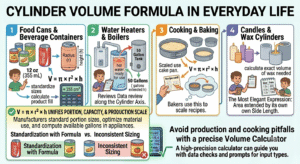
Cylinder Volume Formula in Everyday Life
The Cylinder Volume Formula is far more present in everyday life than most people realize.
Food Cans and Beverage Containers Every standard can of food or beverage is a cylinder. Manufacturers use the Cylinder Volume Formula to standardize portion sizes, optimize packaging material use, and calculate product fill volumes. A standard 12 oz (355 mL) soda can, for example, has dimensions that satisfy V = π × r² × h ≈ 355 cm³.
Water Heaters and Boilers Household water heaters are cylindrical tanks. Knowing the volume of a water heater — computed using the Cylinder Volume Formula — determines how many gallons of hot water are available for use before the tank needs to reheat.
Cooking and Baking Round cake pans and cylindrical baking molds hold a volume computed by the Cylinder Volume Formula. Bakers use this to scale recipes up or down for different pan sizes while maintaining the correct batter depth.
Candles and Wax Cylinders Pillar candles are cylinders, and candle makers use the Cylinder Volume Formula to calculate the exact volume of wax needed to fill each mold — a critical step for consistent production and cost management.
How to Find Radius or Height from Known Volume
The Cylinder Volume Formula can be rearranged to solve for any unknown variable when the other two are known.
Finding Height from Volume and Radius:
V = π × r² × h h = V / (π × r²)
Example: V = 500 cm³, r = 4 cm
h = 500 / (π × 16) = 500 / 50.27 ≈ 9.95 cm
Finding Radius from Volume and Height:
V = π × r² × h r² = V / (π × h) r = √(V / (π × h))
Example: V = 1,000 cm³, h = 20 cm
r² = 1000 / (π × 20) = 1000 / 62.83 ≈ 15.92 r ≈ 3.99 cm
This rearrangement ability makes the Cylinder Volume Formula even more versatile — not just for computing volume, but for reverse-engineering dimensions from a desired capacity.
Common Mistakes When Using the Cylinder Volume Formula
Even with a straightforward formula like the Cylinder Volume Formula, errors are common. Here are the most frequent mistakes to avoid:
- Using diameter instead of radius — The Cylinder Volume Formula uses r (radius), not d (diameter). If given a diameter, always divide by 2 before applying the formula
- Forgetting to square the radius — The formula is π × r² × h, not π × r × h. Failing to square r underestimates the volume significantly
- Mixing units — If radius is in inches and height is in feet, you must convert both to the same unit before applying the Cylinder Volume Formula
- Using the wrong value of π — For high-precision applications, use π = 3.14159265 or the π key on your calculator, not the rough approximation 3.14
- Confusing height with slant height — In an oblique cylinder, use the perpendicular height, not the length along the tilted surface
- Forgetting cubic units in the answer — Volume is always in cubic units; writing the answer without units (or in square units) is a significant error
Practical Cylinder Volume Example
Given: Radius (r) = 5 cm and height (h) = 10 cm
Formula: V = π × r2 × h
Calculation: V = π × 52 × 10 = π × 25 × 10 = 250π
Answer: V ≈ 785.40 cm3
Cylinder Volume Formula
To find the volume of a cylinder, multiply the area of its circular base by its height.
V is the cylinder volume, r is the radius of the circular base, and h is the height. Use the same unit for radius and height; the answer will be in cubic units.
Frequently Asked Questions (FAQs)
What is the Cylinder Volume Formula? The Cylinder Volume Formula is V = π × r² × h, where V is the volume, r is the radius of the circular base, h is the height, and π ≈ 3.14159.
How do I use the Cylinder Volume Formula if I know the diameter? Divide the diameter by 2 to get the radius, then apply the Cylinder Volume Formula: V = π × (d/2)² × h.
What units does the Cylinder Volume Formula produce? The result is always in cubic units — cm³, m³, in³, ft³ — matching the units of the input measurements (r and h must use the same unit).
What is the difference between volume and capacity? Volume refers to the total space enclosed by a shape. Capacity refers to the amount a container can hold, which accounts for wall thickness. For most practical purposes, the Cylinder Volume Formula gives a good approximation of both.
How does the Cylinder Volume Formula relate to the area of a circle? The base area formula for a circle is A = π × r². The Cylinder Volume Formula extends this to 3D by multiplying by the height h: V = A × h = π × r² × h.
Can the Cylinder Volume Formula be used for hollow cylinders (pipes)? For a hollow cylinder (pipe), calculate the volume of the outer cylinder and subtract the volume of the inner (hollow) cylinder:
V = π × h × (R² − r²), where R = outer radius and r = inner radius.
What is the Volume Calculator? The Volume Calculator is an online tool that computes the volume of multiple 3D shapes — including cylinders, spheres, cubes, cones, tanks, pipes, pyramids, and more — from user-entered dimensions, using the appropriate formula for each shape.
How does the Cylinder Volume Formula compare to the cone volume formula? A cone with the same base radius and height as a cylinder has exactly one-third the volume. The cone formula is V = ⅓ × π × r² × h, while the Cylinder Volume Formula is V = π × r² × h.
Is the Cylinder Volume Formula exact or approximate? The Cylinder Volume Formula is mathematically exact. Since π is an irrational number, numerical results are approximations — but the formula itself is precise.
What is 1 liter in terms of the Cylinder Volume Formula? 1 liter = 1,000 cm³ = 1,000 mL. A cylinder with r = 5.64 cm and h = 10 cm has volume ≈ 1,000 cm³ = 1 liter — a useful reference for laboratory and culinary calculations.
What is the difference between cylinder volume and surface area?
Volume measures the three-dimensional space inside a cylinder and is expressed in cubic units, using V = πr2h. Surface area measures the total outside area of the cylinder, including its two circular bases and curved side, using SA = 2πr2 + 2πrh. Surface area is expressed in square units.
Conclusion
The Cylinder Volume Formula — V = π × r² × h — is one of the most important and widely applied formulas in all of mathematics and science. Its elegant simplicity conceals an extraordinary range of applications: from the engine cylinders that power automobiles to the storage tanks that hold our water supply, from the medical syringes that deliver precise drug doses to the cans that preserve our food, from the concrete columns that support our buildings to the pipes that carry fluid through industrial systems.
Mastering the Cylinder Volume Formula means understanding not just how to plug numbers into an equation, but how and why the formula works — how the base area of a circle (π × r²) extends through height (h) to fill three-dimensional space, and how this principle connects to the broader family of volume formulas for cones, spheres, prisms, and ellipsoids.
The Volume Calculator makes applying the Cylinder Volume Formula — and eleven other 3D volume formulas — effortless, fast, and accurate. With support for multiple unit systems and simultaneous calculation of all common 3D shapes, it is the ideal tool for students, engineers, architects, scientists, and anyone who works with volumetric quantities in their academic or professional life.
Bookmark this guide, practice with your own cylinder dimensions, and use the Volume Calculator to explore the full range of 3D geometry at your fingertips. Whether your cylinder is a water pipe, a storage tank, a concrete column, or a laboratory test tube, the Cylinder Volume Formula gives you the precise answer you need — every time.