Calories Calculator
Know If You Are Overweight with the Overweight Calculator
Table of Contents
- Introduction
- What Is a Calorie Calculator?
- Why Knowing Your Daily Caloric Need Is Essential
- The Science Behind the Calorie Calculator – Mifflin-St Jeor Formula
- How Our Calorie Calculator Works Step by Step
- The Six Activity Levels in the Calorie Calculator
- Understanding Every Result from the Calorie Calculator
- BMR Base – Your Metabolic Resting Floor
- Total TDEE – Your Complete Daily Caloric Target
- The Five Goal-Based Calorie Targets from the Calculator
- Protein Target and Water Intake Results
- Daily Burn Rate – Calories Per Hour
- How to Use Your Calorie Calculator Results to Reach Your Goal
- Weight Loss Using the Calorie Calculator
- Muscle Gain and the Calorie Calculator Surplus Targets
- Unit Flexibility – Kilograms, Pounds, Feet, Inches, and Centimetres
- Common Mistakes When Using a Calorie Calculator
- Frequently Asked Questions (FAQs)
- Conclusion
Introduction
Calories are the currency of your body. Every physical action, every heartbeat, every thought, every cellular repair process — all of it costs calories. Your body earns calories through food and spends them on survival, movement, digestion, and growth. When you earn more than you spend, the surplus is stored. When you spend more than you earn, the deficit is met by drawing on stored energy. This simple energy balance equation governs every body composition outcome — fat loss, muscle gain, and weight maintenance alike.
A Calorie Calculator makes this equation precise and personal. Rather than applying a generic calorie recommendation, a Calorie Calculator uses your individual weight, height, gender, and activity level to calculate exactly how many calories your specific body needs each day. It then translates that maintenance number into five goal-specific calorie targets — from aggressive weight loss to active muscle gain — giving you an immediately actionable nutritional roadmap.
Our free Calorie Calculator goes beyond a simple daily calorie estimate. It also calculates your Basal Metabolic Rate (BMR), your Total Daily Energy Expenditure (TDEE), your protein gram target, your daily water intake recommendation, and your average hourly calorie burn rate — seven personalised results from a single calculation. Whether your goal is to lose fat, build muscle, perform better athletically, or simply understand how many calories your body actually requires, the Calorie Calculator is the essential first step toward a nutrition strategy that is grounded in your biological reality rather than generic averages.
In this comprehensive guide, you will learn exactly how the Calorie Calculator works, what every result means, how to choose the right activity level, how to use your calorie targets to achieve specific body composition goals, and how to avoid the most common mistakes that undermine calorie tracking success.
What Is a Calorie Calculator?
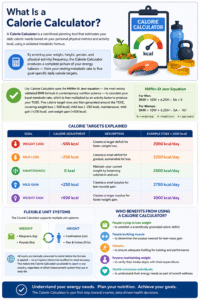
A Calorie Calculator is a nutritional planning tool that estimates your daily caloric needs based on your personal physical metrics and activity level, using a validated metabolic formula. By entering your weight, height, gender, and physical activity frequency, the Calorie Calculator produces a complete picture of your energy balance — from your resting metabolic rate to five goal-specific daily calorie targets.
Our Calorie Calculator uses the Mifflin-St Jeor equation — the most widely validated BMR formula in contemporary nutrition science — to calculate your basal metabolic rate, which is then multiplied by an activity factor to produce your TDEE. Five calorie target rows are then generated around the TDEE, covering weight loss (−500 kcal), mild loss (−250 kcal), maintenance, mild gain (+250 kcal), and weight gain (+500 kcal).
The Calorie Calculator supports multiple unit systems:
- Weight: Kilograms or Pounds
- Height: Feet and Inches, or Centimetres
This flexibility makes the Calorie Calculator accessible to users in any country, regardless of which measurement system they use in daily life. All inputs are internally converted to metric before the formula is applied — so unit system choice has no effect on result accuracy.
Who benefits from using a Calorie Calculator?
- People trying to lose weight — to establish a scientifically grounded caloric deficit
- People building muscle — to determine the surplus needed for lean mass gain
- Athletes — to ensure adequate fuelling for training and performance
- Anyone maintaining weight — to verify their intake aligns with their expenditure
- Health-conscious individuals — to understand their energy needs as part of overall wellness

Why Knowing Your Daily Caloric Need Is Essential
Without knowing how many calories your body requires, every food decision is based on guesswork. Here is why a Calorie Calculator is the non-negotiable starting point for any meaningful nutritional strategy:
It Defines the Energy Balance: Your body weight is determined by the relationship between calories consumed and calories expended. Eat above your Calorie Calculator maintenance target → weight increases. Eat below it → weight decreases. Eat at it → weight holds constant. This relationship is universal — every gram of fat gained or lost is governed by cumulative caloric balance over time.
It Replaces Generalised Recommendations: Government dietary guidelines (e.g. “2,000 kcal for women, 2,500 for men”) are population averages that may be 500 to 1,000 kcal above or below the actual needs of any individual person. A highly active 85 kg man has dramatically different caloric needs from a sedentary 55 kg woman — even if both are the same age. The Calorie Calculator personalises your number to your body, not to a statistical average.
It Makes Macronutrient Targets Meaningful: Macronutrient percentages (e.g. “30% protein, 40% carbohydrates, 30% fat”) are meaningless without a caloric reference. Your Calorie Calculator result is the total from which all macro gram targets are derived — giving protein, carbohydrate, and fat allocations actual numerical meaning.
It Identifies Whether Current Intake Is Appropriate: Many people who “eat healthily” without tracking are either significantly over or under their true caloric needs — creating unintended surpluses or deficits that work against their goals. Using a Calorie Calculator to establish a baseline reveals whether adjustments are needed before any detailed dietary planning begins.
It Quantifies the Impact of Activity Changes: Starting a gym programme, changing jobs, or becoming more or less active all shift TDEE. Recalculating with the Calorie Calculator after lifestyle changes ensures your nutritional targets remain aligned with your current actual expenditure.
The Science Behind the Calorie Calculator – Mifflin-St Jeor Formula
Our Calorie Calculator is built on the Mifflin-St Jeor equation — developed in 1990 and consistently validated as the most accurate BMR estimation formula for general adult populations:
Male BMR: (10 × Weight kg) + (6.25 × Height cm) − (5 × Age) + 5
Female BMR: (10 × Weight kg) + (6.25 × Height cm) − (5 × Age) − 161
Why Mifflin-St Jeor is the preferred formula for a Calorie Calculator:
The Mifflin-St Jeor equation was validated against indirect calorimetry (direct metabolic measurement) in a population of 498 subjects and found to predict resting metabolic rate within 10% for approximately 82% of individuals — outperforming the older Harris-Benedict equation (1919) and the Katch-McArdle formula for general populations.
The formula’s key components:
- (10 × Weight kg): Heavier bodies have more metabolically active tissue and require more calories at rest
- (6.25 × Height cm): Taller people have more body surface area and slightly higher resting energy expenditure
- (−5 × Age): Metabolic rate declines with age — approximately 1% to 2% per decade — reflecting progressive sarcopenia (muscle loss) and reduced organ metabolic activity
- (+5 for males / −161 for females): Gender offset accounting for the systematic difference in lean body mass and metabolic rate between biological sexes
Note on age in our Calorie Calculator: Our tool uses a fixed age of 25 in the formula — providing a standardised baseline BMR that users can interpret relative to their actual age. Users older than 25 will have a slightly lower actual BMR; users younger will have a slightly higher one.
How Our Calorie Calculator Works Step by Step
Using our Calorie Calculator is a five-step process that takes under two minutes:
Step One – Select Gender: Male (+5 offset) or Female (−161 offset). Gender selection in the Calorie Calculator determines which variant of the Mifflin-St Jeor formula is applied — accounting for the systematic metabolic rate difference between biological sexes.
Step Two – Select Activity Level: The most impactful variable in the Calorie Calculator. Choose the level that most accurately reflects your average weekly activity — not your best week, but your genuine, sustainable week-by-week reality. Overestimating activity inflates your TDEE target and creates an unintended caloric surplus.
Step Three – Enter Weight: Enter your current body weight in kilograms or pounds — selectable via the unit dropdown. For maximum consistency, weigh yourself in the morning after using the bathroom and before eating. This eliminates food, water, and clothing weight fluctuations from your Calorie Calculator input.
Step Four – Select Height Mode and Enter Height: Choose between Feet & Inches or Centimetres. Enter your height accurately — height is a significant variable in the Mifflin-St Jeor formula. A 10 cm difference in height changes BMR by approximately 63 kcal/day, which compounds meaningfully over time.
Step Five – Click Calculate: Instantly receive seven personalised results in the Calorie Analysis panel plus five goal-specific calorie targets in the Goal Table below.
The Six Activity Levels in the Calorie Calculator
Our Calorie Calculator offers six activity multipliers — more granular than the four-level systems found in many tools, providing more precise TDEE estimation:
Sedentary — No Exercise (1.2×): A desk job, minimal walking, no structured exercise. The Calorie Calculator produces its lowest TDEE at this multiplier. This level is appropriate for office workers who sit the majority of the day and do not engage in planned exercise.
Light — 1 to 3 Days Per Week (1.375×): Casual exercise one to three times per week — recreational walking, light gym sessions, weekend sport. The Calorie Calculator adds approximately 37.5% to BMR at this level to reflect modest additional energy expenditure.
Moderate — 3 to 5 Days Per Week (1.55×): Regular exercise three to five days per week at moderate intensity. This is the most commonly appropriate level for recreational gym-goers entering their data into the Calorie Calculator. It reflects consistent but not elite-level physical demand.
Active — 6 to 7 Days Per Week (1.725×): Intense exercise nearly every day, or a demanding physical job combined with regular training. The Calorie Calculator’s second-highest multiplier reflects substantial daily energy expenditure.
Very Active — Hard Exercise (1.9×): Twice-daily training or professionally demanding physical work. Select this level in the Calorie Calculator only if your daily physical output genuinely approaches professional-athlete standards — overestimating here significantly inflates TDEE.
Extra Active — Athlete Level (2.1×): The highest multiplier in our Calorie Calculator — reserved for elite athletes, competitive bodybuilders in training, or individuals in extremely physically demanding occupations combined with structured daily training. At 2.1×, the Calorie Calculator produces its maximum TDEE — reflecting exceptional daily energy expenditure.
Understanding Every Result from the Calorie Calculator
Our Calorie Calculator produces seven results in the Calorie Analysis panel:
BMR Base: Your Basal Metabolic Rate — calories burned at complete rest. The metabolic floor below which intake should not fall for extended periods without medical supervision.
Total TDEE: Your Total Daily Energy Expenditure — complete daily caloric maintenance target. Eating at TDEE maintains current body weight at your current activity level.
Activity Load: The activity multiplier applied — confirming which factor was used to convert BMR to TDEE in the Calorie Calculator.
Protein Target: Body weight (kg) × 2 = daily protein grams. The most critical single macronutrient result from the Calorie Calculator — set at the evidence-based upper range for maximising muscle protein synthesis and preserving lean mass.
Water Intake: Body weight (kg) × 0.033 = daily water in litres. A bodyweight-proportional hydration guideline ensuring fluid intake scales with metabolic demand.
Daily Burn: TDEE ÷ 24 = average calories burned per hour. A contextualising metric that helps users understand their hourly metabolic rate.
Net Balance: Confirmed TDEE — the reference point from which all five goal-based calorie targets in the Goal Table are calculated.
BMR Base – Your Metabolic Resting Floor
The BMR result from your Calorie Calculator represents the number of calories your body burns every day simply to sustain life — without any movement, digestion, or deliberate activity included. BMR accounts for:
- Organ function: Brain, heart, liver, kidneys, and lungs consume a substantial portion of BMR — your brain alone uses approximately 20% of resting energy expenditure
- Temperature regulation: Maintaining body temperature at approximately 37°C requires continuous caloric expenditure
- Cellular maintenance: Protein synthesis, DNA repair, and cellular membrane integrity all have ongoing caloric costs
- Hormonal and neurological function: Hormone synthesis, neurotransmitter production, and signal transduction all require energy
For most adults, BMR represents 60% to 70% of TDEE — making it the largest single component of daily caloric expenditure. Understanding your BMR from the Calorie Calculator tells you the minimum caloric floor of your daily needs and quantifies how much of your total expenditure is driven by baseline physiology versus activity.
A higher BMR indicates more metabolically active lean tissue. Building muscle through resistance training raises BMR — each kilogram of new muscle increases resting energy expenditure by approximately 13 kcal/day. Tracking BMR changes over time using the Calorie Calculator confirms whether training is successfully increasing lean mass and metabolic rate.
Total TDEE – Your Complete Daily Caloric Target
TDEE — the Total Daily Energy Expenditure calculated by the Calorie Calculator — is your complete daily caloric maintenance target, accounting for all energy spent across BMR, physical activity, and the thermic effect of food digestion.
TDEE is the reference point for every goal in the Calorie Calculator:
- Eat below TDEE → create a caloric deficit → lose weight
- Eat at TDEE → maintain current weight
- Eat above TDEE → create a caloric surplus → gain weight
The five goal rows in the Calorie Calculator’s Goal Table are all calculated relative to TDEE — making TDEE the essential anchor number from which all other targets are derived. Every nutrition decision you make should be evaluated against your Calorie Calculator TDEE result.
TDEE is a dynamic, not static, number: As your weight changes, your BMR changes, and therefore your TDEE changes. A person who loses 10 kg has a measurably lower TDEE than when they started — because metabolically active body mass has decreased. Failing to recalculate with the Calorie Calculator as weight changes is one of the most common reasons fat loss plateaus occur. The deficit that was accurately calibrated at a starting weight of 90 kg may have shrunk to near zero after several months of successful fat loss.
Recalculate with the Calorie Calculator every 4 to 6 weeks during active weight change to keep all targets current.
The Five Goal-Based Calorie Targets from the Calculator
The Goal Table in our Calorie Calculator provides five ready-to-use daily calorie targets based on your TDEE:
Weight Loss (TDEE − 500 kcal): A 500 kcal daily deficit produces approximately 0.45 kg (1 lb) of fat loss per week — the most widely validated sustainable fat loss rate. This is the standard aggressive fat loss target from the Calorie Calculator, calibrated to maximise fat reduction while minimising lean mass loss and metabolic adaptation.
Mild Loss (TDEE − 250 kcal): A 250 kcal daily deficit produces approximately 0.2 to 0.25 kg of fat loss per week — a more conservative approach. The Mild Loss target from the Calorie Calculator is ideal for individuals who want gradual body composition improvement with minimal lifestyle disruption, athletes who need to maintain training performance, or people who have struggled to adhere to larger deficits.
Maintain Weight (TDEE): Eating at your TDEE maintains current body weight at your current activity level. This target from the Calorie Calculator is the reference baseline — the number against which all deficit and surplus targets are measured. It is also the appropriate target during diet breaks, recovery periods, and body composition maintenance phases.
Mild Gain (TDEE + 250 kcal): A 250 kcal daily surplus provides modest additional energy for muscle protein synthesis without creating significant fat accumulation. This ultra-conservative surplus from the Calorie Calculator is appropriate for experienced lifters who have already built substantial lean mass and want to minimise fat gain during a maintenance or “recomposition” phase.
Weight Gain (TDEE + 500 kcal): A 500 kcal daily surplus provides the caloric environment for meaningful new muscle growth. This lean bulk surplus from the Calorie Calculator is the most commonly recommended starting point for natural athletes building lean mass — sufficient to support muscle protein synthesis above maintenance without producing excessive concurrent fat gain.
Protein Target and Water Intake Results
Two bonus results from the Calorie Calculator — Protein Target and Water Intake — translate your caloric data into specific macronutrient and hydration targets:
Protein Target (Body weight kg × 2g): Set at 2 grams of protein per kilogram of body weight — the upper-middle of the evidence-based range (1.6 to 2.2g/kg) for maximising muscle protein synthesis, preserving lean mass during caloric deficit, and supporting recovery from training. This is the most important single nutritional target from the Calorie Calculator — protein adequacy determines whether a caloric deficit produces fat loss or muscle loss.
Practical protein sources: Chicken breast, turkey, fish (salmon, tuna, cod), eggs, Greek yoghurt, cottage cheese, tofu, tempeh, lentils, chickpeas, and whey or plant-based protein supplements.
Water Intake (Body weight kg × 0.033 litres): Bodyweight-proportional hydration guidance — a heavier person has more metabolically active tissue requiring more fluid for transport, thermoregulation, and biochemical reactions. The 0.033 litre-per-kg formula produces approximately 2.3 litres for a 70 kg person — within the generally recommended 2 to 2.5 litre daily range for adults in temperate climates.
Adequate hydration supports optimal metabolic function, nutrient transport, cognitive performance, and physical output — all of which influence the effectiveness of any calorie-based body composition strategy.
Daily Burn Rate – Calories Per Hour
The Daily Burn result from the Calorie Calculator — TDEE ÷ 24 — provides your average hourly calorie expenditure:
How to interpret this result: For a person with a TDEE of 2,400 kcal, the daily burn rate is 100 kcal/hour. This is not a uniform hourly rate — actual expenditure varies enormously by hour depending on sleep, sedentary activity, and exercise. During sleep, hourly expenditure may be as low as 50 to 60 kcal/hr; during intense exercise, it may reach 600 to 1,200 kcal/hr.
The daily burn rate from the Calorie Calculator is a useful contextualising figure — helping users understand the scale of their energy economy and make relative judgements about the caloric cost of activities (“that 45-minute walk burns about 45 minutes’ worth of my hourly rate”).
How to Use Your Calorie Calculator Results to Reach Your Goal
Translating Calorie Calculator results into daily habits requires a practical implementation strategy:
Step 1 — Set Your Calorie Target: Select the goal row from the Calorie Calculator’s Goal Table that matches your current objective — Weight Loss, Mild Loss, Maintenance, Mild Gain, or Weight Gain. Enter this as your daily calorie goal in a food tracking application (MyFitnessPal, Cronometer, or Lose It).
Step 2 — Track Food Intake: Log everything you eat for at least the first four to eight weeks — the period during which most people develop accurate intuition about portion sizes and caloric density. The Calorie Calculator result is only as useful as the accuracy of your food intake tracking against it.
Step 3 — Hit Your Protein Target First: Structure every meal around a protein source to ensure the Calorie Calculator’s protein gram target is met before the day ends. Protein is the most satiating macronutrient, the most metabolically demanding to digest (highest thermic effect of food), and the most important for preserving lean mass during a deficit.
Step 4 — Monitor Weekly Progress: Body weight fluctuates by 1 to 2 kg daily from water, food, and glycogen changes. Track weekly average weight (sum of seven daily weights ÷ 7) rather than daily weight to assess whether your intake is aligned with your Calorie Calculator target and producing the expected body weight trend.
Step 5 — Recalculate Every 4 to 6 Weeks: As weight changes, so does TDEE. Update your Calorie Calculator inputs when your weight changes by 3 to 5 kg to keep all targets current and maintain the precision of your deficit or surplus.
Weight Loss Using the Calorie Calculator
The Calorie Calculator’s two deficit targets — Weight Loss (−500) and Mild Loss (−250) — are grounded in established nutritional science:
The 500 kcal Deficit Principle: One pound (approximately 0.45 kg) of body fat stores approximately 3,500 kcal of energy. A sustained 500 kcal daily deficit therefore creates a weekly deficit of 3,500 kcal — theoretically producing 0.45 kg of fat loss per week. This is the gold standard fat loss rate for preserving lean mass while achieving meaningful, sustainable body composition change.
Why Not a Larger Deficit? Deficits exceeding 750 to 1,000 kcal/day accelerate short-term weight loss but increase lean mass catabolism, metabolic adaptation, hormonal disruption, and adherence failure. The Calorie Calculator’s −500 kcal target reflects the maximum deficit at which fat loss can be sustained without significant non-fat tissue loss in most individuals.
The Role of Protein in a Caloric Deficit: Meeting the protein target from the Calorie Calculator is the single most important factor determining whether weight loss is primarily fat or muscle. High-protein diets during caloric restriction preserve lean mass significantly better than adequate-to-low protein diets — ensuring the body preferentially oxidises fat stores rather than cannibalising muscle tissue.
Muscle Gain and the Calorie Calculator Surplus Targets
The Calorie Calculator’s two surplus targets — Mild Gain (+250) and Weight Gain (+500) — define the lean bulk approach to muscle gain:
Why a Controlled Surplus? Muscle protein synthesis in natural, trained individuals is rate-limited physiologically — no matter how much excess energy is available, the body cannot build muscle faster than its biological synthesis capacity allows. A 500 kcal surplus from the Calorie Calculator provides sufficient energy for maximised muscle protein synthesis without the excessive fat accumulation that accompanies larger surpluses.
Expected Muscle Gain Rate: At a 500 kcal surplus with adequate protein from the Calorie Calculator’s targets and consistent progressive resistance training, expect 0.5 to 1 kg of total weight gain per month — of which approximately 0.3 to 0.6 kg may be lean mass depending on training stimulus, sleep quality, and individual genetics.
Distinguishing Fat Gain from Muscle Gain: Scale weight alone cannot determine whether surplus calorie consumption is being converted to muscle or fat. Track body composition using progress photos, body measurements, and strength increases alongside the Calorie Calculator’s weight gain targets to assess the quality of surplus-phase progress.
Unit Flexibility – Kilograms, Pounds, Feet, Inches, and Centimetres
Our Calorie Calculator supports full unit flexibility to serve users worldwide:
Weight Units:
- Kilograms (kg): The default and native unit of the Mifflin-St Jeor formula used in the Calorie Calculator. Recommended for users in metric-standard countries.
- Pounds (lbs): Converted to kilograms (× 0.453592) before formula application. Suitable for US users who think in pounds.
Height Units:
- Feet and Inches: Converted to centimetres (total inches × 2.54) before formula application. The default mode in our Calorie Calculator, reflecting the height convention common in the United States.
- Centimetres (cm): The native formula unit. Recommended for users in countries that measure height in centimetres.
All unit combinations produce mathematically equivalent results for identical physical measurements. Unit choice affects only how you enter data — not the accuracy of the Calorie Calculator output.

Common Mistakes When Using a Calorie Calculator
Getting the most from your Calorie Calculator requires avoiding these frequent errors:
Overestimating Activity Level: Selecting “Very Active” when your genuine average is “Moderate” inflates TDEE by 10% to 20% — creating a caloric surplus where you expect maintenance or deficit. Be conservative; if results are not matching expectations after four to six weeks, consider dropping one activity level.
Not Updating After Weight Changes: A Calorie Calculator result from three months ago is outdated if your weight has changed significantly. Stale targets cause fat loss plateaus and muscle gain inefficiencies — recalculate regularly.
Eating to the Calorie Calculator Number Without Tracking Food: The Calorie Calculator tells you your target — but hitting that target requires measuring what you eat. Most people significantly underestimate portion sizes without weighing food, leading to consistent overconsumption above their calorie target.
Ignoring the Protein Target: Many users focus on total calories while underconsuming protein — the most important result from the Calorie Calculator for body composition outcomes. Without adequate protein, even a perfectly calibrated caloric deficit will produce disproportionate muscle loss alongside fat loss.
Expecting Linear Progress: Body weight fluctuates daily by up to 2 kg from water retention, glycogen storage, and food mass — regardless of caloric adherence. Judge your Calorie Calculator strategy by weekly averages over four or more weeks, not by day-to-day scale readings.
Frequently Asked Questions (FAQs)
What is a Calorie Calculator? A Calorie Calculator is a nutritional tool that estimates your daily caloric needs — including BMR, TDEE, and goal-specific targets — based on your weight, height, gender, and activity level using the Mifflin-St Jeor metabolic formula.
How accurate is the Calorie Calculator? The Mifflin-St Jeor formula used in our Calorie Calculator estimates true metabolic rate within 10% for approximately 80% of adults. The primary source of individual inaccuracy is activity level selection — choosing the most honest activity level is the most important step for accurate results.
Should I eat at my Calorie Calculator maintenance level to lose weight? No — eating at maintenance keeps weight constant. To lose weight, use the Weight Loss target (TDEE − 500) or Mild Loss target (TDEE − 250) from your Calorie Calculator results.
How many calories should I eat to build muscle? Use the Mild Gain (+250) or Weight Gain (+500) targets from your Calorie Calculator — combined with the protein target and consistent progressive resistance training. A 300 to 500 kcal surplus is the most effective and efficient range for natural muscle building.
How often should I recalculate using the Calorie Calculator? Every 4 to 6 weeks during active fat loss or muscle gain, or whenever body weight changes by 3 to 5 kg. Recalculating with the Calorie Calculator keeps all targets aligned with your current body weight and metabolic reality.
Can women use the same Calorie Calculator? Yes. Our Calorie Calculator applies the female-specific Mifflin-St Jeor offset (−161) when Female is selected, producing appropriately adjusted BMR and TDEE values for women.
What is the minimum number of calories I should eat? Generally, intake should not fall below your BMR result from the Calorie Calculator for extended periods. Extended sub-BMR intake forces the body to catabolise lean tissue and causes metabolic adaptation. A minimum of 1,200 kcal/day for women and 1,500 kcal/day for men is a commonly cited safe floor for unsupervised caloric restriction.
Why does the Calorie Calculator use age 25 as a fixed value? Our tool applies a standardised age of 25 to provide a consistent baseline BMR across all users. Actual BMR declines with age — users older than 25 may find their actual TDEE is slightly lower than the Calorie Calculator result; users younger than 25 may find it slightly higher.
Does the Calorie Calculator work for all body types? The Mifflin-St Jeor formula used in the Calorie Calculator has been validated across diverse body types. It may slightly underestimate TDEE in very muscular individuals (who have higher lean mass and therefore higher BMR) and slightly overestimate for very sedentary individuals with low lean mass.
How do I use the Calorie Calculator for weight maintenance? Select the Maintain Weight row in the Goal Table. Eat at your TDEE as shown in the Calorie Calculator and track food intake for several weeks to confirm your weight is stable. If weight is slowly rising or falling, adjust activity level selection or caloric intake accordingly.
Conclusion
Nutrition without a caloric reference is guesswork. You may be making “healthy” food choices and exercising regularly — but without knowing how your intake compares to your actual caloric expenditure, you cannot know whether your efforts are moving you toward your goal or away from it. A Calorie Calculator solves this problem completely by turning your personal physical data into a precise, personalised, evidence-based daily energy target.
Our free Calorie Calculator delivers seven personalised analysis results — BMR, TDEE, activity load, protein target, water intake, hourly burn rate, and net balance — plus five goal-specific calorie targets covering the full spectrum from aggressive fat loss to active muscle gain. With full unit flexibility, six activity levels, and the Mifflin-St Jeor formula at its core, our Calorie Calculator provides the most accessible and comprehensive free daily calorie analysis available.
Whatever your goal — leaner, stronger, better-fuelled, or simply more informed about your body’s energy needs — the Calorie Calculator gives you the number that makes every subsequent food decision more precise, more effective, and more aligned with the results you are working toward.
Use our Calculator today. Find your number. Set your target. And let evidence-based nutritional precision do what generic advice never can.