Mulch Calculator
Estimate Roof Area, Materials, and Project Costs with Fast and Accurate Results Using Our Free Roofing Calculator
Table of Contents
- Introduction
- What Is a Mulch Calculator?
- Why Every Gardener Needs a Mulch Calculator
- How Our Mulch Calculator Works
- Key Inputs in the Mulch Calculator Explained
- Understanding Mulch Depth – How Much Is Enough?
- Cubic Yards vs. Cubic Feet – What the Mulch Calculator Uses
- Types of Mulch and Their Coverage Rates
- How to Calculate Mulch for Different Garden Shapes
- Cost Estimation with the Mulch Calculator
- Benefits of Using an Online Mulch Calculator
- Common Mulching Mistakes and How to Avoid Them
- Who Should Use a Mulch Calculator?
- Frequently Asked Questions (FAQs)
- Conclusion
Introduction
Every year, millions of gardeners over-order or under-order mulch — and both mistakes cost money. Order too little and you leave bare spots where weeds will grow freely. Order too much and you are paying for bags that sit unused in your garage. The solution to both problems is simple: use a mulch calculator before you buy.
A mulch calculator takes the guesswork out of one of the most common garden tasks. Whether you are mulching a small flower bed, a large vegetable garden, or a wide landscape border, a mulch calculator tells you exactly how many cubic yards or cubic feet of mulch you need — and what it will cost — based on your actual measurements.
In this complete guide, we will explain everything you need to know about mulching, show you exactly how the mulch calculator works step by step, break down the different types of mulch and their coverage rates, and answer the most frequently asked questions gardeners have. By the end, you will be ready to plan your mulching project with total confidence and zero waste.
What Is a Mulch Calculator?
A mulch calculator is an online tool that calculates the volume of mulch needed to cover a specific area to a specific depth. By entering the length, width, and desired mulch depth of your garden bed or landscape area, the mulch calculator instantly converts those dimensions into cubic feet, cubic yards, and the number of bags required — along with an estimated total cost.
Our mulch calculator is designed for real-world accuracy. It does not give you a rough ballpark — it uses precise volume formulas to deliver the exact amount of mulch your project requires. This means less waste, lower costs, and better results for your garden.
What makes our mulch calculator different from simply guessing?
- It accounts for depth variations — even a 1-inch difference in mulch depth dramatically changes the volume needed
- It converts between cubic feet and cubic yards automatically
- It calculates the number of bags needed if you are buying bagged mulch
- It includes a cost estimate based on your price per unit
Whether you are a first-time gardener or an experienced landscaper, the mulch calculator is the most efficient way to plan and budget your mulching project.
Why Every Gardener Needs a Mulch Calculator
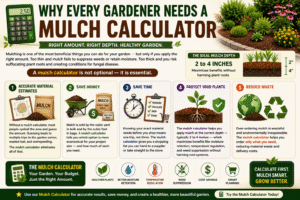
Mulching is one of the most beneficial things you can do for your garden — but only if you apply the right amount. Too thin and mulch fails to suppress weeds or retain moisture. Too thick and you risk suffocating plant roots and creating conditions for fungal disease.
Here is why a mulch calculator is not optional — it is essential:
Accurate Material Estimates Without a mulch calculator, most people eyeball the area and guess the amount. Guessing leads to multiple trips to the garden center, wasted fuel, and overspending. The mulch calculator eliminates all of that.
Save Money Mulch is sold by the cubic yard in bulk and by the cubic foot in bags. A mulch calculator tells you which option is more economical for your project size — and how much of each you need.
Save Time Knowing your exact material needs before you shop means one trip, not three. The mulch calculator gives you a shopping list you can hand to a supplier or take straight to the store.
Protect Your Plants The mulch calculator helps you apply mulch at the correct depth — typically 2 to 4 inches — which maximizes benefits like moisture retention, temperature regulation, and weed suppression without harming root systems.
Reduce Waste Over-ordering mulch is wasteful and environmentally irresponsible. The mulch calculator helps you order only what you need, reducing material waste and delivery costs.
How Our Mulch Calculator Works
Our mulch calculator uses a simple but precise volume formula to calculate how much mulch you need. Here is the process step by step:
Step 1 — Enter Your Area Dimensions Input the length and width of the area you want to mulch in feet. For irregular shapes, break the area into rectangles and run the mulch calculator for each section.
Step 2 — Enter Your Desired Mulch Depth Enter the desired depth of mulch in inches. The standard recommendation is 2 inches for maintenance mulching and 3 to 4 inches for new beds or weed suppression.
Step 3 — The Mulch Calculator Computes Volume The formula is: Volume (cubic feet) = Length × Width × (Depth ÷ 12) The mulch calculator then divides by 27 to convert cubic feet into cubic yards.
Step 4 — Calculate Bags Needed If you are buying bagged mulch, the mulch calculator divides the total cubic feet by the bag size (typically 2 cubic feet per bag) to give you the number of bags to purchase.
Step 5 — Estimate Total Cost Enter your price per cubic yard or price per bag. The mulch calculator multiplies the quantity by the unit price to give you a total project cost estimate.
Key Inputs in the Mulch Calculator Explained
Understanding each input field ensures you get the most accurate results from the calculator.
Length (ft) The longest dimension of the area you are mulching. Measure along the longest side of the garden bed in feet.
Width (ft) The shortest dimension of the area perpendicular to the length. For curved or irregular beds, use the average width.
Depth (inches) How deep you want the mulch layer to be. This is the most critical input in the mulch calculator — even a 1-inch change in depth can increase or decrease your material needs by 25–50%.
Price per Cubic Yard or Bag Enter your local price to get a cost estimate. Bulk mulch prices typically range from $25 to $60 per cubic yard. Bagged mulch typically costs $3 to $8 per 2-cubic-foot bag.
Bag Size (cubic feet) If you are buying bagged mulch, enter the bag volume. Most standard bags are 2 cubic feet. Some large bags are 3 cubic feet. The calculator uses this to calculate the exact number of bags.
Understanding Mulch Depth – How Much Is Enough?
Mulch depth is the single most important factor in a successful mulching project — and it is the variable that the mulch calculator treats with the most precision.
Here are the recommended depths for different mulching situations:
2 inches — Maintenance Mulching If your beds already have mulch and you are simply topping up, 2 inches is usually sufficient. Use the mulch calculator with a 2-inch depth for annual top-dressing.
3 inches — Standard New Bed Mulching For new garden beds with no existing mulch, 3 inches is the standard recommendation. This depth suppresses most weeds and retains moisture effectively.
4 inches — Heavy Weed Suppression In areas with aggressive weed pressure or in vegetable gardens, 4 inches of mulch provides maximum suppression. Enter 4 in the mulch calculator depth field for this application.
1 inch — Fine Mulch Around Delicate Plants For mulching directly around the base of perennials or young seedlings, 1 inch of fine mulch keeps moisture without compacting or burying stems.
Important: Never pile mulch against tree trunks or plant stems. Keep a 2–3 inch gap. This prevents rot and pest infestation — no mulch calculator can compensate for poor application technique.
Cubic Yards vs. Cubic Feet – What the Mulch Calculator Uses
One of the most common sources of confusion when buying mulch is the difference between cubic feet and cubic yards. Our mulch calculator handles both automatically, but here is what you need to know.
Cubic Foot A cubic foot is a cube measuring 1 foot × 1 foot × 1 foot. Bagged mulch is almost always sold in cubic feet. The most common bag size is 2 cubic feet.
Cubic Yard A cubic yard is a cube measuring 3 feet × 3 feet × 3 feet, which equals 27 cubic feet. Bulk mulch — delivered by truck — is sold by the cubic yard.
When should you buy bulk vs. bagged? Our mulch calculator can help you decide. As a general rule:
- For areas under 3 cubic yards, bagged mulch is usually more convenient
- For areas over 3 cubic yards, bulk delivery is almost always cheaper
The calculator shows you both quantities — cubic yards and number of bags — so you can compare options and choose the most economical purchase method for your project.
Types of Mulch and Their Coverage Rates
Different mulch types have slightly different coverage rates and settling behaviors. Understanding the options helps you make the most of the mulch calculator.
Wood Chip Mulch The most popular landscape mulch. Decomposes slowly, adds organic matter to soil, and is excellent for pathways and beds. Coverage is standard — apply at 3 inches for best results.
Shredded Bark Mulch Finely shredded bark locks together well and resists displacement by wind and rain. Great for slopes. Use the mulch calculator with a 2 to 3 inch depth for shredded bark.
Straw Mulch Popular in vegetable gardens and for protecting newly seeded lawns. Lightweight and biodegrades quickly. Apply at 3 to 4 inches since it compresses significantly after application.
Rubber Mulch Made from recycled rubber, this mulch does not decompose and requires no annual replacement. Excellent for playgrounds and high-traffic areas. Apply at 2 to 3 inches. Enter these values into the mulch calculator as you would for any other material.
Cocoa Hull Mulch A rich, dark, fragrant mulch popular in ornamental beds. Decomposes quickly and adds nitrogen to soil. Apply at 1 to 2 inches only — it can form a crust at greater depths.
Compost While not technically mulch, compost is often used as a top dressing. Apply at 1 to 2 inches and use the calculator to determine volume.
How to Calculate Mulch for Different Garden Shapes
Our mulch calculator is optimized for rectangular beds, but here is how to use it for other common garden shapes:
Rectangular Beds The simplest case. Enter the exact length and width. The mulch calculator gives you the precise answer immediately.
Square Beds Enter the same value for both length and width. A 10 × 10 ft square bed at 3 inches depth needs approximately 0.93 cubic yards of mulch.
Circular Beds Calculate the area first: Area = π × radius² (e.g., a 5-foot radius bed = 3.14 × 25 = 78.5 sq ft). Then enter a length of 78.5 and a width of 1 into the calculator for an accurate result.
Irregular or L-Shaped Beds Break the area into two or more rectangles. Run the mulch calculator for each section separately and add the totals together.
Long Pathway or Border For a narrow border — say, 40 feet long and 3 feet wide — simply enter those dimensions. The mulch calculator handles any length-to-width ratio without adjustment.
Cost Estimation with the Mulch Calculator
Knowing your material quantity is only half the story — knowing the cost is what allows you to plan your garden budget effectively. Our calculator includes a built-in cost estimate based on your local pricing.
Bulk Mulch Cost Estimate Enter your local price per cubic yard. Bulk mulch typically costs:
- Basic wood chips: $25–$35 per cubic yard
- Dyed or decorative mulch: $35–$50 per cubic yard
- Premium hardwood bark: $45–$65 per cubic yard
Bagged Mulch Cost Estimate Enter your price per bag. Standard bags typically cost:
- Economy 2 cu ft bags: $3–$5 per bag
- Premium colored bags: $5–$8 per bag
The calculator multiplies your unit price by the quantity needed to give you the total estimated material cost. Remember to add delivery costs for bulk orders if applicable.
Benefits of Using an Online Mulch Calculator
The advantages of using a calculator go far beyond simply knowing how much to buy:
Precision Over Guesswork A mulch calculator eliminates the rounding errors and estimation bias that cause most gardeners to over-order. You get exact cubic footage, exact cubic yards, and an exact bag count.
Instant Results No pencil, paper, or mental math required. Enter your dimensions and the mulch calculator delivers the answer immediately.
Cost Transparency The calculator shows you material costs before you spend a penny, helping you compare bulk vs. bagged and shop for the best price.
Works for Any Project Size Whether you are mulching a 2 × 4 ft raised bed or a 200 × 50 ft commercial landscape, the mulch calculator scales accurately to any project.
Completely Free Our calculator is available at no cost with no registration required. Use it as many times as you need for different beds, projects, and material types.
Mobile Friendly Use the calculator on your phone while standing in the garden center or on the job site — it works perfectly on any device.
Common Mulching Mistakes and How to Avoid Them
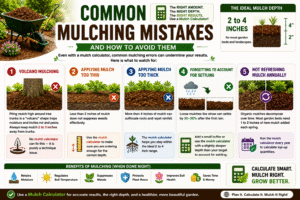
Even with a calculator, common mulching errors can undermine your results. Here is what to watch for:
Volcano Mulching Piling mulch high around tree trunks in a “volcano” shape traps moisture and invites rot and pests. Always keep mulch 2 to 3 inches away from trunks. No mulch calculator can fix this — it is purely a technique issue.
Applying Mulch Too Thin Less than 2 inches of mulch does not suppress weeds effectively. Use the mulch calculator to make sure you are ordering enough for the correct depth.
Applying Mulch Too Thick More than 4 inches of mulch can suffocate roots and repel rainfall. The mulch calculator helps you stay within the ideal 2 to 4 inch range.
Forgetting to Account for Settling Loose mulches like straw can settle by 20–30% after the first rain. Add a small buffer or use the mulch calculator with a slightly deeper depth than your target to account for settling.
Not Refreshing Mulch Annually Organic mulches decompose over time. Most garden beds need 1 to 2 inches of new mulch added each spring. Run the calculator every year to calculate top-up quantities.
Who Should Use a Mulch Calculator?
Our calculator is the perfect tool for:
- Homeowners maintaining flower beds, tree rings, and vegetable gardens
- Landscape contractors calculating material orders for client projects
- Garden centers helping customers estimate purchase quantities
- Property managers budgeting mulch for commercial or HOA landscapes
- DIY gardeners taking on their first mulching project
- Nurseries advising customers on coverage rates
- Schools and municipalities planning large-scale landscape maintenance
- Real estate agents staging properties with fresh mulch before sale
No matter your scale or experience level, the mulch calculator delivers professional-quality estimates instantly and for free.
Frequently Asked Questions (FAQs)
Q1: What does a mulch calculator calculate? A mulch calculator calculates the volume of mulch — in cubic feet, cubic yards, and number of bags — needed to cover a specific area to a specific depth. It also estimates the total cost based on your input price per unit.
Q2: How many cubic yards of mulch do I need for 100 square feet? At a 3-inch depth, 100 square feet requires approximately 0.93 cubic yards of mulch. Enter 100 sq ft at 3 inches into the mulch calculator and it will show you the exact number along with the bag count.
Q3: How deep should I apply mulch? For most applications, 2 to 4 inches is the ideal mulch depth. Use the mulch calculator with a 2-inch depth for maintenance top-dressing and 3 to 4 inches for new beds or heavy weed suppression.
Q4: How many bags of mulch equal one cubic yard? One cubic yard equals 27 cubic feet. If you are buying 2-cubic-foot bags, you need 13.5 bags per cubic yard. Our mulch calculator handles this conversion automatically.
Q5: Is it cheaper to buy bulk mulch or bagged mulch? For projects requiring more than 3 cubic yards, bulk mulch is almost always cheaper. For smaller projects, bagged mulch may be more practical. The mulch calculator shows you both quantities so you can compare costs and decide.
Q6: Can I use the mulch calculator for circular or irregular beds? Yes. For circular beds, calculate the area (π × r²) first and enter it as a rectangular equivalent. For irregular beds, break the area into rectangles and run the mulch calculator for each section, then add the totals.
Q7: How often should I add new mulch? Most organic mulches need to be refreshed once a year — typically in spring. Use the mulch calculator to determine how much top-dressing mulch you need based on your existing depth and your target depth.
Q8: Does the mulch calculator work for rubber mulch? Yes. Our mulch calculator works for any mulch type. Simply enter your desired depth (typically 2 to 3 inches for rubber mulch) and the calculator will compute the volume needed regardless of material type.
Q9: What is the best mulch depth to suppress weeds? 3 to 4 inches of mulch is most effective for weed suppression. Use the mulch calculator with a 3 or 4 inch depth to ensure you are ordering enough material for proper coverage.
Q10: Is the calculator free to use? Yes, our calculator is completely free with no sign-up required. You can use it as many times as needed for different beds, materials, and project sizes.
Conclusion
Mulching is one of the simplest and most impactful things you can do for your garden — and a mulch calculator makes it even easier. With the right depth applied to the right area, mulch suppresses weeds, conserves moisture, regulates soil temperature, improves soil health, and makes your landscape look polished and professional.
Our free online mulch calculator eliminates the guesswork, the over-ordering, and the wasted trips to the garden center. In seconds, it gives you the exact volume of mulch you need in cubic yards and cubic feet, the number of bags to purchase, and a full cost estimate based on your local pricing.
Key takeaways from this guide:
- A calculator uses length, width, and depth to calculate the exact volume of mulch your project requires
- The ideal mulch depth is 2 to 4 inches — the mulch calculator helps you stay within this optimal range
- One cubic yard = 27 cubic feet; one standard bag = 2 cubic feet — the mulch calculator converts automatically
- For projects over 3 cubic yards, bulk mulch is almost always more cost-effective than bagged
- Our mulch calculator is free, mobile-friendly, and works for any garden shape or size
- Refresh mulch annually and use the mulch calculator each spring to calculate your top-up quantity
Use our calculator today and get your garden project started on the right foot — with exactly the right amount of mulch, at exactly the right depth, for the best results your garden has ever seen.