Roofing Calculator
Convert Numbers and Roman Numerals Quickly with Accurate Results Using Our Free Roman Numeral Converter
Table of Contents
- Introduction
- What Is a Roofing Calculator?
- Why Every Homeowner Needs a Roofing Calculator
- How Our Roofing Calculator Works
- Understanding Roof Pitch and Why It Matters
- Key Inputs in a Roofing Calculator Explained
- How to Calculate Roof Squares and Bundles
- Material Cost vs. Labor Cost – What to Expect
- Waste Factor – Why It Is Essential in Any Roofing Calculator
- Step-by-Step Example Using the Roofing Calculator
- Benefits of Using an Online Roofing Calculator
- Common Roofing Materials and Their Costs
- Who Should Use a Roofing Calculator?
- Frequently Asked Questions (FAQs)
- Conclusion
Introduction
Planning a roofing project without a budget estimate is one of the most expensive mistakes a homeowner can make. Material prices, labor costs, roof pitch, overhang, waste — there are dozens of variables that affect the final bill. Getting these numbers wrong can result in thousands of dollars in unexpected expenses, delays, and material shortages on the job site.
That is exactly why a roofing calculator is the most important tool you can use before starting any roofing project. Whether you are replacing an old roof, building a new one, or simply getting a quote from a contractor, our free roofing calculator gives you instant, accurate estimates based on your real measurements and local cost inputs.
In this complete guide, we will walk you through everything you need to know — how the roofing calculator works, what inputs it uses, how to interpret the results, and how to use the numbers to make smarter decisions. By the end, you will be fully equipped to plan your roofing project with confidence and precision.
What Is a Roofing Calculator?
A roofing calculator is a digital tool that helps homeowners, contractors, and builders estimate the total cost of a roofing project. It takes key measurements and cost inputs — such as building length, width, roof pitch, overhang, waste factor, and labor rates — and calculates the total surface area, number of shingles or bundles needed, and the estimated project cost.
Our roofing calculator is built for accuracy and simplicity. It uses the industry-standard pitch multiplier formula to calculate the actual sloped surface area of any roof — not just the flat footprint. This is a critical distinction because a steeply pitched roof has significantly more surface area than a flat one, even if the building dimensions are identical.
Unlike basic area calculators, our roofing calculator accounts for:
- Roof pitch — the slope of the roof expressed as rise over 12 inches of run
- Overhang — the extra roof area that extends beyond the building walls
- Waste factor — the percentage of material added to account for cuts and offcuts
- Bundle coverage — the area each bundle of shingles covers
- Material and labor costs — broken down separately for a full project estimate
- Permit and fees — often overlooked but always included in our roofing calculator
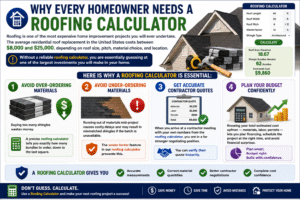
Why Every Homeowner Needs a Roofing Calculator
Roofing is one of the most expensive home improvement projects you will ever undertake. The average residential roof replacement in the United States costs between $8,000 and $25,000, depending on roof size, pitch, material choice, and location. Without a reliable roofing calculator, you are essentially guessing at one of the largest investments you will make in your home.
Here is why a roofing calculator is not just helpful — it is essential:
Avoid Over-Ordering Materials Buying too many shingles wastes money. A precise roofing calculator tells you exactly how many bundles to order, down to the last square.
Avoid Under-Ordering Materials Running out of materials mid-project causes costly delays and may result in mismatched shingles if the batch is unavailable. The waste factor feature in our roofing calculator prevents this.
Get Accurate Contractor Quotes When you arrive at a contractor meeting with your own numbers from the roofing calculator, you are in a far stronger negotiating position. You can verify their quote instantly.
Plan Your Budget Confidently Knowing your total estimated cost upfront — materials, labor, permits — lets you plan financing, schedule the project at the right time, and avoid financial surprises.
How Our Roofing Calculator Works
Our roofing calculator uses a straightforward but precise multi-step calculation process. Here is the logic behind it:
Step 1 — Calculate Total Footprint The calculator adds the overhang on all sides to the building length and width. This gives the true footprint of the roof, including the eaves.
Step 2 — Apply the Pitch Multiplier The pitch multiplier is calculated using the formula: Pitch Factor = √(1 + (Pitch/12)²) This converts the flat footprint into the actual sloped surface area. For example, a 6/12 pitch produces a multiplier of approximately 1.118, meaning the actual roof surface is about 11.8% larger than the footprint.
Step 3 — Add the Waste Factor The roofing calculator adds your specified waste percentage (typically 10–15%) to the actual surface area. This accounts for material lost during cutting around vents, valleys, hips, and ridges.
Step 4 — Convert to Roof Squares One roofing square equals 100 square feet. The roofing calculator divides the total waste-adjusted area by 100 to give you the number of squares required.
Step 5 — Calculate Total Bundles Bundles needed = Roof Squares × Bundles per Square. Standard asphalt shingles require 3 bundles per square.
Step 6 — Calculate Total Cost Grand Total = (Material Cost per Square × Squares) + (Labor Cost per Square × Squares) + Permit & Fees
Understanding Roof Pitch and Why It Matters
Roof pitch is one of the most important variables in any roofing calculation. It is expressed as a ratio — rise over run — where the rise is the number of inches the roof increases in height for every 12 inches of horizontal distance. A 6/12 pitch means the roof rises 6 inches for every 12 inches of run.
Why does pitch matter so much in the roofing calculator?
A steeper pitch means more actual surface area, which means more materials, more labor, and a higher overall cost. It also affects safety — steep roofs require specialized equipment and more time, which drives up labor costs. Our roofing calculator automatically accounts for all of this through the pitch multiplier.
Common pitch categories:
| Pitch | Category | Pitch Multiplier |
|---|---|---|
| 2/12 – 4/12 | Low Slope | 1.03 – 1.054 |
| 5/12 – 7/12 | Medium Slope | 1.083 – 1.158 |
| 8/12 – 10/12 | High Slope | 1.202 – 1.302 |
| 12/12+ | Steep Slope | 1.414+ |
Enter your pitch value into our roofing calculator and it will automatically apply the correct multiplier to your measurements.
Key Inputs in a Roofing Calculator Explained
Our roofing calculator has ten input fields. Understanding each one ensures you get the most accurate estimate possible.
Building Length (ft) The outer length of the building in feet. Do not add overhang here — the roofing calculator handles that separately.
Building Width (ft) The outer width of the building in feet.
Roof Pitch (X/12) Enter the rise value only (e.g., enter 6 for a 6/12 pitch). The roofing calculator does the rest.
Overhang Length (ft) The distance the roof extends beyond the exterior wall on each side. Typical residential overhang is 1 to 2 feet.
Waste Factor (%) The percentage of extra material to order. 10% is standard for simple roofs. Use 15–20% for complex roofs with many hips, valleys, and penetrations.
Bundle Coverage (sq ft) The area covered by one bundle of shingles. Standard asphalt shingles cover 33.3 sq ft per bundle.
Bundles per Square How many bundles make up one roofing square (100 sq ft). Typically 3 bundles per square for standard shingles.
Cost per Square ($) The material cost per roofing square. This varies by shingle type — $150–$500 per square is a typical range.
Labor Cost per Square ($) The contractor labor charge per square. Typically $100–$200 per square depending on your location and roof complexity.
Permit & Fees ($) Fixed project costs such as building permits and inspection fees. Always include these in your roofing calculator estimate.
How to Calculate Roof Squares and Bundles
Understanding roof squares and bundles is fundamental to using any roofing calculator effectively.
What Is a Roofing Square? A roofing square is a unit of measurement equal to 100 square feet of roof surface. It is the standard unit used by contractors, suppliers, and manufacturers. When you order materials or get a contractor quote, everything is priced per square.
What Is a Bundle? A bundle is a physical package of shingles. Three bundles = one roofing square for standard 3-tab or architectural asphalt shingles. Some premium shingles may require 4 or 5 bundles per square.
Why Use the Roofing Calculator Instead of Manual Math? Calculating squares manually requires measuring the roof slope, applying the pitch multiplier, adding overhang, and accounting for waste — all steps that are easy to get wrong. Our roofing calculator handles every step automatically and even shows you the step-by-step working so you can verify the result.
Material Cost vs. Labor Cost – What to Expect
One of the most valuable features of our roofing calculator is the separation of material and labor costs. This gives you a clear picture of where your money is going and makes it easier to compare contractor quotes.
Material Costs Material costs depend heavily on the type of shingle you choose:
- 3-Tab Asphalt Shingles — the most affordable option, typically $80–$120 per square
- Architectural/Dimensional Shingles — the most popular choice, typically $150–$300 per square
- Metal Roofing — durable and long-lasting, typically $300–$700 per square
- Tile Roofing — premium option, typically $400–$900 per square
- Slate Roofing — top-tier material, typically $800–$1,500+ per square
Labor Costs Labor costs vary by region, roof complexity, and pitch. As a general guide:
- Low-slope roofs — $75–$125 per square
- Medium-slope roofs — $125–$175 per square
- Steep roofs — $175–$300+ per square
Enter your specific cost values into the roofing calculator to get a total that reflects your actual market.
Waste Factor – Why It Is Essential in Any Roofing Calculator
The waste factor is one of the most important — and most commonly misunderstood — inputs in a roofing calculator.
When a roofer cuts shingles to fit around vents, chimneys, skylights, valleys, hips, and ridges, the offcuts are typically discarded. If you order exactly the amount of shingles needed to cover your calculated surface area with no extra, you will almost certainly run short.
Standard waste factor recommendations:
| Roof Type | Recommended Waste Factor |
|---|---|
| Simple gable roof | 10% |
| Hip roof | 12–15% |
| Complex multi-plane roof | 15–20% |
| Roof with many penetrations | 20%+ |
Our roofing calculator applies your waste factor automatically — you just enter the percentage and the tool does the rest. Always include the waste factor to avoid material shortages and expensive mid-project reorders.
Step-by-Step Example Using the Roofing Calculator
Let us run a real example through the roofing calculator using the default input values:
Input Values:
- Building Length: 40 ft
- Building Width: 30 ft
- Roof Pitch: 6/12
- Overhang: 1.5 ft
- Waste Factor: 10%
- Bundle Coverage: 33.3 sq ft
- Bundles per Square: 3
- Material Cost: $250 per square
- Labor Cost: $150 per square
- Permit & Fees: $300
Step-by-Step Calculation:
- Total footprint = (40 + 3) × (30 + 3) = 43 × 33 = 1,419 sq ft
- Pitch multiplier = √(1 + (6/12)²) = 1.1180
- Actual surface area = 1,419 × 1.1180 = 1,586.5 sq ft
- With 10% waste = 1,586.5 × 1.10 = 1,745.2 sq ft
- Roof squares = 1,745.2 ÷ 100 = 17.45 squares
- Total bundles = 17.45 × 3 = 53 bundles
- Material cost = 17.45 × $250 = $4,362
- Labor cost = 17.45 × $150 = $2,618
- Grand total = $4,362 + $2,618 + $300 = $7,280
All of these results are displayed instantly when you click Calculate in our roofing calculator, along with the full step-by-step breakdown.
Benefits of Using an Online Roofing Calculator
Using a roofing calculator offers clear advantages over manual estimation or guesswork:
Instant Results No spreadsheets, no manual formulas. Enter your numbers and the roofing calculator delivers results in seconds.
Professional-Grade Accuracy Our roofing calculator uses the same pitch multiplier formula used by professional roofing contractors and estimators.
Transparent Step-by-Step Workings Every calculation step is displayed in the results panel, so you can verify the math and understand exactly how the numbers were derived.
Complete Cost Breakdown The roofing calculator separates material costs, labor costs, and permit fees — giving you a full project budget, not just a single number.
Works on All Devices Whether you are on a desktop in your office or a mobile phone on the job site, the roofing calculator is fully responsive and works perfectly on all screen sizes.
Completely Free No subscription, no registration, no hidden fees. Our roofing calculator is available to everyone at no cost.
Common Roofing Materials and Their Costs
Understanding your material options is essential before using the roofing calculator to its full potential. Here is a quick reference:
Asphalt Shingles The most popular roofing material in North America. Affordable, durable, and available in many styles. Typical lifespan: 20–30 years. Cost: $150–$300 per square.
Metal Roofing Increasingly popular for its longevity and energy efficiency. Lifespan of 40–70 years. Cost: $300–$700 per square depending on the metal type (steel, aluminum, copper).
Wood Shingles and Shakes A natural aesthetic choice. Lifespan of 20–30 years with proper maintenance. Cost: $250–$500 per square.
Clay and Concrete Tiles Extremely durable and common in warmer climates. Lifespan of 50+ years. Cost: $400–$900 per square.
Slate The premium choice — natural stone with a lifespan of 100+ years. Cost: $800–$1,500+ per square.
Enter the cost per square for your chosen material directly into the roofing calculator to get an estimate tailored to your project.

Who Should Use a Roofing Calculator?
Our roofing calculator is designed for a wide range of users:
- Homeowners planning a roof replacement or new construction
- General contractors preparing project bids and client proposals
- Roofing contractors calculating material orders and job estimates
- Real estate investors estimating renovation costs before purchasing a property
- Insurance adjusters calculating roof replacement values for claims
- DIY enthusiasts planning to do their own roofing work
- Architects and designers estimating roofing costs during the design phase
- Property managers budgeting for roof maintenance across multiple properties
No matter your role or experience level, our roofing calculator gives you the professional-grade numbers you need to make informed decisions.
Frequently Asked Questions (FAQs)
Q1: What does a roofing calculator measure? A roofing calculator measures the total sloped surface area of a roof based on the building’s dimensions, pitch, and overhang. It then calculates the number of shingles, bundles, and roofing squares needed, plus the estimated total project cost including materials, labor, and permit fees.
Q2: How accurate is an online roofing calculator? Our roofing calculator uses the industry-standard pitch multiplier formula and produces highly accurate estimates. However, results are estimates — final costs may vary due to site-specific conditions, local material pricing, and contractor rates. Always use the roofing calculator as a planning guide and confirm final numbers with a licensed contractor.
Q3: What is a roofing square and how does the calculator use it? A roofing square equals 100 square feet of roof surface. Our roofing calculator converts your total adjusted area into squares automatically. Everything — material costs, labor costs, and bundle counts — is calculated per square for consistency with industry standards.
Q4: How do I find my roof pitch to use in the calculator? You can measure roof pitch from the attic using a level and a tape measure: hold a 12-inch level horizontally against a rafter and measure the vertical rise at the 12-inch mark. That rise value is your pitch. For example, if the rise is 6 inches, enter 6 in the roofing calculator.
Q5: What waste factor should I enter in the calculator? For a simple gable roof, use 10%. For hip roofs or roofs with skylights and chimneys, use 12–15%. For highly complex multi-plane roofs, use 15–20%. The roofing calculator applies this automatically to your surface area.
Q6: Can the roofing calculator handle metal roofing? Yes. While the default values in our calculator are set for standard asphalt shingles, you can adjust the cost per square and bundle coverage to match any roofing material, including metal, tile, or slate.
Q7: Does the roofing calculator include labor costs? Yes. Our roofing calculator includes a dedicated field for labor cost per square. Enter your local contractor rate and the tool will calculate total labor cost separately from material cost, giving you a complete project budget.
Q8: What are typical permit fees for a roofing project? Permit fees vary widely by location — from $150 to $500 for most residential roof replacements. Some jurisdictions charge a percentage of the project value. Enter your local permit cost into the calculator to include it in your total estimate.
Q9: Is the calculator free to use? Yes, our roofing calculator is completely free with no registration required. Use it as many times as you like for different projects, materials, and scenarios.
Q10: How many bundles of shingles do I need per square? Standard 3-tab and architectural asphalt shingles require 3 bundles per square. Some premium or oversized shingles require 4 or 5 bundles per square. Check the manufacturer’s specifications and enter the correct value into the calculator for an accurate bundle count.
Conclusion
A roofing project is a major investment — and the only way to approach it with confidence is to have accurate numbers before you begin. Our free online roofing calculator gives you everything you need: total surface area, waste-adjusted material quantities, bundle counts, and a full cost breakdown that includes materials, labor, and permit fees.
Whether you are a homeowner preparing for a roof replacement, a contractor putting together a client proposal, or a real estate investor evaluating a property, our calculator delivers professional-grade results in seconds. There is no guesswork, no complicated formulas, and no expensive estimating software required.
Key takeaways from this guide:
- A calculator uses building dimensions, roof pitch, overhang, and waste factor to calculate your true roof surface area
- The pitch multiplier is the key formula that converts flat footprint into actual sloped surface area
- Always include a waste factor of 10–20% in your roofing calculator to avoid material shortages
- One roofing square = 100 square feet; standard asphalt shingles require 3 bundles per square
- Our roofing calculator separates material costs, labor costs, and permit fees for complete budget transparency
- The roofing calculator is free, mobile-friendly, and requires no registration
Stop guessing and start planning. Enter your measurements into our roofing calculator today and get a full, accurate project estimate in under 60 seconds. Your roof — and your budget — deserve nothing less.