Calculate shoe size instantly with our fast and accurate Shoe Size Calculator
Table of Contents- Introduction
- What Is a Mileage Calculator?
- Why Calculating Distances Matters
- How the Mileage Calculator Works
- Key Benefits of Calculating Distances
- Factors That Affect Mileage
- How to Use the Mileage Calculator Step by Step
- Tips to Improve Your Vehicle Mileage
- Common Mistakes While Calculating Distances
- FAQs
- Conclusion
Introduction
Fuel prices are constantly fluctuating, and every driver wants to make sure their vehicle delivers the best possible efficiency. This is where a Mileage Calculator becomes essential. Calculating Distances is no longer a guessing game — with this tool, you can instantly know how many kilometers your vehicle covers per liter of fuel. Calculating Distances properly helps you stay informed, budget smarter, and travel safer.
Understanding how efficiently a vehicle uses fuel is an important part of managing transportation costs and planning long-distance travel. Whether you drive a car for daily commuting, operate a business fleet, or simply want to monitor fuel consumption, knowing the relationship between distance traveled and fuel used can provide valuable insights. This tool is designed to simplify that process by delivering quick and accurate calculations based on just two essential inputs.
Fuel efficiency plays a significant role in both personal and commercial transportation. When drivers understand how much distance they can travel using a specific amount of fuel, they can make better decisions regarding budgeting, trip planning, and vehicle maintenance. Instead of relying on rough estimates or manual calculations, this tool provides instant results, helping users evaluate vehicle performance with greater confidence.
The calculator works using a straightforward formula that divides the total distance traveled by the amount of fuel consumed. The result is displayed in kilometers per liter (km/L), which is one of the most widely used measurements for fuel efficiency around the world. By entering the distance covered and the number of liters of fuel used, users can immediately determine how efficiently their vehicle is operating.
One of the biggest advantages of using this tool is its simplicity. There is no need for complex mathematical calculations or specialized knowledge. The interface is designed to be user-friendly, allowing anyone to obtain results within seconds. Whether you are a new driver or an experienced vehicle owner, the process remains fast, accurate, and easy to understand.
Monitoring fuel efficiency can also help identify potential vehicle issues. If fuel consumption suddenly increases while driving habits remain unchanged, it may indicate problems such as underinflated tires, engine inefficiencies, clogged filters, or other maintenance concerns. Regularly checking fuel usage can therefore contribute to better vehicle performance and lower operating costs over time.
For businesses that manage delivery vehicles, trucks, or company cars, tracking fuel efficiency is especially important. Small improvements in fuel economy can lead to significant savings when applied across multiple vehicles. Accurate calculations make it easier to evaluate driving patterns, optimize routes, and improve overall operational efficiency.
Another key benefit is financial planning. Fuel expenses often represent a substantial portion of transportation costs. By understanding how efficiently a vehicle consumes fuel, drivers can estimate future expenses more accurately and make informed decisions regarding travel plans. This information can be particularly useful during long road trips where fuel budgeting is essential.
Environmental awareness is another reason many people monitor fuel consumption. Vehicles that operate more efficiently generally consume less fuel and produce fewer emissions. Tracking efficiency encourages responsible driving habits and supports efforts to reduce environmental impact.
Overall, this tool offers a practical and reliable way to measure fuel efficiency using clear inputs and instant calculations. By providing accurate results in a simple format, it helps users better understand vehicle performance, manage fuel expenses, plan journeys effectively, and make informed transportation decisions. Whether for personal use or professional fleet management, this calculator serves as a valuable resource for anyone interested in evaluating fuel consumption and improving efficiency.
What Is a Mileage Calculator?
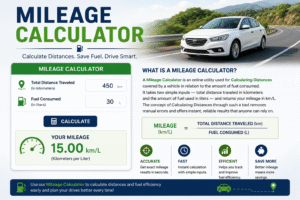
A Mileage Calculator is an online utility used for Calculating Distances covered by a vehicle in relation to the amount of fuel consumed. It takes two simple inputs — total distance traveled in kilometers and the amount of fuel used in liters — and returns your mileage in km/L. The concept of Calculating Distances through such a tool removes manual errors and offers instant, reliable results that anyone can rely on.
Why Calculating Distances Matters
Calculating Distances is not just about numbers; it’s about understanding your vehicle’s behavior. When you know your true mileage, you can detect early signs of engine problems, tire issues, or fuel system inefficiencies. Calculating Distances regularly helps you spot trends — whether your car is becoming less efficient or running smoother after a service.
How the Mileage Calculator Works
The formula behind the Mileage Calculator is straightforward: Mileage = Total Distance ÷ Fuel Consumed. The tool automates this by performing the math instantly. For example, if you traveled 400 km using 20 liters, the calculator divides 400 by 20 and shows 20 km/L. This is the simplest way of Calculating Distances efficiency without using a notebook or calculator app.
Key Benefits of Calculating Distances
Calculating Distances through a mileage tool offers several benefits. First, it saves you time by giving instant results. Second, it improves budgeting for long trips, allowing you to plan refueling stops smartly. Third, it provides transparency on whether your vehicle is performing as advertised. Fourth, Calculating Distances consistently can help you compare different vehicles before buying a new one.
Factors That Affect Mileage
Several factors influence the results when Calculating Distances per liter. Driving habits, such as harsh braking and rapid acceleration, reduce mileage. Tire pressure, vehicle weight, traffic conditions, and even weather play a big role. Modern engines respond differently to city and highway conditions, which is why Calculating Distances in various environments gives a more realistic view of your vehicle’s average efficiency.
How to Use the Mileage Calculator Step by Step
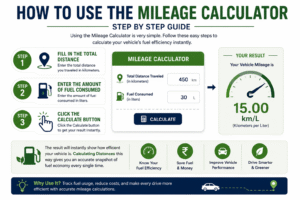
Using the Mileage Calculator is very simple. Step 1: Fill in the total distance you traveled in kilometers. Step 2: Enter the amount of fuel consumed in liters. Step 3: Click the Calculate button. The result will instantly show how efficient your vehicle is. Calculating Distances this way gives you an accurate snapshot of fuel economy every single time.
Tips to Improve Your Vehicle Mileage
To get better numbers when Calculating Distances, follow these tips: maintain proper tire pressure, perform regular servicing, avoid carrying unnecessary weight, and use the recommended grade of fuel. Smooth driving, keeping a steady speed, and minimizing idle time can significantly improve mileage. Calculating Distances after each change helps you confirm whether your improvements are actually working.
Common Mistakes While Calculating Distances
One of the most common errors is not fully filling the fuel tank before starting measurement. Another mistake is forgetting to reset the trip meter. Some drivers mix units, such as miles and kilometers, which throws off accuracy. When Calculating Distances, always use consistent units and keep records of every refill for the most reliable insights.
Why You Should Use an Online Mileage Calculator
An online Mileage Calculator is free, fast, and works on any device. It eliminates manual math and reduces errors. Whether you are at home, at the gas station, or on the road, Calculating Distances with an online tool is always at your fingertips. It is especially useful for fleet owners, delivery companies, and travelers planning long routes.
FAQs
Q1. What is the purpose of a Mileage Calculator?
It helps in Calculating Distances per liter of fuel, giving you accurate fuel efficiency data.
Q2. Is the Mileage Calculator free to use?
Yes, it is completely free and works instantly without any signup.
Q3. Can I use it for bikes and trucks?
Absolutely. The same formula applies to all vehicles, making Calculating Distances universal.
Q4. How accurate is the result?
It is highly accurate as long as you enter correct distance and fuel values.
Q5. How often should I check my mileage?
Checking every full tank gives the best insight when Calculating Distances regularly.
Q6. Does weather affect mileage?
Yes, cold starts and heavy rain can lower mileage temporarily.
Conclusion
The Mileage Calculator is more than just a tool — it is a smart companion for every driver who values efficiency, savings, and informed travel decisions. By Calculating Distances regularly, you can take full control of your vehicle’s performance, reduce fuel expenses, and plan trips with confidence. Start Calculating Distances today and turn every kilometer into a smarter, more economical journey.
In conclusion, Calculating Distances is an essential practice for anyone who wants to better understand travel efficiency, fuel consumption, and overall transportation costs. Whether you are planning a road trip, managing a fleet of vehicles, commuting to work, or simply monitoring vehicle performance, accurately measuring the distance traveled provides valuable information that can support smarter decisions. By combining distance data with fuel usage, drivers can gain a clearer picture of how efficiently their vehicles are operating and identify opportunities for improvement.
One of the greatest advantages of Calculating Distances is the ability to track vehicle performance over time. Consistently measuring travel distances helps users compare trips, analyze fuel efficiency trends, and evaluate changes in driving habits. This information can be useful for both personal and professional purposes, allowing drivers to make adjustments that improve efficiency and reduce operating costs.
Accurate Calculating Distances also plays a key role in financial planning. Transportation expenses often represent a significant portion of monthly budgets, especially for individuals who travel frequently or businesses that operate multiple vehicles. By understanding the relationship between distance traveled and fuel consumed, users can estimate future expenses more effectively and avoid unexpected costs. This level of insight supports better budgeting and more informed travel decisions.
For businesses, Calculating Distances is particularly valuable because it helps optimize routes, improve productivity, and reduce fuel expenses. Delivery services, transportation companies, and organizations with mobile workforces can use distance calculations to evaluate operational efficiency and identify cost-saving opportunities. Even small improvements in route planning can result in substantial savings when applied consistently across multiple vehicles.
Another important benefit of Calculating Distances is its contribution to vehicle maintenance awareness. Significant changes in fuel efficiency relative to the distance traveled may indicate underlying mechanical issues that require attention. Monitoring these measurements regularly can help drivers detect problems early, potentially preventing costly repairs and maintaining optimal vehicle performance.
Environmental considerations also make Calculating Distances increasingly important. Efficient travel planning often leads to reduced fuel consumption and lower emissions. By understanding how distance impacts fuel usage, drivers can adopt more responsible transportation habits that support sustainability efforts while also lowering costs. Small improvements in efficiency can have a meaningful impact when practiced consistently over time.
The simplicity of modern distance and fuel calculations makes them accessible to everyone. With easy-to-use tools and instant results, users no longer need to perform complex manual calculations. Instead, they can focus on interpreting the results and applying the insights to improve their travel habits, manage expenses, and enhance overall efficiency.
Ultimately, Calculating Distances provides valuable information that supports smarter transportation decisions. From tracking fuel efficiency and controlling expenses to improving route planning and monitoring vehicle performance, accurate distance calculations offer numerous practical benefits. Whether used for personal travel, business operations, or long-term vehicle management, understanding and applying the principles of Calculating Distances can lead to greater efficiency, better planning, and more informed decision-making every day.