Calculate voltage, current, and resistance instantly with our fast and accurate Ohm’s Law Calculator
Table of Contents
- Introduction
- What Is a Shoe Size Calculator?
- How Shoe Sizing Systems Work Around the World
- How to Use a Shoe Size Calculator
- Shoe Size Calculator for Adults and Children
- How to Measure Your Foot Length Correctly
- Understanding Global Shoe Size Standards
- Common Shoe Size Conversion Charts
- Why Shoe Sizes Differ Between Brands and Countries
- Tips for Buying Shoes Online Using a Shoe Size Calculator
- FAQs
- Conclusion
Introduction
Finding the right shoe size should be simple — but for millions of people shopping across different countries, brands, and sizing systems, it is anything but. Whether you are ordering footwear from an international retailer, buying a gift for someone who wears a different size system, or simply trying to understand why your shoe size is different in Europe than in the United States, the answer always comes back to one essential tool: a Shoe Size Calculator.
Shoe sizing is not globally standardized. The United States, United Kingdom, European Union, India, China, Japan, Mexico, and Canada all use different numbering systems — and none of them translate directly to one another. A size 9 in the US is not the same as a size 9 in the UK, and both differ from the European size 43. Without a reliable Shoe Size Calculator, making sense of these differences is genuinely confusing and often leads to ordering the wrong size.
This comprehensive guide will explain everything you need to know about shoe sizes worldwide. We will show you how to measure your foot correctly, explain how the different sizing systems work, and demonstrate exactly how a Shoe Size Calculator converts your foot measurement into the right size for any country or standard in seconds. Whether you are shopping for adult shoes, children’s shoes, or comparing brands across markets, this guide and tool will make sure you always get the right fit.
What Is a Shoe Size Calculator?
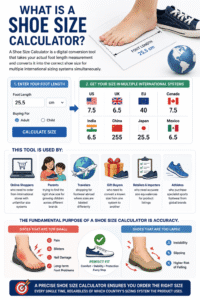
A Shoe Size Calculator is a digital conversion tool that takes your actual foot length measurement and converts it into the correct shoe size for multiple international sizing systems simultaneously. Instead of manually consulting multiple conversion charts and risking errors, you enter your foot length in centimeters, millimeters, or inches, select whether you are buying for an adult or a child, and the calculator instantly returns your size in US, UK, EU, Canadian, Indian, Chinese, Japanese, and Mexican standards all at once.
This tool is used by:
- Online shoppers who need to order from international stores with unfamiliar size systems
- Parents trying to find the right shoe size for growing children across different brands
- Travelers shopping for footwear abroad where sizes are labeled differently
- Gift buyers who need to convert a known size from one system to another
- Retailers and importers who need accurate size equivalences for product listings
- Athletes who purchase specialist sports footwear from global brands
The fundamental purpose of a Shoe Size Calculator is accuracy. Wearing shoes that are even half a size too small can cause pain, blisters, nail damage, and long-term foot problems. Shoes that are too large cause instability, slipping, and a higher risk of falling. A precise Shoe Size Calculator ensures you order the right size every single time, regardless of which country’s sizing system the product uses.
How Shoe Sizing Systems Work Around the World
Before you can fully appreciate what a Shoe Size Calculator does, it helps to understand why shoe size systems differ so significantly across countries.
The US/Canada System The United States and Canada use the same numeric system for shoe sizes, but with different starting points depending on whether the shoe is for men, women, or children. Women’s US sizes are typically 1.5 sizes larger than men’s US sizes for the same physical foot length. This means a woman wearing US size 8 and a man wearing US size 6.5 may have identically sized feet.
The UK System The United Kingdom uses a size scale that runs approximately one size below the US equivalent for men’s shoes. A US men’s size 10 is roughly equivalent to a UK size 9. Children’s UK sizes follow a separate scale that starts from a much smaller number.
The European (EU) System The EU system is based on the metric system and uses what are called “Paris points” — each size unit represents two-thirds of a centimeter of foot length. EU sizes typically range from 35 to 48 for adults, with sizes like 40, 41, 42, and 43 being the most common for adult men.
The Asian Systems (India, China, Japan) India’s system closely mirrors the US system with a one-size offset. China uses a measurement-based system where the size number approximately equals twice the foot length in centimeters minus ten. Japan uses the foot length in centimeters directly as the size number, making it the most straightforward sizing system in the world.
The Mexico System Mexico uses a system that adds approximately 1.5 to the US size, making direct comparisons straightforward once you know the formula.
A Shoe Size Calculator handles all of these conversions automatically, so you never need to memorize the individual formulas for each country’s system.
How to Use a Shoe Size Calculator
Using a Shoe Size Calculator is fast, simple, and requires no prior knowledge of shoe sizing systems. Here is a complete step-by-step guide:
Step One — Measure Your Foot Length Before anything else, you need an accurate measurement of your foot length. Foot length is measured from the very back of the heel to the tip of the longest toe, typically with the foot flat on the floor and the person standing upright under their full body weight.
Step Two — Choose Your Unit Select whether your measurement is in centimeters (cm), millimeters (mm), or inches (in). For most people, centimeters is the most convenient unit. A typical adult foot might be 25 to 28 cm long.
Step Three — Select Your Category Choose whether you are calculating sizes for an Adult or a Child. The Shoe Size Calculator uses different conversion formulas for adults and children because children’s sizing systems start from different base measurements and follow different scaling factors.
Step Four — Click Convert Press the Convert button and the tool immediately displays your equivalent shoe sizes in:
- US (United States)
- UK (United Kingdom)
- EU (European Union)
- Canada
- India
- China
- Japan
- Mexico
Step Five — Use the Result Read the size for the country whose sizing system matches the shoe you want to buy. For example, if you are buying from a European store and your foot is 26 cm long, your EU size from the Shoe Size Calculator will tell you exactly which European size to select, saving you from ordering the wrong size and going through a frustrating return process.
Shoe Size Calculator for Adults and Children
One of the most important features of a good Shoe Size Calculator is its ability to switch between adult and children’s sizing systems, because the formulas are fundamentally different.
Adult Sizing For adults, the US size is calculated using the formula: (Foot Length in cm − 18) × 1.5. This produces the standard US adult shoe size, from which all other adult international sizes are derived. An adult with a 25 cm foot length would receive a US size of 10.5, for example.
Children’s Sizing Children’s shoe sizes follow a different formula: (Foot Length in cm − 10) × 1.2. This different base and multiplier reflects the narrower spread of children’s foot sizes and the way children’s footwear is manufactured and sized internationally.
Why the Difference Matters Accidentally selecting “Adult” when buying for a child — or vice versa — will produce completely wrong size recommendations. Always verify the category setting in this tool before converting, especially when buying gifts or shoes for children who may be transitioning between children’s and adult sizing (which typically happens around foot lengths of 24–25 cm).
The transition point from children’s to adult sizing is an important milestone. Many brands have slight variations at this boundary, which is why using this calculator with explicit category selection is particularly valuable for shoe sizes in this range.
How to Measure Your Foot Length Correctly
The accuracy of any tool result depends entirely on the accuracy of your foot measurement. Here is the correct technique recommended by podiatrists and footwear manufacturers:
Materials Needed
- A blank sheet of paper larger than your foot
- A pen or pencil
- A ruler or tape measure
The Measurement Process
Step One: Place the sheet of paper on a hard, flat floor (not carpet).
Step Two: Stand on the paper with your full body weight. Do not sit — your foot spreads slightly under body weight, and standing gives the most accurate measurement for shoe fit.
Step Three: Trace the outline of your foot with the pen held perfectly vertical (not at an angle). Keep the pen touching your skin throughout.
Step Four: Measure the straight-line distance from the back of your heel to the tip of your longest toe. This is not always the big toe — for many people, the second toe is the longest.
Step Five: Measure both feet and use the larger measurement. Most people have one foot that is slightly larger than the other, and shoes should always be sized to fit the larger foot.
Step Six: Enter this measurement into the tool and select your unit of measurement.
Best Time to Measure Feet swell throughout the day, reaching their largest size in the late afternoon or evening. For the most comfortable shoe fit, measure your feet in the afternoon and use that measurement in the calculator.
Understanding Global Shoe Size Standards
This tool draws on internationally recognized sizing formulas and standards. Here is what underpins each system:
The Mondopoint Standard This international standard, used by Japan and some athletic footwear manufacturers, expresses shoe size directly as the foot length in millimeters. It is the most scientifically precise system, as there is no conversion involved — a Mondopoint size 260 fits a 260 mm (26 cm) foot exactly.
The Brannock Device Standard The Brannock Device is a widely used physical measurement tool in US shoe stores that measures foot length, arch length, and width simultaneously. US standard shoe sizes are based on measurements from this device, using a formula that dates back to 1887.
The Paris Point System EU sizing is based on Paris points, where one Paris point equals 2/3 of a centimeter. EU sizes are calculated by multiplying the foot length in centimeters by 1.5 and adding 1.5 — which is why a 26 cm foot converts to an EU size of 40.5 (rounded to 40 or 41 depending on the brand).
Width Sizing In addition to length, many sizing systems include width designations. US sizes commonly use A (narrow) through EEE (extra wide). Most conversion tools of this kind focus on length conversion, as width sizing is less standardized internationally and varies significantly by brand.
Common Shoe Size Conversion Charts
While this tool gives you instant results, having a reference chart helps you understand the relationships between systems at a glance.
Adult Men’s Sizes (Approximate)
| Foot Length (cm) | US | UK | EU | Japan |
|---|---|---|---|---|
| 24.0 | 7 | 6 | 40 | 24.0 |
| 25.0 | 8 | 7 | 41 | 25.0 |
| 26.0 | 9 | 8 | 42 | 26.0 |
| 27.0 | 10 | 9 | 43 | 27.0 |
| 28.0 | 11 | 10 | 45 | 28.0 |
| 29.0 | 12 | 11 | 46 | 29.0 |
Adult Women’s Sizes (Approximate)
| Foot Length (cm) | US | UK | EU | Japan |
|---|---|---|---|---|
| 22.0 | 5.5 | 3.5 | 36 | 22.0 |
| 23.0 | 6.5 | 4.5 | 37 | 23.0 |
| 24.0 | 8.0 | 6.0 | 38 | 24.0 |
| 25.0 | 9.0 | 7.0 | 40 | 25.0 |
| 26.0 | 10.0 | 8.0 | 41 | 26.0 |
Note: These charts show approximate values. Always use this tool for precise conversions, as different brands apply slight variations to these standard formulas.
Why Shoe Sizes Differ Between Brands and Countries
Even with perfectly accurate conversion results, you may sometimes find that your calculated size fits differently across different brands. Here is why this happens:
Last Shape Variations A “last” is the foot-shaped form around which a shoe is constructed. Different brands use different last shapes that may run narrow, wide, long, or short even within the same nominal size. This is why some people consistently size up in certain brands.
Material Differences Leather shoes stretch and conform to the foot over time. Canvas and synthetic shoes do not. When buying leather shoes, some fitters recommend going slightly smaller, while non-stretch materials should always be sized to fit comfortably at the time of purchase.
Style Differences Running shoes are typically sized larger to accommodate forward foot movement and to allow room for thick socks. Dress shoes and heels are often sized smaller. The purpose of the shoe should influence how you interpret your tool result when applying it to a specific product category.
Manufacturing Country Differences Shoes manufactured in China, India, or Brazil may follow their respective national standards even when labeled with international sizes. Always verify which sizing system a product uses before relying on the labeled size alone, and use a conversion tool to double-check.
Tips for Buying Shoes Online Using a Shoe Size Calculator
Online shoe shopping presents unique challenges, but this tool removes the biggest one: not knowing your correct size in the store’s system.
Always Check the Brand’s Size Guide Most reputable footwear brands publish their own size guides on their websites. Cross-reference your conversion result with the brand’s specific guide, as some brands run consistently half a size large or small.
Read Customer Reviews for Sizing Notes Product reviews frequently contain comments like “runs small — order a size up” or “true to size.” These notes are invaluable when combined with your conversion result, giving you both the mathematical answer and real-world confirmation.
Order Multiple Sizes When Possible For expensive footwear, many online retailers offer free returns. If you are between sizes or trying a new brand for the first time, ordering two sizes and returning the wrong one is a practical way to ensure a perfect fit.
Pay Attention to Width Length is only part of the fit equation. If you know you have wide or narrow feet, look for brands that offer width sizing in addition to the standard length conversion your tool provides.
Use the Centimeter Measurement as Your Reference Because centimeters translate most directly into multiple international sizing systems, measuring your foot in centimeters and entering that into this tool gives you the broadest set of accurate conversions from a single input value Shoe Size Calculator.
FAQs
What does a Shoe Size Calculator do? A Shoe Size Calculator converts your measured foot length into shoe sizes across multiple international systems simultaneously. Enter your foot length in centimeters, millimeters, or inches, choose adult or child, and the tool instantly shows your equivalent size in US, UK, EU, Canadian, Indian, Chinese, Japanese, and Mexican standards — all from a single measurement.
How accurate is a Shoe Size Calculator? This tool is mathematically precise based on standardized international conversion formulas. However, real-world shoe fit can vary between brands and styles due to last shape, material, and manufacturing differences. Use the tool’s result as your starting point, then check the specific brand’s sizing guide for the most reliable outcome.
Can I use a Shoe Size Calculator for children’s shoes? Yes — a tool with a category selection feature handles both adult and children’s sizes using separate conversion formulas. Children’s sizing uses different base measurements and multipliers than adult sizing. Always select the correct category to get the right result.
My US size is 9 — what is my EU size? Rather than using a fixed conversion, using this tool based on your actual foot measurement gives a more accurate result. That said, a men’s US 9 is approximately EU 42–43, and a women’s US 9 is approximately EU 40–41. For precision, measure your foot in centimeters and run it through the calculator directly.
Why does my shoe size differ between brands? Different brands use different “lasts” — the molds around which shoes are built — which means two shoes labeled the same size can fit very differently. This tool gives you the standardized size based on your foot measurement, but always check individual brand size guides and customer reviews for confirmation, especially when shopping online.
What is the most accurate way to measure foot length for shoe size conversion? Stand on a flat, hard surface, trace your foot outline on paper while bearing full body weight, then measure the straight-line distance from heel to the tip of your longest toe. Measure both feet and use the larger measurement. Measure in the afternoon when your feet are at their largest size of the day for the best fit.
Does a Shoe Size Calculator work for all shoe types? The conversion formulas in a Shoe Size Calculator apply to standard footwear across all shoe types. However, some specialist footwear — such as climbing shoes, ski boots, and ballet pointe shoes — uses additional sizing conventions beyond standard length conversion. For these types, always consult the manufacturer’s specialist sizing guide alongside your calculator result.
What is the difference between adult and child sizing in this conversion tool? Adult and child sizing use different mathematical formulas. Adult US size is calculated as (foot length in cm − 18) × 1.5, while child US size is calculated as (foot length in cm − 10) × 1.2. This tool automatically applies the correct formula when you select the right category — making it essential to choose the correct setting before converting Shoe Size Calculator.
Conclusion
Shoe sizing is genuinely complicated by the lack of a single global standard, and the differences between US, UK, EU, Asian, and other sizing systems have caused frustration for online shoppers, travelers, and gift buyers for decades. The good news is that this complexity has a simple solution: a reliable Shoe Size Calculator that does all the conversion work for you in less than a second.
Throughout this guide, we have covered every aspect of shoe sizing — from how each country’s sizing system is constructed and why they differ, to how to measure your foot correctly, how to interpret results for different shoe types, and how to use your size conversion results effectively when shopping online. The single most important habit you can develop is this: always measure your foot in centimeters and run it through a Shoe Size Calculator before placing any shoe order across a different sizing system.
Never guess at your international shoe size. A half-size error in shoe fit causes discomfort and inconvenience. A full-size error can cause real physical harm over time — blisters, bunions, hammer toes, and chronic foot pain are all associated with wearing ill-fitting shoes. The few seconds it takes to use a Shoe Size Calculator are genuinely worth it every time, whether you are spending $30 or $300 on footwear.
Use this tool for every cross-border purchase, every gift, and every time you encounter an unfamiliar sizing system. Measure accurately, select the right category, and compare the result against the brand’s own size guide. That three-step combination — accurate measurement, reliable conversion from this calculator, and brand-specific verification — is the complete formula for getting the right shoe size every time, no matter where in the world you are shopping Shoe Size Calculator