Calculate horsepower instantly with our fast and accurate Horsepower Calculator
Table of Contents
- Introduction
- What Is a Stair Calculator?
- Key Stair Terminology You Must Know
- How to Use a Stair Calculator
- Stair Building Codes and Safety Standards
- Stair Calculator Formulas Explained
- How to Calculate Total Rise and Total Run
- Riser Height and Tread Depth – Getting It Right
- Stringer Length and Angle Calculations
- Headroom Requirements for Safe Stairs
- Common Stair Types and How They Are Calculated
- Mistakes to Avoid When Planning Stairs
- FAQs
- Conclusion
Introduction
Building stairs is one of the most precise and safety-critical tasks in any construction or renovation project. Whether you are adding a staircase to a new home, replacing old steps on a deck, or designing a stairway for a commercial building, every measurement must be exact. A single error in riser height or tread depth can create a staircase that is uncomfortable to climb, fails building code inspection, or worse — causes a dangerous fall. This is exactly why a Stair Calculator is an indispensable tool for builders, architects, and homeowners alike.
Many people underestimate how much mathematics goes into a well-built staircase. The relationship between rise, run, tread depth, headroom, and stringer length involves multiple interdependent measurements that must all work together in perfect harmony. Instead of working through all of this by hand and risking costly errors, a Stair Calculator does the hard work for you — instantly, accurately, and without guesswork.
In this complete guide, you will learn everything you need to know about stair design and measurement. We will cover the essential terminology, explain the formulas step by step, walk you through how to use a Stair Calculator correctly, and highlight the most common mistakes that cause stair projects to go wrong. Whether you are a professional contractor or a weekend DIY enthusiast, this guide will give you the knowledge and confidence to build stairs that are safe, comfortable, and code-compliant every time.
What Is a Stair Calculator?
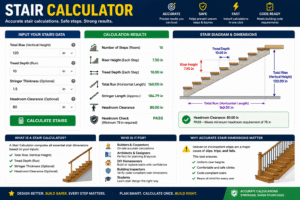
A Stair Calculator is a specialized digital tool that calculates all the key dimensions of a staircase based on your input values. You provide the total rise (the vertical height the stairs must cover), the tread depth (how deep each step is), and optionally the stringer thickness and headroom clearance — and the tool instantly returns the number of steps, the individual riser height, the total horizontal run length, and a headroom safety check.
This tool is used by:
- Professional builders and carpenters who need fast, accurate calculations on site
- Architects and designers who are planning staircase layouts during the design phase
- DIY homeowners who are building or replacing stairs on a deck, porch, or inside their home
- Building inspectors who verify that stair dimensions meet local code requirements
- Students of construction and architecture who are learning the principles of stair design
The core purpose of a Stair Calculator is to eliminate human calculation error and ensure that every step in your staircase is uniform. Non-uniform steps are one of the leading causes of stair-related falls and injuries. When each riser is a slightly different height, your body’s muscle memory gets disrupted mid-climb, which is exactly when accidents happen.
This tool handles all of this automatically, producing results you can trust and bring directly to your building site.
Key Stair Terminology You Must Know
Before you can use a Stair Calculator effectively, you need to be familiar with the standard terminology used in stair construction. These are the terms you will encounter both in the tool and in building codes.
Total Rise This is the total vertical height from the finished floor at the bottom of the stairs to the finished floor at the top. It is measured in centimeters or inches and is the single most important input for any stair calculation. If your total rise measurement is incorrect, every other number produced by the Stair Calculator will also be wrong.
Riser Height This is the vertical height of each individual step. Standard building codes typically require riser heights to fall between 15 cm and 20 cm (approximately 6 to 8 inches). Riser height is calculated by dividing the total rise by the number of steps.
Tread Depth Also called the run of a single step, this is the horizontal depth of each step — the part your foot actually lands on. A standard tread depth for interior stairs is typically 25 to 30 cm (10 to 12 inches).
Total Run This is the total horizontal distance the staircase covers from the first step to the last. It is calculated by multiplying the tread depth by the number of steps minus one (since the last step lands on the upper floor, not a separate tread).
Stringer The stringer is the structural board that runs diagonally along the side of the staircase, supporting the treads and risers. Stringer length and angle are critical for ensuring the staircase is structurally sound.
Headroom This is the vertical clearance above the stairs — the space between the stair surface and the ceiling or floor structure above it. Most building codes require a minimum headroom of 200 cm (about 6 feet 7 inches).
How to Use a Stair Calculator
Using a Stair Calculator is simple, even for those with no prior construction experience. Here is a complete step-by-step walkthrough:
Step One — Measure Your Total Rise Using a tape measure, determine the total vertical height from the bottom floor surface to the upper floor surface. This is your total rise. For example, a standard room height of 270 cm would be your input.
Step Two — Decide on Your Tread Depth Choose your preferred tread depth based on the available horizontal space and comfort. A tread of 25 cm is a common starting point for most residential staircases.
Step Three — Enter Values Into the Tool Enter your measurements into the tool:
- Total Rise (cm): e.g., 270
- Tread Depth (cm): e.g., 25
- Stringer Thickness (optional): e.g., 5 cm
- Headroom (optional): e.g., 200 cm
Step Four — Click Calculate The tool instantly processes your inputs and returns:
- Number of Steps (e.g., 15 steps)
- Riser Height per Step (e.g., 18 cm)
- Total Run Length (e.g., 350 cm)
- Headroom Safety Status (Safe or Check Headroom)
Step Five — Verify Against Building Code Check that the calculated riser height falls within your local building code’s permitted range. Most codes specify that riser height must be consistent throughout the staircase — variation of more than 0.3 cm between any two risers is typically not allowed.
Step Six — Adjust if Needed If the riser height falls outside the code range, adjust your total rise measurement slightly (perhaps due to a subfloor thickness adjustment) or modify your tread depth and run the Stair Calculator again until you achieve compliant dimensions.
Stair Building Codes and Safety Standards
One of the most important reasons to use a Stair Calculator is to verify that your stair dimensions comply with local building codes. Every country, state, and municipality has slightly different standards, but most follow similar principles.
International Residential Code (IRC) Standards (USA)
- Maximum riser height: 7¾ inches (approximately 19.7 cm)
- Minimum tread depth: 10 inches (approximately 25.4 cm)
- Minimum headroom: 6 feet 8 inches (approximately 203 cm)
- Maximum variation between risers: ⅜ inch (approximately 0.95 cm)
UK Building Regulations
- Recommended riser height: 150 mm to 220 mm
- Recommended going (tread depth): 220 mm to 300 mm
- Minimum headroom: 2,000 mm
General Comfort Guidelines Even where codes allow some flexibility, professional builders follow the twice the riser plus tread rule: 2 × Riser Height + Tread Depth = 60 to 65 cm. This formula produces stairs that feel natural and comfortable to climb for most people.
Always input your specific building code requirements when running the calculation to confirm your design is fully compliant before you begin purchasing materials or cutting stringers.
Stair Calculator Formulas Explained
Understanding the underlying math helps you get more from the tool and verify results with confidence. Here are the core formulas every Stair Calculator uses:
Number of Steps
Number of Steps = Total Rise ÷ Ideal Riser Height
The ideal riser height used as a starting point is typically 18 cm. The result is rounded to the nearest whole number. For a total rise of 270 cm: Number of Steps = 270 ÷ 18 = 15 steps
Actual Riser Height
Riser Height = Total Rise ÷ Number of Steps
Riser Height = 270 ÷ 15 = 18.00 cm per step
Total Run
Total Run = (Number of Steps − 1) × Tread Depth
Total Run = (15 − 1) × 25 = 350 cm
Stringer Length (Approximate)
Stringer Length = √(Total Rise² + Total Run²)
Stringer Length = √(270² + 350²) = √(72,900 + 122,500) = √195,400 = approximately 442 cm
Stair Angle
Stair Angle = arctan(Total Rise ÷ Total Run)
Stair Angle = arctan(270 ÷ 350) = approximately 37.6 degrees
These are the exact formulas that power every accurate tool of this kind, and knowing them helps you cross-check results, understand the geometry of your staircase, and communicate confidently with contractors and inspectors.
How to Calculate Total Rise and Total Run
Accurately measuring your total rise and planning your total run are the two most critical steps in any stair project. Errors here cascade through every other calculation.
Measuring Total Rise Total rise is the vertical distance from the finished floor at the bottom to the finished floor at the top. Always measure to the finished floor surface, not the subfloor — flooring thickness can add 1 to 2 cm, which will change your riser calculation.
Use a long level and a tape measure, or a laser distance tool for maximum accuracy. Measure in at least three places and use the largest value if there is any variation — this ensures your bottom step will not end up too tall.
Planning Total Run Total run is determined by your available horizontal space. Measure the floor area where the staircase will sit and subtract any clearance needed at the top and bottom landings. If your available horizontal space is limited, you may need to increase riser height (steeper stairs) or use a different stair style such as a spiral or alternating tread design.
Balancing Rise and Run With the Calculation Tool Enter your measured total rise and available horizontal space into the tool. Adjust the tread depth until the total run fits within your available space while keeping the riser height within the acceptable code range. This balancing act is the heart of stair planning, and the tool makes it fast and visual.
Riser Height and Tread Depth – Getting It Right
The relationship between riser height and tread depth determines how comfortable and safe your stairs feel to walk on every single day.
The Comfort Rule The most widely used comfort formula in stair design is:
2 × Riser + Tread = 60 to 65 cm
This range produces stairs that feel natural — not too steep, not too shallow. For example:
- 2 × 18 + 25 = 61 cm ✓ (comfortable)
- 2 × 20 + 20 = 60 cm ✓ (acceptable but steeper)
- 2 × 15 + 35 = 65 cm ✓ (comfortable but requires more horizontal space)
Why Uniformity Matters More Than Individual Measurements Building research consistently shows that non-uniform risers are more dangerous than risers that are slightly outside the ideal range but consistent throughout the staircase. Your brain and body learn the rhythm of the stairs after just one or two trips up. If one riser is even 5 mm taller or shorter than the rest, the disruption in rhythm is enough to cause a misstep.
This is why a Stair Calculator always divides the total rise evenly across all steps — so every riser is identical to the nearest fraction of a millimeter, not just rounded to the nearest centimeter.
Stringer Length and Angle Calculations
The stringer is the backbone of your staircase, and getting its length and angle right is essential for structural integrity.
What Is the Stringer? The stringer is a diagonal structural member — usually a thick timber board — that runs the full length of the staircase from the floor at the bottom to the floor structure at the top. Most staircases have two stringers: one on each side. Some wide staircases add a central stringer for additional support.
How Stringer Length Is Calculated Stringer length is calculated using the Pythagorean theorem, treating the total rise as the vertical leg and the total run as the horizontal leg of a right triangle:
Stringer Length = √(Total Rise² + Total Run²)
For our example (270 cm rise, 350 cm run): Stringer Length = √(72,900 + 122,500) = approximately 441.8 cm
Stringer Angle The stringer angle (the angle at which the stringer meets the floor) determines how steep the staircase is. For residential use, a stringer angle between 30° and 45° is typically recommended. Steeper than 45° feels more like a ladder; shallower than 30° requires a very long horizontal run.
Always add the stringer thickness value into your tool inputs to account for the material needed at the base of the stringer where it contacts the floor.
Headroom Requirements for Safe Stairs
Headroom is a safety-critical measurement that is often overlooked until it causes an expensive problem during construction.
What Is Headroom? Headroom is the vertical distance measured from the nosing (front edge) of any tread to the ceiling, beam, or floor structure directly above it. Every point along the entire staircase — from the first step to the last — must meet the minimum headroom requirement.
Why It Matters Insufficient headroom is not just uncomfortable — it is a building code violation that will fail inspection. More importantly, it is a real danger: people will hit their heads, particularly on upper steps where the staircase passes under the floor above.
How the Tool Checks Headroom When you enter your headroom value into the tool, it compares it against your total rise. If your entered headroom value is greater than your total rise, the staircase is considered safe. If it is equal to or less than the total rise, the tool flags it with a “Check Headroom” warning, prompting you to revisit your staircase position, reduce the total rise, or lower the ceiling structure before proceeding.
Always input your actual measured headroom clearance into the tool — do not estimate or assume. A few centimeters of error can mean the difference between a passing and failing inspection.
Common Stair Types and How They Are Calculated
Different stair configurations require slightly different approaches, but the core calculations remain the same regardless of stair type.
Straight Stairs The simplest and most common type. All steps run in a straight line from bottom to top. The full calculation formula applies directly with no modifications.
L-Shaped (Quarter-Turn) Stairs These stairs make a 90-degree turn at a landing midway up. Calculate each straight section separately using the tool, treating each section’s portion of the total rise as an independent calculation. Ensure both sections have the same riser height for comfort and code compliance.
U-Shaped (Half-Turn) Stairs These make a full 180-degree turn at a midpoint landing. Again, treat each section separately and ensure identical riser heights throughout.
Spiral Stairs Spiral stairs require more complex calculations involving tread width at different radii. While the basic rise and riser calculations remain the same, the tread depth varies across the width of the tread. The center of the tread (measured at approximately one-third from the narrow end) is the reference point used in most spiral stair building codes.
Deck and Exterior Stairs For outdoor stairs, the same calculations apply, but you must account for potential wood expansion, post heights, and the effect of frost heave on the bottom landing level. Always add at least 5 to 10 mm of allowance to your tread depth for exterior wood stairs to prevent water pooling on the step surface Stair Calculator.
Mistakes to Avoid When Planning Stairs
Even with a reliable calculation tool, certain common mistakes can ruin an otherwise well-planned stair project.
Measuring to the Subfloor Instead of the Finished Floor This is the most frequent and most costly mistake in stair planning. If you measure to the subfloor and then add 2 cm of finished flooring at the top, your bottom riser will be 2 cm shorter than every other riser — an instant code violation and a tripping hazard.
Ignoring the Final Tread Many first-time builders forget that the top tread is actually the upper floor landing itself. This means the number of treads is always one less than the number of risers. If you count treads instead of risers when calculating your total run, you will end up with a staircase that is one tread depth too long.
Not Checking Headroom at Every Step Headroom must be sufficient at every point along the staircase, not just at the top. The most critical point is typically one to two steps from the top, where the underside of the upper floor structure is closest to the stair nosing. Always walk through the headroom check carefully.
Rounding Riser Heights Too Aggressively When dividing total rise by number of steps, the result is often a decimal. Never round each riser to the nearest centimeter — the cumulative error will result in a top step that is noticeably different from all the others. Let the tool calculate to two decimal places and cut your stringers accordingly.
Skipping the Stringer Angle Check A stringer angle above 45° produces stairs that are uncomfortably steep and potentially dangerous. Always verify the calculated stringer angle before cutting materials, and use the tool to explore adjustments if the angle is too steep Stair Calculator.
FAQs
What does a Stair Calculator calculate? A Stair Calculator computes the number of steps, individual riser height, total run length, stringer dimensions, and headroom safety status based on your total rise, tread depth, stringer thickness, and headroom inputs. It gives you everything you need to begin a stair project with confidence and accuracy.
How do I measure total rise for my staircase? Total rise is measured vertically from the finished surface of the lower floor to the finished surface of the upper floor. Always measure to the finished floor level, not the subfloor, and account for any flooring material you plan to add after the staircase is installed. Use a laser level or a long straight board and tape measure for best accuracy.
What is a safe riser height? Most building codes specify a maximum riser height of between 18 cm and 20 cm (approximately 7 to 8 inches). The ideal riser height for comfortable daily use is generally considered to be around 18 cm. Anything above 20 cm starts to feel uncomfortably steep, especially for children and elderly users.
How many steps do I need for a 270 cm rise? For a total rise of 270 cm, the calculation gives you 15 steps with a riser height of exactly 18 cm each. This is considered one of the most comfortable and code-compliant stair configurations for standard residential use.
Can I use a Stair Calculator for exterior deck stairs? Yes, absolutely. The core calculations for riser height, number of steps, total run, and stringer length are exactly the same for exterior deck stairs as for interior stairs. However, for exterior use you should also factor in material expansion, drainage slope on the treads, and the height of your deck posts when determining your total rise.
What is the minimum headroom for stairs? Most international building codes require a minimum headroom clearance of 200 cm (approximately 6 feet 6 inches) measured vertically from any stair nosing to the ceiling or structure above. Some jurisdictions require 203 cm or more. Always check your local code before finalizing your stair design.
What is a stringer in stair construction? A stringer is the diagonal structural board that runs along the side of a staircase, supporting the weight of the treads and risers. It is cut with notches to accept the individual treads and risers, and its length is calculated using the Pythagorean theorem from your total rise and total run values.
Is there a formula for comfortable stair design? Yes — the most widely used comfort formula is: 2 × Riser Height + Tread Depth = 60 to 65 cm. This formula, used by professional architects and builders worldwide, produces stairs that feel natural and effortless to climb for people of all ages. Enter your values into the tool and check them against this formula for the best results.
What stair angle is too steep? A stair angle above 45 degrees is generally considered too steep for comfortable daily use and may not comply with residential building codes. The optimal angle for most residential staircases falls between 30 and 38 degrees. The tool will automatically show you the resulting stair angle so you can adjust your design before cutting any materials Stair Calculator
Conclusion
Building a safe, comfortable, and code-compliant staircase requires precise measurements, careful planning, and a thorough understanding of how rise, run, riser height, tread depth, and headroom all interact with one another. Getting any one of these dimensions wrong can result in a staircase that fails inspection, feels awkward to use, or — most seriously — poses a genuine safety risk to everyone who uses it.
A Stair Calculator removes the risk of human error from every calculation. Instead of working through Pythagorean formulas and rounding decisions by hand, you enter three or four simple measurements and receive a complete, accurate set of dimensions in seconds. This is not just a time-saver — it is a safety tool that ensures your staircase is built right from the very first step.
Throughout this guide, we have covered the full picture of stair planning — from terminology and building codes to formulas, stringer calculations, headroom requirements, and the most common mistakes that send projects back to the drawing board. The single most important habit you can build is this: always calculate before you cut.
Run your measurements through a Stair Calculator every time you begin a new stair project, whether it is a simple two-step deck landing or a full interior staircase spanning two floors. Verify your riser height is within code, confirm your total run fits your available space, check your headroom clearance, and validate your stringer angle — all before you spend a single dollar on materials.
Stairs are used dozens of times every day by every person in a building. They carry children, elderly family members, and everyone in between. The few minutes you invest in proper calculation and planning — supported by a reliable Stair Calculator — can make the difference between a staircase that serves your home safely for decades and one that causes an accident on its very first use.
Build with precision. Build with confidence. Build with the right numbers from the start Stair Calculator.