Calculate GDP instantly with our fast and accurate GDP Calculator
Table of Contents
- Introduction
- What Is a Horsepower Calculator?
- The Formula Behind a Horsepower Calculator
- How to Use a Horsepower Calculator Step by Step
- Understanding Torque and RPM
- Horsepower Calculator Results Explained
- Horsepower vs. Torque – What Is the Real Difference?
- Types of Horsepower Explained
- Real-World Examples Using a Horsepower Calculator
- Why Horsepower Matters in Automotive Engineering
- Applications of a Horsepower Calculator Beyond Cars
- Common Mistakes When Using a Horsepower Calculator
- FAQs
- Conclusion
Introduction
Every engine produces power — and in the world of automotive engineering, motorsport, and mechanical design, that power is measured in horsepower. Whether you are a car enthusiast analyzing your vehicle’s performance, an automotive engineer designing a powertrain, a mechanic diagnosing an engine problem, or simply someone trying to understand what those horsepower numbers on a car spec sheet actually mean, one tool makes the calculation instant and effortless: a Horsepower Calculator.
Horsepower is one of the most widely referenced performance metrics in the automotive world, yet the formula behind it is surprisingly misunderstood. Most people know that more horsepower means a faster car — but fewer know that horsepower is actually derived from two other physical quantities: torque and RPM. The relationship between these three values is precise, mathematically defined, and directly accessible through a Horsepower Calculator that applies the formula automatically.
This comprehensive guide explains everything you need to know about horsepower and how a Horsepower Calculator works. We will cover the formula, the variables, step-by-step usage, the difference between horsepower and torque, the different types of horsepower used across industries, and real-world examples from automotive, industrial, and motorsport applications. By the end of this guide, you will have a complete understanding of engine power — and exactly how to calculate it.
What Is a Horsepower Calculator?
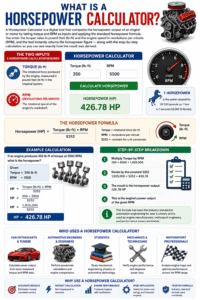
A Horsepower Calculator is a digital tool that computes the horsepower output of an engine or motor by taking torque and RPM as inputs and applying the standard horsepower formula. You enter the torque value in pound-feet (lb-ft) and the engine speed in revolutions per minute (RPM), and the tool instantly returns the horsepower figure — along with the step-by-step calculation so you can see exactly how the result was derived.
The two inputs a Horsepower Calculator requires are:
- Torque (lb-ft) — the rotational force produced by the engine, measured in pound-feet in the imperial system
- RPM (Revolutions Per Minute) — the rotational speed of the engine’s crankshaft
From these two values, the Horsepower Calculator derives the engine’s power output — a single number that represents how quickly the engine can do work. The formula that connects torque, RPM, and horsepower has been the industry standard in automotive engineering for over a century and is used by engine manufacturers, motorsport engineers, and performance tuners worldwide.
This tool is valuable for:
- Car enthusiasts and tuners who want to calculate power output from dyno-measured torque and RPM data
- Automotive engineers and designers performing powertrain calculations and engine comparisons
- Students studying mechanical engineering, physics, or automotive technology
- Mechanics and technicians verifying engine performance and diagnosing power loss
- Motorsport professionals analyzing engine maps and optimizing performance across the RPM range

The Formula Behind a this tool
The mathematical foundation of every Horsepower Calculator is a single elegant formula that connects power, torque, and rotational speed.
The Standard Horsepower Formula:
HP = (Torque × RPM) ÷ 5252
Where:
- HP = Horsepower (output power)
- Torque = Rotational force in pound-feet (lb-ft)
- RPM = Engine speed in revolutions per minute
- 5252 = A constant derived from unit conversions (explained below)
Where Does 5252 Come From? The constant 5252 is not arbitrary — it comes from the mathematical relationship between the units used. One horsepower is defined as 550 foot-pounds of work per second. When you work through the unit conversions for rotational power (converting RPM to radians per second and applying the torque formula), the constant that emerges is exactly 5252. Every Horsepower Calculator uses this constant because it is baked into the definition of the imperial horsepower unit.
What the Formula Tells You The formula reveals an important insight: at exactly 5,252 RPM, the torque value in lb-ft equals the horsepower figure. Below 5,252 RPM, torque is always higher than horsepower. Above 5,252 RPM, horsepower exceeds torque. This is why torque and horsepower curves always cross at 5,252 RPM on a standard dyno chart — and it is a direct consequence of the constant in the formula.
This formula is the engine of every Horsepower Calculator, and understanding it transforms raw numbers on a spec sheet into meaningful insight about how an engine actually performs across its operating range.
How to Use a Horsepower Calculator Step by Step
Using a Horsepower Calculator is fast, straightforward, and requires only two inputs. Here is a complete step-by-step guide:
Step One — Enter the Torque Value Type the torque figure into the Torque field, expressed in pound-feet (lb-ft). This value is typically available from:
- Manufacturer specifications (engine torque rating in the vehicle’s technical data)
- Dynamometer (dyno) test results (measured torque at a specific RPM point)
- Engine tuning software that logs torque across the RPM range
For example, a typical performance car engine might produce 350 lb-ft of torque.
Step Two — Enter the RPM Value Type the engine speed in the RPM field — the rotational speed at which the torque measurement was taken. For the most meaningful result, use the RPM at which peak torque occurs. For example, if peak torque of 350 lb-ft occurs at 4,500 RPM, enter 4500.
Step Three — Click Calculate Press the Calculate button. The Horsepower Calculator applies the formula HP = (Torque × RPM) ÷ 5252, displays the step-by-step working, and shows the horsepower result clearly highlighted at the bottom of the results panel.
Step Four — Read the Result The result shows the horsepower at the torque and RPM values you entered. This is the power output of the engine at that specific operating point. If you entered peak torque values, the result represents peak horsepower — but note that peak horsepower and peak torque typically occur at different RPM points.
Step Five — Experiment With Different Values One of the most valuable uses of a Horsepower Calculator is running multiple scenarios — try different torque and RPM combinations to see how power changes across the operating range, compare two engines, or understand how a tuning modification that changes torque at a specific RPM affects overall power output. Use the Clear button to reset between calculations.
Understanding Torque and RPM
To use a Horsepower Calculator effectively, you need a solid understanding of the two input variables: torque and RPM.
Torque – Rotational Force Torque is the twisting force that an engine produces at its crankshaft. Measured in pound-feet (lb-ft) in the imperial system or Newton-meters (Nm) in the metric system, torque represents the engine’s ability to do work at a given instant. High torque at low RPM is the characteristic of diesel engines and large displacement petrol engines — it produces the strong pulling force you feel when a truck accelerates from rest or when a car effortlessly climbs a steep hill.
A key concept: torque is what accelerates the vehicle — it is the force that overcomes inertia and gets the car moving. A high-torque engine feels “strong” and responsive, especially at low and mid-range RPM.
RPM – Engine Speed RPM (Revolutions Per Minute) measures how fast the engine’s crankshaft is rotating. A typical passenger car engine idles at around 700–900 RPM and reaches peak power at anywhere from 4,000 to 8,000 RPM depending on engine design. High-revving naturally aspirated sports car engines — like those in Ferrari and Honda VTEC models — can reach 8,000–9,000 RPM at peak power.
The Relationship Between Torque, RPM, and Horsepower Horsepower combines both torque and engine speed into a single power measurement. An engine can achieve the same horsepower in two different ways: high torque at moderate RPM (like a diesel truck), or moderate torque at very high RPM (like a racing motorcycle engine). A Horsepower Calculator makes this relationship visible — enter the same torque with double the RPM and the horsepower doubles, illustrating exactly how speed amplifies power output.
Horsepower Calculator Results Explained
When a Horsepower Calculator returns a result, it tells you the mechanical power output of the engine at the specific torque and RPM values you entered.
What “HP” Means One horsepower is defined as the ability to do 550 foot-pounds of work per second. In practical terms, a higher horsepower figure means the engine can accelerate a vehicle faster — assuming the same vehicle weight and drivetrain losses. Horsepower is what determines top speed and sustained high-speed performance.
Peak Horsepower vs. Power Across the Rev Range Most engine specifications list peak horsepower — the maximum power the engine produces at its optimal RPM. However, real-world performance depends on power throughout the entire usable RPM range, not just at the peak point. A Horsepower Calculator lets you calculate power at any point in the rev range by entering the torque and RPM values at that point.
Interpreting Dyno Charts A dynamometer (dyno) test measures torque at every RPM point across the engine’s range. Using a this tool with each torque-RPM data pair from a dyno test allows you to reconstruct the full horsepower curve — the same curve you see plotted on professional dyno charts. This is how automotive engineers and tuners verify that engine modifications have improved power as intended.
Horsepower vs. Torque – What Is the Real Difference?
One of the most common sources of confusion in automotive discussions is the difference between horsepower and torque — and understanding this difference makes a this tool far more useful.
Torque is Force; Horsepower is Power The simplest way to understand the distinction: torque is the force available at a single instant, while horsepower is the rate at which work is being done over time. You can have an enormous amount of torque while barely moving (like an engine starting to pull a very heavy load), but horsepower only becomes significant when that torque is combined with speed.
The Classic Analogy A famous engineering saying captures this perfectly: “Torque is how hard you hit the wall. Horsepower is how fast you carry the bricks.” Torque gives you the initial force. Horsepower tells you how much work you accomplish per unit of time.
Which Matters More? Both matter — but for different types of performance:
- High torque at low RPM is best for towing, hauling, off-road driving, and applications where pulling force matters more than top speed.
- High horsepower (achieved through high RPM) is best for top speed and sustained high-speed acceleration.
- A balanced combination of good torque across the mid-range RPM and strong peak horsepower is the goal of most performance street engines.
A Horsepower Calculator makes the relationship between these quantities tangible — you can directly observe how the same torque value produces different horsepower at different RPM levels, building genuine intuition for engine performance.
Types of Horsepower Explained
Not all horsepower figures mean the same thing. Understanding the different types helps you interpret results correctly.
Mechanical (Imperial) Horsepower This is the standard unit used in the United States and the one used by the Horsepower Calculator formula. One mechanical horsepower = 550 foot-pounds per second, or equivalently 745.7 Watts. This is the value calculated by the formula HP = (Torque × RPM) ÷ 5252 when torque is in lb-ft.
Metric Horsepower (PS) Used primarily in Europe, one metric horsepower (PS, from the German “Pferdestärke”) = 75 kilogram-meters per second = 735.5 Watts. Metric horsepower is approximately 1.4% less than imperial horsepower. European car manufacturers typically rate engines in PS, which is why a “200 PS” European car is slightly less powerful than a “200 HP” American car.
Brake Horsepower (BHP) BHP is the power measured at the engine’s output shaft using a braking device (brake dynamometer), before accounting for transmission and drivetrain losses. It is the most commonly published power rating for road cars. The this tool computes the equivalent of BHP when you use torque and RPM values measured directly at the crankshaft.
Wheel Horsepower (WHP) WHP is the power measured at the driven wheels, after all drivetrain losses have been subtracted. WHP is always lower than BHP — typically by 15–20% for rear-wheel-drive cars and 18–25% for all-wheel-drive vehicles. Dyno tuners often work with WHP measurements and use a this tool to convert between measured torque at the wheels and wheel horsepower figures.
Real-World Examples Using a this tool
Seeing the formula in action with real engine data makes the this tool far more intuitive.
Example 1: Family Sedan Engine
- Torque: 200 lb-ft at 4,000 RPM
- HP = (200 × 4,000) ÷ 5252 = 152.3 HP
A typical result for a 2.0-liter turbocharged family car engine — adequate for daily driving but not a performance vehicle.
Example 2: American Muscle Car
- Torque: 420 lb-ft at 4,250 RPM
- HP = (420 × 4,250) ÷ 5252 = 339.9 HP
Classic muscle car performance territory — strong torque at moderate RPM delivering around 340 horsepower. This is typical for a modern V8-powered pony car.
Example 3: High-Revving Sports Car
- Torque: 310 lb-ft at 7,000 RPM
- HP = (310 × 7,000) ÷ 5252 = 413.2 HP
A high-revving naturally aspirated sports car achieves strong horsepower not through massive torque but through high engine speed — illustrating how RPM amplifies power output.
Example 4: Modified Track Car
- Torque: 350 lb-ft at 5,252 RPM
- HP = (350 × 5,252) ÷ 5252 = 350 HP
At exactly 5,252 RPM, torque in lb-ft always equals horsepower — a direct consequence of the constant in the formula. Running this calculation in a this tool confirms the crossover point perfectly.
Why Horsepower Matters in Automotive Engineering
Horsepower is not just a marketing number — it is a fundamental engineering measurement with real consequences for vehicle design and performance.
Performance and Acceleration The power-to-weight ratio — horsepower divided by vehicle mass — is the primary determinant of acceleration performance. A car with 400 HP and 1,400 kg weight has a better power-to-weight ratio than a car with 500 HP and 2,200 kg, and will accelerate more quickly despite having less total power. Engineers use horsepower figures from tools like a this tool to assess and optimize this ratio.
Powertrain Matching Transmissions, driveshafts, differentials, and axles must all be designed to handle the maximum power and torque the engine produces. Knowing the peak horsepower allows engineers to select components with the appropriate strength ratings, avoiding failures that would occur if components are underspecified for the engine’s output.
Fuel Efficiency and Emissions Modern engine design involves a careful balance between power output and efficiency. Higher horsepower generally requires more fuel, and the horsepower figure directly influences how engineers design fuel injection, ignition timing, and exhaust systems to meet both performance and emissions targets.
Applications of a this tool Beyond Cars
While automotive applications are the most familiar, a this tool is equally useful across a wide range of mechanical and industrial engineering contexts.
Marine Engines Boat engines are rated in horsepower, and the same formula applies. Marine engineers and boat buyers use a this tool to assess propulsion power and determine whether an engine will achieve the desired speed and load capacity for a given hull weight.
Aircraft Engines Piston aircraft engines — particularly in light aviation — are rated in horsepower. The relationship between engine torque, propeller shaft RPM, and power output uses the same fundamental formula. Aviation engineers apply the same this tool principles to verify engine performance and match propellers to powerplants.
Industrial Motors and Machinery Electric motors, hydraulic motors, and industrial engines all produce torque and operate at defined RPM values. Factory engineers, maintenance technicians, and equipment designers use horsepower calculations constantly to select motors, size mechanical drive systems, and verify that machinery is operating within its rated power range.
Agricultural Equipment Tractors and farm machinery are rated by horsepower at the power take-off (PTO) shaft — the connection point for implements. Farmers and agricultural engineers use the same torque-RPM-horsepower relationship to match tractors to implements and ensure sufficient power for fieldwork operations.
Common Mistakes When Using a Horsepower Calculator
Avoiding these errors ensures your calculations are always accurate and meaningful.
Using Mismatched Torque and RPM Values The most important rule for accurate results: the torque value and the RPM value must be measured at the same operating point. Using peak torque from one RPM and a different RPM figure will produce a meaningless number. For peak horsepower calculations, use the torque value measured at the RPM point where you want to know the power.
Confusing lb-ft With Newton-Meters The standard Horsepower Calculator formula (÷ 5252) uses torque in pound-feet only. If your torque value is in Newton-meters (Nm), convert it first: multiply Nm by 0.7376 to get lb-ft. Entering Nm directly into the formula without conversion will produce a result approximately 35% too low.
Forgetting Drivetrain Losses Engine horsepower (BHP) is always higher than wheel horsepower (WHP) because power is lost to friction in the gearbox, driveshaft, differential, and axles. If you are comparing a calculated BHP figure with a wheel dyno result, expect the wheel figure to be 15–20% lower — this is normal and not an error in your this tool.
Using Horsepower as the Only Performance Metric A common mistake is focusing exclusively on peak horsepower without considering torque delivery and the RPM range. Two engines with identical peak horsepower can feel very different to drive if one produces its power at 3,000 RPM and the other at 7,000 RPM. Always interpret horsepower in context with the full torque and power curves Horsepower Calculator.
FAQs
What does a Horsepower Calculator do? A Horsepower Calculator computes engine power output by applying the formula HP = (Torque × RPM) ÷ 5252. You enter torque in pound-feet and engine speed in RPM, and the tool instantly returns the horsepower at that operating point, along with the step-by-step calculation. It is the fastest and most reliable way to convert torque and RPM data into horsepower figures.
Why is 5252 used in the horsepower formula? The constant 5252 comes from the mathematical unit conversions involved in defining one horsepower. One horsepower equals 550 foot-pounds of work per second. When you convert RPM to radians per second and work through the rotational power formula, the unit conversions produce the constant 5252. This is why all standard imperial horsepower calculations use exactly this divisor.
Can I use a this tool with metric torque values? Yes — but you must first convert Newton-meters (Nm) to pound-feet (lb-ft) before entering the value. Multiply your Nm figure by 0.7376 to convert to lb-ft, then enter the result into the this tool. Alternatively, use a metric horsepower formula: HP(metric) = (Torque in Nm × RPM) ÷ 9,549.
What is the difference between peak horsepower and horsepower at a specific RPM? Peak horsepower is the maximum power output the engine achieves across its entire operating range, occurring at the RPM where the product of torque and RPM is highest. Horsepower at a specific RPM is the power at just that one point. A this tool gives you the power at any RPM point — calculate at multiple points to understand how power varies across the full rev range.
Why do torque and horsepower curves always cross at 5,252 RPM? Because at exactly 5,252 RPM, the formula HP = (Torque × RPM) ÷ 5252 reduces to HP = Torque. When torque equals horsepower numerically, the two curves must intersect. This is a direct mathematical consequence of the constant in the formula and holds true for any engine measured in imperial units.
Is a higher horsepower figure always better? Not necessarily — it depends on the application. For top speed and sustained highway performance, high horsepower is the priority. For towing, hauling, and low-speed work, high torque matters more. A this tool helps you understand both figures and how they relate, so you can evaluate performance for your specific use case.
Can a this tool be used for electric motors? Yes — electric motors produce torque and operate at defined RPM values, and the same formula applies. Electric motors typically produce maximum torque from zero RPM, which is why electric vehicles feel so responsive from a standstill. The same HP = (Torque × RPM) ÷ 5252 formula gives accurate power figures for electric motors when torque is in lb-ft Horsepower Calculator.
Conclusion
Horsepower is one of the most important and most discussed metrics in all of automotive and mechanical engineering — and yet, without the right tool, converting torque and RPM data into a meaningful power figure requires careful arithmetic and a clear understanding of the formula. A reliable this tool eliminates that friction entirely, delivering an accurate horsepower figure in seconds from just two inputs.
Understanding the formula HP = (Torque × RPM) ÷ 5252 is not just about performing a calculation — it is about developing real intuition for how engines work. It shows you exactly why engine speed matters, why a high-revving engine can match the power of a torque-heavy engine, and why the crossover point between torque and horsepower always falls at 5,252 RPM. A Horsepower Calculator makes these relationships concrete and immediately verifiable with any combination of torque and RPM values you want to explore.
Throughout this guide, we have covered every dimension of horsepower — from the formula and its mathematical origins, through the difference between torque and power, the various types of horsepower used across industries, and real-world examples from passenger cars to motorsport to industrial machinery. Whether you are a student, an enthusiast, an engineer, or a professional, the knowledge in this guide combined with a Horsepower Calculator gives you everything you need to work confidently with engine power data.
Use a this tool every time you encounter torque and RPM data — whether from a manufacturer spec sheet, a dyno test, a tuning session, or a technical paper. Verify your units, match your torque and RPM to the same operating point, and interpret the result in the context of the full power curve. That disciplined approach — accurate inputs and a reliable this tool — is the foundation of informed, precise engine performance analysis at every level Horsepower Calculator.