Drop Percentage: 0.00 %
Voltage at End: 0.00 V
Convert units instantly with our fast and accurate Conversion Calculator
Table of Contents
- Introduction
- What Is Voltage Drop?
- What Is a Voltage Drop Calculator?
- Why You Should Use a Voltage Drop Calculator
- Step-by-Step Usage Guide
- Key Formulas and How the Tool Uses Them
- Single Phase, Three Phase, and DC Systems Explained
- Real-World Applications
- Tips for Accurate Results
- Common Mistakes to Avoid
- Frequently Asked Questions (FAQs)
- Conclusion
Introduction
Electrical installations depend on one critical measurement that is frequently underestimated: voltage drop. When current flows through a conductor, resistance in the wire causes the voltage to decrease between the source and the load. Too much drop means motors run inefficiently, lights flicker, sensitive electronics malfunction, and heating can occur in undersized cables. A Voltage Drop Calculator is the most reliable way to prevent these problems before they occur.
Whether you are an electrician designing a new circuit, an engineer sizing cables for an industrial installation, a homeowner extending a power run to an outbuilding, or a student learning electrical fundamentals — a Voltage Drop Calculator gives you precise, instant results without manual formula work. You enter the system type, voltage, current, wire length, and conductor size, and the tool computes the voltage drop, percentage drop, and voltage at the load end in seconds.
In this complete guide, you will learn what voltage drop is, why it matters, how a Voltage Drop Calculator works, which formulas it applies, and where these calculations are used in the real world. By the end, you will have everything you need to size conductors correctly and maintain safe, efficient electrical installations every time.
What Is Voltage Drop?
Voltage drop is the reduction in electrical potential that occurs as current flows through a conductor. Every wire — no matter how good its conductivity — has resistance. When current flows through that resistance, energy is lost in the form of heat, and the voltage available at the load end of the circuit is lower than the source voltage.
The fundamental relationship is governed by Ohm’s Law: V = I × R Where V is the voltage drop, I is the current in amperes, and R is the resistance of the conductor in ohms.
Resistance in a wire depends on three factors:
- Resistivity — a property of the conductor material (copper has a resistivity of approximately 0.0172 Ω·mm²/m)
- Length — longer wires have more resistance
- Cross-sectional area — thicker wires have less resistance
When voltage drop is excessive, the consequences are serious:
- Motors and compressors draw more current trying to compensate, leading to overheating and premature failure
- Lighting appears dim or flickers
- Sensitive electronics can malfunction, give incorrect readings, or become damaged
- Heat buildup in undersized conductors creates a fire hazard
Most electrical standards — including NEC, IEC, and BS 7671 — specify maximum permissible voltage drop limits. For branch circuits, a 3% drop is typically the recommended maximum, with 5% as the absolute limit for combined service and feeder drops.
What Is a Voltage Drop Calculator?
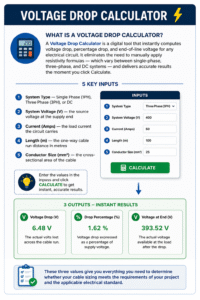
A Voltage Drop Calculator is a digital tool that instantly computes voltage drop, percentage drop, and end-of-line voltage for any electrical circuit. It eliminates the need to manually apply resistivity formulas — which vary between single-phase, three-phase, and DC systems — and delivers accurate results the moment you click Calculate.
This tool accepts five key inputs:
- System Type — Single Phase (1PH), Three Phase (3PH), or DC
- System Voltage (V) — the source voltage at the supply end
- Current (Amps) — the load current the circuit carries
- Length (m) — the one-way cable run distance in metres
- Conductor Size (mm²) — the cross-sectional area of the cable
Once you click Calculate, the Voltage Drop Calculator instantly delivers three outputs:
- Voltage Drop (V) — the actual volts lost across the cable run
- Drop Percentage (%) — voltage drop expressed as a percentage of supply voltage
- Voltage at End (V) — the actual voltage available at the load after the drop
These three values give you everything you need to determine whether your cable sizing meets the requirements of your project and the applicable electrical standard.
Why You Should Use a Voltage Drop Calculator
Many electricians and engineers still perform voltage drop calculations by hand using formulas, reference tables, or mental arithmetic. While that approach works in simple cases, there are compelling reasons to rely on a Voltage Drop Calculator for every circuit you design.
Speed Manual voltage drop calculations involve multiple steps — finding the resistivity factor, adjusting for system type, multiplying by length and current, and dividing by conductor area. A Voltage Drop Calculator performs all of these operations simultaneously in under a second.
Accuracy Errors in manual calculations are surprisingly common. Forgetting to multiply by 2 for single-phase return path, using the wrong resistivity value, or making a simple arithmetic mistake can result in undersized conductors that fail on the job. A Voltage Drop Calculator eliminates human arithmetic error entirely.
System Flexibility Different system types require different calculation factors. Single-phase and DC circuits use a factor of 2 (accounting for both the supply and return conductors), while three-phase systems use √3 (≈ 1.732). Keeping track of which factor to apply manually is error-prone. The tool handles this automatically based on your selected system type.
Code Compliance Staying within the 3–5% voltage drop limits required by electrical codes is straightforward when you use a Voltage Drop Calculator during the design phase. Catching an oversized voltage drop before you run cable saves both time and materials.
Professional Documentation Documenting your calculations is a professional and regulatory requirement on many projects. A Voltage Drop Calculator provides clear, consistent numeric results you can record and include in project documentation.
Step-by-Step Usage Guide
Using this tool is straightforward. Follow these five steps to get accurate results for any electrical circuit.
Step 1 — Select the System Type Choose Single Phase (1PH), Three Phase (3PH), or DC from the System Type dropdown. This is the most important selection — it controls the multiplication factor used in the calculation. Single-phase and DC use a factor of 2; three-phase uses 1.732 (√3).
Step 2 — Enter the System Voltage Type the source voltage into the System Voltage field. Common values are 230V for single-phase (UK/EU), 400V for three-phase (UK/EU), 120V or 240V for North American systems, or 12V/24V/48V for DC systems.
Step 3 — Enter the Current and Cable Length Fill in the Amps field with the circuit load current, and the Length field with the one-way cable run in metres. The tool automatically accounts for the return conductor in its formula — you only need to enter the one-way distance.
Step 4 — Enter the Conductor Size Enter the cable cross-sectional area in mm² in the Conductor field. Common sizes include 1.5 mm², 2.5 mm², 4 mm², 6 mm², 10 mm², and 16 mm². Larger cross-sections produce less resistance and therefore less voltage drop.
Step 5 — Click Calculate and Read the Results Press Calculate. The tool displays Voltage Drop in volts, Drop Percentage as a fraction of supply voltage, and Voltage at End — the actual voltage the load receives. If the percentage drop exceeds 3%, consider upgrading to the next cable size and recalculating.
Click Clear to reset all fields and begin a fresh calculation for a different circuit.
Key Formulas and How the Tool Uses Them
To understand what the tool is computing, it helps to see the underlying formulas. The core voltage drop formula varies by system type.
For Single Phase and DC: Vd = (2 × L × I × ρ) / A
For Three Phase: Vd = (√3 × L × I × ρ) / A
Where:
- Vd = Voltage Drop (Volts)
- L = One-way cable length (metres)
- I = Current (Amps)
- ρ (rho) = Resistivity of conductor material (0.0172 Ω·mm²/m for copper)
- A = Conductor cross-sectional area (mm²)
The factor of 2 in single-phase and DC formulas accounts for the fact that current flows through both the supply conductor and the return conductor — so the total length of conductor is twice the one-way run.
The factor of √3 (≈ 1.732) in three-phase formulas comes from the geometry of three-phase power systems, where the phase-to-phase voltage relationship reduces the effective conductor length factor compared to a simple two-wire return.
Drop Percentage Formula: Vd% = (Vd / Vsource) × 100
Voltage at End Formula: Vend = Vsource − Vd
These four equations are everything the Voltage Drop Calculator uses to deliver complete, accurate results from just five inputs.
Single Phase, Three Phase, and DC Systems Explained
One of the most powerful features of this tool is its support for all three major system types. Understanding the difference helps you choose the right setting and interpret your results correctly.
Single Phase (1PH) Single-phase power is the standard supply for residential and light commercial installations. It uses two conductors — a live and a neutral — with common voltages of 120V (North America) or 230V (UK/Europe). Because current flows out through the live and returns through the neutral, the effective conductor length is doubled in the formula.
Three Phase (3PH) Three-phase power is used in industrial, commercial, and larger building installations. It uses three live conductors offset by 120° — eliminating the need for a separate return path in balanced loads. The √3 factor reflects this geometry. Common voltages are 208V, 400V, or 480V depending on region.
DC Systems DC circuits are common in solar power systems, battery storage, electric vehicles, and low-voltage installations. The formula is identical to single-phase AC because current flows through a positive and negative conductor with no phase angle involved. This tool supports DC voltages from 12V through to high-voltage systems, making it versatile across the full range of DC applications.
Choosing the wrong system type is one of the most common input errors when using a Voltage Drop Calculator — always verify your selection before calculating.
Real-World Applications
Voltage drop calculations are required in a wide range of electrical and engineering contexts. Here are the most important real-world applications.
Residential Wiring Homeowners and electricians routinely encounter voltage drop challenges when extending circuits to garages, garden offices, workshops, or outbuildings. A run of 30–50 metres on a standard 2.5 mm² cable can produce a voltage drop that exceeds the 3% limit, requiring an upgrade to 4 mm² or 6 mm². A Voltage Drop Calculator makes this assessment quick and definitive before any cable is purchased or installed.
Industrial Motor Circuits Motors are especially sensitive to low voltage. A motor operating at 90% of its rated voltage draws approximately 20% more current — increasing heat, reducing efficiency, and shortening motor life. Sizing cable correctly using a Voltage Drop Calculator at the design stage is essential for any motor installation.
Solar PV and Battery Systems Long DC cable runs in solar installations are a major source of energy loss. A voltage drop of even 2–3% on a DC string means lost generation capacity every day. Using this tool to verify conductor sizing in PV arrays, battery banks, and inverter connections is now standard practice in renewable energy installations.
EV Charging Installations EV chargers require dedicated circuits with precise voltage delivery. A drop that reduces the available voltage at the charger can reduce charging speed or trigger error codes. Calculating voltage drop during circuit design ensures the charger receives its full rated voltage.
Data Centre Power Distribution Server racks and networking equipment are highly sensitive to supply voltage variations. Even a 1–2% voltage drop can affect power supply unit (PSU) efficiency and stability. Electrical engineers use voltage drop analysis as a standard step in data centre design.
Tips for Accurate Results
Follow these practical guidelines to get the most reliable results every time you use this tool.
Always Verify the System Type Selecting the wrong system type changes the multiplication factor — and therefore the entire result. Double-check that you have selected Single Phase, Three Phase, or DC to match your actual installation.
Use the One-Way Cable Length Enter only the one-way distance from the supply point to the load — not the total conductor length. The formula automatically doubles this figure (for 1PH/DC) or applies √3 (for 3PH) to account for the return conductor. Entering the round-trip length will double the calculated drop.
Account for Temperature Conductor resistance increases with temperature. The resistivity value of 0.0172 Ω·mm²/m used in this tool applies at 20°C. In hot environments or heavily loaded cables — where temperatures can reach 70°C or higher — the actual resistance will be greater. If maximum accuracy is needed, derate the conductor accordingly.
Check Against Your Applicable Standard The acceptable voltage drop limit depends on your region and application. NEC (US) recommends 3% for branch circuits and 5% total. IEC and BS 7671 (UK) specify 3% for lighting and 5% for other uses. Always compare the calculated percentage against the standard that governs your installation.
Iterate to Find the Right Cable Size If the calculated drop exceeds your limit, simply increase the conductor size and recalculate. Moving from 2.5 mm² to 4 mm² reduces drop by 37.5%. Moving to 6 mm² reduces it by 58%. Use the Voltage Drop Calculator iteratively to find the minimum cable size that keeps you within the allowed limit.
Common Mistakes to Avoid
Even experienced professionals make these errors when calculating voltage drop. Being aware of them protects you from costly rework.
Mistake 1 — Entering the Round-Trip Length The most frequent input error is entering the total conductor length instead of the one-way run. If your cable runs 50 metres to a load, enter 50 — not 100. The formula already accounts for both conductors. Entering 100 will give you a result that is double the actual drop.
Mistake 2 — Selecting the Wrong System Type Using Single Phase settings for a Three Phase circuit (or vice versa) changes the result significantly. The three-phase factor (1.732) is 13.4% lower than the single-phase factor (2.0), so the error is not trivial. Always confirm your system type before calculating.
Mistake 3 — Ignoring the Percentage Result The voltage drop in volts alone does not tell the full story. A 5V drop on a 230V supply (2.2%) is acceptable. A 5V drop on a 24V DC supply (20.8%) is catastrophic. Always check the Drop Percentage output — not just the absolute volt figure — to assess compliance and equipment safety.
Mistake 4 — Assuming All Conductors Are Copper This tool uses the resistivity of copper (0.0172 Ω·mm²/m). Aluminium conductors have a resistivity of approximately 0.0282 Ω·mm²/m — about 64% higher. If your installation uses aluminium cable, the actual voltage drop will be significantly greater than the tool calculates. Adjust your conductor size accordingly.
Mistake 5 — Not Recalculating After Design Changes Circuit designs frequently change during a project. A longer cable route, an added load, or a conductor size substitution all affect voltage drop. Always re-run the Voltage Drop Calculator whenever circuit parameters change — do not assume earlier results still apply.
Frequently Asked Questions (FAQs)
What is a Voltage Drop Calculator used for? A Voltage Drop Calculator is used to determine how much voltage is lost across a cable run, the percentage that loss represents, and the actual voltage delivered to the load. It is essential for sizing conductors correctly in residential, commercial, industrial, solar, and DC installations.
How many inputs do I need to enter? You need five inputs: System Type, System Voltage, Current (Amps), Length (metres), and Conductor Size (mm²). With these five values, the tool delivers a complete three-part result instantly.
What does Drop Percentage mean? Drop Percentage is the voltage drop expressed as a fraction of the supply voltage. For example, a 6.9V drop on a 230V supply = 3.0%. This is the most important output because electrical codes specify maximum percentage limits — not maximum absolute volt limits.
What is an acceptable voltage drop? Most electrical codes allow a maximum of 3% voltage drop for branch circuits, with 5% as the combined maximum for feeder and branch circuits. If the Voltage Drop Calculator shows a percentage above 3%, increase the conductor size and recalculate.
Does this tool work for DC systems? Yes. The Voltage Drop Calculator fully supports DC systems, including 12V, 24V, 48V, and higher voltage DC applications. Select DC from the System Type dropdown. The formula applies the same factor of 2 as single-phase AC.
How do I reduce voltage drop? The most effective way is to increase the conductor cross-sectional area (mm²). Larger conductors have lower resistance. Reducing the cable run length is the next option, followed by using a higher supply voltage where possible. Run the numbers through the Voltage Drop Calculator each time to confirm the improvement.
Can I use this Voltage Drop Calculator for aluminium conductors? This tool uses copper resistivity (0.0172 Ω·mm²/m). Aluminium is approximately 64% more resistive. For aluminium cables, multiply the calculated voltage drop by approximately 1.64 to get the correct figure, or manually adjust the conductor size until your calculated result accounts for the higher resistance Voltage Drop Calculator
Conclusion
Voltage drop is one of the most critical factors in any electrical installation — and one of the most frequently underestimated. Getting it wrong leads to inefficient equipment, premature component failure, safety hazards, and code non-compliance. Getting it right starts with accurate calculation, and that is exactly what this tool provides. A Voltage Drop Calculator makes the entire process instant, reliable, and accessible to everyone from students and DIYers to professional electricians and engineers.
In this guide, we covered:
- What voltage drop is and why it matters
- What this tool is and how it computes results
- Step-by-step instructions for using the tool correctly
- The exact formulas behind every calculation
- The difference between single-phase, three-phase, and DC systems
- Real-world applications across residential, industrial, solar, and EV sectors
- Practical tips for accurate results and code compliance
- The most common mistakes and how to avoid them
- Answers to the most frequently asked questions
Whether you are sizing a cable for a 12V solar installation, a 230V domestic extension, a 400V industrial motor circuit, or anything in between — a Voltage Drop Calculator is your most reliable and efficient tool for the job.
Start using the Voltage Drop Calculator today. Enter your system type, voltage, current, cable length, and conductor size — and get your complete results in seconds.