Find common factors instantly with our fast and easy Common Factor Calculator
Table of Contents- Introduction
- What is Long Division?
- What is a Long Division Calculator?
- Why Use a Long Division Calculator?
- Understanding the Input Fields (Dividend and Divisor)
- How the Long Division Calculator Works
- Step-by-Step Guide to Using the Calculator
- Understanding the Result Output
- The Mathematics Behind Long Division
- Long Division with Decimals
- Long Division with Remainders
- Common Mistakes to Avoid
- Real-World Applications of Long Division
- Long Division vs Short Division
- Tips for Teachers and Students
- Frequently Asked Questions
- Conclusion
Introduction
Mathematics is the foundation of logical thinking, and division is one of the four pillars that hold this foundation strong. Among all division techniques, long division stands out as the most reliable method for handling large numbers that cannot be solved mentally. However, performing long division manually can be time-consuming and prone to errors, especially when dealing with multi-digit numbers, decimals, or remainders. This is exactly where a Long Division Calculator becomes an indispensable tool for students, teachers, engineers, accountants, and anyone working with numerical data.
A Long Division Calculator is a digital tool designed to perform division operations instantly while showing the complete step-by-step process. Instead of just giving you the final answer, it walks you through every stage of the calculation — making it perfect for learning, teaching, and verifying your manual work. In this comprehensive guide, we will explore everything you need to know about this powerful tool, from its working mechanism to its real-world applications Long Division Calculator
What is Long Division?
Long division is a standard arithmetic algorithm used to divide large numbers that are too complex to compute mentally or using simple division. It breaks the problem into a series of easier steps, involving four repeated operations: divide, multiply, subtract, and bring down. This method has been taught in schools for centuries because it builds a strong understanding of number relationships, place values, and remainders.
Unlike a basic calculator that only shows the quotient, long division reveals how the answer was obtained. This transparency is what makes it a fundamental teaching tool in elementary and middle school mathematics.
A Long Division Calculator is a mathematical tool designed to simplify the process of dividing one number by another using the traditional long division method. Whether you are a student learning basic arithmetic, a teacher explaining division concepts, or someone who needs quick and accurate calculations, a Long Division Calculator provides an easy and efficient way to solve division problems while displaying the complete calculation process.
Division is one of the four fundamental operations in mathematics, and long division is the standard method used to divide large numbers that cannot be solved mentally. While manual long division can be time-consuming and sometimes confusing, a Long Division Calculator automates the process and instantly provides the quotient, remainder, fraction form, decimal value, and step-by-step solution.
This Long Division Calculator allows users to enter a dividend and a divisor and then automatically performs the division operation. The tool calculates the quotient, identifies any remainder, converts the result into a fractional representation, and displays the decimal equivalent with high precision. In addition, it provides a detailed breakdown of the long division steps, making it an excellent learning resource for students and educators.
One of the biggest advantages of using a Long Division Calculator is its ability to eliminate manual calculation errors. Traditional long division requires multiple subtraction and multiplication steps, which can lead to mistakes if not performed carefully. By using an automated calculator, users can obtain accurate answers within seconds while also understanding how the solution is derived.
A Long Division Calculator is particularly useful for educational purposes. Students often struggle with understanding how each step of long division works. By showing the complete solution process, the calculator helps users learn the logic behind division rather than simply providing a final answer. This improves mathematical understanding and builds confidence when solving division problems manually.
The calculator works by dividing the dividend by the divisor and determining how many times the divisor fits into the dividend. It then calculates the remaining value, known as the remainder, and presents the result in multiple formats. This comprehensive approach allows users to see the exact relationship between the numbers involved and understand how division results can be expressed in different ways.
This Long Division Calculator is suitable for a wide range of users, including elementary school students, high school learners, teachers, tutors, parents, accountants, engineers, and anyone who regularly works with numbers. Whether you are completing homework assignments, checking calculations, preparing lessons, or solving practical math problems, the tool offers a fast and reliable solution.
Another major benefit of using a Long Division Calculator is convenience. Instead of writing lengthy calculations on paper, users can instantly generate results with a few simple inputs. This saves time and allows for quick verification of answers, especially when working with large numbers or complex division problems.
In today’s digital learning environment, tools that combine speed, accuracy, and educational value are more important than ever. A Long Division Calculator transforms a traditionally complex mathematical process into a simple, user-friendly experience. By providing the quotient, remainder, decimal result, fractional form, and detailed calculation steps, it helps users understand division concepts more effectively while ensuring precise results every time.
Whether you need to solve basic arithmetic problems, verify homework answers, or learn the long division method step by step, this Long Division Calculator offers a practical, accurate, and easy-to-use solution for all your division needs.
What is a Long Division Calculator?
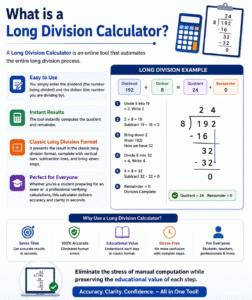
A Long Division Calculator is an online tool that automates the entire long division process. You simply enter the dividend (the number being divided) and the divisor (the number you are dividing by), and the tool instantly computes the quotient and remainder. More importantly, it presents the result in the classic long division format, complete with vertical bars, subtraction lines, and bring-down steps.
This tool eliminates the stress of manual computation while preserving the educational value of seeing each step laid out clearly. Whether you’re a student preparing for an exam or a professional verifying calculations, this calculator delivers accuracy and clarity in seconds.
Why Use a Long Division Calculator?
There are several compelling reasons to rely on a Long Division Calculator rather than performing the operation by hand. First and foremost, it offers unmatched speed. What might take you several minutes on paper can be done in less than a second. Second, it guarantees 100% accuracy, removing the risk of small arithmetic slips that can derail an entire problem.
Third, this tool is an excellent learning companion. Students who struggle with the concept can use it to see the correct procedure unfold step by step. Teachers can use it to generate practice problems and verify student answers quickly. Professionals dealing with financial reports, engineering calculations, or scientific data can use the calculator to double-check their work before submitting critical documents.
Additionally, a Long Division Calculator is available 24/7, free of cost, and requires no installation. It works on any device with a browser — desktop, tablet, or smartphone — making it universally accessible.
Understanding the Input Fields (Dividend and Divisor)
The calculator interface is intentionally simple and clean, requiring only two inputs to function. Understanding these fields is essential for getting accurate results.
Dividend: This is the number that you want to divide. It is the larger number in most cases and sits inside the division bracket in traditional notation. For example, in the expression 945 ÷ 5, the number 945 is the dividend. You can enter whole numbers, decimals, or even very large values depending on the calculator’s capacity.
Divisor: This is the number you are dividing by. It determines how the dividend will be split. In the same example, 5 is the divisor. The divisor must never be zero, because division by zero is mathematically undefined.
Together, these two numbers produce the quotient (the main answer) and, in many cases, a remainder (what’s left over). Some advanced calculators may also display the decimal expansion of the quotient when the division does not result in a whole number.
How the Long Division Calculator Works
Behind the scenes, the Long Division Calculator follows the same algorithm taught in classrooms, but at lightning speed. The process begins by comparing the first digit (or first few digits) of the dividend with the divisor. The calculator then determines how many times the divisor fits into that portion of the dividend.
Once that number is identified, it is written as the first digit of the quotient. The calculator multiplies the quotient digit by the divisor and subtracts the result from the relevant portion of the dividend. The next digit of the dividend is then brought down, and the process repeats until every digit has been processed.
The algorithm uses the formula: Dividend = (Divisor × Quotient) + Remainder
This equation is the golden rule of division and is used internally to verify the accuracy of every computation. The output is then formatted in a monospaced font to preserve the visual alignment of the traditional long division layout.
Step-by-Step Guide to Using the Calculator
Using the tool is straightforward and intuitive. Follow these simple steps to get accurate results every time.
Step 1: Locate the Dividend field and enter the number you wish to divide. Make sure the number is typed correctly without any spaces or special characters.
Step 2: Move to the Divisor field and enter the number by which you want to divide. Confirm that this value is not zero, as that would produce an undefined result.
Step 3: Click the red Calculate button. The tool will immediately process your input and display the complete long division layout in the result panel on the right.
Step 4: Review the step-by-step output, including the quotient, remainder, and the visual breakdown of each subtraction and bring-down operation.
Step 5: If you wish to perform a new calculation, simply click the Clear button to reset both fields, and you can start fresh.
Understanding the Result Output
The output panel of the Long Division Calculator is designed to mimic the classic chalkboard layout that students learn in school. At the top, you will typically see the quotient displayed prominently. Below it, the calculator shows the dividend inside the division bracket with the divisor positioned outside.
Each step of the calculation is laid out vertically, with subtraction lines clearly drawn between operations. The final line displays the remainder, which represents the portion of the dividend that could not be evenly divided.
This visual presentation is more than just decoration — it helps users understand the logical flow of division, reinforcing concepts like place value and partial products. For students, this output acts as a digital tutor, guiding them through the procedure one step at a time.
The Mathematics Behind Long Division
The mathematical principle that powers every Long Division Calculator is rooted in the Euclidean division theorem. This theorem states that for any two integers a (dividend) and b (divisor), where b is not zero, there exist unique integers q (quotient) and r (remainder) such that:
a = b × q + r, where 0 ≤ r < b
This relationship guarantees that every division problem has a definite answer, whether or not the division is exact. When r equals zero, the division is said to be exact, and the divisor is called a factor of the dividend. When r is greater than zero, the result includes a non-zero remainder, which can be expressed as a fraction or continued as a decimal.
Understanding this foundational concept helps users appreciate the precision of the algorithm and the reliability of the results produced.
Long Division with Decimals
When the dividend or divisor contains a decimal point, the long division process requires a small adjustment. The calculator typically shifts the decimal point to convert both numbers into whole numbers before performing the division. This is mathematically equivalent and produces the same accurate result.
For example, dividing 12.6 by 0.3 is the same as dividing 126 by 3. The calculator handles this conversion automatically, sparing the user from manual adjustments. The final answer is then presented with the decimal placed correctly, ensuring precision down to multiple decimal places when needed.
Long Division with Remainders
Not every division problem results in a clean whole number. When the divisor does not fit evenly into the dividend, a remainder is produced. The calculator clearly displays this leftover value at the end of the calculation.
Users can choose to interpret the remainder in different ways depending on the context. In integer division, the remainder is left as is. In decimal division, the calculator continues dividing past the decimal point to produce a more precise quotient. In fractional division, the remainder is expressed as a fraction over the divisor, such as 47 ÷ 5 = 9 remainder 2, which can also be written as 9 and 2/5.
Common Mistakes to Avoid
Even with a reliable tool at hand, users sometimes make small errors that affect their results. The most common mistake is swapping the dividend and divisor. Always remember that the larger number (in most cases) goes into the Dividend field and the smaller one into the Divisor field.
Another frequent error is entering zero as the divisor, which produces an undefined result. Some users also forget to clear the previous values before starting a new calculation, which can cause confusion. Finally, when working with decimals, ensure the decimal point is correctly placed to avoid misreading the input.
Real-World Applications of Long Division
Long division is not just an academic exercise — it has practical applications in everyday life and various professions. In finance, it is used to calculate loan payments, interest rates, and budget allocations. In engineering, it helps determine measurements, material distributions, and load calculations.
Teachers and educators use long division to teach foundational math skills, while scientists and researchers rely on it for statistical analysis and data interpretation. Even in cooking and construction, dividing quantities accurately is essential — whether you’re splitting a recipe or dividing materials across a project.
A Long Division Calculator simplifies all these tasks, making complex division accessible to everyone, regardless of their math background.
Long Division vs Short Division
Short division is a simplified version of long division, typically used when the divisor is a single-digit number. It is faster but less transparent because most of the work is done mentally, with only the final quotient written down. While short division is convenient for quick calculations, it lacks the clarity that long division provides.
Long division, on the other hand, is suited for multi-digit divisors and complex problems where each step needs to be visible and verifiable. This makes it the preferred method in academic settings and whenever detailed work needs to be shown.
Tips for Teachers and Students
For teachers, the Long Division Calculator is a valuable resource for classroom demonstrations. Projecting the step-by-step output on a screen allows students to follow along visually, reinforcing the lesson. Teachers can also use the tool to quickly generate answer keys for homework and quizzes.
For students, the calculator serves as a 24/7 tutor. Whenever you’re stuck on a homework problem, you can use it to see how the answer is reached, not just what the answer is. Try solving a problem on paper first, then verify your work using the calculator. This practice builds confidence and mastery over time.
Frequently Asked Questions
Q1: Is the calculator free to use? Yes, it is completely free and unlimited. There are no subscriptions, downloads, or sign-ups required.
Q2: Can I divide decimal numbers? Absolutely. The tool handles both whole numbers and decimals with full precision.
Q3: What happens if I enter zero as the divisor? The calculator will display an error because division by zero is mathematically undefined.
Q4: Does the calculator show the steps? Yes, the result panel displays the complete step-by-step process, just like manual long division.
Q5: Can I use this on my mobile phone? Yes, the interface is fully responsive and works seamlessly on smartphones and tablets.
Q6: Is there a limit on the size of numbers I can enter? The tool handles very large numbers, though extremely massive values may slow down the display slightly.
Conclusion
The Long Division Calculator is a versatile, powerful, and user-friendly tool that transforms a traditionally tedious math operation into a quick and educational experience. Whether you’re a student learning the basics, a teacher preparing lesson plans, or a professional verifying figures, this tool offers unmatched convenience and clarity.
By presenting results in the classic step-by-step format, it not only delivers the correct answer but also teaches the process behind it. This dual function makes it more than just a calculator — it’s a learning companion that bridges the gap between manual practice and digital efficiency.
In a world where speed and accuracy matter more than ever, having access to a reliable division tool can save time, reduce errors, and build confidence in your numerical skills. Bookmark this calculator, share it with friends and colleagues, and make it a regular part of your problem-solving toolkit. Mastering division has never been easier or more accessible.