Solve large numbers instantly with our fast and easy Big Number Calculator
Table of Contents- Introduction
- What Is a Common Factor Calculator
- Why You Need a Common Factor Calculator
- How the Common Factor Calculator Works
- Step-by-Step Guide to Using the Tool
- Understanding Common Factors
- Common Factors vs Greatest Common Factor (GCF)
- Prime Factorization Method Explained
- Real-Life Applications
- Benefits for Students and Professionals
- Tips for Getting Accurate Results
- Common Mistakes to Avoid
- Frequently Asked Questions (FAQs)
- Conclusion
Introduction
Mathematics becomes far easier when you have the right digital tools by your side. One such powerful and time-saving tool is the Common Factor Calculator, designed to help students, teachers, engineers, and everyday users quickly find the shared factors between two or more numbers. Whether you are simplifying fractions, solving algebra problems, or working through number theory, this tool removes the stress of manual calculation and delivers instant, accurate answers.
In this detailed guide, we will explore everything you need to know about the Common Factor Calculator — how it works, why it matters, and how you can use it effectively. By the end of this article, you will understand the logic behind factors, the importance of accuracy, and how this simple yet smart tool can become your daily math companion.
What Is a Common Factor Calculator
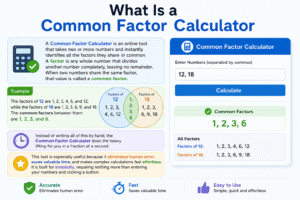
A Common Factor Calculator is an online tool that takes two or more numbers and instantly identifies all the factors they share in common. A factor is any whole number that divides another number completely, leaving no remainder. When two numbers share the same factor, that value is called a common factor.
For example, the factors of 12 are 1, 2, 3, 4, 6, and 12, while the factors of 18 are 1, 2, 3, 6, 9, and 18. The common factors between them are 1, 2, 3, and 6. Instead of writing all of this by hand, the Common Factor Calculator does the heavy lifting for you in a fraction of a second.
This tool is especially useful because it eliminates human error, saves valuable time, and makes complex calculations feel effortless. It is built for simplicity, requiring nothing more than entering your numbers and clicking a button.
Why You Need a Common Factor Calculator
Many people underestimate how often factors appear in everyday math. From simplifying fractions to dividing quantities evenly, understanding shared factors is essential. The Common Factor Calculator becomes indispensable because it offers speed, precision, and reliability all in one place.
Imagine a student working through dozens of homework problems. Doing each calculation manually is slow and error-prone. With this tool, the same student can verify answers instantly and focus more on learning the concept rather than struggling with arithmetic. Professionals such as accountants, engineers, and data analysts also benefit, since they frequently deal with ratios, proportions, and divisibility.
In short, this calculator is not just a convenience — it is a productivity booster that supports both education and professional work.
How the Common Factor Calculator Works
The Common Factor Calculator operates on a straightforward yet efficient algorithm. When you enter your numbers, the tool first calculates all the factors of each individual number. It does this by checking which integers divide each number evenly, typically testing values up to the square root of the number for efficiency.
Once the factor lists are generated, the tool compares them and isolates the values that appear in every list. These shared values are then displayed as your common factors. The entire process happens almost instantly, giving you a clean, organized result without any guesswork.
This automation ensures consistent accuracy, something that is difficult to achieve when performing long calculations by hand. The behind-the-scenes logic is complex, but the user experience remains simple and smooth.
Step-by-Step Guide to Using the Tool
Using the Common Factor Calculator is incredibly easy, even for beginners. Follow these simple steps:
Step 1: Locate the input field labeled “Enter Numbers.” Step 2: Type your numbers separated by commas, for example: 12, 18, 24. Step 3: Click the Calculate button to process your input. Step 4: Instantly view the shared factors displayed in the result panel. Step 5: Press Clear if you want to start a new calculation.
This user-friendly design ensures that anyone, regardless of math skill level, can get results quickly. There are no complicated menus, no confusing settings, and no unnecessary steps — just clean, fast functionality.
Understanding Common Factors
To truly appreciate the Common Factor Calculator, it helps to understand the concept of factors deeply. A factor is a building block of a number. Every whole number greater than one has at least two factors: 1 and itself.
When we talk about common factors, we are referring to the values that two or more numbers can be divided by without leaving a remainder. The number 1 is always a common factor of any set of numbers, which is why it appears in every result.
Understanding this concept strengthens your foundation in number theory, fractions, and algebra. The calculator not only provides answers but also serves as a learning aid, helping users visualize how numbers relate to one another.
Common Factors vs Greatest Common Factor (GCF)
People often confuse common factors with the Greatest Common Factor. While they are related, they are not the same. The common factors are all the shared divisors between numbers, whereas the GCF is the largest value among those shared factors.
For instance, the common factors of 12 and 18 are 1, 2, 3, and 6, but the GCF is simply 6. The Common Factor Calculator helps you see the full picture by listing every shared value, which makes it easy to identify the greatest one yourself.
This distinction is important in fraction simplification, where the GCF is used to reduce fractions to their simplest form. Knowing both concepts gives you a complete mathematical understanding.
Prime Factorization Method Explained
Another reliable way to find shared factors is through prime factorization. This method breaks each number down into its prime building blocks — numbers that can only be divided by 1 and themselves.
For example, 12 = 2 × 2 × 3 and 18 = 2 × 3 × 3. By identifying the common primes, you can determine the shared factors and the GCF. While this method is powerful, doing it by hand can be tedious for large numbers.
That is exactly why the Common Factor Calculator is so valuable — it applies these mathematical principles automatically, giving you accurate results without the manual effort. It blends mathematical theory with modern convenience.
Real-Life Applications
Factors are not just abstract math concepts — they appear in many practical situations. The Common Factor Calculator can assist in numerous real-world scenarios, such as:
- Cooking and Recipes: Dividing ingredients evenly among servings.
- Construction: Cutting materials into equal, shared lengths.
- Finance: Splitting payments or resources fairly.
- Education: Teaching divisibility and fractions.
- Computer Science: Optimizing algorithms and cryptography.
In each of these cases, identifying shared factors leads to efficient, balanced, and logical decisions. The tool brings academic concepts directly into everyday problem-solving.
Benefits for Students and Professionals
The Common Factor Calculator offers tremendous value across different groups of users. For students, it acts as a study partner that reinforces classroom concepts and builds confidence. It allows learners to check their work and understand where they may have gone wrong.
For teachers, it serves as a demonstration tool to explain factors clearly during lessons. For professionals, it provides quick verification during tasks that involve measurement, distribution, or analysis.
The biggest advantages include time savings, error reduction, accessibility, and ease of use. Because it is available online, anyone can use it anytime, anywhere, on any device. This flexibility makes it a truly universal math resource.
Tips for Getting Accurate Results
To get the most out of the Common Factor Calculator, keep these helpful tips in mind:
1. Enter valid whole numbers — the tool works best with positive integers. 2. Use commas correctly — separate each number clearly to avoid input errors. 3. Double-check your numbers before clicking calculate. 4. Avoid decimals or symbols, as factors apply to whole numbers. 5. Read the full result list to identify both common factors and the GCF.
Following these best practices ensures that you always receive reliable, precise, and meaningful answers. Good input habits lead to flawless output every time.
Common Mistakes to Avoid
Even with a powerful tool, users sometimes make small errors that affect their understanding. One common mistake is confusing factors with multiples — factors divide a number, while multiples are produced by multiplying it.
Another frequent error is forgetting that 1 is always a common factor. Some users also enter decimals or negative values, which can lead to confusion since factors are typically defined for positive integers.
Finally, relying solely on the tool without understanding the underlying concept can limit learning. The Common Factor Calculator should be used as both a solution provider and a teaching aid, helping you grow your mathematical knowledge while saving time.
Frequently Asked Questions (FAQs)
Q1: Is the Common Factor Calculator free to use? Yes, it is completely free and accessible online without any registration.
Q2: Can it handle more than two numbers? Absolutely. You can enter multiple numbers separated by commas to find their shared factors.
Q3: Does it work on mobile devices? Yes, the tool is fully responsive and works smoothly on phones, tablets, and desktops.
Q4: Is it accurate for large numbers? Yes, the calculator uses an efficient algorithm to deliver precise results even for big values.
Q5: Can it help with fractions? Definitely. Identifying common factors is a key step in simplifying fractions and finding the GCF.
Conclusion
The Common Factor Calculator is more than just a simple math tool — it is a reliable companion for students, teachers, and professionals alike. By delivering instant, accurate, and easy-to-understand results, it transforms a once tedious task into a quick and enjoyable experience.
From simplifying fractions to solving real-world problems, this tool proves its value across countless situations. It combines mathematical precision with modern convenience, making it an essential resource for anyone who works with numbers. Whether you are learning the basics or handling advanced calculations, the Common Factor Calculator empowers you to work smarter, faster, and with greater confidence.
Start using the Common Factor Calculator today and experience how effortless factor calculation can truly be.