Number Sequence Calculator
Try our easy and powerful stats tool for quick results – Standard Deviation Calculator
Table of Contents
- Introduction
- What Is an Arithmetic Sequence?
- Key Terms — First Term, Common Difference, nth Term
- The nth Term Formula for Arithmetic Sequences
- What Is the Arithmetic Sequence Sum Formula?
- Deriving the Arithmetic Sequence Sum Formula — Gauss’s Method
- Two Forms of the Arithmetic Sequence Sum Formula
- How to Use the Arithmetic Sequence Sum Formula Step by Step
- The Number Sequence Calculator — Arithmetic Mode
- Arithmetic Sequence Sum Formula in Algebra and Number Theory
- Arithmetic Sequence Sum Formula in Physics and Engineering
- Arithmetic Sequence Sum Formula in Finance and Economics
- Arithmetic Sequence Sum Formula in Computer Science
- Arithmetic Sequence Sum Formula in Architecture and Design
- Geometric Sequences vs. Arithmetic Sequences — Key Differences
- Fibonacci Sequences vs. Arithmetic Sequences
- Common Mistakes with the Arithmetic Sequence Sum Formula
- Frequently Asked Questions (FAQs)
- Conclusion
Introduction
Mathematics is full of patterns, but few patterns are as clean, predictable, and universally applicable as the arithmetic sequence. An arithmetic sequence is a list of numbers where each term increases (or decreases) by the same fixed amount — called the common difference. Whether you are counting in twos, adding seven to each previous number, or counting backwards by three, you are working with an arithmetic sequence. And when you need to find the sum of all those numbers without adding them one by one, you need the arithmetic sequence sum formula — one of the most elegant and powerful shortcuts in all of algebra.
The arithmetic sequence sum formula transforms what could be hours of tedious addition into a single, instantaneous calculation. From computing the total of the first 100 natural numbers to solving problems in physics, finance, programming, and architecture, the formula Sₙ = n/2 × (2a + (n−1)d) — or its equivalent Sₙ = n/2 × (first term + last term) — appears constantly across mathematics and its applications. In this comprehensive guide, we will explore every aspect of the arithmetic sequence sum formula — its derivation, both of its forms, how to use it, and where it appears in the real world.
Whether you are a student building your algebra foundation, a teacher preparing worked examples, or a professional applying sequence mathematics to real problems, this guide provides everything you need to master the arithmetic sequence sum formula completely.
What Is an Arithmetic Sequence?
An arithmetic sequence is an ordered list of numbers in which consecutive terms differ by a constant amount — called the common difference. Every term in an arithmetic sequence is obtained by adding the same fixed value to the preceding term.
General form:
a, a + d, a + 2d, a + 3d, …, a + (n−1)d
Where:
- a = first term (also written a₁)
- d = common difference
- n = number of terms
Examples of arithmetic sequences:
| Sequence | First Term (a) | Common Difference (d) |
|---|---|---|
| 1, 2, 3, 4, 5, … | 1 | 1 |
| 5, 10, 15, 20, 25, … | 5 | 5 |
| 100, 97, 94, 91, … | 100 | −3 |
| 3, 7, 11, 15, 19, … | 3 | 4 |
| 0.5, 1.0, 1.5, 2.0, … | 0.5 | 0.5 |
How to verify an arithmetic sequence: Calculate the difference between each consecutive pair of terms. If the difference is the same every time, the sequence is arithmetic and the arithmetic sequence sum formula applies.
Arithmetic sequences are everywhere:
- The floors of a building (floor 1, 2, 3, 4…)
- The days of the month (1, 2, 3, … 30)
- Regular savings deposits of the same amount each month
- Equal annual salary increments
- Evenly spaced measurements along a ruler
Key Terms — First Term, Common Difference, nth Term
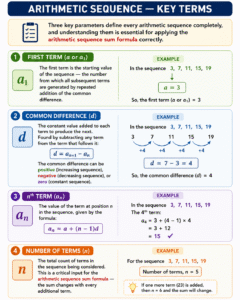
Three key parameters define every arithmetic sequence completely, and understanding them is essential for applying the arithmetic sequence sum formula correctly.
First Term (a or a₁) The first term is the starting value of the sequence — the number from which all subsequent terms are generated by repeated addition of the common difference. Denoted a or a₁.
In the sequence 3, 7, 11, 15, 19 → a = 3
Common Difference (d) The constant value added to each term to produce the next. Found by subtracting any term from the term that follows it: d = aₙ₊₁ − aₙ. The common difference can be positive (increasing sequence), negative (decreasing sequence), or zero (constant sequence).
In the sequence 3, 7, 11, 15, 19 → d = 7 − 3 = 4
nth Term (aₙ) The value of the term at position n in the sequence, given by the formula aₙ = a + (n−1)d.
In the sequence 3, 7, 11, 15, 19 → the 4th term: a₄ = 3 + (4−1) × 4 = 3 + 12 = 15 ✓
Number of Terms (n) The total count of terms in the sequence being considered. This is a critical input for the arithmetic sequence sum formula — the sum changes with every additional term.
The nth Term Formula for Arithmetic Sequences
Before computing the sum of an arithmetic sequence, it is important to understand the formula for its individual terms. The nth term formula gives the value of any term in the sequence without needing to list all previous terms.
nth Term Formula:
aₙ = a + (n − 1) × d
Where:
- aₙ = the value of the nth term
- a = the first term
- n = the position of the term
- d = the common difference
The Number Sequence Calculator’s arithmetic mode uses this formula — accepting the first term (a), common difference (d), and term position (n), then displaying:
- Formula: a + (n−1)d
- Substitution with actual values
- The result — the value of the nth term
Example: Find the 10th term of the sequence 1, 4, 7, 10, …
a = 1, d = 3, n = 10 a₁₀ = 1 + (10−1) × 3 = 1 + 27 = 28
The nth term formula and the arithmetic sequence sum formula work together — the nth term formula finds specific positions; the sum formula totals all terms from 1 to n.
What Is the Arithmetic Sequence Sum Formula?
The arithmetic sequence sum formula gives the total (sum) of the first n terms of an arithmetic sequence without requiring you to add every term individually. This makes it possible to sum sequences of any length — 10 terms, 100 terms, 1,000 terms — in a single calculation.
The formula exists because arithmetic sequences have a special property: the sum of equally spaced pairs of terms is always the same. The first term plus the last term equals the second term plus the second-to-last term, and so on. This constant pair-sum makes a shortcut possible.
The arithmetic sequence sum formula is denoted Sₙ — the sum of the first n terms.
Why is the arithmetic sequence sum formula important?
- It converts a potentially enormous addition problem into a three-step formula
- It is used in algebra, calculus, financial mathematics, physics, and computer science
- It underpins the formula for the sum of the first n natural numbers, the sum of the first n even numbers, the sum of the first n odd numbers, and many other classic results
- It was discovered by the mathematician Carl Friedrich Gauss at approximately age 8 or 9, according to legend — demonstrating its elegance and power
Deriving the Arithmetic Sequence Sum Formula — Gauss’s Method
The most famous derivation of the arithmetic sequence sum formula is attributed to the young Carl Friedrich Gauss, who reportedly summed the integers from 1 to 100 almost instantly by recognizing a pattern.
The Gauss Method: Write the sum of n terms forward and backward:
Sₙ = a + (a+d) + (a+2d) + … + (a+(n−1)d) Sₙ = (a+(n−1)d) + (a+(n−2)d) + … + a
Add the two rows column by column:
2Sₙ = [a + (a+(n−1)d)] + [a + (a+(n−1)d)] + … (n times) 2Sₙ = n × [2a + (n−1)d]
Divide both sides by 2:
Sₙ = n/2 × [2a + (n−1)d]
The key insight: every paired column sum equals 2a + (n−1)d — the first term plus the last term — and there are n such pairs. Dividing by 2 gives the arithmetic sequence sum formula.
Gauss’s original insight (for 1 to 100):
S₁₀₀ = 100/2 × (1 + 100) = 50 × 101 = 5,050
This result — the sum of the first 100 natural numbers equals 5,050 — follows directly from the arithmetic sequence sum formula with a = 1, d = 1, n = 100.
Two Forms of the Arithmetic Sequence Sum Formula
The arithmetic sequence sum formula can be written in two equivalent forms, each convenient for different situations.
Form 1 — Using First Term and Common Difference:
Sₙ = n/2 × [2a + (n−1)d]
Use this form when you know the first term (a), common difference (d), and number of terms (n) — but do not necessarily know the last term.
Example: Sum of the first 10 terms of 3, 7, 11, 15, … (a = 3, d = 4, n = 10)
S₁₀ = 10/2 × [2(3) + (10−1)(4)] S₁₀ = 5 × [6 + 36] S₁₀ = 5 × 42 = 210
Form 2 — Using First Term and Last Term:
Sₙ = n/2 × (a + aₙ)
Use this form when you know both the first term (a) and the last term (aₙ), and need the sum. This is Gauss’s original form — the “pair sum” method.
Example: Sum of 3, 7, 11, 15, …, 39 (first term = 3, last term = 39)
- First find n: 39 = 3 + (n−1)×4 → 36 = (n−1)×4 → n = 10
S₁₀ = 10/2 × (3 + 39) = 5 × 42 = 210 ✓
Both forms of the arithmetic sequence sum formula always give the same answer. Choose the form that matches the information you have available.
How to Use the Arithmetic Sequence Sum Formula Step by Step
Applying the arithmetic sequence sum formula follows a clear, systematic process. Here is a complete guide with a worked example.
Problem: Find the sum of the first 15 terms of the sequence 2, 5, 8, 11, …
Step 1 — Identify the Parameters
- First term: a = 2
- Common difference: d = 5 − 2 = 3
- Number of terms: n = 15
Step 2 — Choose the Formula Form We know a, d, and n but not the last term → use Form 1:
Sₙ = n/2 × [2a + (n−1)d]
Step 3 — Substitute the Values
S₁₅ = 15/2 × [2(2) + (15−1)(3)] S₁₅ = 7.5 × [4 + 42]
Step 4 — Simplify Inside the Brackets
S₁₅ = 7.5 × 46
Step 5 — Compute the Final Sum
S₁₅ = 345
Verification using Form 2:
- Last term: a₁₅ = 2 + (15−1)×3 = 2 + 42 = 44
- S₁₅ = 15/2 × (2 + 44) = 7.5 × 46 = 345 ✓
Both forms confirm Sₙ = 345 — always a valuable cross-check when using the arithmetic sequence sum formula in high-stakes contexts.
The Number Sequence Calculator — Arithmetic Mode
The Number Sequence Calculator provides an instant, step-by-step computation for arithmetic sequence problems, eliminating the need for manual calculation and showing the formula substitution clearly.
Arithmetic mode inputs:
- First (a) — the first term of the sequence
- Diff (d) — the common difference
- Nth Term (n) — the position of the term you want to find
The calculator displays:
- Formula: a + (n−1)d
- Substitution: [a] + ([n]−1) × [d]
- Result: the value of the nth term
For a complete sum calculation, use the nth term result as the last term in Form 2 of the arithmetic sequence sum formula: Sₙ = n/2 × (a + aₙ). The Number Sequence Calculator gives you aₙ; the arithmetic sequence sum formula gives you Sₙ.
The calculator covers three sequence types:
- Arithmetic Sequence — uses the arithmetic sequence sum formula principles
- Geometric Sequence — uses a × r^(n−1)
- Fibonacci Sequence — generates terms iteratively
Having all three in one tool makes it easy to compare sequence behaviors and understand how arithmetic sequences — with their constant difference — differ from geometric sequences (constant ratio) and Fibonacci sequences (each term is the sum of the two preceding terms).
Arithmetic Sequence Sum Formula in Algebra and Number Theory
The arithmetic sequence sum formula is the foundation for numerous classic algebraic results that every mathematics student encounters.
Sum of the First n Natural Numbers Setting a = 1 and d = 1:
Sₙ = n/2 × (1 + n) = n(n+1)/2
This is one of the most important formulas in combinatorics and number theory. The arithmetic sequence sum formula proves it directly, without requiring induction.
Sum of the First n Even Numbers Sequence: 2, 4, 6, 8, … (a = 2, d = 2)
Sₙ = n/2 × [2(2) + (n−1)(2)] = n/2 × [4 + 2n − 2] = n/2 × (2n + 2) = n(n+1)
Sum of the First n Odd Numbers Sequence: 1, 3, 5, 7, … (a = 1, d = 2)
Sₙ = n/2 × [2(1) + (n−1)(2)] = n/2 × [2 + 2n − 2] = n/2 × 2n = n²
This remarkable result — the sum of the first n odd numbers is always a perfect square — follows directly from the arithmetic sequence sum formula and is one of the most beautiful results in elementary number theory.
Arithmetic Sequence Sum Formula in Physics and Engineering
Arithmetic sequences and their sum formula appear throughout physics and engineering, particularly wherever constant-rate changes accumulate over time.
Uniformly Accelerated Motion An object accelerating at constant rate a gains velocity v, 2v, 3v, … at equal time intervals. The total distance traveled is the sum of this arithmetic sequence of velocities — computed directly using the arithmetic sequence sum formula.
The kinematic equation s = ut + ½at² is, in fact, the continuous equivalent of the discrete arithmetic sequence sum formula — one of the deepest connections between algebra and calculus.
Structural Engineering — Stacked Loads In a multi-story building, each successive floor bears the weight of all floors above it. If additional load per floor follows an arithmetic pattern, the total cumulative load on a foundation column is the sum of an arithmetic sequence — computed with the arithmetic sequence sum formula.
Signal Processing — Arithmetic Progressions in Time Signals sampled at arithmetic intervals form arithmetic sequences in time. The arithmetic sequence sum formula helps compute cumulative signal strength, total energy, or integrated signal values over uniform time steps.
Electrical Engineering — Resistor Ladders Resistor networks designed with values in arithmetic progression are analyzed using the arithmetic sequence sum formula to compute total resistance and current distribution.
Arithmetic Sequence Sum Formula in Finance and Economics
Financial mathematics relies on arithmetic sequences whenever quantities grow by a constant amount rather than a constant percentage.
Simple Interest Under simple interest, the amount of interest earned each period is constant — an arithmetic sequence. The total interest over n periods is the sum of n equal payments, computable with the arithmetic sequence sum formula (though for equal payments, this simplifies to n × payment).
Arithmetic Gradient Cash Flows In engineering economics, cash flows that increase by a fixed amount each period form an arithmetic sequence. The arithmetic sequence sum formula computes the total of these gradient cash flows, which feeds into net present value calculations for project evaluation.
Salary Increment Analysis An employee starting at $50,000 with a fixed annual raise of $2,000 receives a salary sequence: 50,000 | 52,000 | 54,000 … The arithmetic sequence sum formula computes the total earnings over any given number of years — essential for employment contract analysis and retirement planning.
Installment Payment Schedules Certain installment plans involve payments that increase by a fixed amount each period. The arithmetic sequence sum formula determines the total amount paid over the full repayment schedule.
Arithmetic Sequence Sum Formula in Computer Science
Arithmetic sequences and their sum formula are foundational in algorithm analysis and programming.
Loop Iteration Counting A nested loop where the inner loop runs 1, 2, 3, …, n times across n outer iterations executes a total of 1 + 2 + 3 + … + n = n(n+1)/2 iterations — computed directly from the arithmetic sequence sum formula. This is the basis for the O(n²) time complexity of many sorting algorithms.
Array Index Arithmetic Accessing elements in a 2D array stored in row-major order involves arithmetic sequences of memory addresses. The arithmetic sequence sum formula computes total memory offsets for rectangular subarray access patterns.
Pagination and Data Ranges When dividing n records into pages of fixed size, the starting indices of each page form an arithmetic sequence. The arithmetic sequence sum formula computes cumulative record counts up to any page.
Dynamic Programming Several dynamic programming problems involve summing arithmetic sequences of subproblem solutions. Understanding the arithmetic sequence sum formula allows these solutions to be computed in O(1) time rather than O(n) iterative summation.
Arithmetic Sequence Sum Formula in Architecture and Design
Patterns based on arithmetic sequences are visually and structurally prevalent in architecture and design.
Stair Design A classic staircase with equal rise on each step represents an arithmetic sequence of heights. The arithmetic sequence sum formula computes the total vertical height after any number of steps — critical for building code compliance and structural planning.
Seating Arrangements — Amphitheaters and Auditoriums Amphitheater seating often follows an arithmetic pattern — each successive row has more seats than the previous (e.g., 10, 12, 14, 16, … per row). The arithmetic sequence sum formula computes the total seating capacity of any section** with arithmetic row counts — a direct application that architects use in venue planning.
Tile and Mosaic Patterns Decorative patterns where each row of tiles is longer than the previous by a fixed number follow arithmetic sequence geometry. The arithmetic sequence sum formula calculates the total number of tiles needed for any such pattern.
Architectural Proportions Some architectural traditions use arithmetic progressions for window heights, column spacings, and decorative band widths. The arithmetic sequence sum formula is the tool for computing total lengths and material requirements in these proportionally designed structures.
Geometric Sequences vs. Arithmetic Sequences — Key Differences
Understanding the difference between arithmetic and geometric sequences clarifies when to apply the arithmetic sequence sum formula versus geometric sum formulas.
Arithmetic Sequence (Constant Difference)
- Each term = previous term + constant (d)
- Grows linearly
- Sum formula: Sₙ = n/2 × [2a + (n−1)d]
- Example: 2, 5, 8, 11, 14 … (d = 3)
Geometric Sequence (Constant Ratio)
- Each term = previous term × constant (r)
- Grows exponentially
- Sum formula: Sₙ = a × (1 − rⁿ) / (1 − r) for r ≠ 1
- Example: 2, 6, 18, 54, 162 … (r = 3)
The Number Sequence Calculator handles both types, making it easy to compare them side by side. The arithmetic sequence sum formula produces linear totals; the geometric sum formula produces exponential totals — a fundamental difference with profound implications in finance (compound vs. simple interest), physics (uniform vs. exponential decay), and algorithms.
Fibonacci Sequences vs. Arithmetic Sequences
The Fibonacci sequence is neither arithmetic nor geometric, but understanding it alongside arithmetic sequences deepens appreciation for the variety of mathematical patterns.
Fibonacci Sequence Each term is the sum of the two preceding terms: 0, 1, 1, 2, 3, 5, 8, 13, 21, 34, …
- No constant difference (not arithmetic)
- No constant ratio (not geometric)
- Grows approximately exponentially at rate φ ≈ 1.618 (the golden ratio)
Arithmetic Sequence Each term is the previous term plus a constant d: 1, 4, 7, 10, 13, 16, …
- Constant difference (arithmetic)
- Linear growth
- Sum computable by the arithmetic sequence sum formula
The Number Sequence Calculator handles all three — arithmetic (with the arithmetic sequence sum formula principles), geometric, and Fibonacci — providing a comprehensive toolkit for sequence mathematics in one interface.
Common Mistakes with the Arithmetic Sequence Sum Formula
Even students and professionals familiar with the arithmetic sequence sum formula make these recurring errors:
- Confusing n with the last term — n is the count of terms, not the value of the last term. Always verify: “How many terms am I summing?” before applying the arithmetic sequence sum formula
- Using the nth term formula when the sum formula is needed — aₙ = a + (n−1)d gives the value of one term; Sₙ = n/2 × [2a + (n−1)d] gives the total of all terms up to n. These are different formulas for different questions
- Incorrectly identifying the common difference — If the sequence decreases (e.g., 20, 17, 14, 11…), the common difference is negative (d = −3). Entering a positive d when it should be negative produces incorrect results from the arithmetic sequence sum formula
- Forgetting the n/2 factor — A common algebraic slip is writing Sₙ = n × [2a + (n−1)d] without the division by 2. Always divide by 2 in the arithmetic sequence sum formula
- Applying the formula to non-arithmetic sequences — Verify that consecutive differences are constant before applying the arithmetic sequence sum formula. If differences are not constant, the sequence is not arithmetic and the formula does not apply
Frequently Asked Questions (FAQs)
What is the arithmetic sequence sum formula? The arithmetic sequence sum formula is Sₙ = n/2 × [2a + (n−1)d], where Sₙ is the sum of the first n terms, a is the first term, d is the common difference, and n is the number of terms. It can also be written as Sₙ = n/2 × (first term + last term).
What is the difference between the nth term formula and the sum formula? The nth term formula (aₙ = a + (n−1)d) gives the value of one specific term at position n. The arithmetic sequence sum formula (Sₙ = n/2 × [2a + (n−1)d]) gives the total of all terms from position 1 to position n.
What is the sum of the first 100 natural numbers? Using the arithmetic sequence sum formula with a = 1, d = 1, n = 100: S₁₀₀ = 100/2 × (1 + 100) = 50 × 101 = 5,050. This is Gauss’s famous result.
When does the sum of an arithmetic sequence equal zero? The sum of an arithmetic sequence equals zero when positive and negative terms cancel out perfectly. This occurs when the sequence is symmetric around zero — for example, −4, −2, 0, 2, 4 (sum = 0).
Can the arithmetic sequence sum formula be used for infinite sequences? The arithmetic sequence sum formula applies to finite sequences of n terms. For infinite arithmetic sequences with d ≠ 0, the sum diverges (grows without bound) and no finite sum exists.
What is an arithmetic series? An arithmetic series is the sum of the terms of an arithmetic sequence. The arithmetic sequence sum formula computes the value of this series for any specified number of terms.
How is the arithmetic sequence sum formula related to the area under a line? The arithmetic sequence sum formula computes the sum of equally spaced values along a linear function — which is equivalent to the area under that linear function in discrete mathematics. This makes the formula the discrete analog of integration for linear functions.
What is Bessel’s correction and how does it relate to arithmetic sequences? Bessel’s correction (dividing by n−1 in sample variance) is unrelated to the arithmetic sequence sum formula — it belongs to statistics. The two formulas involve similar-looking expressions but serve completely different purposes.
How do I find the common difference from the sum? Given Sₙ, a, and n, rearrange the arithmetic sequence sum formula: 2Sₙ/n = 2a + (n−1)d → d = (2Sₙ/n − 2a) / (n−1).
Does the arithmetic sequence sum formula work for decreasing sequences? Yes. A decreasing arithmetic sequence has a negative common difference (d < 0). The arithmetic sequence sum formula handles negative d correctly — simply substitute the negative value and the formula produces the correct (smaller or negative) sum.
Conclusion
The arithmetic sequence sum formula is one of the most elegant, powerful, and widely applicable formulas in all of mathematics. From its discovery — attributed to young Gauss adding the integers from 1 to 100 — to its daily application in algebra classrooms, physics problems, financial calculations, software algorithms, and architectural designs, the arithmetic sequence sum formula transforms what could be an impossibly long addition into an instantaneous three-step calculation.
At its core, the arithmetic sequence sum formula — Sₙ = n/2 × [2a + (n−1)d] — captures a profound truth about evenly spaced numbers: their sum is always equal to n times the average of the first and last terms. This insight, simple to state but profound in its reach, makes the formula applicable everywhere that constant-difference patterns arise — which turns out to be a remarkable proportion of all the mathematical structure in the natural and human-made world.
Whether you are computing the total of an arithmetic salary increment series, summing the first hundred natural numbers for a combinatorics proof, analyzing the cumulative distance traveled under constant acceleration, or planning the seating capacity of an arithmetic-pattern auditorium, the arithmetic sequence sum formula gives you the answer instantly and exactly.
Bookmark this guide, practice with the Number Sequence Calculator’s arithmetic mode, and master both forms of the arithmetic sequence sum formula — the first term and common difference form, and the first term and last term form — so that whatever version of the problem you encounter, you always have the right tool to solve it in a single, elegant calculation.