Calculate volume instantly with our easy-to-use Volume Calculator
Table of Contents
- What Is Percent Error?
- What Is a Percent Error Calculator?
- The Percent Error Formula Explained
- How to Use the Percent Error Calculator Step by Step
- Understanding the Results — Positive vs. Negative Percent Error
- Percent Error vs. Absolute Error vs. Relative Error
- Percent Error Calculator in Science and Laboratory Work
- Percent Error Calculator in Engineering and Manufacturing
- Percent Error Calculator in Education and Academic Research
- Percent Error Calculator in Finance and Economics
- How Percent Error Relates to Experimental Accuracy and Precision
- Tips for Minimizing Percent Error in Real-World Measurements
- Common Mistakes When Using the Percent Error Calculator
- Benefits of Using an Online Percent Error Calculator
- Frequently Asked Questions (FAQs)
- Conclusion
Introduction
In science, mathematics, and engineering, accuracy is everything. Every measurement, every experiment, and every observation carries with it the possibility of deviation from the true or accepted value. Understanding how far off a measurement is from the expected result is a critical skill in any analytical discipline — and this is precisely where the Percent Error Calculator becomes an indispensable tool. Whether you are a student verifying a laboratory experiment, a scientist checking the precision of an instrument, or an engineer auditing a manufacturing process, the Percent Error Calculator provides you with a fast, reliable, and mathematically precise way to quantify the accuracy of any measured value.
In this comprehensive guide, we will walk you through everything you need to know about the Percent Error Calculator — from the fundamental definition of percent error and the formula behind it, to step-by-step usage instructions, real-world applications, and common pitfalls to avoid. This guide is designed for learners and professionals alike, giving you all the knowledge required to use this powerful tool confidently and correctly.
What Is Percent Error?
Percent error is a mathematical expression that quantifies the difference between an observed (measured) value and the true (accepted) value, expressed as a percentage of the true value. It is one of the most widely used metrics in science and engineering for evaluating the accuracy of experimental results.
In simpler terms, percent error tells you: “By what percentage did my measurement miss the mark?”
A low percent error indicates that the observed value is very close to the true value — meaning the measurement is highly accurate. A high percent error signals a significant deviation, which may point to errors in methodology, instrument calibration, or data collection.
Percent error can be positive or negative:
- A positive percent error means the observed value is greater than the true value
- A negative percent error means the observed value is less than the true value
In many scientific contexts, the absolute value of percent error is used, since the direction of the error (over or under) may be less important than the magnitude of the deviation.
What Is a Percent Error Calculator?
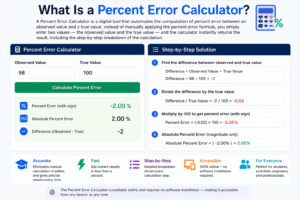
A Percent Error Calculator is a digital tool that automates the computation of percent error between an observed value and a true value. Instead of manually applying the percent error formula, you simply enter two values — the observed value and the true value — and the Percent Error Calculator instantly returns the result, including the step-by-step breakdown of the calculation.
A well-designed Percent Error Calculator will display:
- The final percent error value (with sign to indicate direction)
- The absolute percent error (magnitude only)
- The difference between observed and true values
- A detailed step-by-step solution showing every calculation
The Percent Error Calculator is especially useful in academic and professional environments where speed and accuracy are both essential. Rather than risk arithmetic mistakes in manual computation, users can rely on the Percent Error Calculator to deliver precise results in under a second.
The tool is available online and requires no software installation — making it accessible to students, scientists, engineers, and professionals from any device, at any time.
The Percent Error Formula Explained
The mathematical foundation of the Percent Error Calculator is the percent error formula. The formula is defined as:
Percent Error = [(Observed Value − True Value) / True Value] × 100
Where:
- Observed Value = the value obtained from measurement or experiment
- True Value = the accepted, theoretical, or actual value
Let us walk through an example:
Suppose you measure the boiling point of water in a lab and record 98°C. The true boiling point of water at standard pressure is 100°C.
Percent Error = [(98 − 100) / 100] × 100 Percent Error = [−2 / 100] × 100 Percent Error = −2%
This means your measurement was 2% below the true value — a relatively small and acceptable error in most laboratory settings.
Important note: The true value cannot be zero. Division by zero is mathematically undefined, so the Percent Error Calculator will flag an error if the true value is entered as 0.
When absolute percent error is desired (ignoring sign):
|Percent Error| = |(Observed − True) / True| × 100
How to Use the Percent Error Calculator Step by Step
Using the Percent Error Calculator is straightforward and takes only seconds. Here is a step-by-step walkthrough:
Step 1 — Identify Your Observed Value This is the value you measured, recorded, or obtained through experiment. It is the result you are comparing against the accepted standard.
Step 2 — Identify the True Value This is the accepted, theoretical, or expected value. In scientific experiments, this is typically the value listed in reference materials or established by prior research.
Step 3 — Enter the Values into the Percent Error Calculator Input your observed value and true value into their respective fields in the Percent Error Calculator.
Step 4 — Click Calculate Press the Calculate button. The Percent Error Calculator will immediately apply the formula and display:
- The computed percent error (with sign)
- The absolute percent error
- A step-by-step breakdown showing every calculation in detail
Step 5 — Interpret the Result Review the output. A small percent error (close to 0%) indicates high accuracy. A large percent error indicates significant deviation from the true value, which may require revisiting your measurement process.
Step 6 — Reset if Needed Use the Clear button to reset all fields and start a fresh calculation.
Understanding the Results — Positive vs. Negative Percent Error
When you receive results from the Percent Error Calculator, understanding what positive and negative values mean is essential.
Positive Percent Error A positive percent error occurs when the observed value is greater than the true value. For example, if you measure a mass as 52 grams when the true mass is 50 grams, the percent error is +4%. This indicates an overestimation — your instrument measured too high.
Negative Percent Error A negative percent error occurs when the observed value is less than the true value. For example, measuring 48 grams when the true value is 50 grams gives a percent error of −4%. This indicates an underestimation — your instrument measured too low.
Absolute Percent Error In many contexts, only the magnitude matters — not the direction. The absolute percent error strips the sign, giving you a number like 4% regardless of whether the error was an overestimate or underestimate.
| Percent Error | What It Means |
|---|---|
| 0% | Perfect accuracy — observed equals true |
| 1% to 5% | Excellent accuracy — minor deviation |
| 5% to 10% | Acceptable accuracy — moderate deviation |
| 10% to 20% | Poor accuracy — significant deviation |
| Above 20% | Very poor accuracy — major error likely |
Percent Error vs. Absolute Error vs. Relative Error
Many users confuse percent error with related concepts. Here is a clear comparison:
Absolute Error The absolute error is simply the difference between the observed and true values, without division or percentage:
Absolute Error = |Observed − True|
It is expressed in the same units as the measurement (grams, meters, seconds, etc.). Absolute error tells you the raw magnitude of the deviation but not how significant it is relative to the true value.
Relative Error Relative error is the ratio of the absolute error to the true value:
Relative Error = |Observed − True| / True
It is a dimensionless number between 0 and 1 (or expressed as a decimal). Multiplying relative error by 100 gives you the percent error, which is exactly what the Percent Error Calculator computes.
Percent Error Percent error = relative error × 100. It is the most commonly used and universally understood form of error measurement, because expressing deviation as a percentage makes it easy to communicate accuracy regardless of the scale of measurement.
Percent Error Calculator in Science and Laboratory Work
The most common use of the Percent Error Calculator is in scientific experiments and laboratory work. In any experiment, the goal is to measure a known physical quantity and compare the result to its accepted value.
Common laboratory applications include:
- Chemistry — Comparing experimentally measured molar masses, densities, melting points, or reaction yields to theoretical values
- Physics — Verifying measured values of gravitational acceleration, speed of light, or electrical resistance against known constants
- Biology — Assessing the accuracy of cell counts, concentration measurements, or growth rate data
In laboratory reports, percent error is a required section that demonstrates whether your experimental technique was sufficiently accurate. A percent error below 5% is generally considered acceptable in most high school and undergraduate labs. Consistently high percent error values signal the need to review experimental technique, instrument calibration, or data recording procedures.
Percent Error Calculator in Engineering and Manufacturing
In engineering and manufacturing, precision is not just desirable — it is often a matter of safety and regulatory compliance. The Percent Error Calculator is widely used in quality control processes to assess whether manufactured components meet their design specifications.
For example:
- A mechanical part designed to be 50.00 mm in diameter, but measured at 50.45 mm, has a percent error of 0.9% — within most acceptable tolerances
- A structural beam designed to hold 10,000 kg of load, tested to fail at 9,500 kg, has a percent error of −5% — which may or may not be acceptable depending on safety margins
Engineers use the Percent Error Calculator to evaluate instrument calibration, validate simulation results against physical test data, and audit production batches for consistency. Any percent error exceeding defined tolerance thresholds triggers corrective action in quality-controlled environments.
Percent Error Calculator in Education and Academic Research
The Percent Error Calculator is a fundamental tool in science education. From middle school through university-level research, students regularly use percent error to evaluate the quality of their experimental work.
In academic settings, the Percent Error Calculator serves multiple purposes:
- Lab Reports — Students compute percent error to assess how closely their experimental values matched theoretical predictions
- Homework and Assignments — Problems in chemistry, physics, and biology courses regularly ask students to calculate percent error
- Research Papers — Academic researchers use percent error to report the accuracy of measurement instruments and experimental methods
Teachers and professors use percent error as a teaching tool to reinforce the relationship between theoretical predictions and real-world measurements — helping students develop a quantitative understanding of accuracy and experimental uncertainty.
Percent Error Calculator in Finance and Economics
While percent error is most commonly associated with science, it also has meaningful applications in finance and economics, where predicted values are regularly compared to actual outcomes.
Common financial applications include:
- Forecasting Accuracy — Comparing a revenue forecast of $5.2 million to actual revenue of $4.9 million yields a percent error of approximately 6.1%, helping analysts evaluate forecasting models
- Budgeting — Comparing budgeted costs to actual costs using percent error helps organizations identify budget variances and improve future planning
- Economic Modeling — Economists compare model-predicted GDP, inflation, or employment figures to observed data, using percent error to assess model reliability
In finance, percent error is closely related to the concept of forecast error, which is widely used in supply chain management, demand planning, and financial reporting.
How Percent Error Relates to Experimental Accuracy and Precision
Understanding the relationship between percent error, accuracy, and precision is essential for correctly interpreting results.
Accuracy refers to how close a measurement is to the true value. A low percent error indicates high accuracy — the measured value closely matches the accepted value.
Precision refers to how repeatable a measurement is — how consistent results are across multiple trials. A measurement can be precise but inaccurate (consistently wrong by the same amount), or accurate but imprecise (correct on average but varying widely between trials).
Percent error specifically measures accuracy, not precision. If you want to assess precision, you would use standard deviation or coefficient of variation across multiple measurements.
In experimental science, the ideal outcome is high accuracy AND high precision — low percent error AND low standard deviation across repeated measurements. The Percent Error Calculator helps you evaluate the accuracy component of this dual standard.
Tips for Minimizing Percent Error in Real-World Measurements
Reducing percent error requires attention to both instrument quality and measurement technique. Here are practical tips:
- Calibrate your instruments regularly — Instruments drift over time; regular calibration against known standards keeps measurements accurate
- Use the most precise instrument available — A digital scale accurate to 0.001g produces less error than one accurate to 0.1g
- Take multiple measurements and average them — Random errors tend to cancel out over many trials; averaging reduces their effect
- Control environmental conditions — Temperature, humidity, and vibration can all affect measurement accuracy
- Minimize parallax error — When reading analog scales, always view the measurement straight-on, not at an angle
- Record the true value from authoritative sources — Using an outdated or approximate reference value as your “true value” will produce misleading percent error results
Common Mistakes When Using the Percent Error Calculator
Even a simple tool like the Percent Error Calculator can produce incorrect results if used improperly. Here are the most frequent mistakes:
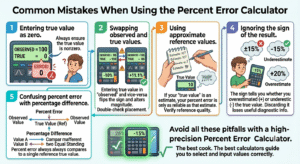
- Entering the true value as zero — Division by zero is undefined; the Percent Error Calculator will return an error. Always ensure the true value is nonzero.
- Swapping observed and true values — Entering the true value in the “observed” field and vice versa will flip the sign of your result and alter the magnitude. Always double-check which value goes where.
- Using approximate reference values — If your “true value” is itself an estimate, your percent error result is only as reliable as that estimate.
- Ignoring the sign of the result — The sign tells you whether your measurement overestimated or underestimated the true value. Discarding the sign loses useful diagnostic information.
- Confusing percent error with percentage difference — Percentage difference compares two values of equal standing (neither is designated “true”), while percent error always compares to a reference true value.

Benefits of Using an Online Percent Error Calculator
An online Percent Error Calculator offers significant advantages over manual computation:
Instant Results The Percent Error Calculator delivers your result in milliseconds — far faster than manual arithmetic, especially when working with complex decimal values.
Step-by-Step Transparency A good Percent Error Calculator shows every step of the calculation — making it an excellent educational tool that helps users understand the formula, not just the answer.
Zero Arithmetic Errors Manual percent error calculations are prone to sign errors, division mistakes, and decimal misplacement. The Percent Error Calculator eliminates all of these risks.
Accessibility Available in any browser on any device, an online Percent Error Calculator requires no software installation and no account creation. It is available whenever you need it.
Free to Use Online Percent Error Calculators are universally free, making professional-grade calculation accessible to students and professionals worldwide.
Frequently Asked Questions (FAQs)
What is percent error? Percent error is the percentage difference between an observed (measured) value and the true (accepted) value, calculated as [(Observed − True) / True] × 100.
What does a negative percent error mean? A negative percent error means the observed value is less than the true value — your measurement underestimated the actual quantity.
What does a positive percent error mean? A positive percent error means the observed value is greater than the true value — your measurement overestimated the actual quantity.
What is an acceptable percent error? In most scientific and educational contexts, a percent error below 5% is considered acceptable. However, acceptable ranges vary by discipline and application — engineering tolerances may be far stricter.
Can percent error be greater than 100%? Yes. If the observed value is more than double the true value (or less than zero when the true value is positive), the percent error will exceed 100%.
Why can’t the true value be zero in the percent error formula? Because the formula divides by the true value, and division by zero is mathematically undefined. Always use a nonzero true value.
Is percent error the same as percentage difference? No. Percent error compares one value to a known true value. Percentage difference compares two values of equal status, using their average as the denominator.
Can I use the Percent Error Calculator for financial analysis? Yes. The Percent Error Calculator can be applied to any scenario where you compare a predicted or estimated value to an actual outcome — including financial forecasting, budgeting, and economic modeling.
How do I interpret a percent error of 0%? A percent error of 0% means your observed value is exactly equal to the true value — perfect accuracy. In practice, true 0% error is rare due to instrument limitations and environmental factors.
Does percent error account for precision? No. Percent error measures accuracy (closeness to the true value) for a single measurement. To assess precision, you need to analyze the spread of multiple measurements using standard deviation or similar statistics.
Conclusion
Percent error is one of the most fundamental and universally applicable metrics in quantitative analysis. Whether you are conducting a chemistry experiment, validating an engineering design, evaluating a financial forecast, or grading student lab reports, the ability to accurately compute and interpret percent error is an essential skill.
The Percent Error Calculator makes this process effortless — delivering instant, precise, step-by-step results from just two input values. It eliminates the risk of manual arithmetic errors, saves valuable time, and provides clear, interpretable output that helps you understand not just the result but the reasoning behind it.
By using the Percent Error Calculator, you transform raw measurements into meaningful insights — quantifying the gap between what you observed and what you expected, and gaining the information needed to improve your methods, validate your instruments, and draw reliable conclusions from your data.
We encourage you to bookmark this page and use the Percent Error Calculator regularly in your academic, scientific, or professional work. Accuracy is not an accident — it is the result of careful measurement, rigorous analysis, and the right tools. The Percent Error Calculator is one of those tools, and with the understanding you have gained from this guide, you are fully equipped to use it to its maximum potential.