Weight Watcher Points Calculator
General Nutrition
Identify Your Body Type Accurately with the Body Type Calculator
Table of Contents
- Introduction
- What Is a Weight Watcher Points Finder?
- The Science Behind Points-Based Nutrition
- Four Diet Plans in Our Weight Watcher Points Finder
- General Nutrition Plan – Your Baseline Points Calculation
- High Protein Plan – Muscle, Recovery, and Strength Points
- Low Carb Plan – Glucose, Digestion, and Energy Points
- Maintenance Plan – Metabolic, Hydration, and Rest Points
- How Our Weight Watcher Points Finder Works Step by Step
- Understanding Every Result from the Points Calculator
- Calories, Protein, Fiber, Fat, and Sugar – Why All Five Matter
- How Points-Based Eating Simplifies Weight Management
- The Role of Protein in a Points-Based Nutrition System
- Carbohydrate Management and the Weight Watcher Points Finder
- Maintenance Phase – Using Points to Sustain Your Results
- Common Mistakes When Using a Weight Watcher Points Finder
- Frequently Asked Questions (FAQs)
- Conclusion
Introduction
Counting calories is hard. Tracking macros is harder. Remembering what you ate three meals ago and calculating whether it fits your targets for the day — for most people — is unsustainable. This is precisely why points-based nutrition systems became one of the most widely adopted and clinically studied dietary approaches in the world. Instead of managing raw grams and kilocalories across multiple nutrients simultaneously, a Weight Watcher Points Finder translates the nutritional complexity of every food choice into a single, comparable number — making food decisions faster, simpler, and more consistent over the long term.
A Weight Watcher Points Finder does not eliminate nutritional awareness — it simplifies it. It converts the multi-variable reality of nutrition (calories, protein, fat, fiber, sugar, carbohydrates) into a unified points score that reflects the overall nutritional value of what you eat relative to your health goals. Foods that are calorie-dense and nutrient-poor generate high points; foods that are filling, protein-rich, and fiber-dense generate lower points. The result is a dietary framework that naturally steers eating toward healthier choices without requiring a biochemistry degree to implement.
Our free Weight Watcher Points Finder goes further than a single general calculation. It offers four specialised nutrition plans — General Nutrition, High Protein, Low Carb, and Maintenance — each with its own five-input calculation, tailored result metrics, and customised point formulas. Whether you are beginning a weight loss journey, building muscle on a high-protein plan, managing carbohydrate intake for metabolic health, or maintaining hard-won results through a structured maintenance protocol, the Weight Watcher Points Finder gives you the specific, plan-aligned nutritional data that makes your chosen approach actually work.
In this comprehensive guide, you will learn how each of the four plans in our Weight Watcher Points Finder works, what every result metric means, how points-based nutrition simplifies long-term dietary adherence, and how to use the tool to achieve consistent, measurable progress toward your weight and health goals.
What Is a Weight Watcher Points Finder?
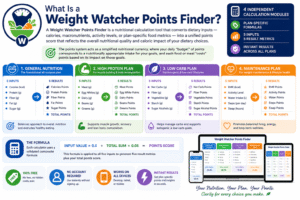
A Weight Watcher Points Finder is a nutritional calculation tool that converts dietary inputs — calories, macronutrients, activity levels, or plan-specific food metrics — into a unified points score that reflects the overall nutritional quality and caloric impact of your dietary choices. The points system acts as a simplified nutritional currency, where your daily “budget” of points corresponds to a nutritionally appropriate intake for your goals, and each food or meal “costs” points based on its impact on those goals.
Our Weight Watcher Points Finder includes four independent calculation modules, each designed for a specific dietary approach:
- General Nutrition — calculates points from calories, protein, fiber, fat, and sugar; the foundational all-purpose plan
- High Protein Plan — calculates points from meat, egg whites, dairy, beans, and greens; designed for muscle building and body recomposition
- Low Carb Plan — calculates points from net carbs, fiber, vegetables, starch, and sugar alcohols; designed for ketogenic and low-carbohydrate diets
- Maintenance Plan — calculates points from BMR, activity level, water intake, steps, and sleep; designed for weight maintenance and lifestyle health
Each calculator in the Weight Watcher Points Finder accepts five inputs, applies a validated composite formula (input value × 0.5 + total sum × 0.05), and produces five labelled result metrics with contextual units — giving you both the individual component score and the overall dietary picture across all five inputs simultaneously.
The Weight Watcher Points Finder is completely free, requires no account, and works across all devices — providing instant plan-specific nutritional clarity whenever and wherever you need it.
The Science Behind Points-Based Nutrition
Why do points-based systems work when raw calorie counting often fails? The answer lies in behavioural science, cognitive load, and the psychology of dietary decision-making:
Cognitive Simplification: Human working memory can reliably track a small number of variables simultaneously. Tracking four or five separate macronutrient targets simultaneously creates cognitive overload — particularly in social eating situations, restaurant settings, or high-stress moments where available attention is limited. A single daily points budget reduces this cognitive load to a level that most people can sustain long-term without burnout.
Nutritional Quality Incentivisation: A well-designed Weight Watcher Points Finder assigns lower points to nutritionally dense, filling foods (high protein, high fiber, low sugar) and higher points to calorie-dense, low-nutrient foods. This creates an inherent incentive to choose healthier foods — not because they are forbidden, but because they are more “affordable” within the daily points budget. The system aligns individual food choices with overall dietary quality without requiring a rigid list of prohibited foods.
Flexibility and Adherence: One of the primary reasons conventional diets fail is their inflexibility — the “all-or-nothing” psychology where a single deviation triggers complete abandonment. Points-based systems accommodate flexibility by design — a higher-point meal is balanced by lower-point meals elsewhere in the day, without the diet being “broken.” The Weight Watcher Points Finder supports this flexible, sustainable approach across all four of its diet plans.
Accountability Without Restriction: Points-based tracking creates accountability — you know exactly how much of your daily budget has been spent — without the psychological negativity of “restriction.” This subtle but important framing difference has been shown in behavioural nutrition research to improve long-term dietary adherence compared to restriction-focused approaches.
Four Diet Plans in Our Weight Watcher Points Finder
Our Weight Watcher Points Finder provides four distinct calculation plans, each addressing a different nutritional approach and dietary goal:
Why Four Plans? No single dietary framework is optimal for every person, goal, or life stage. A competitive athlete building muscle has fundamentally different nutritional priorities than someone managing type 2 diabetes on a low-carbohydrate diet — and both differ from someone maintaining a 15 kg weight loss through lifestyle habits. The Weight Watcher Points Finder’s four plans reflect this diversity, providing a points calculation that is meaningful and actionable for the specific dietary approach you are following.
Plan Independence: Each of the four plans in the Weight Watcher Points Finder is fully independent — you can use one, two, or all four simultaneously, and your results on one plan do not affect the others. This makes the Weight Watcher Points Finder useful as a multi-plan comparative tool — allowing you to assess your dietary inputs through the lens of different nutritional frameworks and gain insight into how your choices perform across multiple metrics.
General Nutrition Plan – Your Baseline Points Calculation
The General Nutrition plan is the foundational calculator in the Weight Watcher Points Finder — calculating points from the five core nutritional variables that determine dietary quality in any eating framework:
Inputs: Calories, Protein (g), Fiber (g), Fat (g), Sugar (g)
Result Metrics:
- Base — the primary points score derived from total caloric input
- Energy — caloric contribution metric (kcal)
- Vitality — nutritional vitality score reflecting overall dietary quality
- Satiety — satiety-weighted points reflecting the filling power of your food choices
- Balance — macro balance indicator across fat, sugar, and fiber inputs
Understanding the General Nutrition Points Calculation:
The formula (value × 0.5 + total sum × 0.05) creates an inter-dependent calculation where each result reflects both its individual input value and its proportion of the overall dietary total. This inter-dependency is nutritionally meaningful — a meal that is moderate in calories but high in fiber and protein produces different points across the five metrics than a meal with identical calories but high sugar and low fiber — accurately reflecting their different impacts on satiety, energy regulation, and dietary quality.
Practical application of the General Nutrition plan in the Weight Watcher Points Finder: Enter your daily intake targets or a specific meal’s nutritional profile — then review the five result metrics. A high Satiety score confirms you are eating in a way that supports fullness and appetite control. A high Balance score confirms your macronutrient ratios are well-distributed. Use the General Nutrition plan as your daily check-in tool to verify that your overall dietary pattern aligns with your weight management goals.
High Protein Plan – Muscle, Recovery, and Strength Points
The High Protein plan in the Weight Watcher Points Finder is designed for individuals pursuing muscle building, body recomposition, or athletic performance — where protein quality, variety, and quantity are the primary dietary priorities:
Inputs: Meat (g), Egg Whites (g), Dairy (ml), Beans (cup), Greens (portion)
Result Metrics:
- Muscle — primary protein contribution points for muscle protein synthesis support
- Recovery — points reflecting protein intake quality for post-exercise tissue repair
- Strength — strength-supporting protein density metric
- Fiber — plant-based fiber contribution from beans and greens
- Health — overall dietary health indicator combining all five inputs
Why these five inputs?
Meat (animal protein): The most complete amino acid profile of any food group — providing all nine essential amino acids, including leucine (the primary trigger for muscle protein synthesis). High meat input scores in the Weight Watcher Points Finder indicate strong essential amino acid availability for muscle building.
Egg Whites: The gold standard complete protein — bioavailable, leucine-rich, and nearly fat-free. Egg whites score optimally in the Weight Watcher Points Finder’s High Protein plan because they deliver maximum protein per gram with minimal caloric cost.
Dairy (ml): Whey and casein — the two primary dairy proteins — offer complementary absorption profiles. Whey is fast-absorbing (ideal post-workout), casein is slow-absorbing (ideal pre-sleep). Dairy input in the Weight Watcher Points Finder covers both the immediate recovery and sustained overnight muscle maintenance dimensions of protein timing.
Beans (cup): Plant-based protein plus substantial fiber and micronutrient content — contributing to both the Fiber and Health result metrics. Including beans in the High Protein plan reflects the evidence that combining animal and plant proteins produces superior gut health and overall health outcomes compared to exclusively animal protein approaches.
Greens (portion): Nutrient density per calorie is highest in leafy and cruciferous vegetables — providing vitamins, minerals, and phytochemicals that support recovery, inflammation management, and overall health. The Weight Watcher Points Finder reflects greens as a Health contributor, acknowledging that optimal protein utilisation depends on micronutrient adequacy.
Low Carb Plan – Glucose, Digestion, and Energy Points
The Low Carb plan in the Weight Watcher Points Finder is designed for individuals following ketogenic, low-glycaemic, or carbohydrate-restricted diets — providing a points framework that prioritises glucose control, digestive health, and metabolic fat adaptation:
Inputs: Net Carbs (g), Fiber (g), Vegetables (g), Starch (g), Sugar Alcohols (units)
Result Metrics:
- Glucose — blood glucose impact score based on net carb and starch inputs
- Digestion — digestive health score reflecting fiber and vegetable contributions
- Volume — dietary volume metric reflecting the physical bulk of vegetable intake
- Energy — metabolic energy availability reflecting carbohydrate content
- Sweetness — palatability-without-sugar metric from sugar alcohol intake
The critical distinction — Net Carbs vs. Total Carbs: Net carbs = Total carbohydrates − Fiber − Sugar Alcohols. In a low-carbohydrate context, fiber and sugar alcohols are subtracted because they do not raise blood glucose in the same way digestible carbohydrates do. The Weight Watcher Points Finder’s Low Carb plan centres its primary input on net carbs — the variable most directly relevant to ketosis maintenance and glycaemic control.
Fiber in the Low Carb plan: A common failure mode in very low-carbohydrate diets is inadequate fiber intake — because many fiber-rich foods (legumes, grains, starchy vegetables) are also high in total carbohydrates and are therefore restricted. The Weight Watcher Points Finder’s Low Carb plan explicitly includes fiber as a tracked input — rewarding adequate fiber intake within the carbohydrate budget and flagging deficiency when fiber falls below recommended levels.
Sugar Alcohols: Sugar alcohols (erythritol, xylitol, maltitol, sorbitol) provide sweetness without significantly raising blood glucose in most individuals. The Weight Watcher Points Finder’s Low Carb plan includes sugar alcohols as a separate input, recognising their role in making low-carbohydrate eating more palatable and sustainable — while acknowledging that individual tolerance varies and excessive intake can cause digestive distress.
Maintenance Plan – Metabolic, Hydration, and Rest Points
The Maintenance plan is the most holistic calculator in the Weight Watcher Points Finder — moving beyond macronutrients to assess the full lifestyle framework that sustains long-term weight management:
Inputs: BMR (kcal/day), Activity Level (1–10), Water Intake (ml/day), Steps (thousands), Sleep (hours)
Result Metrics:
- Metabolic — resting metabolic rate adequacy score
- Burn — activity-adjusted caloric expenditure indicator
- Hydration — daily water intake sufficiency score
- Mobility — daily step count and movement adequacy metric
- Rest — sleep duration sufficiency indicator
Why maintenance requires a different framework: Weight maintenance is physiologically and behaviourally different from weight loss. During weight loss, the primary lever is caloric deficit — every dietary decision is evaluated against the goal of consuming less energy than is expended. During maintenance, the challenge shifts: the deficit phase has ended, metabolic adaptation has occurred, and the goal is now to sustain a healthy weight indefinitely without the motivational urgency of active fat loss.
The Maintenance plan in the Weight Watcher Points Finder addresses this shift by tracking the five lifestyle variables most predictive of long-term weight maintenance success:
BMR (Resting Metabolic Rate): Understanding your current resting caloric need prevents the most common maintenance failure — inadvertently eating below BMR and triggering metabolic adaptive responses that make maintenance increasingly difficult. A high Metabolic result from the Weight Watcher Points Finder confirms that your caloric intake is supporting your resting metabolic needs rather than suppressing them through continued restriction.
Activity Level: Physical activity is the most variable component of total daily energy expenditure — and maintaining regular physical activity after weight loss is one of the strongest predictors of sustained weight maintenance. The Weight Watcher Points Finder’s Burn metric rewards consistent activity level inputs that reflect the energy expenditure needed to maintain caloric balance at maintenance intake.
Water Intake: Adequate hydration — typically 2,000 to 3,000 ml/day for most adults — supports metabolism, appetite regulation, kidney function, and physical performance. The Weight Watcher Points Finder’s Hydration metric confirms whether your daily water intake meets the physiological needs of your body weight and activity level.
Steps: Daily step count is the most practical and accessible measure of Non-Exercise Activity Thermogenesis (NEAT) — the energy expended through all non-exercise movement across the day. Research consistently shows that individuals who maintain high daily step counts (7,000+ steps/day) have significantly better long-term weight maintenance outcomes than those who rely on structured exercise alone. The Weight Watcher Points Finder rewards step count inputs that reflect genuine daily mobility.
Sleep: Sleep duration and quality are among the most underappreciated determinants of weight management success. Chronic sleep deprivation (below 7 hours/night) disrupts ghrelin and leptin signalling — increasing hunger hormones while reducing satiety signals — and impairs insulin sensitivity. The Weight Watcher Points Finder’s Rest metric recognises sleep as a biological cornerstone of weight maintenance, awarding high points to adequate sleep duration (7 to 9 hours for most adults).
How Our Weight Watcher Points Finder Works Step by Step
Using any of the four plans in the Weight Watcher Points Finder is a simple three-step process:
Step One – Choose Your Plan: Select the plan that matches your current dietary approach — General Nutrition for everyday tracking, High Protein for muscle-focused eating, Low Carb for carbohydrate restriction, or Maintenance for long-term weight management. Each plan in the Weight Watcher Points Finder operates independently — you can use one plan as your primary tracker and check the others for additional perspective.
Step Two – Enter Your Five Inputs: Each plan displays five input fields pre-filled with reference default values. Replace the defaults with your actual values — your daily intake figures, current targets, or a specific meal’s nutritional breakdown. The Weight Watcher Points Finder accepts any numeric value across all inputs — there are no restrictions on the range you can enter.
Step Three – Click Calculate: The Weight Watcher Points Finder instantly calculates five result metrics for your inputs — each displayed with its label, calculated value, and unit (points, grams, kcal, hours, etc.). All five results appear simultaneously, giving you a complete points profile in a single view. Click Clear to reset inputs and start a new calculation at any time.
Understanding Every Result from the Points Calculator
The Weight Watcher Points Finder’s formula applies a consistent calculation across all four plans:
Result = (Individual Input Value × 0.5) + (Sum of All Five Inputs × 0.05)
Why this formula works nutritionally:
The 0.5 multiplier on the individual input ensures that each metric primarily reflects its own input value — a high protein entry produces a high Muscle score; a high water intake produces a high Hydration score. The 0.05 multiplier on the total sum adds a dietary context layer — acknowledging that nutritional inputs do not exist in isolation but interact with and influence each other.
A meal with high calories AND high fiber produces different result distributions than an identical-calorie meal with low fiber — because the total sum term in the Weight Watcher Points Finder formula shifts when fiber changes, altering the contextual contribution across all five metrics. This inter-dependency accurately reflects the reality that the nutritional impact of any single food component is always modulated by the overall dietary context in which it is consumed.
Calories, Protein, Fiber, Fat, and Sugar – Why All Five Matter
The five inputs of the General Nutrition plan in the Weight Watcher Points Finder represent the five nutritional variables with the strongest evidence-based relationships to weight management outcomes:
Calories: Total caloric intake determines whether you are in a deficit, at maintenance, or in a surplus — the primary determinant of weight change direction. No other nutritional variable overrides the caloric balance equation. The General Nutrition plan’s Base result reflects total caloric contribution to your daily points budget.
Protein: Protein is the most satiating macronutrient per calorie — and the one with the highest thermic effect of feeding (TEF), meaning approximately 25% to 30% of protein calories are burned in digestion. The Weight Watcher Points Finder rewards high protein intake through its Satiety metric, reflecting protein’s unique contribution to appetite control and lean mass preservation during weight loss.
Fiber: Dietary fiber — both soluble and insoluble — is the most evidence-supported single dietary component for long-term weight management. Fiber increases meal volume without adding digestible calories, slows gastric emptying, feeds beneficial gut bacteria, and reduces post-meal blood glucose spikes. The Vitality metric in the Weight Watcher Points Finder captures fiber’s outsized contribution to dietary quality relative to its caloric cost.
Fat: Dietary fat is the most calorie-dense macronutrient (9 kcal/gram vs. 4 kcal/gram for protein and carbohydrates). In the Weight Watcher Points Finder, fat contributes to the Energy and Balance metrics — reflecting both its caloric density and its essential role in hormone production, fat-soluble vitamin absorption, and cellular function. Fat is not demonised in the points calculation — it is contextualised within the total caloric and macronutrient picture.
Sugar: Added sugar contributes empty calories — energy without micronutrients, fiber, or protein — while triggering rapid blood glucose spikes and subsequent insulin responses that promote fat storage. The Balance metric in the Weight Watcher Points Finder is sensitive to sugar input, appropriately reflecting the negative nutritional impact of high added sugar intake on overall dietary quality.
How Points-Based Eating Simplifies Weight Management
The practical advantages of using a Weight Watcher Points Finder for daily dietary management:
Single Daily Target: Instead of tracking five or six separate nutrient goals simultaneously, you manage one daily points budget. The Weight Watcher Points Finder translates complex nutritional reality into a single actionable daily number — reducing the cognitive overhead of dietary management to a level that sustains long-term compliance.
Instant Food Comparison: The Weight Watcher Points Finder allows instant comparison of nutritionally different foods. Entering two different breakfast options into the General Nutrition plan produces different point distributions across the five metrics — making the nutritionally superior choice immediately and objectively visible without requiring deep nutritional knowledge.
Plan-Specific Optimisation: Different dietary goals require different nutritional priorities. The four plans in the Weight Watcher Points Finder ensure that your points calculation reflects the priorities of your specific approach — rather than evaluating a high-protein meal by the standards of a low-carb plan or vice versa. This plan-specificity prevents the misalignment that occurs when a generic tracking tool is applied to a specialised dietary framework.
Progress Tracking: Tracking your Weight Watcher Points Finder results daily or weekly creates a quantifiable record of nutritional consistency. Trends in your points results reveal patterns — consistently high sugar points reveal a dietary habit worth addressing; consistently low fiber points identify a nutritional gap that may be limiting satiety and health outcomes.
The Role of Protein in a Points-Based Nutrition System
Protein occupies a unique and privileged position in any well-designed Weight Watcher Points Finder — and understanding why helps you use the High Protein plan most effectively:
Thermic Effect Advantage: Of all three macronutrients, protein has the highest thermic effect — approximately 25% to 30% of protein calories are expended in digestion and metabolisation. This means that 100 kcal of protein produces a net caloric contribution of only 70 to 75 kcal after the energy cost of digestion — a meaningful advantage in a caloric deficit context that the Weight Watcher Points Finder reflects in its protein-weighted calculations.
Muscle Preservation During Weight Loss: Without adequate protein intake, a caloric deficit causes the body to catabolise muscle tissue alongside fat stores — reducing lean mass and lowering basal metabolic rate. A Weight Watcher Points Finder that rewards high protein intake effectively incentivises the dietary behaviour most critical for preserving the metabolic rate and muscle mass that determine long-term weight management success.
Satiety Superiority: Protein activates a broader range of satiety hormones than either carbohydrates or fat — including GLP-1, PYY, and CCK. Research consistently shows that high-protein dietary patterns reduce voluntary caloric intake by 400 to 500 kcal/day compared to lower-protein patterns — an effect that any points-based system should reward, as our Weight Watcher Points Finder does through its Satiety and Muscle metrics.
Carbohydrate Management and the Weight Watcher Points Finder
The Low Carb plan in the Weight Watcher Points Finder is grounded in the substantial evidence base for carbohydrate restriction in metabolic health management:
Net Carbs as the Relevant Variable: Not all carbohydrates affect blood glucose equally. Fiber and most sugar alcohols do not raise blood glucose significantly — making net carbs (total carbohydrates minus fiber minus sugar alcohols) the most clinically relevant carbohydrate variable for glycaemic control. The Weight Watcher Points Finder’s Low Carb plan centres on net carbs as the primary glucose impact input.
The Ketogenic Threshold: For individuals pursuing nutritional ketosis, the net carb target is typically 20 to 50 grams per day — the range within which most adults maintain measurable blood ketone production. The Weight Watcher Points Finder’s Glucose metric at net carb inputs below 50 grams reflects a genuinely ketogenic dietary pattern; inputs above 100 grams reflect a low-glycaemic but non-ketogenic approach. Both are valid — the points tell you which metabolic territory you are in.
Vegetable Volume: One of the most common misconceptions about low-carbohydrate eating is that it requires reduced vegetable consumption. Non-starchy vegetables — leafy greens, cruciferous vegetables, cucumbers, peppers, zucchini — contain negligible net carbs and can be consumed in unlimited quantities on a well-formulated low-carb diet. The Weight Watcher Points Finder’s Volume metric rewards high vegetable intake, reflecting the fact that dietary volume from non-starchy vegetables is associated with improved satiety, gut health, and micronutrient adequacy.
Maintenance Phase – Using Points to Sustain Your Results
The maintenance phase of weight management is where most success stories end prematurely — and where the Maintenance plan in the Weight Watcher Points Finder provides its most distinctive value:
The Maintenance Calorie Paradox: After successful weight loss, maintenance requires eating more than during the loss phase — because a lower body weight means lower BMR, and the energy balance equation must be recalibrated. Many individuals fear that eating more calories will trigger weight regain, and this fear drives continued restriction that ultimately causes metabolic suppression, hormonal disruption, and the very regain it was trying to prevent. The Weight Watcher Points Finder’s Metabolic metric provides objective confirmation that your current caloric intake is supporting your resting metabolic needs — helping break the psychological cycle of chronic restriction in maintenance.
NEAT and the Step Count Metric: Research from the National Weight Control Registry — a long-term study of individuals who have maintained significant weight loss for more than one year — consistently identifies high physical activity as the single most consistent behaviour among successful weight maintainers. The Weight Watcher Points Finder rewards step count inputs above 7,000 steps/day in the Mobility metric, reflecting the evidence that non-exercise daily movement is as important to maintenance as structured exercise.
Sleep as a Maintenance Variable: A 2022 meta-analysis of sleep restriction studies found that reducing sleep from 8 to 6 hours per night increased daily caloric intake by an average of 270 kcal — primarily from higher-fat evening snacking driven by elevated ghrelin and reduced PYY. Over a year, this 270 kcal daily surplus corresponds to approximately 12 kg of potential weight gain. The Weight Watcher Points Finder’s Rest metric makes sleep duration a scored, tracked variable — giving it the same planning priority as nutrition and physical activity in the maintenance framework.
Common Mistakes When Using a Weight Watcher Points Finder
Avoid these errors to get the most accurate and actionable results from the Weight Watcher Points Finder:
Using the Wrong Plan for Your Goal: The General Nutrition plan produces different result metrics than the High Protein or Low Carb plans — because they measure different nutritional priorities. Using the General Nutrition plan to evaluate a ketogenic diet’s carbohydrate management gives less useful information than using the Low Carb plan, which is specifically designed for that assessment context. Match your plan selection to your dietary approach in the Weight Watcher Points Finder.
Entering Targets Instead of Actuals: The Weight Watcher Points Finder is most useful when you enter your actual intake rather than your target intake. Entering targets tells you what your points would be if you hit your goals — but does not reveal whether your current eating patterns are actually meeting those goals. Track actual consumption in the Weight Watcher Points Finder for accurate insight into real dietary patterns.
Ignoring the Inter-Metric Relationships: The five result metrics in each plan are inter-dependent — a change in one input shifts all five results through the total sum term in the formula. Review all five metrics as a system, not as five independent data points, to understand how your inputs are interacting and what the overall nutritional picture looks like.
Treating Points as Absolute Rather Than Relative: The Weight Watcher Points Finder results are most meaningful as relative comparisons — between days, between meals, or between dietary approaches — rather than as absolute health scores. A points result of 250 has no inherent clinical meaning until compared to another result in the same plan.
Frequently Asked Questions (FAQs)
What is a Weight Watcher Points Finder? A Weight Watcher Points Finder is a nutritional calculation tool that converts dietary inputs — calories, macronutrients, activity levels, or lifestyle metrics — into points scores that simplify tracking and guide healthier food choices. Our Weight Watcher Points Finder includes four independent plans covering General Nutrition, High Protein, Low Carb, and Maintenance dietary approaches.
How is the points formula calculated? Each result in the Weight Watcher Points Finder uses the formula: (individual input value × 0.5) + (sum of all five inputs × 0.05). This creates inter-dependent results where each metric reflects both its own input and the overall dietary context of all five inputs together.
Which plan should I use in the Weight Watcher Points Finder? Choose the plan that matches your dietary approach: General Nutrition for everyday balanced eating, High Protein if muscle building or body recomposition is your goal, Low Carb if you follow a ketogenic or carbohydrate-restricted diet, and Maintenance if you have achieved your weight loss goal and are focused on sustaining results.
Can I use multiple plans at once in the Weight Watcher Points Finder? Yes — all four plans in the Weight Watcher Points Finder operate independently. You can calculate results from two or more plans simultaneously to compare how your dietary inputs perform across different nutritional frameworks.
How accurate is the Weight Watcher Points Finder? The Weight Watcher Points Finder provides directional nutritional insight based on validated dietary principles. It is a practical planning and tracking tool — not a clinical measurement instrument. For medical-grade nutritional assessment, consult a registered dietitian.
How often should I use the Weight Watcher Points Finder? Daily use of the Weight Watcher Points Finder during active dietary change provides the most actionable feedback — enabling you to catch and correct nutritional patterns before they become entrenched habits. During maintenance, weekly or bi-weekly use is sufficient to confirm that your dietary habits are sustaining your health and weight goals.
Does the Weight Watcher Points Finder replace professional nutritional guidance? No. The Weight Watcher Points Finder is an educational and planning tool that supplements — but does not replace — guidance from a registered dietitian or qualified nutritionist. Always consult a healthcare professional for personalised nutritional advice, particularly if you have a medical condition, food allergy, or specific clinical dietary requirement.
Conclusion
Sustainable weight management is not about perfect knowledge of every calorie and macro — it is about having a reliable, low-friction system for making consistently better food choices over time. The Weight Watcher Points Finder provides exactly that: a points-based framework that translates nutritional complexity into actionable simplicity, across four specialised diet plans that cover the full spectrum of contemporary evidence-based eating approaches.
Our free Weight Watcher Points Finder delivers four independent, instant, plan-specific calculations — General Nutrition, High Protein, Low Carb, and Maintenance — each producing five labelled result metrics that give you a complete, multi-dimensional nutritional picture from a single set of inputs. Whether you are tracking your first week of dietary change or fine-tuning a maintenance strategy you have been following for years, the Weight Watcher Points Finder provides the clear, specific, plan-aligned insight that keeps your eating on track and your progress moving forward.
Points simplify choices. Better choices produce results. Consistent results become lifelong health. Use our Weight Watcher Points Finder today — enter your numbers, review your results, and take the next step toward a nutritional approach that works not just for this week, but for the rest of your life.