Body Type Calculator
Predict Your Menstrual Cycle with the Period Calculator
Table of Contents
- Introduction
- What Is a Body Type Calculator?
- The Three Somatotypes: Ectomorph, Mesomorph, and Endomorph
- How the Body Type Calculator Classifies Your Somatotype
- Understanding Waist-to-Hip Ratio (WHR)
- Understanding Shoulder-to-Hip Ratio
- BMI, BMR, and Body Type – How They Interact
- What Each Body Type Calculator Result Means
- Training Strategies for Each Body Type
- Nutrition Strategies for Each Body Type
- How Age and Gender Affect Body Type Classification
- Common Misconceptions About Body Types
- Frequently Asked Questions (FAQs)
- Conclusion
Introduction
Walk into any gym, scroll through any fitness forum, or flip through any nutrition book, and you will find advice presented as universally applicable: “Eat 500 calories above maintenance to build muscle.” “Do three cardio sessions per week to lose fat.” “Consume 1.6 grams of protein per kilogram of body weight.” The problem? No two bodies are built the same way, and a strategy that produces extraordinary results for one person may produce frustrating stagnation — or even setbacks — for another.
This is where your body type becomes one of the most important pieces of self-knowledge you can possess. Body type, or somatotype, describes the fundamental structural and metabolic characteristics of your physique — how you store fat, how readily you build muscle, how your skeleton is proportioned, and how your metabolism responds to changes in food and exercise. Understanding your body type transforms generic fitness advice into a personally targeted action plan.
A Body Type Calculator is the fastest and most systematic way to determine your somatotype based on objective measurements rather than subjective self-assessment. Rather than trying to identify your body type by comparing yourself to ambiguous diagrams, the Body Type Calculator processes your waist, hip, shoulder, and chest measurements alongside your weight, height, age, gender, and activity level to produce a clear, data-driven body type classification with personalised metabolic insights.
In this comprehensive guide, we will walk you through everything you need to know about the three body types, how the Body Type Calculator determines your classification, what each result means for your training and nutrition strategy, and how to use your body type knowledge to achieve better, faster, and more sustainable results.
What Is a Body Type Calculator?
A Body Type Calculator is a digital body composition tool that classifies your somatotype — Ectomorph, Mesomorph, or Endomorph — based on a combination of your body measurements, biometric data, and lifestyle inputs. Unlike generic BMI charts or simple weight-for-height tables, a Body Type Calculator evaluates the proportional relationships between different parts of your body to determine not just how much you weigh, but how your body is structured and how it distributes mass.
Our Body Type Calculator processes the following inputs to generate your complete body type profile:
- Gender — Male and female bodies have fundamentally different fat distribution patterns, hormonal profiles, and skeletal proportions. The Body Type Calculator applies gender-appropriate classification thresholds and BMR calculations for each.
- Age (years) — Body composition naturally shifts with age — lean muscle mass tends to decrease while fat mass increases after age 30, particularly without deliberate resistance training. Age also directly affects your BMR calculation.
- Weight (kg) — Total body weight is used alongside height to calculate your Body Mass Index (BMI), which provides a weight-for-height context for your body type classification.
- Height (cm) — Height contributes to BMI calculation and determines bone structure classification — taller frames are generally classified as larger skeletal structures with different proportional norms.
- Shoulder circumference (cm) — Shoulder width relative to hip width is the primary indicator of upper-body dominance versus lower-body dominance in body proportion analysis and is a key input for the shoulder-to-hip ratio.
- Chest circumference (cm) — Chest measurement provides context for upper body mass distribution and muscularity, complementing the shoulder measurement in body proportion analysis.
- Waist circumference (cm) — Waist measurement is the numerator in the Waist-to-Hip Ratio (WHR) calculation — the primary metric the Body Type Calculator uses to classify your somatotype.
- Hip circumference (cm) — Hip measurement is the denominator in the WHR calculation and the reference point for the shoulder-to-hip ratio, providing the baseline for all proportional assessments.
- Activity Level (1–5) — Your activity level influences your hydration target recommendation and contextualises your body type results within your current lifestyle demands.
- Goal (Muscle Gain or Fat Loss) — Your stated goal determines whether the Body Type Calculator frames your strategy in terms of hypertrophy (caloric surplus, progressive overload) or deficit (caloric restriction, fat oxidation priority).
By evaluating all ten of these inputs together, the Body Type Calculator produces a personalised profile that goes far beyond a simple body type label — it gives you a complete set of metabolic and structural insights to guide your fitness strategy.
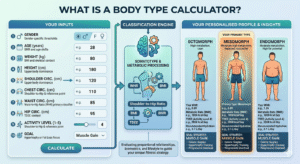
The Three Somatotypes: Ectomorph, Mesomorph, and Endomorph
The concept of somatotypes was first developed by American psychologist William Herbert Sheldon in the 1940s. While Sheldon’s original psychological interpretations of body types have since been discredited, the structural classification framework he introduced — Ectomorph, Mesomorph, and Endomorph — has proven enduringly useful as a practical descriptor of how different bodies respond to exercise and nutrition. Every modern Body Type Calculator is built on this foundational three-type framework.
| Body Type | Physical Characteristics | Metabolism | Fat Storage Tendency | Muscle Building Ease |
|---|---|---|---|---|
| Ectomorph | Narrow shoulders & hips, long limbs, low body fat, small joints | Fast — high caloric needs | Very low | Difficult — requires high calorie surplus |
| Mesomorph | Broad shoulders, narrow waist, muscular build, moderate body fat | Moderate — well-balanced | Moderate | Easy — responds well to training |
| Endomorph | Wide hips, rounder physique, higher natural body fat, shorter limbs | Slow — lower caloric needs | High — especially abdominal | Moderate — with right protocol |
It is critically important to understand that pure somatotypes are rare. Most people are a blend of two somatotypes — commonly described as Ecto-Mesomorph, Meso-Endomorph, or Endo-Ectomorph. The Body Type Calculator identifies your dominant somatotype based on your current measurements, which provides the most actionable classification for tailoring your training and nutrition approach.
How the Body Type Calculator Classifies Your Somatotype
The Body Type Calculator uses your Waist-to-Hip Ratio (WHR) as the primary classification metric, combined with your shoulder-to-hip ratio and BMI for a comprehensive profile. Here is the exact classification logic the calculator applies:
WHR 0.85 to 0.94 → Mesomorph — Moderate waist-to-hip proportion, suggesting a balanced, athletic build with favourable fat distribution.
WHR 0.95 and above → Endomorph — Higher waist-to-hip proportion, suggesting greater central fat accumulation and a rounder structural profile.
This WHR-based classification is grounded in decades of body composition research and is consistent with the thresholds used by the World Health Organization (WHO) for cardiometabolic risk assessment. The Body Type Calculator goes beyond the raw WHR by also computing your shoulder-to-hip ratio — which identifies whether your proportional dominance is upper-body (V-taper) or lower-body (pear shape) — and your BMI and BMR for complete metabolic context.
Understanding Waist-to-Hip Ratio (WHR)
The Waist-to-Hip Ratio (WHR) is one of the most clinically validated anthropometric measurements in sports science and preventive medicine. Calculated simply as waist circumference divided by hip circumference, it provides a direct indicator of fat distribution pattern — specifically, whether excess fat is stored predominantly in the abdominal region (apple shape) or the gluteal and femoral regions (pear shape).
The Body Type Calculator uses WHR as its primary somatotype classification variable because it captures a deeper and more meaningful dimension of body composition than weight or BMI alone. Two people with identical BMI values can have dramatically different WHR values — and therefore dramatically different health risk profiles, fat storage patterns, and appropriate body type classifications.
| WHR Range | Classification | Health Risk (WHO) | Body Type Indication |
|---|---|---|---|
| Below 0.80 (F) / Below 0.90 (M) | Low | Low metabolic risk | Ectomorph lean profile |
| 0.80–0.84 (F) / 0.90–0.94 (M) | Moderate | Moderate metabolic risk | Ecto-Mesomorph blend |
| 0.85–0.94 (F) / 0.95–0.99 (M) | High | Elevated metabolic risk | Mesomorph-Endomorph blend |
| 0.85+ (F) / 0.95+ (M) | Very High | High metabolic risk | Endomorph dominant profile |
The Fat Storage Risk indicator shown by the Body Type Calculator (High / Low) is derived directly from your WHR value. A WHR above 0.90 triggers the High fat storage risk classification, signalling that abdominal fat accumulation is a priority target for your fitness strategy.
Understanding Shoulder-to-Hip Ratio
While the WHR tells you how fat is distributed around your midsection, the Shoulder-to-Hip Ratio tells you about your skeletal proportionality — specifically, whether your upper body is broader, narrower, or equivalent in width to your lower body. The Body Type Calculator calculates this as your shoulder circumference divided by your hip circumference.
- Shoulder-to-Hip Ratio above 1.10: Indicates upper-body dominance — the classic “V-taper” associated with the Mesomorph somatotype in males. Broad shoulders with comparatively narrower hips suggest a skeletal frame naturally suited to upper-body strength development.
- Shoulder-to-Hip Ratio around 1.00: Indicates balanced proportions — equivalent shoulder and hip width. Common in Mesomorphs with symmetrical development and in female athletes with well-developed lower and upper body musculature.
- Shoulder-to-Hip Ratio below 1.00: Indicates hip dominance — wider hips relative to shoulders. Common in female Endomorphs and Ectomorphs with naturally narrower shoulder frames.
The shoulder-to-hip ratio from the Body Type Calculator is particularly useful for identifying training imbalances and setting targeted hypertrophy goals — for example, a person with a low shoulder-to-hip ratio pursuing muscle gain may prioritise upper body width development to improve visual proportionality.
BMI, BMR, and Body Type – How They Interact
The Body Type Calculator produces both your BMI and your BMR as part of its complete results profile. Understanding how these two metrics relate to your body type classification helps you use all the calculator outputs together as an integrated picture of your physiology.
Body Mass Index (BMI)
BMI (Body Mass Index) is calculated as your weight in kilograms divided by the square of your height in metres. It provides a quick weight-for-height classification and is a useful screening tool, but it has well-known limitations — particularly for muscular individuals. A Mesomorph with high lean muscle mass may register as “overweight” on the BMI scale despite carrying very little body fat, which is precisely why the Body Type Calculator presents BMI alongside WHR and somatotype classification rather than as a standalone verdict.
| BMI Range | Standard Classification | Context for Body Type |
|---|---|---|
| Below 18.5 | Underweight | Common in Ectomorphs with fast metabolism |
| 18.5 – 24.9 | Normal weight | Typical range for lean Ectomorphs and fit Mesomorphs |
| 25.0 – 29.9 | Overweight | May indicate Endomorph fat accumulation OR Mesomorph muscle mass |
| 30.0 and above | Obese | Likely Endomorph with elevated visceral fat — WHR confirms |
Basal Metabolic Rate (BMR)
Your BMR — the calories your body burns at complete rest — is calculated by the Body Type Calculator using the Mifflin-St Jeor equation and is deeply connected to your body type. Ectomorphs typically have the highest BMR relative to their body weight, making weight gain genuinely difficult without a significant caloric surplus. Endomorphs tend to have lower relative BMRs, which means they require less food to maintain their current weight and must be more precise about caloric intake to achieve fat loss. Mesomorphs generally fall in between, with a balanced metabolic rate that responds predictably to structured training and nutrition.
What Each Body Type Calculator Result Means
Here is a complete breakdown of every output the Body Type Calculator produces and exactly what each value tells you about your body:
- Body Classification (Ectomorph / Mesomorph / Endomorph): Your primary somatotype, determined by your WHR. This is the central result of the Body Type Calculator and the foundation for all personalised strategy recommendations.
- Shoulder-Hip Ratio: The ratio of your shoulder circumference to your hip circumference. Values above 1.0 indicate upper-body dominance (V-taper); values below 1.0 indicate lower-body dominance (pear shape).
- BMI Score: Your Body Mass Index. Provides weight-for-height context for your body type classification. Must be interpreted alongside WHR and body type for meaningful conclusions.
- Daily BMR: Your Basal Metabolic Rate in kilocalories — the minimum calories your body needs at complete rest. Use this as the floor of your daily caloric intake planning.
- Waist-Hip Ratio: Your WHR value — the primary somatotype classification metric. Also a validated indicator of cardiometabolic risk; values above 0.90 (male) or 0.85 (female) indicate elevated risk.
- Goal Strategy: Shows whether your stated goal is being approached as Hypertrophy (caloric surplus + resistance training) or Deficit (caloric restriction + fat oxidation priority).
- Fat Storage Risk: High or Low classification based on whether your WHR exceeds 0.90. High fat storage risk indicates a priority need for abdominal fat reduction strategies.
- Bone Structure: Large or Compact classification based on height. Taller frames (above 170 cm) are classified as larger skeletal structures, which influences natural muscle-building potential and BMI interpretation.
- Hydration Target (L/day): A personalised daily water intake target calculated from your activity level. Higher activity levels generate more metabolic heat and require greater fluid replacement.
- Activity Level: Confirms the activity level input you provided on a 1–5 scale, contextualising all metabolic calculations within your current lifestyle demands.
Training Strategies for Each Body Type
One of the most powerful applications of the Body Type Calculator is using your somatotype classification to select a training approach that works with your body’s natural tendencies rather than against them. Here is the evidence-based training strategy for each body type:
Ectomorph Training Strategy
Ectomorphs face the challenge of stimulating muscle growth in a body that is naturally resistant to gaining mass. The most effective training approach for Ectomorphs is heavy compound lifting with moderate volume and ample rest periods. Focus on the foundational compound movements — squat, deadlift, bench press, overhead press, and barbell row — performed in the 5–8 repetition range with progressive overload as the primary driver. Limit cardio to one or two low-intensity sessions per week during muscle-building phases, as excessive cardio creates a caloric deficit that works directly against the surplus needed for Ectomorph hypertrophy.
Mesomorph Training Strategy
Mesomorphs are the body type most naturally suited to structured training programmes — they gain muscle readily, lose fat relatively easily, and recover well between sessions. The most effective approach for Mesomorphs is a balanced combination of compound and isolation exercises across all major muscle groups, training 4–5 days per week in the 8–12 repetition range for hypertrophy or 3–6 repetitions for strength. Mesomorphs can incorporate regular cardio without significantly compromising muscle-building progress, making them the best suited of the three body types for simultaneous fat loss and muscle gain (body recomposition).
Endomorph Training Strategy
Endomorphs have the highest natural tendency to store body fat and typically carry a higher percentage of body fat relative to lean mass. The most effective training strategy for Endomorphs prioritises high-frequency resistance training combined with regular cardiovascular exercise. Resistance training preserves and builds the lean muscle mass that elevates resting metabolic rate — the most effective long-term tool for counteracting the Endomorph’s naturally slower metabolism. Cardio sessions 3–4 times per week — particularly HIIT protocols — accelerate fat oxidation without sacrificing muscle. The Body Type Calculator’s fat storage risk indicator gives Endomorphs immediate feedback on whether their abdominal proportions require priority attention.
Nutrition Strategies for Each Body Type
Training strategy accounts for approximately 30% of body composition results. The remaining 70% is determined by nutrition. The Body Type Calculator gives you the metabolic foundation — your BMR — to build a nutrition strategy tailored specifically to your somatotype:
| Body Type | Caloric Approach | Carbohydrate Tolerance | Protein Target | Fat Intake |
|---|---|---|---|---|
| Ectomorph | Significant surplus (+300–500 kcal above TDEE) | Very high — carbs are primary fuel | 1.6–2.0g per kg bodyweight | Moderate — 25–30% of total calories |
| Mesomorph | Moderate surplus (+200–300 kcal) for gain; deficit for cut | Moderate — responds well to carb cycling | 1.8–2.2g per kg bodyweight | Moderate — 25–30% of total calories |
| Endomorph | Caloric deficit (300–500 kcal below TDEE) | Lower — reduced carb sensitivity, prioritise complex sources | 2.0–2.4g per kg bodyweight | Moderate-high — satiating, metabolically supportive |
Your BMR from the Body Type Calculator is the essential starting point for all of these caloric calculations. Multiply your BMR by your activity multiplier to get your TDEE, then apply the appropriate surplus or deficit for your body type and goal to arrive at your target daily calorie intake.
How Age and Gender Affect Body Type Classification
Body type is not entirely fixed — it is influenced significantly by both age-related physiological changes and gender-specific hormonal and structural differences. The Body Type Calculator accounts for both of these variables through its gender-specific BMR formula and its age input, but understanding how they interact with your somatotype classification helps you interpret your results with appropriate nuance.
How Age Affects Body Type
After age 30, the average person loses approximately 3–5% of lean muscle mass per decade through a process called sarcopenia — unless they engage in deliberate resistance training. This loss of muscle mass naturally shifts body composition toward a higher body fat percentage over time, which means WHR tends to increase with age even in individuals who maintain the same total body weight. This means a person who classified as a Mesomorph in their twenties may see their Body Type Calculator result shift toward the Mesomorph-Endomorph boundary in their forties if they have not maintained their lean mass through training.
How Gender Affects Body Type
Biological males and females have fundamentally different fat distribution patterns driven primarily by hormonal differences. Testosterone in males promotes fat storage in the abdominal region (android fat distribution), while oestrogen in females promotes fat storage in the gluteal and femoral regions (gynoid fat distribution). This means that the same WHR value can have different implications for male versus female bodies — which is why the WHO maintains gender-specific WHR risk thresholds that the Body Type Calculator references in its fat storage risk assessment.
Common Misconceptions About Body Types
Despite the practical value of somatotype classification, several persistent misconceptions can lead people to misuse or dismiss the results of a Body Type Calculator. Here are the most important myths to understand and correct:
- ‘My body type is fixed and cannot change’: Body type describes your natural structural and metabolic tendencies, not an immutable destiny. With consistent training and targeted nutrition, an Endomorph can achieve a lean, muscular physique, and an Ectomorph can build significant mass. The Body Type Calculator identifies where you start and what strategies work best — it does not set a ceiling on your potential.
- ‘Mesomorphs don’t need to work hard’: Mesomorphs respond well to training, but they still require consistent effort, progressive overload, and disciplined nutrition to achieve and maintain their results. Natural responsiveness is an advantage, not a substitute for work.
- ‘BMI tells me my body type’: BMI cannot distinguish between muscle and fat. A heavily muscled Mesomorph and a sedentary Endomorph can have identical BMI values with entirely different body compositions. The Body Type Calculator correctly uses WHR and body proportions — not BMI alone — as the primary classification metrics.
- ‘Endomorphs should avoid all carbohydrates’: Endomorphs have reduced carbohydrate tolerance relative to Ectomorphs, but complete carbohydrate elimination is neither necessary nor sustainable. The goal is to prioritise complex, fibre-rich carbohydrate sources, time carbohydrate intake around exercise, and maintain an overall caloric deficit — not to eliminate an entire macronutrient.
- ‘You can only be one pure body type’: The vast majority of people are blends of two somatotypes. The Body Type Calculator identifies your dominant type to guide strategy, but your actual physiology exists on a spectrum. Use the dominant classification as your primary framework while remaining aware that you may share characteristics with adjacent body types.
Frequently Asked Questions (FAQs)
What does a Body Type Calculator measure?
A Body Type Calculator analyses your body measurements — waist, hip, shoulder, chest, weight, and height — alongside your age, gender, and activity level to classify your somatotype as Ectomorph, Mesomorph, or Endomorph. It also produces your BMI, BMR, waist-to-hip ratio, shoulder-to-hip ratio, fat storage risk, bone structure classification, and hydration target.
How accurate is the Body Type Calculator’s somatotype classification?
The Body Type Calculator uses Waist-to-Hip Ratio as its primary classification metric, which is one of the most clinically validated anthropometric measurements in body composition research. For most people with consistent measurement technique, the classification accurately reflects their dominant somatotype. However, remember that pure somatotypes are rare — most people fall on the spectrum between two adjacent types.
How do I take accurate body measurements for the Body Type Calculator?
Measure your waist at the narrowest point of your torso (typically just above your belly button), your hips at the widest point of your gluteal region, your shoulders at the widest point of your deltoids, and your chest at the fullest point across your pectorals. Take all measurements without clothing, with a flexible measuring tape held snugly but not compressively against the skin. Measure first thing in the morning for the most consistent results.
Can my body type change over time?
Yes. While your fundamental skeletal structure is fixed, your soft tissue composition — the relative proportions of muscle and fat — changes significantly with training and nutrition. Consistently building muscle through resistance training naturally reduces your WHR over time (moving toward the Ectomorph-Mesomorph range), while fat accumulation increases it (moving toward the Endomorph range). Re-running the Body Type Calculator every 8–12 weeks tracks this progression.
What does ‘Fat Storage Risk: High’ mean in the Body Type Calculator?
A High fat storage risk result means your Waist-to-Hip Ratio exceeds 0.90, indicating that you are storing a meaningful proportion of excess body fat in the abdominal region. Abdominal or visceral fat is associated with elevated cardiometabolic risk. For individuals with a High fat storage risk, the Body Type Calculator recommends prioritising abdominal fat reduction through a combination of caloric deficit, resistance training, and cardiovascular exercise.
What is the Goal Strategy output in the Body Type Calculator?
The Goal Strategy shows whether the Body Type Calculator is framing your personalised recommendations in terms of Hypertrophy (muscle gain through caloric surplus and progressive resistance training) or Deficit (fat loss through caloric restriction and increased energy expenditure). It reflects the goal you selected — Muscle Gain or Fat Loss — and the appropriate strategic approach for that goal given your somatotype.
Does gender affect my body type classification?
Yes. Biological males and females have different fat distribution patterns, hormonal profiles, and skeletal proportions — all of which influence body type classification. The Body Type Calculator applies gender-specific BMR calculations and interprets WHR values within the appropriate gender-specific context established by the WHO risk thresholds.
Why is my BMI showing ‘overweight’ even though I’m muscular?
BMI cannot differentiate between muscle and fat — it is simply a weight-for-height ratio. A muscular Mesomorph can easily register as ‘overweight’ or even ‘obese’ on the BMI scale while carrying minimal body fat. This is exactly why the Body Type Calculator presents BMI alongside WHR and somatotype classification — so you can interpret your BMI result in the full context of your actual body composition.
What does the Hydration Target in the Body Type Calculator mean?
Your hydration target — calculated as (activity level × 0.5) + 2 litres per day — represents the estimated minimum daily water intake needed to support your metabolic functions, exercise performance, and recovery at your current activity level. Higher activity levels generate more metabolic heat and require more fluid to maintain optimal hydration status.
How often should I use the Body Type Calculator?
Re-run the Body Type Calculator every 8–12 weeks, or after any significant change in your body measurements, weight, or activity level. This allows you to track whether your WHR, shoulder-to-hip ratio, and BMI are moving in the direction your training and nutrition strategy is designed to produce — and to adjust your approach if the measurements indicate you are off course.
Conclusion
Your body type is not a limitation — it is a roadmap. Understanding whether you are an Ectomorph, Mesomorph, or Endomorph gives you a profound advantage in the gym, the kitchen, and the recovery room, because it transforms generic fitness advice into a personalised strategy built specifically around how your body actually works. The Body Type Calculator is the most systematic and objective tool available for making that determination based on data rather than guesswork.
From your waist-to-hip ratio and shoulder-to-hip ratio to your BMI, BMR, fat storage risk, bone structure, and hydration target — every result the Body Type Calculator produces is a piece of a larger, interconnected picture of your unique physiology. Read them together, understand what each value means for your training and nutrition strategy, and use them to build a fitness approach that works with your body’s natural tendencies rather than frustratingly against them.
Remember: body type is not destiny. With the right training protocol, the right nutritional strategy, and the consistency to execute both over time, every somatotype can achieve a lean, strong, and healthy physique. The Body Type Calculator simply ensures that the strategies you choose are the ones most likely to work for your specific body — saving you months of trial and error and helping you get to your goal faster.
Use the Body Type Calculator today, record your measurements accurately, understand your results fully, and build your most effective fitness strategy yet. Your body already knows what it is — now you do too.