Fat Intake Calculator
Discover Your Target Heart Rate with the Target Heart Rate Calculator
Table of Contents
- Introduction
- What Is a Fat Intake Calculator?
- How Does the Fat Intake Calculator Work?
- Types of Dietary Fat Explained
- How Much Fat Do You Actually Need Per Day?
- Fat Intake Based on Your Fitness Goals
- Understanding the Macro Distribution Table
- The Role of BMR and TDEE in Fat Calculations
- Benefits of Tracking Your Fat Intake Daily
- Common Mistakes People Make With Fat Intake
- Practical Tips to Meet Your Daily Fat Target
- Best Food Sources of Healthy Fats
- Frequently Asked Questions (FAQs)
- Conclusion
Introduction
Fat has long been misunderstood and unfairly blamed for weight gain, heart disease, and dozens of other health problems. For decades, low-fat diets were promoted as the gold standard of healthy eating, and dietary fat was treated as the enemy of a lean, healthy body. The reality, however, is far more nuanced — and far more interesting.
Dietary fat is an essential macronutrient that your body depends on for energy, hormone production, brain function, cell membrane integrity, and the absorption of fat-soluble vitamins like A, D, E, and K. Without the right amount of fat in your diet, your body simply cannot function at its best, regardless of how hard you train or how clean you eat in every other respect.
The challenge is knowing how much fat is the right amount for your specific age, gender, weight, height, and activity level. What works for a 25-year-old male athlete training six days per week is very different from what works for a 45-year-old woman pursuing gentle fat loss. That is exactly where a Fat Intake Calculator becomes an indispensable tool in your nutrition toolkit.
Rather than following generic government guidelines or one-size-fits-all chart recommendations, a Fat Intake Calculator gives you a precise, personalized number — in grams and kilocalories — tailored entirely to your body composition, metabolic rate, activity level, and fitness goal. In this comprehensive guide, we will walk you through everything you need to know about dietary fat and how to use the Fat Intake Calculator to unlock your best nutritional strategy.
What Is a Fat Intake Calculator?
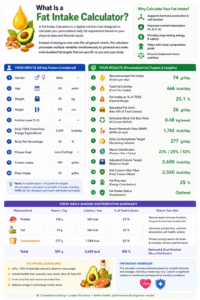
A Fat Intake Calculator is a digital nutrition tool designed to calculate your personalized daily fat requirement based on your physical data and lifestyle inputs. Instead of relying on one-size-fits-all generic charts, this calculator processes multiple variables simultaneously to generate accurate, individualized fat targets that are specific to you and your body.
Our Fat Intake Calculator is built on a robust multi-variable framework that considers all of the following inputs:
- Gender — Male and female bodies have fundamentally different metabolic rates, hormonal profiles, and fat storage patterns. The calculator adjusts for these biological differences automatically.
- Age — Metabolic rate and fat utilization change significantly as we age. Older individuals generally burn fewer calories at rest, which directly influences fat targets.
- Weight (kg) — Heavier individuals generally require more total calories and therefore more fat to meet their energy and hormone needs.
- Height (cm) — Height is used alongside weight to estimate body composition and calculate Basal Metabolic Rate using the Mifflin-St Jeor equation.
- Activity Level (1–5) — Higher physical activity levels increase both caloric and fat demands. A sedentary office worker and a professional cyclist have vastly different fat needs.
- Daily TDEE (Total Daily Energy Expenditure) — Your total daily calorie burn serves as the baseline from which all macro allocations — including fat — are calculated.
- Body Fat Percentage (%) — Your current body fat percentage helps determine lean mass and estimated body fat burn rate. It also contextualizes how aggressively you should pursue a caloric deficit.
- Fitness Goal (Loss or Gain) — Whether you are cutting body fat or building muscle dramatically changes both total calorie targets and the optimal fat percentage allocation.
- Protein Intake (g) — Since protein calories are fixed first, the calculator subtracts them from your adjusted TDEE to correctly determine the remaining budget available for fat and carbohydrates.
- Fiber Intake (g) — Dietary fiber affects net caloric absorption. The calculator accounts for a fiber calorie offset to ensure your macro targets reflect actual metabolizable energy rather than gross calories.
By combining all these variables in a single calculation, the Fat Intake Calculator delivers a comprehensive breakdown including your target fat in grams, total fat kilocalories, saturated fat limit, body fat burn rate, basal metabolic rate, daily carb target, and a complete macro distribution table.
How Does the Fat Intake Calculator Work?
The Fat Intake Calculator uses well-established, peer-reviewed scientific formulas to generate your results. Here is a detailed breakdown of the underlying calculation logic so you understand exactly what the numbers mean and where they come from:
Step 1: Basal Metabolic Rate (BMR)
The calculator first determines your Basal Metabolic Rate using the industry-standard Mifflin-St Jeor equation — one of the most clinically validated BMR formulas currently available:
For Women: BMR = (10 × weight in kg) + (6.25 × height in cm) − (5 × age in years) − 161
This gives you the calories your body burns at absolute rest — the minimum energy required to sustain vital organ function, breathing, circulation, and cellular repair.
Step 2: Adjusted TDEE Based on Goal
Depending on your fitness goal, the calculator intelligently adjusts your TDEE to create the right caloric environment for your objective:
- Weight Loss Goal: TDEE − 500 kcal — creates a sustainable, evidence-based caloric deficit that promotes roughly 0.5 kg of fat loss per week without compromising muscle mass.
- Weight Gain Goal: TDEE + 300 kcal — creates a moderate, clean caloric surplus that supports muscle protein synthesis without excessive fat accumulation.
Step 3: Fat Grams and Kilocalorie Calculation
The Fat Intake Calculator allocates a scientifically appropriate percentage of your adjusted TDEE to fat, then converts that to grams since fat provides 9 kilocalories per gram:
- Fat Loss Phase: 25% of adjusted TDEE ÷ 9 kcal/g = daily fat grams
- Muscle Gain Phase: 30% of adjusted TDEE ÷ 9 kcal/g = daily fat grams
Step 4: Complete Macro Distribution
After calculating fat, the remaining calories are distributed between your protein (based on your input) and carbohydrates. This ensures a complete, balanced macro breakdown that fully supports your specific fitness goal without leaving any caloric gap unaccounted for.
Types of Dietary Fat Explained
Not all fats are created equal. Before you use the Fat Intake Calculator, it is critically important to understand the different types of dietary fat and how each one uniquely affects your health, hormones, and cardiovascular system.
| Type of Fat | Primary Sources | Health Impact | Should You Eat It? |
|---|---|---|---|
| Monounsaturated Fat | Olive oil, avocado, almonds, cashews | Lowers LDL (bad) cholesterol, raises HDL (good) cholesterol, supports heart health and insulin sensitivity | ✅ Actively include |
| Polyunsaturated Fat (Omega-3) | Fatty fish, walnuts, flaxseeds, chia seeds | Reduces inflammation, supports brain health, lowers triglycerides, improves cardiovascular markers | ✅ Actively include |
| Polyunsaturated Fat (Omega-6) | Sunflower oil, corn oil, soybean oil | Essential in moderation; excess relative to Omega-3 promotes inflammation | ⚠️ Moderate amounts |
| Saturated Fat | Red meat, butter, full-fat dairy, coconut oil | Raises LDL when consumed in excess; neutral to beneficial in moderate amounts from whole foods | ⚠️ Limit to 10% of fat kcal |
| Trans Fat (artificial) | Margarine, fast food, packaged snacks, fried foods | Strongly raises LDL, lowers HDL, directly increases heart disease and stroke risk | ❌ Avoid completely |
Our Fat Intake Calculator automatically calculates your saturated fat limit at 10% of total fat kilocalories, directly in line with the guidelines published by both the World Health Organization (WHO) and the American Heart Association (AHA). This keeps your heart health protected while still allowing you to enjoy moderate amounts of naturally occurring saturated fats from whole food sources.
How Much Fat Do You Actually Need Per Day?
According to major health organizations including the WHO, the U.S. Dietary Guidelines, and the Academy of Nutrition and Dietetics, dietary fat should make up between 20% to 35% of your total daily calories. However, this range is just a starting point — the specific number shifts dramatically based on your goal, body type, and metabolic rate. This is precisely why a Fat Intake Calculator is so much more valuable than any static reference chart.
Here is a general reference table for daily fat intake based on different calorie levels, showing both the weight-loss allocation (25%) and the muscle-gain allocation (30%):
| Daily TDEE (kcal) | Fat at 25% — Weight Loss | Fat at 30% — Weight Gain |
|---|---|---|
| 1,500 kcal | ~42g / 375 kcal | ~50g / 450 kcal |
| 1,800 kcal | ~50g / 450 kcal | ~60g / 540 kcal |
| 2,000 kcal | ~56g / 500 kcal | ~67g / 600 kcal |
| 2,500 kcal | ~69g / 625 kcal | ~83g / 750 kcal |
| 3,000 kcal | ~83g / 750 kcal | ~100g / 900 kcal |
| 3,500 kcal | ~97g / 875 kcal | ~117g / 1,050 kcal |
These numbers change significantly when you factor in your specific protein and fiber intake, activity burn factor, and body fat percentage. That is why using the Fat Intake Calculator above is far more accurate than any static reference table alone.
Fat Intake Based on Your Fitness Goals
Fat Intake for Weight Loss
When your primary goal is fat loss, the Fat Intake Calculator creates a 500 kcal deficit from your TDEE and allocates 25% of the remaining adjusted calories to dietary fat. This approach ensures you preserve lean muscle mass while systematically burning stored body fat as your primary fuel source. Severely restricting fat during a cut is one of the most common and most damaging nutritional mistakes people make — it can critically impair hormone function (especially estrogen and testosterone), lower sustained energy levels, and paradoxically slow your overall metabolism.
Fat Intake for Muscle Gain
During a deliberate bulking or muscle-building phase, the Fat Intake Calculator adds a conservative 300 kcal surplus above your TDEE and allocates a higher 30% to dietary fat. Healthy fats are absolutely crucial for muscle growth because they directly support testosterone and growth hormone production, maintain joint health and connective tissue integrity, reduce post-workout inflammation, and provide long-lasting, stable energy for intense training sessions. Without adequate fat intake, even the most rigorous and well-programmed training plan will yield significantly suboptimal muscle-building results over time.
Fat Intake for Maintenance
If you are currently satisfied with your body composition and simply want to maintain your existing weight and health, the ideal fat intake for maintenance sits comfortably between 25–30% of your TDEE. Use the Fat Intake Calculator with your actual TDEE and select the goal that most closely matches your current phase to get the most accurate and actionable fat target for your maintenance nutrition plan.
Understanding the Macro Distribution Table
One of the most powerful and distinctive features of the Fat Intake Calculator is the detailed Macro Distribution Table it generates alongside your fat target. This table provides a complete, unified view of how your total daily calories are intelligently divided across all three macronutrients — fat, protein, and carbohydrates — expressed in both grams and kilocalories for maximum clarity and usability.
Here is how to correctly read and productively use every result the calculator produces:
- Target Fat Intake (g): The precise grams of fat you should aim to consume daily, calculated from your goal-adjusted TDEE and the appropriate fat percentage allocation.
- Total Fat Kcal: Total calories contributed exclusively by fat in your diet. Since fat yields 9 kcal per gram — more than double protein and carbohydrates — even modest fat amounts contribute significantly to your total calorie budget.
- Saturated Fat Limit (g): The maximum saturated fat your diet should contain per day, set at 10% of total fat kilocalories. Staying within this limit actively protects your cardiovascular health and keeps LDL cholesterol in a healthy range.
- Activity Burn Factor: A calculated multiplier derived from your activity level input (1–5) that reflects how physical movement scales your total daily energy expenditure beyond your resting BMR.
- Fat per kg Bodyweight (g/kg): An alternative way to express your fat target relative to your body weight. Particularly useful for athletes and bodybuilders who track performance nutrition in body-weight-relative terms.
- Protein Kcal Load: Total calories allocated to protein based on your input. Protein calories are calculated first and deducted from your total budget to determine the correct remaining space for fat and carbohydrates.
- Fiber Calorie Impact: The estimated calorie reduction from your fiber intake, since dietary fiber is partially indigestible and reduces the net metabolizable energy your body actually absorbs from food.
- Body Fat Burn Rate (kg/day): An estimated daily rate at which your body burns stored adipose tissue as fuel, calculated from your current body fat percentage. Higher body fat means more available stored fuel for energy.
- Daily Carb Target (g): Carbohydrates receive all remaining calories after fat and protein have been fully allocated. This ensures your entire calorie budget is accounted for with zero gaps.
- Energy Adjusted TDEE (kcal): Your baseline TDEE after applying the goal-based caloric adjustment — minus 500 for fat loss, or plus 300 for muscle gain. This is the actual daily calorie target your macros are built around.
- Surplus / Deficit Margin (kcal): Clearly shows exactly how many calories above or below your original TDEE baseline you are operating at each day, helping you verify that your deficit or surplus is on target.
By reading all these values together as a unified nutritional profile, you gain a complete and actionable picture of your daily needs — something no generic chart or government guideline can ever provide.
The Role of BMR and TDEE in Fat Calculations
To fully understand and trust the output of the Fat Intake Calculator, it helps to have a solid grasp of the two most foundational concepts in nutrition science: Basal Metabolic Rate (BMR) and Total Daily Energy Expenditure (TDEE).
Basal Metabolic Rate (BMR) represents the minimum number of calories your body needs to sustain all vital biological functions while completely at rest — including breathing, circulation, cellular repair, hormone regulation, and brain activity. Your BMR accounts for the vast majority of your total calorie burn (typically 60–70%) and is heavily influenced by your body weight, height, age, and biological sex.
Total Daily Energy Expenditure (TDEE) is your BMR multiplied by an activity factor that accounts for all the additional calories burned through physical movement, exercise, and the thermic effect of food processing. Your TDEE is the number the Fat Intake Calculator uses as the starting point for all macro calculations. It represents the total number of calories you burn on a typical day, and therefore the number you either eat at (maintenance), eat below (fat loss), or eat above (muscle gain).
Understanding the relationship between your BMR and TDEE helps you see why the Fat Intake Calculator produces such personalized results — two people of the same weight and height can have dramatically different TDEEs based purely on their activity levels, making a personalized calculator infinitely more accurate than any static reference table.
Benefits of Tracking Your Fat Intake Daily
Consistently using a Fat Intake Calculator and tracking your daily fat consumption offers several meaningful, well-documented advantages for both short-term performance and long-term health outcomes:
- Prevents Overconsumption: Fat is the most calorie-dense macronutrient at 9 kcal/g, compared to just 4 kcal/g for both protein and carbohydrates. Even small unmeasured portions of high-fat foods like nuts, olive oil, or cheese can add hundreds of unnoticed calories to your day. Tracking prevents this invisible creep.
- Prevents Dangerous Underconsumption: Too little fat causes hormonal imbalances, impaired fat-soluble vitamin absorption, dry and flaking skin, reduced cognitive function, chronic fatigue, and a measurably slowed metabolism. The Fat Intake Calculator ensures your daily fat never drops dangerously low.
- Improves Overall Macro Balance: When you know your precise fat target, you can balance it far more effectively alongside your protein and carbohydrate allocations, ensuring no single macronutrient dominates or crowds out the others.
- Directly Supports Your Fitness Goals: Whether your goal is fat loss, muscle gain, or maintenance, consistently hitting your calculated fat target from the Fat Intake Calculator keeps your body in the exact metabolic environment needed to make consistent, measurable progress.
- Promotes Heart-Healthy Food Choices: Active fat tracking naturally increases your awareness of different fat types, encouraging you to replace harmful trans fats and excess saturated fats with heart-protective monounsaturated and polyunsaturated options.
- Enables Accurate Progress Monitoring: As your weight changes, your activity level evolves, or your goals shift from cutting to bulking, you can instantly re-run the Fat Intake Calculator to update your targets and stay precisely aligned with your new metabolic reality.
Common Mistakes People Make With Fat Intake
Even with a reliable Fat Intake Calculator at your disposal, certain patterns repeatedly derail people’s results. Understanding these pitfalls helps you avoid them entirely:
- Avoiding all fat completely: Triggered by outdated low-fat diet advice, many people dramatically restrict fat and suffer hormonal disruption, vitamin deficiencies, and chronic hunger as a direct result. The Fat Intake Calculator is specifically designed to keep your fat intake in a healthy, functional range.
- Ignoring fat type distinctions: Hitting your fat gram target with processed fast food and margarine is not the same as hitting it with olive oil and salmon. Always prioritize fat quality alongside fat quantity.
- Forgetting hidden fats in cooking: Cooking oils, dressings, and sauces contribute significant fat that goes untracked. These hidden fats can add 20–40g of fat to a day without a single conscious food choice.
- Never updating your calculator inputs: As your weight, activity, or goal changes, your fat target changes too. Re-running the Fat Intake Calculator every 4–6 weeks ensures your targets stay current with your evolving body.
- Tracking only at the start: The first week of tracking is the easiest — most people quit after a few days. Consistent daily tracking is what produces lasting results, not a single calculation.
Practical Tips to Meet Your Daily Fat Target
Once the Fat Intake Calculator gives you your daily fat target, here are the most effective, practical strategies to consistently hit that number through smart food choices and planning:
Anchor Every Meal With a Quality Fat Source
The most reliable way to consistently hit your daily fat target is to deliberately plan one quality fat source into every main meal. This removes the risk of falling short by the end of the day and scrambling to add high-calorie fat sources at dinner or before bed.
Use Olive Oil as Your Primary Cooking Fat
Extra-virgin olive oil is one of the most nutritionally powerful and versatile fat sources available. At roughly 14g of fat per tablespoon — predominantly heart-healthy monounsaturated fat — it makes reaching your daily fat target effortless while actively supporting cardiovascular health.
Make Avocados a Daily Habit
Half a medium avocado provides approximately 15g of fat, almost entirely monounsaturated. Adding avocado to salads, toast, or eggs is one of the tastiest and most nutrient-dense ways to close the gap on your calculated fat target from the Fat Intake Calculator.
Read Nutrition Labels Diligently
Always check the total fat, saturated fat, and trans fat content on food packaging before purchasing. Many processed, packaged, and fast foods contain hidden artificial trans fats and surprising amounts of saturated fat that can push you over the saturated fat limit calculated by the Fat Intake Calculator without you realizing it.
Meal Prep for Weekly Consistency
Meal prepping 3–5 days in advance is one of the single most effective strategies for consistently hitting your macro targets, including fat. Planned meals based on the macro distribution table from the Fat Intake Calculator eliminate the daily decision fatigue that leads to impulsive, off-target food choices.
Track Using a Nutrition App
Use a nutrition tracking app such as MyFitnessPal, Cronometer, or MacroFactor to log your daily food intake in real time. Pairing consistent food logging with the output from your Fat Intake Calculator is the most reliable combination available for staying accurately within your fat, protein, and carbohydrate targets every single day.
Best Food Sources of Healthy Fats
Your Fat Intake Calculator tells you how much fat to eat — but choosing the right sources determines the actual health impact of that fat on your body. Here are the best whole food sources of each major fat type:
| Food | Fat (per serving) | Dominant Fat Type | Key Benefit |
|---|---|---|---|
| Olive Oil (1 tbsp) | 14g | Monounsaturated | Heart protection, anti-inflammatory |
| Avocado (½ medium) | 15g | Monounsaturated | Potassium, fiber, vitamin E |
| Salmon (100g) | 13g | Omega-3 Polyunsaturated | Brain health, inflammation reduction |
| Almonds (30g) | 14g | Monounsaturated | Vitamin E, magnesium, satiety |
| Walnuts (30g) | 18g | Omega-3 Polyunsaturated | ALA Omega-3, cognitive support |
| Chia Seeds (2 tbsp) | 9g | Omega-3 Polyunsaturated | Fiber, calcium, sustained energy |
| Whole Eggs (2 large) | 10g | Saturated + Monounsaturated | Complete protein, choline, lutein |
| Coconut Oil (1 tbsp) | 14g | Saturated (MCT) | Quick energy, antimicrobial MCTs |
Frequently Asked Questions (FAQs)
What does a Fat Intake Calculator measure?
A Fat Intake Calculator measures your ideal daily dietary fat requirement in both grams and kilocalories. It uses your weight, height, age, gender, TDEE, activity level, body fat percentage, protein intake, fiber intake, and fitness goal to produce a fully personalized, science-backed fat target.
How many grams of fat should I eat per day?
The answer varies significantly by individual. On a 2,000 kcal/day diet, most people need between 44g and 78g of fat per day (20–35% of calories). For your specific number, enter your details into the Fat Intake Calculator above to get an accurate, goal-specific result.
Can eating too little fat be harmful?
Yes. Insufficient fat intake causes hormonal imbalances, impaired absorption of vitamins A, D, E, and K, dry skin, cognitive impairment, chronic fatigue, and a measurably slowed metabolism. The Fat Intake Calculator is designed to ensure your fat intake stays safely above clinically dangerous minimums.
Is dietary fat bad for weight loss?
No. Healthy fats actually support weight loss by maintaining satiety, regulating hunger hormones like ghrelin and leptin, and providing long-lasting, stable energy. The key is eating the right types and the right amounts — which is exactly what the Fat Intake Calculator helps you determine with precision.
What is the saturated fat limit in the calculator?
The Fat Intake Calculator sets your daily saturated fat limit at 10% of your total fat kilocalories, directly in line with the official recommendations from the World Health Organization (WHO) and the American Heart Association (AHA). Staying within this limit significantly reduces your risk of cardiovascular disease and high LDL cholesterol.
How does body fat percentage affect the calculation?
Your body fat percentage directly influences the body fat burn rate displayed in the calculator results. Higher body fat percentages indicate more stored adipose energy available for fuel during a caloric deficit, which informs how aggressively you can safely pursue fat loss.
How often should I recalculate using this tool?
It is recommended to re-run the Fat Intake Calculator every 4–6 weeks, or whenever your body weight changes by more than 3–4 kg, your activity level shifts significantly, or your fitness goal transitions from cutting to bulking or vice versa.
What is the difference between BMR and TDEE?
BMR (Basal Metabolic Rate) is the energy your body burns at complete rest to maintain all vital biological functions. TDEE (Total Daily Energy Expenditure) includes BMR plus all additional calories burned through physical activity and food processing. The Fat Intake Calculator uses your TDEE as the baseline and adjusts it based on your goal.
Can this tool be used for a keto diet?
While the Fat Intake Calculator is optimized for standard balanced diets (25–30% fat), it can still help keto practitioners understand their TDEE and BMR. For a strict ketogenic macro split (65–75% fat), you would manually increase the fat percentage beyond the default calculator allocations.
Why does fiber intake affect the fat calculation?
Dietary fiber is partially indigestible and reduces net caloric absorption from food. The Fat Intake Calculator incorporates a fiber calorie offset to ensure your macro targets reflect the actual metabolizable energy your body absorbs, rather than just the gross caloric value of raw food intake.
Conclusion
Understanding and actively managing your dietary fat intake is one of the most impactful nutritional decisions you can make for your long-term health, athletic performance, and body composition. For too long, fat has been the misunderstood villain of the nutrition world — when in reality, the right kinds of fat in the right amounts are essential to nearly every biological process in your body.
The Fat Intake Calculator removes all the complexity, confusion, and guesswork from this critical piece of your nutrition puzzle. By translating your personal body metrics — weight, height, age, gender, activity level, body fat percentage, and fitness goal — into a precise, actionable daily fat target, the Fat Intake Calculator gives you exactly the information you need to eat with confidence and purpose.
From your target fat grams to your saturated fat limit, basal metabolic rate, body fat burn rate, and complete macro distribution table — every number is calculated specifically for your body, your metabolism, and your goal. No more generic advice. No more one-size-fits-all charts. No more frustration with a nutrition plan that was never built for your specific biology.
Whether you are in a disciplined fat-loss deficit, a strategic muscle-building surplus, or simply seeking to maintain your current physique with better nutritional precision, the Fat Intake Calculator gives you the personalized roadmap you need to reach your destination efficiently and sustainably. Use it consistently, update your inputs as your body evolves, choose high-quality whole food fat sources, and watch your results accelerate.