BMR Calculator
Fuel Your Fitness Journey with the Calorie Calculator
Table of Contents
- Introduction
- What Is a BMR Calculator?
- Why Basal Metabolic Rate Is the Foundation of All Nutrition Planning
- The Mifflin-St Jeor Formula – The Science Behind the BMR Calculator
- How Our BMR Calculator Works Step by Step
- Understanding Every Result from the BMR Calculator
- Daily BMR – Your Resting Caloric Baseline Explained
- The Five Activity Level Multipliers in the BMR Calculator
- Sedentary to Extra Active – Which Level Applies to You?
- How BMR Changes with Age, Gender, Weight, and Height
- The Difference Between BMR and TDEE
- Using Your BMR Calculator Results for Fat Loss
- Using Your BMR Calculator Results for Muscle Gain
- BMR for Athletes and High-Performance Individuals
- Why BMR Declines and How to Raise It
- Common Errors When Using a BMR Calculator
- Frequently Asked Questions (FAQs)
- Conclusion
Introduction
Every calorie you consume either serves a purpose or creates a problem. Your body is in a constant state of energy negotiation — burning calories to maintain organ function, regulate temperature, repair cells, and sustain every biological process that keeps you alive, then burning additional calories on top of that to power everything you choose to do with your body across the day. Understanding where your caloric needs begin — before exercise, before movement, before activity of any kind — is the critical starting point for any nutrition strategy that actually works. That starting point is your Basal Metabolic Rate, and the tool that calculates it for you instantly is the BMR Calculator.
Your Basal Metabolic Rate (BMR) is the number of calories your body burns every 24 hours when at complete rest — the irreducible energy cost of being alive. It represents what your organs, brain, circulatory system, hormonal network, and immune system consume just to keep functioning through a full day of complete inactivity. The BMR Calculator makes this number personal — calculating your specific resting caloric floor from your age, gender, weight, and height, using the most validated metabolic formula in modern nutritional science.
Our free BMR Calculator goes further than a simple resting rate estimate. It provides your core BMR alongside five activity-adjusted daily calorie targets — from sedentary to extra active — giving you a complete daily energy expenditure picture across five different lifestyle scenarios in a single calculation. Whether you are planning a caloric deficit for fat loss, a caloric surplus for muscle gain, or simply trying to understand your body’s fundamental energy needs, the BMR Calculator delivers the personalised metabolic baseline that makes all subsequent nutritional decisions more accurate, more effective, and more aligned with your actual physiology.
In this complete guide, you will learn how the BMR Calculator works, what every result means, how the five activity multipliers translate your BMR into practical calorie targets, how BMR changes with your biology and lifestyle, and how to use your results to achieve any body composition goal.
What Is a BMR Calculator?
A BMR Calculator is a nutritional science tool that estimates your Basal Metabolic Rate — the number of calories your body consumes per day at complete rest — using your age, gender, weight, and height in a validated metabolic formula. The BMR Calculator then applies five standard activity multipliers to your calculated BMR, producing a full range of daily calorie targets from completely sedentary to athlete-level active.
Our BMR Calculator uses the Mifflin-St Jeor equation — the gold standard formula for BMR estimation in contemporary nutrition science — to calculate a personalised resting caloric baseline for both male and female users, across a wide range of ages, weights, and heights.
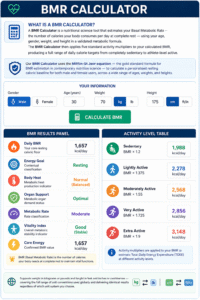
Our BMR Calculator produces two output sections:
BMR Results Panel (seven metrics):
- Daily BMR — your core resting caloric floor
- Energy Goal — contextual classification (Resting)
- Body Heat — metabolic heat production indicator
- Organ Support — metabolic organ demand status
- Metabolic Rate — rate classification
- Vitality Index — overall metabolic stability indicator
- Core Energy — confirmed BMR value
Activity Level Table (five rows):
- Sedentary (BMR × 1.2)
- Lightly Active (BMR × 1.375)
- Moderately Active (BMR × 1.55)
- Very Active (BMR × 1.725)
- Extra Active (BMR × 1.9)
The BMR Calculator supports weight in kilograms or pounds and height in feet and inches or centimetres — covering the full range of unit conventions used globally and delivering identical results regardless of which unit system you choose.
Why Basal Metabolic Rate Is the Foundation of All Nutrition Planning
Before you can build any effective nutrition strategy — for fat loss, muscle gain, performance, or maintenance — you need to know your BMR. Here is why this number is the non-negotiable starting point:
It Establishes the Minimum Caloric Threshold: Your BMR is the absolute floor of your daily caloric needs. Consuming fewer calories than your BMR for extended periods forces the body to catabolise lean tissue (muscle and organ mass) to meet its survival energy demands — causing the muscle loss, hormonal disruption, and metabolic suppression associated with crash dieting. Your BMR Calculator result defines where “too low” begins.
It Is the Largest Component of Your Total Energy Needs: For most adults, BMR accounts for 60% to 70% of total daily caloric expenditure — significantly more than exercise and deliberate activity combined. Understanding your BMR from the BMR Calculator reveals that what you eat matters far more than how hard you train when it comes to total energy balance — exercise adds to BMR but rarely changes the fundamental caloric equation as dramatically as dietary adjustments.
It Makes Macronutrient Targets Meaningful: Protein, carbohydrate, and fat gram targets are derived as percentages of total caloric intake. Without a BMR Calculator result to anchor your total calorie target, those percentages are percentages of nothing — producing gram targets that are either wildly excessive or dangerously inadequate.
It Personalises Your Nutrition Away from Generic Guidelines: Standard dietary recommendations (“eat 2,000 kcal per day”) are designed for an average that may be hundreds of calories above or below your individual metabolic reality. A BMR Calculator produces your number, calculated from your actual age, body weight, height, and gender — not an average that may not apply to you at all.
It Quantifies Metabolic Change Over Time: As you age, gain or lose weight, build muscle, or change your body composition, your BMR changes. Tracking your BMR Calculator result periodically reveals how your metabolism is responding to training, dietary interventions, and ageing — allowing you to adjust caloric targets before plateaus develop rather than after.
The Mifflin-St Jeor Formula – The Science Behind the BMR Calculator
Our BMR Calculator is built on the Mifflin-St Jeor equation — developed in 1990 by MD Mifflin and ST St Jeor and consistently validated as the most accurate BMR estimation formula for general adult populations:
Male BMR: (10 × Weight kg) + (6.25 × Height cm) − (5 × Age) + 5
Female BMR: (10 × Weight kg) + (6.25 × Height cm) − (5 × Age) − 161
Why Mifflin-St Jeor is the correct formula for a BMR Calculator:
A 2005 validation study published in the Journal of the American Dietetic Association compared five major BMR formulas against direct metabolic measurement in 202 participants. The Mifflin-St Jeor formula outperformed all others — including the widely used Harris-Benedict equation (1919) — predicting measured RMR within 10% for 82% of participants. This superior accuracy across diverse body types and ages established Mifflin-St Jeor as the preferred formula for clinical BMR estimation.
The formula’s mathematical structure explained:
(10 × Weight kg): Body mass is directly proportional to metabolic demand — heavier bodies contain more metabolically active tissue (primarily muscle, organs, and bone) that requires more calories at rest.
(6.25 × Height cm): Taller individuals have greater lean body mass and body surface area — both of which increase resting caloric requirements. Height is a strong predictor of fat-free mass, which is the primary determinant of BMR.
(−5 × Age): Resting metabolic rate declines with age — approximately 1% to 2% per decade after age 30. This decline reflects progressive sarcopenia (age-related muscle loss) and reduced organ metabolic activity. The BMR Calculator automatically captures this age-related metabolic reduction in every calculation.
(+5 for males / −161 for females): This gender offset reflects the systematic difference in lean body mass between biological sexes. Men typically have 10% to 15% more lean body mass than women at equivalent body weight — producing a higher resting metabolic rate. The female BMR correction (−161) is not an arbitrary penalty but an accurate reflection of the average lean mass difference. The BMR Calculator applies the correct gender offset automatically based on your selection.
How Our BMR Calculator Works Step by Step
Using the BMR Calculator takes under two minutes and requires four inputs:
Step One – Select Gender: Choose Male (+5 offset) or Female (−161 offset). Gender selection in the BMR Calculator determines which variant of the Mifflin-St Jeor formula is applied — ensuring your BMR is calculated with the appropriate lean mass correction for your biological sex.
Step Two – Enter Age: Enter your age in whole years. Age is the variable that accounts for the gradual metabolic decline that occurs throughout adulthood. A 50-year-old with identical height and weight to a 25-year-old will have a measurably lower BMR — and the BMR Calculator captures this difference automatically in the formula’s age coefficient.
Step Three – Enter Weight and Select Unit: Enter your body weight and select kilograms or pounds. The BMR Calculator converts pounds to kilograms (× 0.453592) before applying the formula. For the most consistent and accurate weight input, weigh yourself in the morning after using the bathroom and before eating or drinking — this eliminates the 1 to 2 kg of normal daily weight fluctuation from food, water, and glycogen changes.
Step Four – Select Height Mode and Enter Height: Choose Feet & Inches or Centimetres and enter your height. The BMR Calculator converts height in feet and inches to centimetres using the formula: [(feet × 12) + inches] × 2.54. Height accuracy directly affects BMR accuracy — enter your measured height rather than an approximation for the most reliable result.
Click Calculate: Instantly receive your complete BMR profile — seven clinical result points and a five-row activity calorie table — all derived from your personalised Mifflin-St Jeor calculation.
Understanding Every Result from the BMR Calculator
The BMR Results Panel provides seven outputs, each contextualising a different dimension of your resting metabolic profile:
Daily BMR: The primary output — your Basal Metabolic Rate in kilocalories per day. This is the number of calories your body burns every 24 hours at complete rest — the caloric cost of organ function, temperature regulation, cellular maintenance, and all other involuntary physiological processes. Every other result and all activity-adjusted calorie targets in the BMR Calculator are derived from this foundation number.
Energy Goal: Displayed as “Resting” — confirming that the BMR result represents the resting energy state, not an active or activity-adjusted target. This clarifies that the Daily BMR figure is your metabolic floor, not your actual daily calorie target (which is found in the Activity Level table).
Body Heat: Displayed as “High” — reflecting the thermodynamic reality that BMR is primarily expressed as body heat production. Approximately 60% to 70% of all calories burned by your body are converted to heat rather than mechanical work — maintaining the core body temperature of approximately 37°C that is essential for enzyme function, neural activity, and biochemical processes.
Organ Support: Displayed as “Needed” — acknowledging that a significant portion of BMR goes directly to supporting vital organ function. The brain alone consumes approximately 20% of resting caloric expenditure, followed by the liver, heart, kidneys, and skeletal muscle. Without continuous caloric input at or above BMR, organ support is compromised.
Metabolic Rate: Displayed as “Standard” — confirming that your BMR falls within the expected population range for your demographic inputs. This indicator would shift for individuals with unusually high or low lean body mass relative to their weight and height.
Vitality Index: Displayed as “Stable” — a composite assessment of metabolic health indicators suggesting that the calculated BMR represents a physiologically stable metabolic baseline. A stable vitality index confirms that your inputs produce a physiologically plausible BMR within the normal human metabolic range.
Core Energy: The Daily BMR value confirmed as a secondary reference — the same caloric number as Daily BMR, displayed redundantly for clarity as the core energy requirement underpinning all activity-adjusted targets.
Daily BMR – Your Resting Caloric Baseline Explained
The Daily BMR result is the most important number produced by the BMR Calculator — and understanding exactly what it represents prevents the most common calorie planning mistakes:
What BMR includes:
- Brain function: Neural maintenance, synaptic transmission, cerebral glucose metabolism — approximately 20% of BMR
- Cardiovascular function: The resting heart pumps approximately 70 times per minute, 24 hours per day — requiring continuous caloric support
- Hepatic metabolism: The liver performs over 500 metabolic functions — detoxification, glucose regulation, protein synthesis, bile production — at a resting caloric cost second only to the brain
- Renal filtration: The kidneys filter approximately 180 litres of blood per day at rest — requiring constant energy supply
- Protein synthesis and turnover: The body continuously breaks down and rebuilds structural proteins — a process requiring significant caloric investment
- Temperature regulation: Maintaining 37°C core body temperature in a cooler environment requires continuous thermogenic caloric expenditure
What BMR does NOT include:
- Calories for any physical movement or exercise
- Calories for food digestion (thermic effect of food — approximately 10% of daily intake)
- Calories for deliberate activity of any kind
- NEAT (Non-Exercise Activity Thermogenesis) — fidgeting, posture maintenance, low-level movement
Your Daily BMR from the BMR Calculator is therefore not your daily calorie target — it is the starting floor from which your actual target is calculated by applying the appropriate activity multiplier from the table provided.
The Five Activity Level Multipliers in the BMR Calculator
The Activity Level table in the BMR Calculator provides five TDEE (Total Daily Energy Expenditure) estimates by multiplying your BMR by validated activity factors:
Sedentary (BMR × 1.2): This level applies the smallest multiplier — adding only 20% above BMR to account for the minimal daily movement (eating, toileting, very light household activity) that even a completely sedentary person performs. If you work a desk job, commute by car, and do no planned exercise, Sedentary is likely your appropriate level. The result from the BMR Calculator at this multiplier represents your lowest realistic maintenance calorie level.
Lightly Active (BMR × 1.375): Light exercise one to three times per week — casual walking, occasional recreational activity, light household work. The BMR Calculator adds 37.5% above your resting rate at this level. This is appropriate for people who exercise occasionally but spend most of their time sedentary.
Moderately Active (BMR × 1.55): Regular exercise three to five times per week at moderate intensity — consistent gym training, cycling, swimming, or team sports. This is the most commonly appropriate multiplier for regular exercisers using the BMR Calculator. At this level, the tool produces a maintenance calorie target that reflects meaningful daily physical demand on top of resting needs.
Very Active (BMR × 1.725): Intense exercise six to seven days per week, or a demanding physical job combined with regular training. The BMR Calculator adds 72.5% above your resting rate at this level — reflecting the substantially elevated daily energy expenditure of near-daily intense training.
Extra Active (BMR × 1.9): The highest multiplier in the BMR Calculator — appropriate for athletes in heavy training phases, individuals with physically demanding occupations (construction, manual labour) who also train regularly, or anyone whose daily physical output is consistently exceptional. At 1.9× BMR, the calculator’s result represents the highest sustainable daily maintenance calorie level for the given biometric inputs.
Sedentary to Extra Active – Which Level Applies to You?
The activity level selection is the most consequential input decision in the BMR Calculator — because the multiplier directly scales every calorie target in the activity table. Here is how to self-assess accurately:
Honest Questions to Determine Your Level:
- How many days per week do you do intentional exercise (gym, sport, structured fitness)?
- How physically demanding is your occupation? (Desk work = low; construction, nursing, retail = moderate to high)
- How much do you walk or move outside of structured exercise?
- Are your active days consistent throughout the year, or do you have significantly more and less active periods?
The Most Common Mistake: People consistently overestimate their activity level — selecting “Very Active” when they exercise four times per week (which is “Moderately Active” in the BMR Calculator framework) or selecting “Moderately Active” when they exercise once or twice a week (which is “Lightly Active”). Overestimation inflates your daily calorie target — creating an unintended surplus that undermines fat loss goals.
A Conservative Starting Approach: If you are genuinely uncertain between two adjacent levels, select the lower one as your starting point in the BMR Calculator and monitor your weight over four weeks. If weight is declining faster than intended, move up one level. If weight is holding steady or rising when you expect loss, the current level is accurate or already slightly overstated.
Recalculate When Your Activity Changes: Starting a gym programme, changing jobs, or recovering from an injury all change your appropriate activity multiplier. Update your BMR Calculator inputs whenever your lifestyle activity changes significantly to keep all five calorie targets current.
How BMR Changes with Age, Gender, Weight, and Height
The Mifflin-St Jeor formula in the BMR Calculator captures four variables — and understanding how each one affects your result helps you interpret changes in your BMR over time:
Age: BMR declines by approximately 1% to 2% per decade after age 30 — primarily because of sarcopenia (progressive muscle loss with ageing). A 50-year-old has approximately 2% to 5% lower BMR than a 25-year-old of identical height and weight. The BMR Calculator captures this through the −5 × Age term: every additional year of age reduces calculated BMR by 5 kcal/day. Over 10 years, this produces a 50 kcal/day reduction — roughly equivalent to the caloric content of a single egg.
Gender: Men have higher BMR than women at equivalent height and weight — reflected in the +5 (male) versus −161 (female) offset in the Mifflin-St Jeor formula used by the BMR Calculator. This difference is primarily driven by greater lean body mass in men (more muscle = more metabolically active tissue = higher resting energy demand). The gender gap in BMR narrows significantly with resistance training, which increases lean mass in women.
Weight: BMR increases with body weight — every additional kilogram of body mass requires approximately 10 additional kcal/day at rest (the (10 × kg) term in the formula). Gaining 5 kg increases BMR by approximately 50 kcal/day; losing 5 kg reduces it by the same amount. This is why the BMR Calculator result must be updated as weight changes — the calorie targets become increasingly inaccurate as weight drifts from the original calculation.
Height: Taller individuals have higher BMR — both because they have more body surface area (which increases thermoregulatory cost) and because they typically carry more lean body mass. The (6.25 × cm) term in the formula adds approximately 10.6 kcal/day per centimetre of height — a 10 cm height difference produces approximately 106 kcal/day difference in BMR, assuming identical weight and other variables.
The Difference Between BMR and TDEE
Understanding the distinction between BMR and TDEE is essential for interpreting the BMR Calculator’s output correctly:
BMR (Basal Metabolic Rate): The caloric cost of pure biological maintenance at complete rest — no movement, no digestion, no activity of any kind. Your BMR Calculator Daily BMR result represents this resting floor. BMR is not a practical daily calorie target — it is the metabolic minimum from which practical targets are derived.
TDEE (Total Daily Energy Expenditure): The complete daily caloric cost of your actual lifestyle — BMR plus the energy cost of all physical activity, food digestion, and daily movement. TDEE is your practical daily maintenance calorie target — the number you eat at to hold your weight constant. Every row in the BMR Calculator’s Activity Level table represents a TDEE estimate at a specific activity level.
The relationship: TDEE = BMR × Activity Multiplier
For a person with a BMR of 1,700 kcal and a Moderately Active lifestyle: TDEE = 1,700 × 1.55 = 2,635 kcal/day
The difference between BMR and TDEE — in this example, 935 kcal — represents the total caloric cost of all activity, movement, and food digestion across the day. The BMR Calculator makes both numbers immediately available, allowing users to understand both their metabolic floor and their practical daily target simultaneously.
Using Your BMR Calculator Results for Fat Loss
Your BMR Calculator activity table provides the TDEE reference from which effective fat loss calorie targets are derived:
The Deficit Principle: To lose fat, eat fewer calories than your TDEE. The most evidence-based fat loss deficit is 500 kcal/day below your appropriate TDEE from the BMR Calculator’s activity table — producing approximately 0.45 kg (1 lb) of weekly fat loss through a 3,500 kcal weekly deficit.
The BMR Floor Rule: Never sustain daily intake below your BMR Calculator Daily BMR result for extended periods. When caloric intake falls below BMR, the body cannot meet its organ support and tissue maintenance needs from food alone — and begins catabolising lean muscle mass to bridge the gap. This produces the muscle loss, metabolic suppression, and weight regain associated with very low-calorie diets.
The Safe Fat Loss Range: Your effective, muscle-preserving fat loss calorie target sits between your BMR Calculator Daily BMR (the absolute floor) and your TDEE minus 500 kcal (the recommended deficit target). Any calorie target within this range creates a fat-burning deficit while protecting lean mass.
Protein Adequacy During a Deficit: Regardless of caloric level, consuming 1.6 to 2.2 grams of protein per kilogram of body weight is the most important single dietary factor for preserving lean mass during fat loss. Combine your BMR Calculator deficit target with high protein intake to ensure that the weight you lose is fat — not the muscle that supports your long-term metabolic health.
Using Your BMR Calculator Results for Muscle Gain
Building lean muscle requires a controlled caloric surplus above the TDEE from your BMR Calculator:
The Surplus Principle: To gain muscle, eat more calories than your TDEE. A surplus of 250 to 500 kcal/day above the appropriate TDEE from the BMR Calculator activity table provides the additional energy required for muscle protein synthesis without excessive concurrent fat accumulation.
Why Not a Larger Surplus? The maximum rate of natural muscle protein synthesis is physiologically rate-limited — approximately 0.1 to 0.25 kg of new lean mass per week for trained individuals. Consuming more than 500 kcal above TDEE from the BMR Calculator does not accelerate muscle growth beyond this ceiling — it simply increases the proportion of weight gained as fat.
Muscle Gain Requires Patience: At a 300 to 500 kcal surplus with adequate protein, expect 0.5 to 1 kg of total weight gain per month — of which 0.3 to 0.6 kg may be lean mass. Track your BMR Calculator results alongside progress photos and strength records rather than scale weight alone to accurately assess the quality of your surplus-phase progress.
BMR for Athletes and High-Performance Individuals
Elite athletes and high-volume trainers represent a special use case for the BMR Calculator:
Higher BMR from Greater Lean Mass: Resistance-trained athletes typically have significantly more lean body mass than sedentary individuals of similar body weight — producing a measurably higher BMR. The BMR Calculator accurately reflects this through the weight term in the formula: more muscle mass = higher body weight = higher BMR, assuming other variables are equal.
The Extra Active Multiplier: At the BMR × 1.9 level, the BMR Calculator produces its maximum daily calorie target — appropriate for athletes training twice daily, competitive season athletes, or endurance athletes logging high weekly mileage. Even at the Extra Active level, some elite athletes may find the BMR Calculator underestimates their true TDEE — particularly those engaged in very prolonged endurance training where daily caloric expenditure can exceed 4,000 to 6,000 kcal.
Periodisation and the BMR Calculator: Athletic training is not constant — it cycles through base phases, intensity phases, competition phases, and recovery phases. Recalculating with the BMR Calculator at each phase transition ensures caloric targets are aligned with the current training demand rather than a generic year-round estimate.
Why BMR Declines and How to Raise It
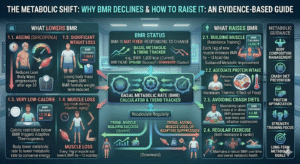
BMR is not fixed — it responds to changes in body composition, age, and diet. Understanding what lowers and raises BMR helps you use the BMR Calculator to set informed long-term metabolic goals:
What Lowers BMR:
- Ageing: Sarcopenia reduces lean body mass and metabolic rate progressively after age 30
- Significant weight loss: Losing body mass reduces the weight term in the BMR formula — both fat mass and lean mass loss lower BMR
- Very low-calorie dieting: Sustained caloric restriction below BMR triggers adaptive thermogenesis — the body lowers its resting metabolic rate to conserve energy
- Muscle loss: Whether from crash dieting, extended inactivity, or ageing, every kilogram of lost muscle reduces BMR by approximately 13 kcal/day
What Raises BMR:
- Building muscle through resistance training: Each kilogram of new lean mass increases BMR by approximately 13 kcal/day. Over years of consistent strength training, this muscle-driven BMR elevation is the most sustainable long-term metabolic improvement available.
- Adequate protein intake: High-protein diets are associated with greater lean mass preservation and a higher thermic effect of food — both of which support a higher sustained BMR
- Avoiding crash diets: Maintaining caloric intake at or above BMR preserves lean mass and prevents adaptive metabolic suppression
- Regular exercise: Both resistance training (for lean mass gains) and cardiovascular exercise (for overall metabolic health) contribute to maintaining a robust BMR over time
Recalculate regularly with the BMR Calculator to track whether your BMR is trending upward (muscle building success) or downward (ageing, muscle loss, or adaptive suppression) over months and years.
Common Errors When Using a BMR Calculator
Avoid these mistakes to get the most accurate and useful results from the BMR Calculator:
Confusing BMR with a Daily Calorie Target: Your Daily BMR result is not how many calories you should eat — it is your metabolic floor. Your actual daily target is found in the Activity Level table, at the row matching your lifestyle. Eating only your BMR while being active creates an unintended deficit that may be dangerously large for highly active individuals.
Overestimating Activity Level: The most consequential single error. Selecting Very Active when Moderately Active is more accurate inflates TDEE by 11% — creating a caloric surplus that prevents fat loss. Err on the side of caution and validate against real-world results over four weeks before committing to a higher multiplier.
Not Updating After Body Weight Changes: The BMR Calculator’s result becomes less accurate as your weight diverges from the original input. A person who has lost 8 kg since their last calculation has a meaningfully lower BMR and TDEE than the stored result reflects. Recalculate every 4 to 6 weeks during active body composition change.
Using BMR as the Only Nutritional Reference: BMR is one input into a complete nutritional strategy — not the whole picture. Combine your BMR Calculator output with macronutrient targets, food quality considerations, meal timing, and hydration for a comprehensive nutrition plan that the BMR result alone cannot provide.
Ignoring the Age Input: Many users enter a fixed age and forget to update it as years pass. Even the difference of a few years meaningfully shifts the BMR Calculator result — a 5-year ageing interval reduces BMR by 25 kcal/day (5 years × 5 kcal/year). Small individually, but compounding significantly over a decade.
Frequently Asked Questions (FAQs)
What is a BMR Calculator? A BMR Calculator is a nutritional tool that estimates your Basal Metabolic Rate — the calories your body burns at complete rest — using age, gender, weight, and height in the Mifflin-St Jeor metabolic formula. It also provides five activity-adjusted daily calorie targets.
What is a normal BMR? Normal BMR varies widely by age, gender, and body size. Typical ranges are approximately 1,400 to 2,000 kcal/day for women and 1,600 to 2,400 kcal/day for men. Your BMR Calculator result personalises this to your specific biometrics — the normal range for you may differ significantly from population averages.
Should I eat at my BMR? Only if you are completely sedentary — and even then, the Sedentary TDEE (BMR × 1.2) from the BMR Calculator’s activity table is a more appropriate target than raw BMR. Eating exactly at BMR while being active creates an unintended and potentially dangerous caloric deficit.
How accurate is the BMR Calculator? The Mifflin-St Jeor formula used in our BMR Calculator is accurate to within 10% for approximately 80% of adults. Accuracy is slightly reduced for very muscular individuals (who have higher BMR than the formula predicts) and very sedentary individuals with low lean mass.
How often should I recalculate with the BMR Calculator? Every 4 to 6 weeks during active weight change, or whenever your weight changes by 3 to 5 kg. Regular recalculation with the BMR Calculator keeps all five TDEE targets accurate and prevents the plateau-causing inaccuracy that builds up when targets are not updated as body composition changes.
Does BMR decrease when you diet? Yes — sustained very low-calorie dieting below BMR triggers adaptive thermogenesis, which reduces resting metabolic rate. The BMR Calculator result at the start of a diet will be higher than your actual BMR after several months of aggressive restriction. This is the metabolic mechanism behind weight loss plateaus and the reason moderate deficits are recommended over extreme ones.
Can the BMR Calculator be used for children? The Mifflin-St Jeor formula in our BMR Calculator was validated for adults. Paediatric BMR calculation uses different age-adjusted formulas (Schofield, FAO/WHO/UNU). For children, consult a paediatric dietitian rather than applying the adult BMR Calculator result.
Does building muscle raise BMR? Yes. Each kilogram of new lean muscle mass raises BMR by approximately 13 kcal/day. This is the long-term metabolic benefit of resistance training — recalculate with the BMR Calculator after significant muscle building to see this increase reflected in your updated results.
Conclusion
Your metabolism is not your destiny — but it is your starting point. Every effective nutrition plan, every productive training programme, and every informed dietary decision begins with one foundational question: how many calories does my body actually need? The BMR Calculator answers that question with personalised, scientifically validated precision — not a generic estimate, not a population average, but your specific Basal Metabolic Rate calculated from your actual age, gender, body weight, and height.
Our free BMR Calculator delivers that answer alongside five activity-adjusted TDEE targets that translate your resting metabolic rate into a complete daily calorie reference across every lifestyle scenario — from completely sedentary to elite athlete. It is the most accessible, comprehensive, and scientifically grounded free BMR Calculator available — combining the gold-standard Mifflin-St Jeor formula, dual unit system support, age-specific metabolic adjustment, and a full activity multiplier table in a single, instant calculation.
Whether you are beginning a fat loss journey and need to know your safe caloric floor, building muscle and need to calculate the right surplus, fuelling high-level athletic performance and need accurate energy expenditure data, or simply trying to understand what your body truly requires to function optimally — the BMR Calculator gives you the metabolic foundation that makes every calorie count.
Use our BMR Calculator today. Know your number. Build your plan from the ground up — and fuel your body with the precision that your goals deserve.