TDEE Calculator
Track Your Pregnancy Timeline with the Pregnancy Calculator
Table of Contents
- Introduction
- What Is a TDEE Calculator?
- Why TDEE Is the Most Important Number in Nutrition
- The Science Behind the TDEE Calculator – BMR and Activity Multipliers
- How Our TDEE Calculator Works Step by Step
- The Six Activity Levels in the TDEE Calculator
- Understanding All Eight TDEE Calculator Results
- Total Daily Energy – Your Caloric Maintenance Target
- Basal Metabolic Rate – Your Metabolic Floor
- Weight Loss Plan – TDEE Minus 500 kcal Explained
- Muscle Gain Plan – TDEE Plus 300 kcal Explained
- Protein, Carbs, and Fat Targets from the TDEE Calculator
- BMI Estimation in the TDEE Calculator
- Three Unit Systems in the TDEE Calculator
- How to Use Your TDEE Calculator Results Every Day
- Common TDEE Calculator Mistakes to Avoid
- Frequently Asked Questions (FAQs)
- Conclusion
Introduction
Every meaningful nutrition decision — how much to eat, what to eat, when to eat — depends on a single foundational number: how many calories your body actually needs each day. Without this number, calorie counting is guesswork, macronutrient targets are generic, and the gap between the diet you follow and the body you want remains frustratingly wide. A TDEE calculator closes that gap by calculating the exact number of calories your specific body requires every day, given your age, gender, height, weight, and physical activity level.
Total Daily Energy Expenditure (TDEE) is the complete caloric cost of being you for one full day — the sum of every calorie your body burns keeping you alive, moving, digesting food, and performing whatever physical activity your lifestyle demands. When you eat at your TDEE, your weight stays constant. When you eat below it, you lose weight. When you eat above it, you gain weight. This simple relationship, made precise by a TDEE calculator, is the foundation of every evidence-based body composition strategy in existence.
Our free TDEE calculator goes further than just your maintenance calorie total. It provides your BMR, a ready-to-use Weight Loss Plan calorie target, a Muscle Gain Plan calorie target, personalised daily protein, carbohydrate, and fat targets, and a BMI estimation — eight results that together constitute a complete, personalised nutritional blueprint in a single calculation. In this comprehensive guide, you will learn how the TDEE calculator works, what every result means, and how to use each output to achieve your specific body composition goal.
What Is a TDEE Calculator?
A TDEE calculator is a nutritional planning tool that estimates the total number of calories your body expends in a 24-hour period — your Total Daily Energy Expenditure — based on your individual physical characteristics and daily activity level. By combining your gender, age, height, weight, and physical activity multiplier in the Mifflin-St Jeor metabolic formula, the TDEE calculator produces a personalised caloric maintenance target that is specific to your body and lifestyle.
The TDEE calculator is the starting point for all body composition goals:
- Fat loss: Eat below your TDEE to create the caloric deficit that drives fat reduction
- Muscle gain: Eat above your TDEE to create the caloric surplus that supports new muscle growth
- Weight maintenance: Eat at your TDEE to maintain current body composition
- Performance fuelling: Use your TDEE to ensure you are consuming enough energy to sustain training output and recovery
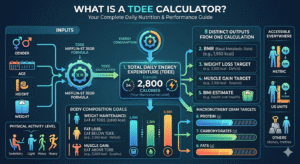
Our TDEE calculator produces eight distinct outputs from a single calculation — making it not just a calorie counter but a complete daily nutrition guide. In addition to your TDEE, it calculates your BMR, two goal-specific calorie targets (weight loss and muscle gain), three macronutrient gram targets (protein, carbohydrates, and fats), and a BMI estimate — providing an immediately actionable nutritional foundation.
The TDEE calculator supports three unit systems — Metric (kg and cm), US Units (lbs and inches), and Others (stones and metres) — making it accessible to users in every country and measurement convention.
Why TDEE Is the Most Important Number in Nutrition
Before you can make a single informed nutritional decision, you need to know your TDEE. Here is why this number is the non-negotiable foundation of any serious body composition strategy:
It Determines Whether You Gain, Lose, or Maintain Weight: The relationship between TDEE and caloric intake is the governing equation of body composition change. Every gram of fat lost, every pound of muscle gained, every week of weight maintenance is determined by where your daily caloric intake sits relative to your TDEE. A TDEE calculator makes this relationship precise — replacing “eat less, move more” with exact caloric targets.
It Eliminates Caloric Guesswork: Most people who “eat healthy” and “watch what they eat” without tracking against a TDEE are either eating too much (creating an unintended surplus that prevents fat loss) or too little (creating an excessive deficit that causes muscle loss). A TDEE calculator removes this uncertainty by establishing an accurate caloric baseline against which intake can be measured.
It Makes Macronutrient Targets Meaningful: Macronutrient percentages (e.g. “40% carbohydrates”) are meaningless without a total caloric reference. Your TDEE calculator result is the denominator that transforms percentages into gram targets — making protein, carbohydrate, and fat allocations specific, calculable, and achievable.
It Adjusts for Your Unique Physiology: Two people of the same age and gender can have dramatically different TDEEs due to differences in height, weight, muscle mass, and activity level. A TDEE calculator personalises the caloric baseline to your actual metabolic reality — not to an average that may be significantly above or below your individual needs.
It Quantifies the Impact of Activity Changes: Increasing activity level — adding gym sessions, walking more, changing jobs — directly raises TDEE and therefore your caloric maintenance target. Using the TDEE calculator to recalculate after lifestyle changes ensures your nutritional targets remain aligned with your actual energy expenditure.
The Science Behind the TDEE Calculator – BMR and Activity Multipliers
Our TDEE calculator is built on two layers of validated metabolic science:
Layer 1 – Basal Metabolic Rate (BMR) via Mifflin-St Jeor:
The Mifflin-St Jeor equation — developed in 1990 and validated as the most accurate BMR formula for general adult populations — calculates your resting metabolic rate:
Male BMR: (10 × Weight kg) + (6.25 × Height cm) − (5 × Age) + 5
Female BMR: (10 × Weight kg) + (6.25 × Height cm) − (5 × Age) − 161
BMR is your metabolic floor — the caloric cost of sustaining life at complete rest. It accounts for organ function, temperature regulation, cellular repair, and neurological maintenance. For most adults, BMR represents 60% to 70% of TDEE — making it the largest component of total daily energy expenditure.
Layer 2 – Activity Multipliers:
BMR is then multiplied by an activity factor to produce TDEE:
TDEE = BMR × Activity Multiplier
Activity multipliers scale resting caloric needs upward to reflect the additional energy cost of daily movement, structured exercise, non-exercise activity thermogenesis (NEAT), and the thermic effect of food digestion. The accuracy of your TDEE calculator result depends critically on selecting the correct activity multiplier — overestimating activity produces a TDEE target above actual expenditure, creating an unintended caloric surplus.
How Our TDEE Calculator Works Step by Step
Using our TDEE calculator is a six-step process that takes under two minutes:
Step One – Select Your Unit System: Choose Metric (cm and kg), US Units (inches and lbs), or Others (metres and stones). The TDEE calculator converts all inputs to metric internally before applying the Mifflin-St Jeor formula.
Step Two – Select Gender: Male or Female — determines which BMR formula variant (+5 for males; −161 for females) is applied. Gender selection in the TDEE calculator accounts for the systematic difference in lean body mass and metabolic rate between biological sexes.
Step Three – Enter Age: Age in whole years. Age directly modifies the BMR formula — as age increases, BMR declines slightly (approximately 1% per decade after 30), reflecting the gradual sarcopenia (muscle loss) and metabolic slowdown that occur with ageing. The TDEE calculator captures this age adjustment automatically.
Step Four – Enter Height and Weight: In your chosen unit system. Height and weight are the two most influential variables in the BMR formula — enter them as accurately as possible. For weight: use morning weight after bathroom and before eating for maximum consistency.
Step Five – Select Physical Activity Level: The most impactful choice in the TDEE calculator. Select the level that most accurately reflects your average daily activity across a typical week — not your best week or your most active day, but your genuine week-by-week average.
Step Six – Click Calculate: Instantly receive all eight results: TDEE, BMR, Weight Loss Plan, Muscle Gain Plan, Protein Target, Carbs Target, Fats Target, and BMI Estimation.
The Six Activity Levels in the TDEE Calculator
Our TDEE calculator offers six activity levels, providing more granular options than the standard four-level systems found in many tools:
Sedentary — No Exercise (1.2×): A desk job, minimal walking, no structured exercise. The TDEE calculator at this multiplier produces the lowest maintenance calorie total. Honest self-assessment is essential here — many people who believe they are “lightly active” are actually sedentary by metabolic standards.
Lightly Active — 1 to 3 Days Per Week (1.375×): Casual exercise 1 to 3 times per week — recreational walking, light gym sessions, weekend sport. The TDEE calculator adds approximately 37.5% above BMR to account for this modest additional energy expenditure.
Moderately Active — 3 to 5 Days Per Week (1.55×): Regular exercise 3 to 5 days per week at moderate intensity — consistent gym training, cycling, swimming, or team sports. This is the most commonly appropriate activity level for regular gym-goers using the TDEE calculator, and produces meaningfully elevated calorie and macronutrient targets.
Very Active — 6 to 7 Days Per Week (1.725×): Intense exercise nearly every day, or a physically demanding job combined with regular training. The TDEE calculator produces its second-highest maintenance calorie total at this multiplier, reflecting the substantial daily energy demand.
Extra Active — Hard Training (1.9×): Twice-daily training, professional sports schedules, or extremely physically demanding work. Select this level in the TDEE calculator only if your physical output genuinely matches professional-athlete demands — overestimating here significantly inflates your calorie target.
BMR — Recovery Mode (1.1×): A unique option in our TDEE calculator for periods of illness, injury recovery, or complete rest. The 1.1× multiplier accounts for minimal movement and the thermic effect of food while essentially zeroing out exercise contribution — providing a calorie target appropriate for bed-rest or convalescence.
Understanding All Eight TDEE Calculator Results
Our TDEE calculator produces eight results in a single calculation — each providing a specific, actionable piece of your complete nutritional profile:
Total Daily Energy (TDEE): Your complete daily caloric maintenance target. Eating at this number maintains your current body weight at your current activity level. This is the reference point from which all other results are derived and the anchor of your entire nutritional plan.
Basal Metabolic Rate (BMR): Your resting metabolic rate — calories burned at complete rest. Displayed alongside TDEE in your TDEE calculator results, BMR provides context for how much of your total expenditure comes from baseline physiology versus activity. A large gap between BMR and TDEE confirms high activity; a small gap confirms sedentary status.
Weight Loss Plan: TDEE − 500 kcal. A 500 kcal daily deficit from your TDEE calculator maintenance target produces approximately 0.5 kg of fat loss per week — the maximum rate at which fat loss can be sustained without significant lean mass loss. This is the most evidence-supported fat loss calorie target.
Muscle Gain Plan: TDEE + 300 kcal. A 300 kcal daily surplus above your TDEE calculator maintenance target provides sufficient energy for muscle protein synthesis without excessive fat accumulation. This “lean bulk” approach is the most efficient muscle gain strategy for natural athletes.
Protein Target: Body weight (kg) × 2 = daily protein in grams. The most critical macronutrient result from the TDEE calculator, set at the upper-middle of the evidence-based range (1.6 to 2.2g/kg) for maximising muscle protein synthesis and preserving lean mass during deficit.
Carbohydrates Target: (TDEE × 0.40) ÷ 4 = daily carbohydrate grams. Forty percent of your TDEE calculator calories allocated to carbohydrates, divided by 4 (carbohydrates provide 4 kcal/g). This allocation supports training performance while leaving room for protein and fat.
Fats Target: (TDEE × 0.30) ÷ 9 = daily fat grams. Thirty percent of your TDEE calculator calories allocated to dietary fat, divided by 9 (fats provide 9 kcal/g). This level supports hormonal health, fat-soluble vitamin absorption, and cellular function.
BMI Estimation: Weight (kg) ÷ Height (m)². A bonus output from the TDEE calculator providing your Body Mass Index — the globally recognised weight status indicator. A BMI of 18.5 to 24.9 indicates Normal weight; below 18.5 is Underweight; 25 to 29.9 is Overweight; 30+ is Obese.
Total Daily Energy – Your Caloric Maintenance Target
The TDEE figure from your TDEE calculator is the single most important number in your nutritional plan. Here is how to use it effectively:
As a Baseline Reference: Your TDEE is not a prescription but a reference point. Every dietary decision you make should be made in context of your TDEE calculator result — is today’s intake above, at, or below maintenance? The cumulative answer to that question over weeks and months determines your body composition outcome.
As a Dynamic, Not Static, Number: TDEE changes as body weight, muscle mass, and activity level change. A person who loses 10 kg has a lower TDEE than when they started, because BMR declines with weight loss. Failing to recalculate with the TDEE calculator as weight changes is one of the most common reasons fat loss plateaus — the deficit that was 500 kcal below TDEE at the start may have shrunk to 100 kcal after several months of weight loss.
As a Performance Floor: For athletes, TDEE is the minimum intake required to sustain training quality and recovery. Eating significantly below TDEE calculator maintenance impairs strength output, reduces endurance capacity, slows recovery, and suppresses hormonal function — consequences that no short-term aesthetic benefit justifies for a performance-focused individual.
Basal Metabolic Rate – Your Metabolic Floor
The BMR result in your TDEE calculator output represents the caloric bedrock of your physiology — the energy your body consumes simply by existing, before any movement or activity is accounted for.
Understanding your BMR has practical importance beyond the TDEE calculation:
Minimum Safe Intake: Eating below BMR long-term forces the body to catabolise lean tissue (muscle) for energy — causing the muscle loss, metabolic adaptation, and fatigue associated with very low-calorie crash diets. Your TDEE calculator BMR result defines the absolute floor below which sustained intake should never fall without medical supervision.
Metabolic Health Indicator: A higher BMR (relative to body weight) indicates greater lean muscle mass — muscle tissue has a significantly higher resting metabolic rate than fat tissue. As you build muscle through resistance training, your BMR rises, increasing your TDEE and giving you more caloric flexibility. Tracking BMR changes over time with the TDEE calculator confirms whether your training programme is successfully building metabolically active lean mass.
Recovery and Illness Context: During illness or injury (the BMR Recovery Mode in our TDEE calculator), the BMR figure shows your near-baseline caloric requirement — the minimum you need to support healing and basic function. This prevents under-eating during recovery, which would impair immune function and tissue repair.
Weight Loss Plan – TDEE Minus 500 kcal Explained
The Weight Loss Plan result from the TDEE calculator — your maintenance TDEE minus 500 kcal — is grounded in one of the most well-established relationships in nutritional science:
The 500 kcal Deficit Rule: One pound (approximately 0.45 kg) of body fat contains approximately 3,500 kcal of stored energy. A 500 kcal daily deficit therefore creates a weekly deficit of 3,500 kcal — theoretically producing approximately 0.5 kg of fat loss per week. This 500 kcal deficit rule is the gold standard for sustainable, muscle-preserving fat loss, and it is built directly into our TDEE calculator’s Weight Loss Plan output.
Why Not a Larger Deficit? Larger deficits (750 to 1,000+ kcal below TDEE) accelerate fat loss in the short term but significantly increase muscle catabolism, metabolic adaptation, hormonal disruption, and diet adherence failure. The TDEE calculator’s conservative 500 kcal target prioritises muscle preservation — ensuring that the weight you lose is predominantly fat rather than the lean mass that supports long-term metabolic health.
The Weight Loss Plan Calorie Target Is the Floor, Not the Ceiling: On days with higher activity, eating slightly closer to your full TDEE calculator maintenance level is appropriate — the deficit self-corrects through variable expenditure. Use the Weight Loss Plan number as a daily average target rather than a rigid daily maximum.
Muscle Gain Plan – TDEE Plus 300 kcal Explained
The Muscle Gain Plan result from the TDEE calculator adds 300 kcal to your maintenance TDEE — a “lean bulk” surplus calibrated to maximise muscle growth while minimising concurrent fat gain.
Why 300 kcal Specifically? The maximum rate of natural muscle protein synthesis in a trained individual is limited physiologically — approximately 0.1 to 0.25 kg of lean mass per week for men and slightly less for women. Consuming more than 300 to 500 kcal above TDEE calculator maintenance produces no additional muscle growth but does produce additional fat accumulation, as the surplus energy exceeds what muscle protein synthesis can utilise.
The 300 kcal surplus from the TDEE calculator is the “sweet spot” — enough to fuel muscle growth without the excessive fat gain that accompanies aggressive bulk protocols. This approach produces a more favourable muscle-to-fat gain ratio and avoids the extended cutting phase that aggressive bulk surpluses necessitate.
Muscle Gain Plan Requires Patience: At a 300 kcal surplus with the TDEE calculator, progress is steady but not dramatic. Expect 0.5 to 1 kg of total weight gain per month, of which perhaps 0.3 to 0.6 kg may be lean mass (depending on training stimulus, protein intake, sleep, and individual genetics). Use the TDEE calculator alongside progress photos and strength tracking rather than scale weight alone to assess muscle gain results.
Protein, Carbs, and Fat Targets from the TDEE Calculator
The three macronutrient targets from the TDEE calculator translate your calorie goal into a complete daily eating framework:
Protein Target (Body weight × 2g/kg): Set at 2 grams per kilogram of body weight — the upper-middle of the evidence-based range for maximising muscle protein synthesis. This is the most non-negotiable target from the TDEE calculator — protein adequacy determines whether your caloric deficit produces fat loss or muscle loss, and whether your surplus builds muscle or primarily fat.
Practical protein sources: Chicken breast, turkey, fish, eggs, Greek yoghurt, cottage cheese, tofu, tempeh, legumes, protein supplements.
Carbohydrates Target (40% of TDEE ÷ 4): Forty percent of TDEE calculator calories allocated to carbohydrates provides the glycogen fuel needed for training performance while leaving caloric room for adequate protein and fat. This moderate-carbohydrate approach suits most recreational and intermediate athletes.
Practical carbohydrate sources: Oats, rice, sweet potato, whole grain bread and pasta, fruit, legumes.
Fats Target (30% of TDEE ÷ 9): Thirty percent of TDEE calculator calories allocated to dietary fat — sufficient to support testosterone and oestrogen production, fat-soluble vitamin absorption, and cellular membrane integrity without crowding out protein and carbohydrate space. Fat cannot be reduced below approximately 0.5g/kg body weight without hormonal consequences.
Practical fat sources: Avocado, olive oil, nuts, seeds, fatty fish (salmon, mackerel), eggs, full-fat dairy.
The remaining 30% of calories after carbohydrates and fats is accounted for by protein at 40% of TDEE — the three-way allocation totalling 100%. Your TDEE calculator’s macro targets are a starting framework, not a rigid prescription — adjust based on individual response, food preferences, and training demands.
BMI Estimation in the TDEE Calculator
Our TDEE calculator includes a bonus BMI estimation — giving you the internationally recognised weight status indicator alongside your caloric and macronutrient targets:
BMI = Weight (kg) ÷ Height (m²)
The BMI result from the TDEE calculator provides immediate body composition context for your caloric targets:
BMI below 18.5 (Underweight): Your TDEE calculator Muscle Gain Plan calorie target is most relevant — focus on eating above TDEE to build healthy weight through lean mass. Ensure protein target is consistently met.
BMI 18.5 to 24.9 (Normal): Your TDEE calculator maintenance TDEE is your anchor. If building muscle, use the +300 surplus; if purely maintaining, eat at TDEE with protein target met.
BMI 25.0 to 29.9 (Overweight): Your TDEE calculator Weight Loss Plan calorie target (TDEE − 500) is most relevant. Combine with the protein target to ensure fat loss rather than muscle loss drives the scale change.
BMI 30.0+ (Obese): The Weight Loss Plan target from the TDEE calculator is the starting point — but professional medical guidance is recommended alongside nutritional planning for BMI scores in the obese range.
Three Unit Systems in the TDEE Calculator
Our TDEE calculator supports three unit systems to serve users worldwide:
Metric Units (Default): Height in centimetres, weight in kilograms. The native format of the Mifflin-St Jeor formula used in the TDEE calculator — requiring only the cm-to-metres conversion for BMI. Recommended for users in metric-standard countries.
US Units: Height in inches, weight in pounds. The TDEE calculator converts pounds to kilograms (× 0.453592) and inches to centimetres (× 2.54) before applying the formula. Recommended for users in the United States.
Others Units: Height in metres, weight in stones. The TDEE calculator converts metres to centimetres (× 100) and stones to kilograms (× 6.35029) before calculation. This format suits users who measure height in metres but think of body weight in stones — common in some UK and Commonwealth contexts.
All three unit systems produce mathematically identical results for equivalent physical measurements. Unit system selection affects only how you enter data — not the accuracy of the TDEE calculator output.
How to Use Your TDEE Calculator Results Every Day
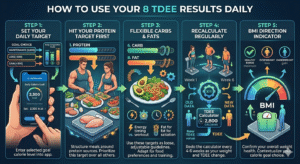
Calculating your TDEE is the beginning, not the end. Here is how to put your eight results to work daily:
Set Your Daily Calorie Target: Choose one of the three calorie levels from the TDEE calculator — Maintenance (TDEE), Weight Loss (TDEE − 500), or Muscle Gain (TDEE + 300) — based on your current goal. Enter this as your daily calorie goal in a food tracking app (MyFitnessPal, Cronometer, or similar).
Hit Your Protein Target First: Structure every meal around a protein source to ensure the TDEE calculator’s protein gram target is met before the day ends. Protein is the most important macronutrient for body composition; if you hit only one macro target each day, make it this one.
Use Carbs and Fat Targets as Flexible Guidelines: The carbohydrate and fat targets from the TDEE calculator are a balanced framework — they provide structure but can flex based on food preferences, training timing, and meal composition. Do not sacrifice protein adequacy to hit carb or fat targets precisely.
Recalculate Every 4 to 6 Weeks: As weight changes, TDEE changes. A person who has lost 5 kg has a measurably lower TDEE than when they started. Recalculating with the TDEE calculator regularly ensures your caloric targets remain accurate rather than progressively overestimating your needs.
Use the BMI Result as a Direction Indicator: The BMI estimate from the TDEE calculator confirms whether your overall body weight is in a healthy range and contextualises which calorie target (deficit, maintenance, or surplus) is most appropriate for your current status.
Common TDEE Calculator Mistakes to Avoid
Getting the most from your TDEE calculator requires avoiding these common errors:
Overestimating Activity Level: The most consequential mistake. Selecting “Very Active” when your genuine average is “Moderately Active” inflates your TDEE calculator result by 10% to 15% — creating a caloric surplus where you expect maintenance or deficit. Be conservative; you can always increase if you are losing weight faster than intended.
Not Updating After Weight Changes: TDEE is a dynamic number, not a fixed one. A TDEE calculator result from 3 months ago is outdated if your weight has changed significantly. Stale targets cause fat loss plateaus and muscle gain inefficiencies.
Ignoring the Protein Target: Many people focus on total calories while underconsuming protein. The protein target from the TDEE calculator is the most important single result — without meeting it, no calorie target, regardless of precision, will produce optimal body composition changes.
Using the TDEE Calculator Once and Never Again: A TDEE calculator is most valuable as a regular tracking tool, not a one-time curiosity. Monthly recalculations keep all eight targets current and aligned with your evolving body and activity level.
Frequently Asked Questions (FAQs)
What is a TDEE calculator? A TDEE calculator is a nutritional tool that estimates your Total Daily Energy Expenditure — the total calories your body burns in a day — based on age, gender, height, weight, and activity level, using the Mifflin-St Jeor BMR formula.
What does TDEE stand for? TDEE stands for Total Daily Energy Expenditure — the complete caloric cost of all physiological and physical activity in a 24-hour period. The TDEE calculator calculates this using your personal metrics and activity level.
How accurate is the TDEE calculator? The Mifflin-St Jeor formula used in the calculator is accurate to approximately ±10% for most adults. The primary source of individual inaccuracy is activity level selection — selecting the correct multiplier is the most important step for accurate TDEE results.
Should I eat at my TDEE to lose weight? No — to lose weight, eat below your TDEE. The calculator’s Weight Loss Plan target (TDEE − 500 kcal) is the recommended fat loss calorie level for sustainable, muscle-preserving weight reduction.
How often should I recalculate my TDEE calculator? Every 4 to 6 weeks during active weight change, or whenever your weight changes by 3 to 5 kg. The calculator’s results become less accurate as your weight changes, making regular recalculation important for continued precision.
What is the difference between BMR and TDEE? BMR (Basal Metabolic Rate) is your caloric need at complete rest — the energy floor. TDEE (Total Daily Energy Expenditure) is your complete daily caloric need including all activity. Your TDEE calculator displays both, with TDEE being the practical nutrition target.
Can women use the same calculator? Yes. Our TDEE calculator applies the female-specific Mifflin-St Jeor formula (−161 offset) when Female is selected, producing appropriately adjusted BMR and TDEE values.
Why does the TDEE calculator include a Recovery Mode? The BMR Recovery Mode (1.1× multiplier) is included to help users who are ill, injured, or completely resting determine their caloric needs during periods when standard activity multipliers are not appropriate. The TDEE calculator’s recovery mode calorie target supports healing without creating a significant surplus or deficit.
How do I use the calculator for muscle gain? Select the Muscle Gain Plan output (TDEE + 300 kcal) as your daily calorie target. Ensure you consistently hit the TDEE calculator’s protein target (body weight kg × 2g) and combine with progressive resistance training for maximum lean mass gains.
Does the calculator work for all body types? Yes — the Mifflin-St Jeor formula used in the calculator has been validated across diverse body types and populations. It may slightly underestimate TDEE for very muscular individuals (who have higher lean mass and therefore higher BMR) and slightly overestimate for sedentary individuals with very low lean mass.
Conclusion
Nutrition without a caloric reference is navigation without a map. You may be moving — eating, training, sleeping, making food choices — but without knowing where your intake sits relative to your Total Daily Energy Expenditure, you cannot know whether you are heading toward your goal or away from it. A TDEE calculator provides that map.
Our free TDEE calculator goes far beyond a simple maintenance calorie estimate. In a single calculation, it delivers eight personalised, evidence-based results: your complete daily caloric target, your resting metabolic rate, a ready-to-use weight loss calorie plan, a lean muscle gain calorie plan, precise daily protein, carbohydrate, and fat gram targets, and a BMI estimation — all calibrated to your specific age, gender, height, weight, and activity level across three flexible unit systems.
Whether your goal is sustainable fat loss, lean muscle gain, athletic performance, weight maintenance, or simply understanding how many calories your body actually needs, the TDEE calculator provides the accurate, personalised, immediately actionable nutritional baseline that makes every subsequent food decision more informed and more effective.
Use our TDEE calculator today. Know your number. Set your targets. Fuel your body with precision — and let the results speak for themselves.