Pregnancy Calculator
Calculate your ideal protein intake with the Protein Calculator
Table of Contents
- Introduction
- What Is a Pregnancy Calculator?
- What Are Ovulation Predictor Kits?
- How Ovulation Predictor Kits Work
- Types of Ovulation Predictor Kits Available
- When and How to Use Ovulation Predictor Kits
- Reading and Interpreting Ovulation Predictor Kits Results
- How Ovulation Predictor Kits Connect to Pregnancy Calculation
- The Five Pregnancy Calculator Methods Explained
- Week-by-Week Pregnancy Milestones
- Understanding the Three Trimesters
- Baby Size, Weight, and Development by Stage
- IVF, Ultrasound, and Conception-Based Calculations
- Factors That Affect Ovulation Prediction Accuracy
- Maximising Your Chances After Using Ovulation Predictor Kits
- Common Mistakes When Using Ovulation Predictor Kits
- Frequently Asked Questions (FAQs)
- Conclusion
Introduction
For couples trying to conceive, time is everything. The human fertility window is remarkably narrow — typically just 5 to 6 days per menstrual cycle during which conception is possible, with the peak window lasting only 24 to 48 hours around ovulation. Missing this window means waiting another full cycle. Identifying it precisely means dramatically increasing the probability of a successful pregnancy.
Ovulation Predictor Kits are the most reliable at-home tool available for identifying this window. By detecting the hormonal surge that precedes egg release, they give women advanced notice of their most fertile days — transforming uncertain guesswork into confident, timed action. And once conception occurs, a Pregnancy Calculator takes over — tracking the journey from fertilisation through all 40 weeks to delivery, week by week, milestone by milestone.
In this comprehensive guide, you will learn exactly how Ovulation Predictor Kits work, the different types available, how to use and interpret them correctly, how they connect to our free Pregnancy Calculator, and how to maximise your chances of conception once your kit confirms your fertile window. Whether you are just beginning your conception journey or have been trying for months, understanding Ovulation Predictor Kits is the single most impactful change you can make to your approach.
What Is a Pregnancy Calculator?
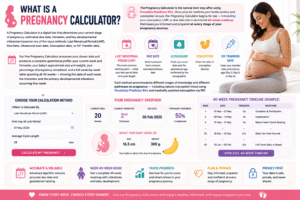
A Pregnancy Calculator is a digital tool that determines your current stage of pregnancy, estimated due date, trimester, and key developmental milestones based on one of five input methods: Last Menstrual Period (LMP), Due Date, Ultrasound scan date, Conception date, or IVF Transfer date.
Our free Pregnancy Calculator processes your chosen date and produces a complete gestational profile: your current week and trimester, your baby’s approximate size and weight, your percentage of pregnancy completed, and a full week-by-week table spanning all 40 weeks — showing the date of each week, the trimester, and the primary developmental milestone occurring that week.
The Pregnancy Calculator is the natural next step after using Ovulation Predictor Kits. Once your kit confirms your fertile window and conception occurs, the Pregnancy Calculator begins its role — translating your conception, LMP, or due date into a structured 40-week roadmap that keeps you informed and prepared at every stage of your pregnancy journey.
Five calculation methods are available:
- Last Period (LMP): The most common starting point — enter your last period date and cycle length
- Due Date: Work backward from a known estimated delivery date
- Ultrasound: Enter your scan date and the gestational age confirmed by the sonographer
- Conception: Enter the date of conception directly
- IVF Transfer Date: Enter your transfer date and embryo age (Day 3, Day 5, or Day 6)
Each method accommodates different stages of knowledge and different pathways to pregnancy — including natural conception timed using Ovulation Predictor Kits and medically assisted conception via IVF.
What Are Ovulation Predictor Kits?
Ovulation Predictor Kits are home testing devices that detect hormonal changes in urine to predict when ovulation is about to occur. They work by measuring the level of Luteinising Hormone (LH) — a hormone that surges dramatically in the 24 to 48 hours before an egg is released from the ovary.
This LH surge is the biological signal that ovulation is imminent. When Ovulation Predictor Kits detect this surge, they signal that the optimal conception window has arrived — typically 12 to 36 hours before the egg is released. This advance notice gives couples the critical lead time needed to time intercourse or insemination for maximum conception probability.
Ovulation Predictor Kits were first introduced commercially in the 1980s and have since become the gold standard for at-home fertility timing — outperforming basal body temperature charting, cervical mucus observation, and calendar-based methods in both accuracy and ease of use.
Who benefits from using Ovulation Predictor Kits?
- Women trying to conceive naturally who want to identify their fertile window with precision
- Women with irregular cycles for whom calendar-based prediction is unreliable
- Couples who have been trying for several months without success and want to ensure intercourse timing is optimal
- Women undergoing fertility monitoring as part of an IUI or natural IVF preparation protocol
- Women over 35 who are aware that fertility window accuracy becomes more critical with age
How Ovulation Predictor Kits Work
The mechanism behind Ovulation Predictor Kits is based on the detection of Luteinising Hormone (LH) in urine. Throughout most of the menstrual cycle, LH is present at low, baseline levels. In the 24 to 48 hours before ovulation, the pituitary gland releases a dramatic spike of LH — the LH surge — that triggers the release of a mature egg from the dominant follicle.
Ovulation Predictor Kits contain antibodies that react to LH. When urine containing surging levels of LH contacts these antibodies, a visible signal is produced — typically a coloured line, a digital smiley face, or a peak/high fertility indicator, depending on the kit type.
The key timing principle: Ovulation typically occurs 12 to 36 hours after the LH surge begins. Ovulation Predictor Kits detect the beginning of this surge, giving you a practical advance notice window of one to two days — the ideal timeframe for timing conception attempts.
The basic detection process:
- Collect urine in a clean cup or hold the test stick in the urine stream
- The LH in the urine binds to antibodies on the test strip
- If LH levels are at or above the surge threshold, a positive result is displayed
- Intercourse is timed for within 12 to 36 hours of the positive result
Advanced digital Ovulation Predictor Kits go further by also detecting oestrogen metabolites (specifically estrone-3-glucuronide, or E3G), which rise in the 2 to 5 days before the LH surge. These kits identify both “High Fertility” (rising oestrogen) and “Peak Fertility” (LH surge) days, extending the detectable fertile window and providing earlier advance notice than LH-only tests.
Types of Ovulation Predictor Kits Available
Not all Ovulation Predictor Kits are equal. Understanding the different types available helps you choose the option best matched to your cycle and conception goals:
Standard Strip Tests: The most affordable type of Ovulation Predictor Kits — simple paper strips dipped in urine. They display two lines: a control line (always present) and a test line (present when LH is detected). A positive result occurs when the test line is as dark as or darker than the control line. Strip tests are highly accurate when used correctly but require careful comparison of line intensities, which can be subjective.
Midstream Tests: Similar to standard strips but with a plastic casing and a urine-collecting tip — identical in format to home pregnancy tests. Midstream Ovulation Predictor Kits are easier to handle and reduce the risk of user error compared to strip tests. They use the same LH-threshold detection mechanism but are typically more expensive per test.
Digital LH Tests: Display a clear digital symbol — typically a smiley face for positive — eliminating the subjectivity of line-intensity comparison. Digital Ovulation Predictor Kits are ideal for users who find line-reading unreliable or who have experienced false negatives with strip tests due to colour interpretation errors.
Advanced Digital Tests (Dual Hormone): The most sophisticated category of Ovulation Predictor Kits — detecting both LH and E3G (oestrogen metabolite) to identify multiple fertile days. These kits display “High Fertility” (rising oestrogen, 2 to 5 days before ovulation) and “Peak Fertility” (LH surge, 1 to 2 days before ovulation) — providing the widest and most actionable fertile window.
Connected/Smart Ovulation Monitors: Handheld devices or smartphone-connected readers that store cycle data, track hormone trends over time, and build a personalised fertility profile. These represent the premium tier of Ovulation Predictor Kits and are particularly valuable for women with irregular cycles whose fertile window is difficult to predict by calendar alone.
When and How to Use Ovulation Predictor Kits
Correct timing and technique are essential for accurate results from Ovulation Predictor Kits. Here is the complete protocol:
Start Testing at the Right Time: For regular cycles, begin testing approximately 3 to 4 days before your expected ovulation date. Ovulation typically occurs 14 days before the next period — so for a 28-day cycle, ovulation is around day 14, meaning testing should begin around day 10 or 11. For irregular cycles, start testing earlier in the cycle — around day 8 to 10 — to avoid missing an early ovulation.
Test at the Right Time of Day: Unlike pregnancy tests (best taken first thing in the morning), Ovulation Predictor Kits are most accurate when used in the mid-morning to early afternoon — typically between 10am and 2pm. The LH surge begins in the blood in the early morning hours and reaches urine levels approximately 2 to 6 hours later.
Reduce Fluid Intake Before Testing: Avoid drinking large amounts of fluid in the 2 hours before testing. Excessive hydration dilutes urine and can reduce the concentration of LH, potentially causing a false negative result or a weaker positive signal.
Test Daily — or Twice Daily Near the Expected Surge: Test once daily in the early cycle days. As you approach your expected ovulation window, switch to testing twice daily (morning and afternoon) to catch a surge that begins and peaks within the same day. Missing the peak day of Ovulation Predictor Kits results means missing the optimal conception window.
Continue Testing Until a Clear Positive: Do not stop testing after a “near positive” — wait for a confirmed positive result. Ovulation Predictor Kits are only actionable when the test is definitively positive, not just approaching the threshold.
Reading and Interpreting Ovulation Predictor Kits Results
Accurate interpretation of your test results is critical for acting on the information Ovulation Predictor Kits provide:
Positive Result:
- Strip/midstream tests: Test line equal to or darker than the control line. This indicates LH surge — ovulation expected within 12 to 36 hours. Begin conception attempts immediately and continue for the next 24 to 48 hours.
- Digital tests: Flashing smiley (High Fertility) or solid smiley (Peak Fertility). The solid smiley is the actionable peak — equivalent to the positive line on a strip test.
- Advanced dual-hormone tests: “High” for oestrogen rise days; “Peak” for LH surge day. Begin conception attempts on “High” days and intensify on “Peak” day.
Negative Result: Test line lighter than control line (strip tests) or empty circle (digital tests). LH surge has not yet occurred — continue daily testing.
Common interpretation pitfalls:
- Reading strip tests after the reading window: Lines darken over time as the test dries. Always read within the specified window (typically 3 to 10 minutes). Ovulation Predictor Kits read outside this window are not reliable.
- Comparing to previous days’ tests: Keep used strips to compare line intensity progression — a visual darkening trend confirms the approach of the surge even before a definitive positive.
- PCOS and elevated baseline LH: Women with Polycystic Ovary Syndrome (PCOS) may have chronically elevated LH, causing consistently positive-appearing results on standard Ovulation Predictor Kits even without an actual surge.
How Ovulation Predictor Kits Connect to Pregnancy Calculation
The relationship between Ovulation Predictor Kits and a Pregnancy Calculator is direct and sequential. Ovulation Predictor Kits identify the conception window; the Pregnancy Calculator tracks the journey after conception occurs.
When you receive a positive result from Ovulation Predictor Kits and conception follows, you have several options for entering your pregnancy data into the Pregnancy Calculator:
Using Conception Date: If you know the approximate date of conception (typically within 24 to 48 hours of your positive Ovulation Predictor Kits result), select the Conception method in the Pregnancy Calculator and enter that date.
Using Last Period Date: If you prefer the standard obstetric method, enter your LMP date and cycle length. The Pregnancy Calculator adds 14 days to estimate the ovulation and conception date — which will align closely with your Ovulation Predictor Kits positive if your cycle is regular.
Using IVF Transfer Date: For IVF pregnancies monitored with Ovulation Predictor Kits during natural cycle monitoring, enter your embryo transfer date and embryo age for the most accurate gestational calculation.
The Pregnancy Calculator then produces your current week, trimester, baby size and weight estimates, pregnancy completion percentage, and a full 40-week milestone table — translating the success identified by your Ovulation Predictor Kits into a complete pregnancy roadmap.
The Five Pregnancy Calculator Methods Explained
Our Pregnancy Calculator supports five distinct input methods, each designed for a different pregnancy origin and knowledge context:
Last Period (LMP): The standard obstetric starting point. Enter your LMP date and cycle length; the calculator estimates ovulation at day (cycle length − 14) and projects your due date 40 weeks from LMP. This method aligns naturally with conception timed by Ovulation Predictor Kits, as the ovulation estimate will match your positive test date.
Due Date: Work backward from a known estimated delivery date. Useful when you already have an EDD from a healthcare provider and want to calculate your current gestational age or view the full milestone table.
Ultrasound: The most accurate method when available. Enter your scan date and the gestational age confirmed by the sonographer. Ultrasound-based dating corrects for cycle irregularities that can affect LMP-based estimates — particularly relevant for women whose Ovulation Predictor Kits revealed earlier or later ovulation than calendar prediction suggested.
Conception: Enter the known or estimated date of conception directly. This method is ideal for couples who have used Ovulation Predictor Kits to time conception precisely and know within 24 to 48 hours when fertilisation likely occurred.
IVF Transfer Date: A specialised input for assisted reproduction. Enter your transfer date and embryo age (Day 3, Day 5, or Day 6); the calculator adjusts gestational age accordingly.
Week-by-Week Pregnancy Milestones
Our Pregnancy Calculator generates a complete 40-week milestone table that shows your pregnancy’s developmental journey from the first week through to birth. Each row displays the week number, the date that week begins, the trimester, and the primary developmental milestone:
Weeks 1 to 12 – Organ Formation: The embryonic period — the most critical phase of structural development. This is when all major organ systems, limbs, facial features, and the neural tube are established. The heart begins beating around week 6; all major organs are present (though immature) by week 10.
Weeks 13 to 27 – Rapid Growth: The second trimester growth phase. The baby’s structures are established; this phase is characterised by dramatic size and weight gains. By week 20, the baby is approximately 25cm long. The mother typically begins feeling movement (quickening) between weeks 16 and 22.
Weeks 28 to 40 – Preparing for Birth: The third trimester preparation phase. The baby gains the fat deposits needed for thermoregulation, the lungs mature for independent breathing, and the baby moves into a head-down position in preparation for delivery. A baby born after week 37 is considered full term.
Understanding the Three Trimesters
The Pregnancy Calculator identifies which trimester you are in at every stage of your 40-week journey. Each trimester represents a distinct phase of development:
First Trimester (Weeks 1 to 13): The most critical and often most challenging trimester. Rapid cell division, organ formation, and hormonal adjustment all occur simultaneously. Morning sickness, fatigue, and breast tenderness are common as the body adapts to dramatically elevated progesterone and hCG levels. The risk of miscarriage is highest in the first trimester — which is why many couples delay announcement until week 12 or 13.
Second Trimester (Weeks 14 to 27): Widely considered the most comfortable trimester. Morning sickness typically subsides, energy returns, and the growing bump becomes visible. This is the period of most rapid fetal growth, and regular prenatal appointments confirm that development is progressing normally.
Third Trimester (Weeks 28 to 40): The final preparation phase. The baby’s systems mature in readiness for independent life; the mother experiences increasing physical demands as the baby’s size grows. Birth planning, hospital bag preparation, and finalising arrangements become the practical focus of this trimester.
Baby Size, Weight, and Development by Stage
Our Pregnancy Calculator provides approximate baby size and weight estimates based on gestational week:
Under 12 Weeks: Baby is approximately 5cm and weighs around 10 grams — roughly the size of a lime. All major organ systems are present but continue maturing.
Weeks 12 to 24: Baby grows from 5cm to approximately 25cm and weight increases from 10 grams to around 400 grams. This is the phase where sex can typically be determined by ultrasound (around weeks 18 to 20) and where movement becomes consistently noticeable.
Weeks 24 to 40: Baby grows to 40cm or more and weight increases from 400 grams to approximately 3 to 3.5 kilograms at full term. The final weeks involve significant fat deposition and lung maturation in preparation for breathing independently after birth.
IVF, Ultrasound, and Conception-Based Calculations
For women who have used assisted reproduction or have had early ultrasound dating, the Pregnancy Calculator offers specialised input methods that account for the different gestational reference points used in clinical practice:
IVF Transfer Dating: IVF embryos are dated from the egg retrieval date. A Day 5 embryo (blastocyst) is equivalent to a naturally fertilised embryo at 5 days post-ovulation. The Pregnancy Calculator adjusts gestational age accordingly — typically adding 17 days to a Day 5 transfer date to align with standard LMP-based dating.
Ultrasound Dating: First-trimester ultrasound (Crown-Rump Length measurement) is the most accurate method of gestational dating — more reliable than LMP calculation when cycles are irregular. For women whose Ovulation Predictor Kits revealed cycle irregularities or unusual ovulation timing, ultrasound-based dating corrects for any discrepancy between LMP-estimated and actual gestational age.
Conception-Based Dating: Women who have timed conception precisely using Ovulation Predictor Kits have a significant advantage in pregnancy dating accuracy. Entering the confirmed conception date — within 24 to 48 hours of the positive Ovulation Predictor Kits result — into the Pregnancy Calculator produces highly accurate gestational calculations from the earliest possible stage.
Factors That Affect Ovulation Prediction Accuracy
Ovulation Predictor Kits are highly accurate under normal circumstances, but several factors can affect result reliability:
Irregular Cycles: Women with cycle lengths that vary by more than 7 to 10 days may find standard calendar-based test start timing unreliable. Begin testing earlier in the cycle and test for a longer window when cycle length is unpredictable.
PCOS (Polycystic Ovary Syndrome): PCOS causes chronically elevated LH levels in some women, producing persistent positive-appearing results on Ovulation Predictor Kits even without an actual ovulatory surge. Women with PCOS may benefit from dual-hormone kits that also track oestrogen patterns.
Perimenopause: Fluctuating hormone levels during perimenopause can produce LH surges that do not result in ovulation. Ovulation Predictor Kits detect the LH surge but cannot confirm whether ovulation actually occurred.
Recent Hormonal Contraception: Ovulation may take several cycles to resume a predictable pattern after stopping hormonal contraception. Ovulation Predictor Kits are particularly valuable during this readjustment period, helping women identify when ovulation has resumed.
Thyroid Conditions: Both hypothyroidism and hyperthyroidism affect cycle regularity and hormone levels, potentially influencing the accuracy of Ovulation Predictor Kits results.
Maximising Your Chances After Using Ovulation Predictor Kits
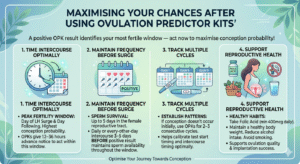
A positive result on Ovulation Predictor Kits is an invitation to act — here is how to maximise conception probability during the identified fertile window:
Time Intercourse Optimally: The highest probability of conception comes from intercourse on the day of the LH surge and the day following. Ovulation Predictor Kits give you the 12 to 36-hour advance notice needed to act within this peak window.
Maintain Frequency Before the Surge: Daily or every-other-day intercourse in the 3 to 5 days before the positive result maintains sperm availability throughout the fertile window — since sperm can survive in the female reproductive tract for up to 5 days.
Track Multiple Cycles: If conception does not occur in the first cycle, use Ovulation Predictor Kits for 2 to 3 consecutive cycles to establish a consistent ovulation pattern, ensuring test start timing and intercourse timing are optimally calibrated.
Support Overall Reproductive Health: Folic acid supplementation (at least 400mcg daily), healthy body weight, reduced alcohol intake, and avoiding smoking all support ovulation quality and implantation success alongside the hormonal detection work of Ovulation Predictor Kits.
Common Mistakes When Using Ovulation Predictor Kits
Even with the best products, user errors are the most common cause of missed results or misinterpreted positives:
Starting Testing Too Late: Many women begin testing on the expected ovulation day — missing the advance warning that makes Ovulation Predictor Kits valuable. Start 3 to 5 days before expected ovulation.
Testing Only Once Per Day: A single daily test can miss a surge that begins and peaks within the same day. Test twice daily during the approach to your expected fertile window for the highest detection reliability.
Reading Results Outside the Time Window: Test results are only valid within the manufacturer’s specified reading window. Reading outside this window produces unreliable results regardless of Ovulation Predictor Kits brand or type.
Stopping Testing After One Negative: Many women stop testing after a few negative results, assuming they have missed ovulation. Continue testing until you get a confirmed positive — variations in cycle length and hormonal patterns mean ovulation can occur considerably later than expected.
Using First Morning Urine for Standard LH Tests: Unlike pregnancy tests, most Ovulation Predictor Kits should not be used with first morning urine, as the LH surge begins in the blood in early morning and takes several hours to reach detectable urine levels.
Frequently Asked Questions (FAQs)
What are Ovulation Predictor Kits? Ovulation Predictor Kits are home fertility tests that detect the Luteinising Hormone (LH) surge in urine to predict ovulation 12 to 36 hours in advance. They are the most accurate at-home method for identifying the fertile window.
How accurate are Ovulation Predictor Kits? Standard LH-detecting Ovulation Predictor Kits are approximately 97% to 99% accurate at detecting the LH surge. However, detecting the surge does not guarantee that ovulation occurred — it indicates that the hormonal trigger for ovulation has been released.
When should I start using Ovulation Predictor Kits? For a 28-day cycle, begin testing around day 10 to 11. For shorter cycles, begin earlier; for longer or irregular cycles, start testing from day 8 to 9 to avoid missing an early surge.
Can I use Ovulation Predictor Kits if I have irregular cycles? Yes — in fact, Ovulation Predictor Kits are especially valuable for women with irregular cycles because calendar-based prediction is unreliable without hormonal confirmation. Start testing early in the cycle and continue until a positive is detected.
What does a positive Ovulation Predictor Kits result mean? A positive result means LH has surged to its peak level, indicating that ovulation is likely to occur within 12 to 36 hours. This is the optimal time to attempt conception.
Can I use the Pregnancy Calculator after getting a positive Ovulation Predictor Kits result? Once conception occurs following a positive result, you can enter the conception date (approximately 24 to 48 hours after your positive Ovulation Predictor Kits result) into the Pregnancy Calculator using the Conception method for accurate gestational dating from the earliest stage.
Do Ovulation Predictor Kits work for women with PCOS? Standard LH-only Ovulation Predictor Kits can give misleadingly positive results in women with PCOS due to elevated baseline LH. Dual-hormone kits that track both LH and oestrogen are more reliable for this group.
How many tests will I need per cycle? Most women use 5 to 10 tests per cycle with standard protocols. If testing twice daily near the expected surge, plan for 7 to 14 tests per cycle to ensure adequate coverage.
What is the difference between Ovulation Predictor Kits and pregnancy tests? Ovulation Predictor Kits detect LH in urine to predict ovulation before it occurs. Pregnancy tests detect hCG — the hormone produced after a fertilised egg implants — to confirm pregnancy after conception.
Is the Pregnancy Calculator free? Yes. Our Pregnancy Calculator is completely free, with no account or registration required. Enter your date using any of the five available methods and receive your complete pregnancy summary and 40-week milestone table instantly.
Conclusion
The journey to pregnancy begins with understanding your body’s signals — and nothing reads those signals more clearly than Ovulation Predictor Kits. By detecting the LH surge that precedes ovulation by 12 to 36 hours, Ovulation Predictor Kits transform guesswork into precision timing, giving every couple trying to conceive their best possible chance each cycle.
Used correctly and consistently, Ovulation Predictor Kits identify the narrow fertile window that no calendar, temperature chart, or intuition can reliably predict alone. They are accessible, affordable, non-invasive, and scientifically validated — the single most impactful addition to any natural conception strategy.
And when conception succeeds, our free Pregnancy Calculator stands ready to guide you through the next 40 weeks — from the first confirmed week through every trimester milestone to the day your baby arrives. Five input methods, a complete week-by-week milestone table, baby size and weight estimates, and a pregnancy progress percentage together create a clear, reassuring roadmap for the remarkable journey ahead.
Start with Ovulation Predictor Kits to identify your window. Conceive with confidence. Then let the Pregnancy Calculator show you every step of the journey to follow.