One Rep Max Calculator
Find Your Healthy Weight Goal with the Healthy Weight Calculator
Table of Contents
- Introduction
- What Is a One Rep Max Calculator?
- Why Your 1RM Matters – The Foundation of Strength Training
- The Three Formulas in Our One Rep Max Calculator
- Epley Formula – The Industry Standard
- Brzycki Formula – Precision for Lower Rep Ranges
- Lombardi Formula – The Conservative Estimate
- How to Choose the Right Formula in Your One Rep Max Calculator
- Understanding Units – Kilograms vs. Pounds
- Reading Your One Rep Max Calculator Results
- The Percentage Training Table – Your Workout Blueprint
- How to Structure Training Zones Around Your 1RM
- How Often Should You Test Your 1RM?
- Safety Guidelines for One Rep Max Testing
- Programming Your Training Using One Rep Max Calculator Results
- How to Improve Your One Rep Max Over Time
- Frequently Asked Questions (FAQs)
- Conclusion
Introduction
Every serious strength athlete, powerlifter, bodybuilder, and performance-focused gym-goer shares one core question: how strong am I, really? Not in terms of how a weight felt, how many reps you managed, or how impressive a number sounds — but in objective, measurable terms that can be tracked, compared, and systematically improved. The answer to that question is your one-rep maximum: the heaviest single repetition you can complete with correct form for any given exercise.
A One Rep Max Calculator makes this measurement accessible to everyone. Rather than requiring you to attempt a potentially dangerous all-out maximum lift — especially without an experienced spotter — the One Rep Max Calculator extrapolates your 1RM from a submaximal performance: the weight you lifted and the number of repetitions you completed. Three scientifically validated formulas — Epley, Brzycki, and Lombardi — process this data to produce an accurate 1RM estimate, and a percentage training table then maps that maximum to every rep range from 1 to 10.
In this comprehensive guide, you will learn what a One Rep Max Calculator is, why your 1RM is the most important number in strength training, how each of the three formulas works, how to choose between them, and how to use your results to structure a systematic, evidence-based training programme that drives genuine, measurable strength gains. Whether you are new to strength training or an experienced lifter pursuing a personal record, the One Rep Max Calculator is your most essential analytical tool.
What Is a One Rep Max Calculator?
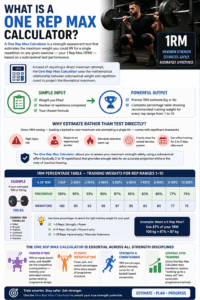
A One Rep Max Calculator is a strength assessment tool that estimates the maximum weight you could lift for a single repetition on any given exercise — your 1 Rep Max (1RM) — based on a submaximal test performance. Instead of requiring a direct maximum attempt, the One Rep Max Calculator uses the mathematical relationship between submaximal weight and repetition count to project the theoretical maximum.
The input is simple: the weight you lifted, the number of repetitions completed, and your chosen formula. The output is powerful: a precise 1RM estimate in your preferred unit (kilograms or pounds), plus a complete percentage table showing the recommended training weight for every rep range from 1 to 10.
Why estimate rather than test directly?
Direct 1RM testing — loading a barbell to near-maximum and attempting a single lift — carries significant injury risk, requires an experienced spotter, demands extensive warm-up, and taxes the central nervous system heavily enough to affect training for 2 to 3 days afterward. The One Rep Max Calculator allows you to assess your maximum strength safely, using a submaximal effort (typically 2 to 10 repetitions) that provides enough data for an accurate projection without the risks of maximal loading.
The One Rep Max Calculator is essential across all strength disciplines:
- Powerlifting: 1RM on squat, bench press, and deadlift are the competitive scoring metrics — knowing your estimated maxima guides peaking programme design
- Olympic weightlifting: Clean, jerk, and snatch percentages drive every aspect of programme structure
- Strength and conditioning: 1RM percentages define intensity zones for all barbell-based movements
- General gym training: Using One Rep Max Calculator data transforms random “working up to a heavy set” into systematic progressive overload

Why Your 1RM Matters – The Foundation of Strength Training
Your one-rep maximum is not just a bragging rights figure — it is the mathematical anchor of your entire strength training programme. Every percentage-based training prescription — from 70% of 1RM for hypertrophy to 90% for maximum strength development — depends on an accurate 1RM estimate to be meaningful.
Without a One Rep Max Calculator, you are training by feel. Training by feel produces inconsistent intensity across sessions, makes it impossible to objectively track progress, and prevents the systematic progressive overload that drives long-term strength adaptation. With a One Rep Max Calculator, every session has a precise, calculated intensity target that ensures you are training in the right zone for your specific adaptation goal.
Here is why 1RM accuracy matters for different training goals:
Hypertrophy (Muscle Growth): Research consistently shows optimal muscle hypertrophy occurs at 65% to 85% of 1RM for 6 to 15 repetitions. If your 1RM estimate from the One Rep Max Calculator is 20% off, your entire hypertrophy zone shifts — you may be training at intensities that are either too easy to stimulate growth or too heavy to sustain the required volume.
Strength Development: Maximal strength improves most efficiently at 85% to 95% of 1RM for 1 to 5 repetitions. Accurate 1RM data from the One Rep Max Calculator is critical here — the difference between 85% and 90% of 1RM at heavy loads is a meaningful performance and recovery demand difference.
Neural Adaptation: The highest neurological adaptation (improved motor unit recruitment and firing rate) occurs at 90% to 100% of 1RM. Programming these intensities accurately with a One Rep Max Calculator ensures you are achieving the neural stimulus needed for peak strength expression.
Progress Tracking: Retesting your 1RM using the One Rep Max Calculator every 4 to 8 weeks provides objective proof of whether your training programme is producing the expected strength gains — enabling data-driven programme adjustments.
The Three Formulas in Our One Rep Max Calculator
Our One Rep Max Calculator offers three distinct mathematical formulas — Epley, Brzycki, and Lombardi — each with different mathematical assumptions and optimal accuracy ranges. Understanding the differences helps you select the most appropriate formula for your lifting profile.
All three formulas share the same fundamental input variables:
- Weight (W): The load lifted in the submaximal test
- Repetitions (R): The number of complete, controlled repetitions performed
The differences lie in how each formula mathematically models the relationship between submaximal load, repetition count, and the theoretical maximum. Each formula was derived from different datasets and lifter populations, producing slightly different estimates — particularly at higher rep counts.
Epley Formula – The Industry Standard
The Epley formula is the most widely used 1RM estimation method in strength and conditioning, and is the default choice in most One Rep Max Calculator implementations worldwide.
The Epley Formula: 1RM = Weight × (1 + Reps ÷ 30)
Example: 100kg × 5 reps → 100 × (1 + 5/30) = 100 × 1.167 = 116.7 kg estimated 1RM
Developed by Boyd Epley (one of the founding fathers of collegiate strength and conditioning in the United States) in 1985, this formula uses a linear model that adds 1/30 of the lifted weight for each additional repetition performed.
Strengths of the Epley formula:
- Highly accurate at moderate rep ranges (3 to 8 reps) — the most common testing range in practical training settings
- Simple to calculate mentally without a calculator
- Validated across a wide range of exercises and lifter populations
- The default formula in most strength and conditioning research
Limitations:
- Slightly overestimates 1RM at higher rep counts (9 to 10+ reps)
- Assumes a linear relationship between reps and load that may not hold at very high rep counts
Best used when: You are testing at 3 to 8 repetitions and want a broadly applicable, research-validated estimate. The Epley formula is the recommended default in our One Rep Max Calculator for most users.
Brzycki Formula – Precision for Lower Rep Ranges
The Brzycki formula is preferred by powerlifters and heavy strength athletes who test at low repetition ranges (1 to 5 reps) and want the most precise estimate at near-maximal loads.
The Brzycki Formula: 1RM = Weight ÷ (1.0278 − 0.0278 × Reps)
Example: 100kg × 3 reps → 100 ÷ (1.0278 − 0.0278 × 3) = 100 ÷ (1.0278 − 0.0834) = 100 ÷ 0.9444 = 105.9 kg estimated 1RM
Developed by Matt Brzycki at Princeton University, this formula uses a declining denominator model that produces slightly more conservative 1RM estimates than Epley — particularly relevant for near-maximal efforts where Epley’s linear extrapolation can become less reliable.
Strengths of the Brzycki formula:
- Most accurate for 1 to 5 rep testing ranges — the regime most familiar to powerlifters and strength athletes
- More conservative estimate reduces the risk of overestimating true maximal capacity
- Widely used in powerlifting programming and competitive setting
Limitations:
- Becomes mathematically unreliable at very high repetition counts (the denominator approaches zero at ~37 reps)
- Less accurate than Epley for moderate to high rep tests (6 to 10 reps)
Best used when: You are an advanced lifter testing at 1 to 5 repetitions, particularly for powerlifting movements. Select Brzycki in our One Rep Max Calculator when precision at low rep counts is your priority.
Lombardi Formula – The Conservative Estimate
The Lombardi formula produces the most conservative 1RM estimate of the three options in our One Rep Max Calculator, making it valuable for new lifters, injury recovery contexts, or situations where training conservatively is appropriate.
The Lombardi Formula: 1RM = Weight × Reps^0.10
Example: 100kg × 5 reps → 100 × 5^0.10 = 100 × 1.1746 = 117.5 kg (at 5 reps, similar to Epley; diverges more at higher reps)
The Lombardi formula uses a power function rather than a linear or rational model — applying a small exponential relationship between repetitions and load. At low rep counts, Lombardi estimates closely parallel Epley; at higher rep counts, they diverge more significantly.
Strengths of the Lombardi formula:
- Produces moderate to conservative estimates that suit cautious programming approaches
- Mathematically stable across all rep ranges
- Appropriate for rehabilitation or return-to-training contexts where conservative loading is prioritised
Limitations:
- Less used in research than Epley or Brzycki, providing less external validation data
- May slightly underestimate 1RM for well-trained lifters at low rep counts
Best used when: You are new to strength training, returning from injury, or prefer conservative load prescription. Select Lombardi in our One Rep Max Calculator when you would rather train below your maximum than risk overestimation.
How to Choose the Right Formula in Your One Rep Max Calculator
With three formulas available, the practical question is: which should you use? Here is a concise guide:
Use Epley when:
- You are testing at 3 to 8 repetitions (the most common practical range)
- You want a broadly applicable, research-backed estimate
- You are unsure which formula to start with — Epley is the recommended default in our One Rep Max Calculator
Use Brzycki when:
- You are testing at 1 to 5 repetitions
- You are an experienced or competitive strength athlete who regularly trains near maximum loads
- You want the most conservative estimate at low rep counts
Use Lombardi when:
- You are a beginner learning to train with submaximal loads
- You are returning to training after injury or illness
- Your training philosophy prioritises leaving margin below your theoretical maximum
A practical tip: Run your test data through all three formulas in the One Rep Max Calculator and note the range of estimates. The spread between the lowest and highest value gives you a confidence interval for your actual maximum — a range within which your true 1RM most likely falls.
Understanding Units – Kilograms vs. Pounds
Our One Rep Max Calculator supports both kilogram and pound inputs and outputs, accommodating the preference of lifters in every country and training environment:
Input Unit: Select kg if you lifted the weight in kilograms, or lbs if your equipment uses pounds. The One Rep Max Calculator converts your input to kilograms internally (1 lb = 0.453592 kg) before applying the formula.
Output Unit: Choose whether you want your 1RM result and percentage table displayed in kilograms or pounds. If your training plates and records are in pounds, select lbs output so your training percentages are immediately applicable without manual conversion.
The conversion accuracy is precise: the One Rep Max Calculator applies the exact conversion factor (2.20462 kg to lbs) rather than rounding approximations — ensuring your percentage table weights are accurate to the decimal place.
Practical note: Many competitive powerlifting federations record attempts in kilograms regardless of training convention. If you compete internationally, familiarise yourself with both units — and use the One Rep Max Calculator’s dual-unit capability to maintain parallel records in both systems.
Reading Your One Rep Max Calculator Results
Our One Rep Max Calculator produces three primary results and a complete ten-row percentage table:
Estimated 1RM: Your projected one-rep maximum in your chosen output unit. This is the number around which your entire training load structure is built. For most strength athletes, this number should be recalculated every 4 to 8 weeks to keep percentage prescriptions current as strength improves.
Formula Used: Confirms which of the three formulas was applied — important when comparing results across different test sessions or different exercises.
Total Reps: Confirms the repetition count used in the calculation — important for context when reviewing historical records.
The Percentage Table: A ten-row table showing the recommended training weight for each repetition range from 1 to 10. This table is the practical conversion of your 1RM estimate into a workout plan. Each row shows:
- Reps: The number of repetitions in the set
- % of 1RM: The percentage of your estimated maximum corresponding to that rep range
- Weight: The actual load (in your chosen output unit) that represents that percentage
The Percentage Training Table – Your Workout Blueprint
The percentage table generated by our One Rep Max Calculator is the most practically useful output for day-to-day training. Here is what the standard percentages mean and how to apply them:
1 Rep – 100% of 1RM: Your estimated maximum single lift. Rarely trained directly in general programmes; reserved for competition attempts or occasional peaking cycles.
2 Reps – 95% of 1RM: Near-maximal intensity. Develops maximal strength and neural adaptation. Appropriate for advanced lifters in peaking phases; requires significant recovery between sessions.
3 Reps – 90% of 1RM: Heavy strength work. This is the core range of powerlifting-style strength programmes — heavy enough to drive maximal strength adaptation while allowing more frequency than true 1RM work.
4 Reps – 85% of 1RM: Strength-hypertrophy overlap. Builds both maximal strength and muscle cross-section simultaneously. A productive range for intermediate to advanced lifters.
5 Reps – 80% of 1RM: The most versatile training range — productive for strength, hypertrophy, and technical proficiency simultaneously. The 5×5 programming methodology is built around this intensity. Most One Rep Max Calculator users find their test performance falls in the 5-rep range, making this the most commonly used input.
6 to 8 Reps – 70% to 75% of 1RM: Primary hypertrophy zone. The optimal intensity range for maximising muscle cross-sectional area growth in compound movements, supported by a large body of research.
9 to 10 Reps – 65% to 70% of 1RM: Hypertrophy with muscular endurance. Slightly below the peak hypertrophy intensity but effective for volume accumulation and metabolic stress. The upper testing limit for One Rep Max Calculator inputs — accuracy declines beyond 10 reps.
How to Structure Training Zones Around Your 1RM
The percentage table from the One Rep Max Calculator maps directly onto the standard training zones used in evidence-based strength programming:
Maximum Strength Zone (90% to 100%): 1 to 3 repetitions. Develops peak force production, neural drive, and inter-muscular coordination. Requires extended rest periods (3 to 5 minutes between sets) and significant recovery days. Use your One Rep Max Calculator percentages here with the utmost accuracy — errors at near-maximal loads carry the highest injury risk.
Strength Zone (80% to 90%): 3 to 5 repetitions. The primary zone for strength development in both powerlifting and general athletic strength training. Rest periods of 2 to 4 minutes. Most systematic strength programmes (5/3/1, Texas Method, Juggernaut) operate primarily in this zone.
Strength-Hypertrophy Zone (70% to 80%): 5 to 8 repetitions. Both strength and muscle growth stimulated simultaneously. Rest periods of 1.5 to 3 minutes. The most productive zone for intermediate lifters who want to develop both strength and physique simultaneously.
Hypertrophy Zone (60% to 70%): 8 to 12 repetitions. Primary muscle growth stimulus. Shorter rest periods (60 to 90 seconds) increase metabolic stress and growth hormone response. Use the One Rep Max Calculator to ensure these sets are genuinely challenging — many lifters use weights far below 60% of 1RM in this range, sacrificing adaptation stimulus.
Endurance Zone (50% to 60%): 12 to 20+ repetitions. Muscular endurance and technique practice. Limited strength or hypertrophy stimulus for trained lifters at true 1RM percentages.
How Often Should You Test Your 1RM?
One of the most common questions from users of the One Rep Max Calculator is how frequently to retest — balancing the value of updated data against the cost of testing effort and recovery.
For beginner lifters (under 1 year of training): Strength improves rapidly enough that 1RM estimates from the One Rep Max Calculator become outdated within 4 to 6 weeks. Retest every 4 to 6 weeks — using the submaximal method rather than direct maximum attempts.
For intermediate lifters (1 to 3 years of training): Strength gains slow. Retest every 6 to 8 weeks, or at the end of each training block (typically 4 to 8 weeks). Retesting with the One Rep Max Calculator at the end of each block confirms whether the block achieved its intended strength target.
For advanced lifters (3+ years of training): Annual or biannual formal 1RM tests (direct maximum attempts in competition or a controlled gym setting), supplemented by One Rep Max Calculator estimates from regular training sets to track continuous progress between formal tests.
Practical testing protocol: Select a day when you are well-rested, fully recovered from the previous session, and not in the middle of a high-volume training period. Warm up progressively to the working weight. Perform your test set at 2 to 5 repetitions (the most accurate range for the One Rep Max Calculator) and record the result immediately.
Safety Guidelines for One Rep Max Testing
Even when using the One Rep Max Calculator to estimate rather than directly test your maximum, safety in your submaximal test set is paramount:
Warm Up Thoroughly: Begin with empty bar sets and progressively add weight across 4 to 6 warm-up sets before your test set. Each warm-up set should use 60%, 70%, 80%, and 90% of your expected test weight — allowing your joints, connective tissue, and neural system to activate progressively.
Use Correct Form: The test weight must be lifted with the same technique you would use in training. Breaking form to grind out an extra rep produces invalid data for the One Rep Max Calculator and increases injury risk. Terminate the test at technical failure, not muscular failure.
Use a Spotter for Upper Body Pressing Movements: Bench press, overhead press, and similar movements carry genuine risk without a competent spotter when testing near-maximal loads. A proper spotter allows you to push your test intensity to the productive range for the One Rep Max Calculator without the risk of being stranded under a failing lift.
Test Movements You Know Well: Only test 1RM on movements you have trained consistently for at least 3 to 6 months. Unfamiliar movements tested at high intensities combine technical uncertainty with high loads — a reliable injury scenario.
Avoid Testing in a Fatigued State: The One Rep Max Calculator produces accurate estimates only when the test set is performed at your genuine submaximal capability. Testing while fatigued — after a heavy previous session or during a high-volume training block — produces underestimates that skew all subsequent percentage prescriptions downward.
Programming Your Training Using One Rep Max Calculator Results
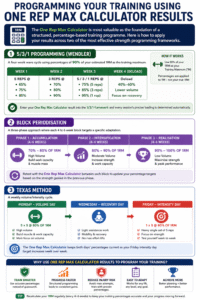
The One Rep Max Calculator is most valuable as the foundation of a structured, percentage-based training programme. Here is how to apply your results across two of the most effective strength programming frameworks:
5/3/1 Programming (Wendler): A four-week wave cycle using percentages of 90% of your estimated 1RM as the training maximum. Week 1: 5 reps at 65%, 75%, 85%. Week 2: 3 reps at 70%, 80%, 90%. Week 3: 5/3/1 reps at 75%, 85%, 95%. Week 4: deload. Enter your One Rep Max Calculator result into the 5/3/1 framework and every session’s precise loading is determined automatically.
Block Periodisation: A three-phase approach where each 4 to 6 week block targets a specific adaptation. Phase 1 (Accumulation): 70% to 80% of 1RM, high volume. Phase 2 (Intensification): 80% to 90% of 1RM, moderate volume. Phase 3 (Realisation): 90% to 100% of 1RM, low volume. Retest with the One Rep Max Calculator between each block to update your percentage targets based on the strength gained in the previous phase.
Texas Method: A weekly volume/intensity cycle where Monday is volume day (5×5 at 80% of 1RM), Wednesday is recovery day, and Friday is intensity day (1×5 at 90% of 1RM). The One Rep Max Calculator keeps both days’ percentages current as your Friday intensity day target increases week over week.
How to Improve Your One Rep Max Over Time
Consistently improving your One Rep Max Calculator results requires a systematic approach to progressive overload, recovery, and technique:
Progressive Overload: The fundamental driver of 1RM improvement. Add the minimum effective increment — 2.5kg per session for upper body, 5kg per session for lower body — as long as progress continues. Use microplates (0.5kg to 1.25kg increments) when standard jumps become too large.
Technical Mastery: Strength gains from technique improvements are often larger than gains from training volume changes — particularly in the first 2 to 3 years of barbell training. Invest in regular technique analysis and coaching. A technically superior lifter will always outperform a stronger but technically inferior one at the point of maximum expression.
Specificity: Train the movement pattern you want to maximise. Consistent squat training improves your squat 1RM; sporadic squat training does not. Use the One Rep Max Calculator to track specific movement maxima separately — bench press, squat, deadlift, overhead press — rather than using a single composite measure.
Recovery Optimisation: Sleep (7 to 9 hours per night), protein intake (1.6 to 2.2g per kg bodyweight), and managed training stress collectively determine how effectively your body adapts between sessions. The One Rep Max Calculator measures the output of your recovery as much as your training — consistently improving results indicate that recovery is adequate; stagnating results often indicate it is not.
Deload Cycles: Schedule one reduced-volume, reduced-intensity week every 4 to 8 weeks. Deloads allow the central nervous system to recover fully, often producing surprising strength gains in the immediately following week. Plan your One Rep Max Calculator retests for the session after a deload to capture your peak recovered strength.
Frequently Asked Questions (FAQs)
What is a One Rep Max Calculator? A One Rep Max Calculator is a tool that estimates the maximum weight you can lift for a single repetition based on a submaximal test (a weight you lifted for 2 to 10 reps). It uses mathematical formulas to project your theoretical maximum from this submaximal performance.
Is the One Rep Max Calculator accurate? Yes — for tests conducted at 2 to 8 repetitions with good technique, the One Rep Max Calculator produces estimates that typically fall within 3% to 5% of a directly tested maximum. Accuracy decreases at higher rep counts (9 to 10+), where the extrapolation becomes less reliable.
Which formula should I use in the One Rep Max Calculator? Use Epley as a general default (3 to 8 reps), Brzycki for low rep strength testing (1 to 5 reps), and Lombardi for conservative estimates or beginner/rehabilitation contexts. All three are available in our One Rep Max Calculator.
How many reps should I perform for the most accurate One Rep Max Calculator estimate? 2 to 5 repetitions produces the most accurate One Rep Max Calculator estimates. Higher rep tests (6 to 10) are also valid but carry slightly more estimation error. Never test beyond 10 reps — estimates become unreliable above this threshold.
Can I use the One Rep Max Calculator for any exercise? Yes, the One Rep Max Calculator formulas apply to any resistance exercise. However, accuracy is highest for compound barbell movements (squat, bench press, deadlift, overhead press) and lower for machine or isolation exercises where technique variability is higher.
How often should I update my One Rep Max Calculator results? Every 4 to 6 weeks for beginners; every 6 to 8 weeks for intermediate lifters; every training block for advanced athletes. Regular retesting keeps your percentage prescriptions current and ensures your training intensity accurately reflects your current strength level.
Can I use the One Rep Max Calculator for bodyweight exercises? The One Rep Max Calculator is designed for weighted resistance exercises. For bodyweight movements, you would need to add external load (weighted vest, belt) to generate meaningful submaximal data.
What is the percentage table in the One Rep Max Calculator? The percentage table maps your estimated 1RM to the recommended training weight for every rep range from 1 to 10. It is the most practically useful output of the One Rep Max Calculator — converting your maximum estimate into a ready-to-use training load guide.
Is it safe to test my 1RM directly without the One Rep Max Calculator? Direct 1RM testing is safe for experienced lifters with proper warm-up, technique, spotting, and recovery. For beginners and most recreational gym-goers, using the One Rep Max Calculator with a submaximal test is both safer and more practical than direct maximum attempts.
Does the One Rep Max Calculator work for women? Yes. The mathematical formulas in the One Rep Max Calculator are physiologically neutral — they apply equally to male and female lifters. The same formulas, accuracy ranges, and programming applications apply regardless of gender.
Conclusion
Strength training without data is exercise; strength training with data is a programme. The difference between randomly lifting heavy and systematically building strength lies in knowing your numbers — and the most important number in any strength training framework is your one-rep maximum.
Our free One Rep Max Calculator gives you that number accurately, safely, and instantly — using your choice of three scientifically validated formulas, supporting both kilograms and pounds, and transforming your 1RM estimate into a complete percentage training table that maps every rep range from 1 to 10 to an exact training weight.
Whether you are a beginner establishing your first strength baseline, an intermediate lifter structuring a periodised programme, or an advanced athlete preparing for competition, the One Rep Max Calculator provides the objective, precise foundation that systematic strength development demands. It eliminates guesswork, standardises intensity across exercises, enables accurate progress tracking, and connects your training to the research-backed programming frameworks that have produced elite strength athletes for decades.
Use our One Rep Max Calculator today. Test your strength. Know your numbers. Train with precision. And watch your one-rep maximum grow.