Body Fat Calculator
Know Your Fitness Status with the BMI Calculator
Table of Contents
- Introduction
- What Is a Body Fat Calculator?
- Why Body Fat Percentage Matters More Than Body Weight
- How Our Body Fat Calculator Works
- The Key Inputs – Age, Gender, Height, Weight, Waist, and Neck
- Why Waist and Neck Measurements Are Critical in the Body Fat Calculator
- The Four Body Fat Categories – Athletic, Fitness, Average, and Obese
- The Visual Body Fat Meter Explained
- Body Fat Percentage by Gender – What Is Normal?
- Athletic Body Fat Range – Performance and Physique
- Average Body Fat Range – Health Maintenance
- Obese Body Fat Range – Health Risks and Action Plan
- Three Unit Systems in the Body Fat Calculator
- How to Take Accurate Measurements for the Body Fat Calculator
- How to Reduce Your Body Fat Percentage
- Tracking Progress with the Body Fat Calculator Over Time
- Frequently Asked Questions (FAQs)
- Conclusion
Introduction
Step on a scale and you get one number: your total body weight. But that number tells you nothing about what your body is actually made of — how much of it is muscle, bone, water, and organs versus how much is fat. Two people can weigh exactly the same and have dramatically different health profiles, disease risks, and physical capabilities depending on the proportion of fat to lean mass that underlies that identical weight. Your body fat percentage is the number that actually matters — and a body fat calculator is the tool that reveals it.
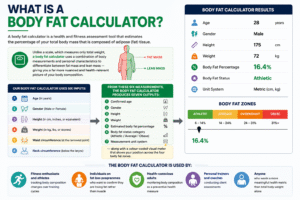
A body fat calculator estimates the percentage of your total body weight that consists of adipose tissue (body fat), using measurements that reflect fat distribution in the body: your waist circumference, neck circumference, height, weight, age, and gender. By processing these six inputs through a validated formula, the body fat calculator produces a percentage figure and places you within one of four health categories — Athletic, Fitness, Average, or Obese — giving you a meaningful, actionable assessment of your body composition.
In this comprehensive guide, you will learn what a body fat calculator is, why body fat percentage is a more important health metric than total weight, how our tool’s formula and visual meter work, what each of the four categories means for your health and fitness, and how to use your results to make evidence-based decisions about diet, training, and lifestyle. Whether you are tracking athletic performance, monitoring health, or managing a fat loss programme, our free body fat calculator gives you the precise body composition data that total weight alone cannot provide.
What Is a Body Fat Calculator?
A body fat calculator is a health and fitness assessment tool that estimates the percentage of your total body mass that is composed of adipose (fat) tissue. Unlike a scale, which measures only total weight, a body fat calculator uses a combination of body measurements and personal characteristics to differentiate between fat mass and lean mass — giving you a far more nuanced and health-relevant picture of your body composition.
Our body fat calculator uses six inputs:
- Age (in years)
- Gender (Male or Female)
- Height (in cm, inches, or equivalent)
- Weight (in kg, lbs, or stones)
- Waist circumference (at the narrowest point)
- Neck circumference (below the larynx)
From these six measurements, the body fat calculator produces seven outputs: confirmed age, gender, height, weight, estimated body fat percentage, body fat status category (Athletic / Average / Obese), and measurement unit system — along with a colour-coded visual meter that shows your position across the four body fat zones.
The body fat calculator is used by:
- Fitness enthusiasts and athletes tracking body composition changes over training cycles
- Individuals on fat loss programmes who want to confirm they are losing fat rather than muscle
- Health-conscious adults monitoring body composition as a preventive health measure
- Personal trainers and coaches conducting client assessments
- Anyone who wants a more meaningful health metric than total body weight alone

Why Body Fat Percentage Matters More Than Body Weight
Total body weight is the most commonly tracked health metric — and one of the least informative. Here is why body fat percentage, as measured by a body fat calculator, is a far more meaningful indicator of health, performance, and disease risk:
Lean Mass vs. Fat Mass: Your body weight is the sum of muscle, bone, water, organs, and fat. Two people at the same weight can have body fat percentages that differ by 20% or more — meaning one is lean, muscular, and metabolically healthy while the other carries dangerous levels of adipose tissue despite appearing similar on the scale. Only a body fat calculator distinguishes between these two profiles.
Metabolic Health: Excess body fat — particularly visceral fat stored around internal organs — drives insulin resistance, chronic inflammation, dyslipidaemia, and hypertension regardless of total body weight. A “normal weight” person with high body fat (sometimes called metabolically obese normal weight, or MONW) carries the same metabolic disease risk as an overweight person — a risk that is invisible on a scale but visible in a body fat calculator result.
Performance and Strength: For athletic performance, body fat percentage is more relevant than total weight. Lower body fat percentage means a higher proportion of total weight is functional muscle — directly improving strength-to-weight ratio, power output, endurance capacity, and overall athletic performance.
Progress Tracking: During a body recomposition programme (simultaneously losing fat and gaining muscle), total weight may remain unchanged even as body composition improves dramatically. A body fat calculator reveals the progress that the scale hides — showing declining fat percentage even when the number on the scale stays constant.
Psychological Impact: Scale weight fluctuates by 1 to 3 kg daily due to hydration, food volume, and glycogen levels. Body fat percentage measured consistently with the body fat calculator is more stable and more meaningful — reducing the frustration and discouragement that come from misleading daily weight fluctuations.
How Our Body Fat Calculator Works
Our body fat calculator uses a circumference-based estimation formula that processes your waist measurement, neck measurement, and age to estimate body fat percentage. This approach — using body circumference measurements as proxies for fat distribution — is one of several validated methods for non-invasive body fat assessment.
The Core Formula:
Body Fat (%) = (Waist − Neck) × 0.5 + (Age × 0.05)
The logic behind this formula:
Waist circumference is the primary indicator of central (abdominal) fat accumulation — the most metabolically active and health-relevant fat depot. A larger waist circumference relative to neck circumference indicates proportionally more central fat storage.
Neck circumference is used as a proxy for lean mass and body frame — individuals with larger necks tend to have more lean mass, making neck circumference a natural counterweight in the formula. The (Waist − Neck) differential captures the relative fat distribution between a fat-accumulating site (waist) and a lean-indicating site (neck).
Age is incorporated as a modifier because body fat percentage naturally increases with age even at stable weight — driven by gradual muscle loss (sarcopenia) and hormonal changes that shift body composition toward greater fat proportion. The body fat calculator’s age adjustment reflects this well-documented age-related fat accumulation trend.
The result is capped between 5% and 40% — the physiologically plausible range for healthy human body fat percentage — preventing extreme or non-physiological outputs from unusual measurement combinations.
The Key Inputs – Age, Gender, Height, Weight, Waist, and Neck
Understanding what each input represents and why it matters in the body fat calculator ensures accurate, meaningful results:
Age: Influences body fat calculation through the age modifier (Age × 0.05). Older individuals typically carry more body fat at equivalent weight and circumference measurements due to age-related changes in hormones (declining testosterone and growth hormone), metabolic rate, and activity level. The body fat calculator accounts for this systematically through the age adjustment.
Gender: Biological sex fundamentally affects body fat distribution and healthy percentage ranges. Females typically have 8 to 10% higher body fat than males at equivalent fitness levels — driven by sex hormones (oestrogen promotes peripheral fat storage) and physiological requirements for reproductive function. The body fat calculator uses gender to contextualise results within sex-appropriate norms.
Height: Height contributes to the body frame and proportional measurement context. Taller individuals typically have proportionally larger absolute circumference measurements; height helps normalise these measurements in the body composition picture.
Weight: Total body weight is displayed in results as contextual information. In circumference-based body fat calculator methods, weight is less directly involved in the core formula than in BMI-based calculations — but it provides essential context for interpreting the fat percentage result and estimating absolute fat mass (total weight × fat percentage = kg of fat).
Waist Circumference: The most important measurement in the body fat calculator. Waist circumference directly reflects abdominal fat accumulation — the primary determinant of metabolic disease risk. Measure at the narrowest point of the torso, typically just above the navel, with a relaxed (not sucked-in) abdomen.
Neck Circumference: The lean mass indicator in the body fat calculator formula. Measure circumference of the neck just below the larynx (Adam’s apple), keeping the tape horizontal. Accurate neck measurement is critical — an underestimate inflates the Waist-Neck differential and produces a falsely high body fat result.
Why Waist and Neck Measurements Are Critical in the Body Fat Calculator
The waist-to-neck approach used in our body fat calculator is not arbitrary — it reflects decades of research on the relationship between body circumferences and body composition:
Waist Circumference and Health Risk: The World Health Organisation identifies waist circumference as a primary independent predictor of metabolic disease risk. Men with waist circumferences above 94 cm and women above 80 cm carry significantly elevated cardiovascular and metabolic disease risk — regardless of total weight or BMI. The body fat calculator’s use of waist circumference captures this risk in its fat percentage estimate.
The U.S. Navy Method: Circumference-based body fat estimation using waist and neck measurements (sometimes with hip measurements for women) was originally developed by the U.S. Navy for practical field assessment of body composition without specialised equipment. Our body fat calculator uses an adapted version of this approach — providing a practical, no-equipment-needed estimate that correlates reasonably well with more sophisticated methods like DEXA scanning.
Measurement Consistency is Key: Because the formula is sensitive to circumference inputs, measurement technique consistency is essential for meaningful tracking with the body fat calculator over time. Measure at the same time of day (ideally morning, before eating), at the same anatomical landmark, with the same tape tension, and under comparable hydration conditions.
The Four Body Fat Categories – Athletic, Fitness, Average, and Obese
Our body fat calculator classifies results into four categories, each corresponding to a distinct body composition profile and health/performance context:
Athletic (Body Fat below 15%): The lowest body fat category — associated with competitive athletes, physique competitors, and highly trained individuals. At athletic body fat levels, muscle definition is visible (visible abdominal musculature, defined limbs), strength-to-weight ratio is at its peak, and metabolic efficiency is optimised. The body fat calculator assigns Athletic status at below 15% — noting that this range requires active maintenance through consistent training and controlled nutrition.
Fitness (Body Fat 15% to 25%): The healthy fitness range — associated with active, health-conscious individuals who maintain a regular exercise habit and balanced nutrition without extreme restriction. The fitness range from the body fat calculator is the target for most adults seeking optimal health and reasonable physical performance without the demands of competitive athletics.
Average (Body Fat 15% to 25% by calculator threshold): The broad middle range representing most of the sedentary to moderately active adult population. Average body fat status from the body fat calculator indicates no immediate health emergency but suggests meaningful improvement potential through modest lifestyle changes.
Obese (Body Fat above 25%): The highest category in our body fat calculator — associated with excess fat accumulation that carries elevated health risks. The body fat calculator flags obese body fat status as a health priority requiring structured intervention: dietary modification, increased physical activity, and professional medical guidance where appropriate.
The Visual Body Fat Meter Explained
Our body fat calculator includes a four-zone colour-coded visual meter that provides an immediate, intuitive representation of your estimated body fat percentage position:
Dark Green Zone (Athletic): Covers the lowest body fat range — below approximately 15%. A pointer in this zone confirms a highly trained body composition with low relative fat mass.
Yellow Zone (Fitness): Covers the healthy fitness range. A pointer in the yellow zone indicates a body composition associated with good health and reasonable physical capacity — the target range for most health-motivated adults using the body fat calculator.
Orange Zone (Average): Covers the moderate body fat range. A pointer here indicates average body composition — functional but with clear room for improvement through lifestyle changes.
Dark Red Zone (Obese): Covers body fat percentages associated with health risk. A pointer in this zone from the body fat calculator is a clear signal that body fat reduction should be a health priority.
The pointer transitions smoothly based on your calculated percentage — positioned proportionally within the 5% to 40% range so that your precise relative position within each zone is visible, not just the zone label.
Body Fat Percentage by Gender – What Is Normal?
Healthy body fat ranges differ significantly between males and females, reflecting fundamental physiological differences in fat distribution and hormonal requirements. Our body fat calculator uses gender as a key input for contextualising results against sex-appropriate norms:
Males – Reference Ranges:
- Essential fat: 2% to 5% (minimum fat required for basic physiological function)
- Athletic: 6% to 13%
- Fitness: 14% to 17%
- Average: 18% to 24%
- Obese: 25% and above
Females – Reference Ranges:
- Essential fat: 10% to 13% (higher than males due to sex-specific fat requirements for hormonal and reproductive function)
- Athletic: 14% to 20%
- Fitness: 21% to 24%
- Average: 25% to 31%
- Obese: 32% and above
The body fat calculator uses gender to map your result against the appropriate sex-specific scale, ensuring that a female result of 22% is correctly categorised as Fitness rather than incorrectly flagged as Average on a male-calibrated scale.
Athletic Body Fat Range – Performance and Physique
Achieving and maintaining athletic body fat levels requires a combination of consistent resistance training, strategic nutrition, and lifestyle discipline that goes beyond what most recreational exercisers can sustain long-term — and in many cases, sustained extremely low body fat is neither necessary nor healthy for non-competitive individuals.
What the body fat calculator result means at the Athletic level:
- Excellent strength-to-weight ratio supporting performance in virtually all athletic disciplines
- High muscle mass relative to total weight — the result of sustained resistance training and adequate protein intake
- Elevated metabolic rate driven by high lean mass content
- Visible muscle definition — particularly in the abdominal region, where essential fat and subcutaneous fat are minimal
Maintaining athletic body fat levels from the body fat calculator requires:
- Consistent resistance training (3 to 5 sessions per week minimum)
- Controlled protein intake (1.8 to 2.4g per kg body weight)
- Managed total caloric intake — typically at or slightly below TDEE
- Adequate sleep (7 to 9 hours) for hormonal support of lean mass maintenance
Average Body Fat Range – Health Maintenance
A body fat calculator result in the Average range is not a medical emergency — but it is a meaningful indicator that body composition could be improved, and that health risks are beginning to accumulate:
Health implications of the Average body fat range:
- Moderate insulin sensitivity impairment — fasting blood glucose may be trending upward, particularly in sedentary Average-range individuals
- Reduced cardiovascular efficiency — excess fat mass increases the circulatory workload without contributing to mechanical output
- Lower functional strength and endurance — a higher proportion of non-functional mass reduces relative performance metrics
Practical steps for moving from Average to Fitness in the body fat calculator:
- Add 2 to 3 sessions of resistance training per week to build lean mass (which raises BMR and improves body fat percentage)
- Increase daily non-exercise movement (steps, standing, stair use) to raise TDEE
- Prioritise protein at every meal to support muscle maintenance and satiety
- Reduce ultra-processed food and refined carbohydrate consumption — the primary dietary driver of fat accumulation in Average-range individuals
Obese Body Fat Range – Health Risks and Action Plan
A body fat calculator result in the Obese range indicates a level of fat accumulation associated with significantly elevated health risk — and a clear indication that professional medical guidance and structured intervention are appropriate:
Health risks associated with Obese body fat status:
Cardiovascular Disease: Excess adipose tissue, particularly visceral fat, promotes atherosclerosis, hypertension, and cardiac hypertrophy. A body fat calculator result in the obese range correlates strongly with elevated cardiovascular disease risk even in the absence of other obvious symptoms.
Type 2 Diabetes: Visceral fat directly impairs insulin signalling through the release of pro-inflammatory adipokines. Reducing body fat percentage toward the Fitness range through lifestyle intervention produces measurable improvements in insulin sensitivity, often reducing or eliminating early-stage type 2 diabetes.
Musculoskeletal Stress: Carrying excess fat mass increases mechanical load on joints — accelerating cartilage breakdown, increasing osteoarthritis risk, and reducing physical activity capacity in a compounding cycle.
Recommended action plan for body fat calculator Obese results:
- Consult a healthcare professional or registered dietitian for personalised assessment
- Begin with sustainable, moderate changes — a 300 to 500 kcal daily deficit through combined dietary reduction and increased movement
- Introduce resistance training to prevent muscle loss during fat loss
- Set body fat percentage milestones using the body fat calculator every 6 to 8 weeks
- Address sleep and stress — both significantly influence fat loss hormone dynamics
Three Unit Systems in the Body Fat Calculator
Our body fat calculator supports three measurement unit systems to accommodate users globally:
Metric Units: Height in centimetres, weight in kilograms, waist and neck in centimetres. The native format of the body fat calculator formula — no internal conversion required. Recommended for users in metric-standard countries.
US Units: Height in inches, weight in pounds, waist and neck in inches. The body fat calculator converts these inputs internally (pounds to kilograms: × 0.453592; inches to centimetres: × 2.54) before applying the formula. Recommended for users in the United States.
Other Units: Height in centimetres, weight in stones, waist and neck in centimetres. The body fat calculator converts stones to kilograms (stones × 6.35029) internally. This hybrid system reflects common usage in the UK and Ireland, where body weight is often expressed in stones while other measurements use metric.
All three unit systems produce identical mathematical results for the same physical measurements — the only difference is how inputs are entered and converted internally.
How to Take Accurate Measurements for the Body Fat Calculator
The accuracy of your body fat calculator result depends entirely on the accuracy of your input measurements. Here is the correct technique for each:
Waist Circumference: Stand upright, relaxed (do not suck in or push out your abdomen). Wrap a flexible tape measure around your torso at the narrowest point — typically just above the navel or at the point of minimum circumference when viewed from the front. The tape should be snug but not compressing the skin. Take the measurement at the end of a normal exhale. Consistent landmark selection is essential for meaningful comparison across body fat calculator tests over time.
Neck Circumference: Measure the circumference of the neck just below the larynx (Adam’s apple). Hold the tape horizontal (not angled), with the same snug-but-not-compressing tension as the waist measurement. Do not tilt your head down — maintain a neutral head position throughout.
Height: Stand against a flat wall without shoes, heels touching the wall. Measure from floor to the top of the head with a horizontal reference line. For metric input to the body fat calculator, record in centimetres to one decimal place.
Weight: Weigh yourself first thing in the morning after using the bathroom and before eating or drinking. Consistency in timing minimises the 1 to 3 kg daily fluctuation due to hydration and food volume — ensuring your body fat calculator result reflects actual changes in body composition rather than measurement noise.
Best Practice for Repeated Testing: Take all measurements at the same time of day, under the same conditions (hydration, time since eating, clothing), every time you use the body fat calculator. Consistency of measurement conditions is more important than absolute precision for tracking meaningful trends over time.
How to Reduce Your Body Fat Percentage
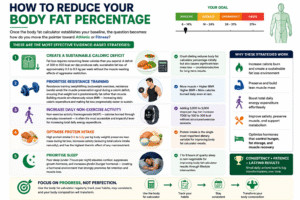
Once the body fat calculator establishes your baseline, the question becomes: how do you move the pointer toward Athletic or Fitness? These are the most effective evidence-based strategies:
Create a Sustainable Caloric Deficit: Fat loss requires consuming fewer calories than you expend. A deficit of 300 to 500 kcal per day produces safe, sustainable fat loss of approximately 0.3 to 0.5 kg per week without the muscle-wasting effects of aggressive restriction. Crash dieting reduces body fat calculator percentage initially but also causes significant lean mass loss — counterproductive for long-term results.
Prioritise Resistance Training: Resistance training (weightlifting, bodyweight exercises, resistance bands) sends the muscle-preservation signal during a caloric deficit, ensuring that weight lost is predominantly fat rather than muscle. Building muscle simultaneously raises BMR — increasing daily caloric expenditure and making fat loss progressively easier to sustain.
Increase Daily Non-Exercise Activity: Non-exercise activity thermogenesis (NEAT) — calories burned through everyday movement — is often the most accessible and impactful lever for increasing total daily energy expenditure. Adding 3,000 to 5,000 steps per day can increase TDEE by 100 to 300 kcal without structured exercise sessions.
Optimise Protein Intake: High protein intake (1.6 to 2.2g per kg body weight) preserves lean mass during fat loss, increases satiety (reducing total caloric intake naturally), and has the highest thermic effect of any macronutrient. Protein intake is the single most important dietary variable for improving body fat calculator results.
Prioritise Sleep: Poor sleep (under 7 hours per night) elevates cortisol, suppresses growth hormone, and increases ghrelin (hunger hormone) — creating a hormonal environment that strongly promotes fat retention and muscle loss. 7 to 9 hours of quality sleep is non-negotiable for improving body fat calculator results through lifestyle intervention.
Tracking Progress with the Body Fat Calculator Over Time
The most powerful use of the body fat calculator is not a single reading but a consistent tracking practice over weeks and months. Here is how to use it effectively for progress monitoring:
Establish a Baseline: Your first body fat calculator result is your baseline — the reference point against which all future measurements are compared. Record this baseline alongside your measurement date, weight, and unit system used.
Retest Every 6 to 8 Weeks: Body fat percentage changes slowly — a rate of 0.5% to 1% per month is realistic and sustainable for most individuals. Retesting your body fat calculator every 6 to 8 weeks allows enough time for meaningful change to accumulate while keeping your assessment current.
Distinguish Fat Loss from Muscle Gain: If your total weight is stable but your body fat calculator percentage is falling, you are simultaneously losing fat and gaining muscle — the most desirable body recomposition outcome. This progress is invisible on a scale but clearly visible in a consistent body fat calculator tracking practice.
Photograph and Measure Simultaneously: Progress photographs, circumference measurements, and body fat calculator results together provide a more complete picture than any single metric alone. Compare photographs at the same pose, lighting, and time of day for the most accurate visual tracking.
Frequently Asked Questions (FAQs)
What is a body fat calculator? A body fat calculator is a tool that estimates the percentage of your total body weight that is composed of fat tissue, using measurements such as waist circumference, neck circumference, height, weight, age, and gender.
How accurate is the body fat calculator? Circumference-based methods like those used in our body fat calculator typically estimate body fat percentage within 3% to 5% of DEXA scan results for most individuals. Accuracy is highest when measurements are taken consistently and correctly. The tool is most valuable for tracking trends over time rather than establishing precise absolute values.
What is a healthy body fat percentage? Healthy ranges differ by gender. For males: Fitness range is approximately 14% to 17%; for females: 21% to 24%. Our body fat calculator categorises results against these norms automatically. Consult a healthcare professional for clinical assessment.
Can I use the body fat calculator if I am very muscular? Circumference-based methods may slightly overestimate body fat in very muscular individuals (who have large neck circumferences) because larger neck size reduces the Waist − Neck differential. For highly muscular individuals, DEXA scanning provides more accurate body fat calculator-equivalent data.
How often should I use the body fat calculator? Every 6 to 8 weeks during active body composition change programmes. More frequent body fat calculator testing does not add meaningful information because changes accumulate over weeks, not days.
Does the body fat calculator work for all ages? Yes. The age modifier in the body fat calculator formula adjusts the result to account for the well-documented age-related increase in body fat percentage that occurs even at stable weight. Results are valid across adult age ranges.
What is the difference between body fat percentage and BMI? BMI measures weight relative to height — it cannot distinguish fat from muscle. The body fat calculator measures the actual proportion of fat mass in your total body weight, making it a more specific body composition indicator than BMI.
Is it possible to have a healthy BMI but unhealthy body fat? Yes — this is called Metabolically Obese Normal Weight (MONW). A body fat calculator can identify this scenario where BMI cannot, flagging elevated fat percentage despite a normal-range BMI score.
What units does the body fat calculator support? Our body fat calculator supports three unit systems: Metric (cm and kg), US Units (inches and lbs), and Other (cm for height, stones for weight).
Can women use the same body fat calculator? Yes. The body fat calculator uses gender as an input to apply sex-appropriate classification — ensuring female results are compared against female-specific healthy body fat ranges rather than male norms.
Conclusion
Total body weight is a blunt instrument. Body fat percentage is the precision tool that actually reveals the composition behind that number — separating functional, metabolically active lean mass from the excess fat that drives disease risk, reduces performance, and undermines quality of life. Our free body fat calculator makes this essential distinction accessible in seconds, using simple measurements that require no equipment beyond a tape measure.
By entering your age, gender, height, weight, waist circumference, and neck circumference, our body fat calculator produces your estimated body fat percentage, assigns your status category (Athletic, Fitness, Average, or Obese), and positions your result on a colour-coded visual meter that makes your body composition picture immediately clear. Across three unit systems — Metric, US, and Other — the body fat calculator delivers precise, personalised results to users worldwide.
Whether your pointer sits in the green Athletic zone, the yellow Fitness zone, the orange Average zone, or the red Obese zone, your body fat calculator result is actionable information — the precise, objective baseline from which every meaningful body composition journey begins. Use it to establish your baseline, set your target category, track your progress every 6 to 8 weeks, and confirm that your training and nutrition programme is delivering the body composition transformation you are working toward.
Use our body fat calculator today. Measure what matters. Track what changes. Build the body you are training for.