BMI Calculator
Unlock Your Complete Loan Schedule with the Mortgage Amortization Calculator
Table of Contents
- Introduction
- What Is a BMI Calculator?
- Why BMI Matters – The Case for Measuring Body Mass Index
- The BMI Formula – How It Works
- How Our BMI Calculator Processes Your Data
- Understanding the Four BMI Categories
- Underweight – Risks and Health Implications
- Normal Weight – The Healthy Target Range
- Overweight – What the Numbers Mean
- Obesity – Health Risks and Structured Action
- The BMI Visual Meter Explained
- Three Unit Systems in the BMI Calculator
- Age and Gender in the BMI Calculator
- BMI Calculator for Men vs. Women – Key Differences
- Limitations of the BMI Calculator – What It Cannot Tell You
- How to Improve Your BMI Calculator Score
- Frequently Asked Questions (FAQs)
- Conclusion
Introduction
Health assessment should be simple, accessible, and actionable. For decades, clinicians, researchers, public health organisations, and fitness professionals have relied on one straightforward metric to provide an immediate, evidence-based indication of whether a person’s body weight falls within a range associated with good health or elevated disease risk. That metric is the Body Mass Index — and the tool that calculates it instantly from your personal data is the BMI calculator.
A BMI calculator takes your height and weight — two measurements available to virtually everyone, requiring no specialist equipment — and produces a single score that places you within one of four internationally recognised weight status categories: Underweight, Normal, Overweight, or Obese. These categories are not arbitrary labels; they are thresholds derived from decades of population research linking BMI ranges to health outcomes, chronic disease incidence, and mortality rates.
In this comprehensive guide, you will learn exactly what a BMI calculator is, how it works, what every score range means for your health, why age and gender matter in BMI interpretation, what the tool’s limitations are, and how to use your results to make informed decisions about your weight and wellbeing. Whether you are checking your BMI for the first time, monitoring ongoing progress, or helping a family member understand their weight status, our free BMI calculator delivers instant, personalised, evidence-based results in seconds.
What Is a BMI Calculator?
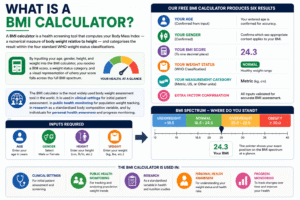
A BMI calculator is a health screening tool that computes your Body Mass Index — a numerical measure of body weight relative to height — and categorises the result within the four standard WHO weight status classifications. By inputting your age, gender, height, and weight into the BMI calculator, you receive a BMI score, a weight status category, and a visual representation of where your score falls across the full BMI spectrum.
The BMI calculator is the most widely used body weight assessment tool in the world. It is used in clinical settings for initial patient assessment, in public health monitoring for population weight tracking, in research as a standardised body composition variable, and by individuals for personal health awareness and progress monitoring.
Our free BMI calculator produces six results:
- Your age (confirmed from input)
- Your gender (confirming which sex-appropriate context applies)
- Your BMI score (to one decimal place)
- Your weight status (Underweight, Normal, or Overweight/Obese)
- Your measurement category (Metric, US, or Other units)
- An extra factor confirmation
It also features a four-zone colour-coded visual meter — spanning Underweight, Normal, Overweight, and Obesity zones — with a moving pointer that shows your exact position on the BMI spectrum at a glance.
Why BMI Matters – The Case for Measuring Body Mass Index
The question is not whether you should know your BMI score — it is why you should use a BMI calculator regularly. Here is the evidence-based case for the importance of this simple measurement:
Population-Level Validation: BMI has been validated in thousands of population studies as a reliable predictor of weight-related health outcomes. Individuals with BMI scores in the Overweight and Obese ranges have statistically significant elevated risks of cardiovascular disease, type 2 diabetes, hypertension, sleep apnoea, and certain cancers — independent of other risk factors. The BMI calculator translates this population-level evidence into a personal risk indicator.
Accessibility: Unlike body fat percentage measurement (which requires calipers, DEXA scanning, or hydrostatic weighing), the BMI calculator requires only a scale and a measuring tape — both accessible to anyone, anywhere. This accessibility makes it the standard tool for initial health screening in virtually every healthcare system globally.
Objectivity: Personal perception of body weight is notoriously unreliable. Studies consistently show that most overweight individuals underestimate their weight status, while some healthy-weight individuals overestimate it. The BMI calculator provides an objective, mathematical score that removes subjective perception from weight status assessment.
Progress Tracking: For individuals undertaking weight management programmes — whether for fat loss, weight gain, or maintenance — the BMI calculator provides a consistent, standardised measurement that tracks progress objectively over weeks and months.
Medical Communication: Healthcare providers use BMI universally as a common reference language for weight status. Knowing your BMI calculator score means you speak the same measurement language as your doctor — making clinical conversations about weight, disease risk, and management strategies more specific and productive.
The BMI Formula – How It Works
The BMI calculator applies one of the most elegant formulas in health measurement — converting two simple measurements into a composite index that predicts health risk better than either measurement alone:
Standard Metric Formula:
BMI = Weight (kg) ÷ Height² (m²)
Example: A person 175 cm tall (1.75 m) weighing 70 kg: 1.75 × 1.75 = 3.0625 70 ÷ 3.0625 = BMI 22.9 — squarely within the Normal range.
US Imperial Formula:
BMI = (Weight in lbs ÷ Height in inches²) × 703
The 703 conversion factor accounts for the unit difference between the metric and imperial systems — ensuring the same BMI score is produced for equivalent metric and imperial inputs.
Other Units Formula (Stones): First convert stones and lbs to total pounds, then convert height from centimetres to inches, and apply the US formula. Our BMI calculator handles all three conversions automatically — you enter your measurements in your preferred unit system and receive the same standardised BMI score regardless of which unit system you use.
The formula’s mathematical logic: By dividing weight by height squared (rather than simply by height), the formula corrects for the fact that taller people carry more weight by geometric necessity — a 6-foot person naturally weighs more than a 5-foot person even at the same body composition. The BMI calculator’s division by height squared produces a body size-normalised score that is comparable across individuals of different heights.
How Our BMI Calculator Processes Your Data
Our BMI calculator accepts inputs across three unit systems and processes them through the appropriate formula to produce a consistent BMI score:
Metric Unit Processing:
- Height converted from centimetres to metres: height (cm) ÷ 100
- Formula: BMI = weight (kg) ÷ (height in metres)²
- The native format of the BMI calculator formula — no conversion required beyond the cm-to-metres step
US Units Processing:
- Height combined: (feet × 12) + inches = total inches
- Formula: BMI = (weight in lbs ÷ total inches²) × 703
- The BMI calculator handles the feet-to-inches conversion and applies the 703 imperial correction factor automatically
Other Units Processing (Stones and Pounds):
- Weight converted: (stones × 14) + pounds = total pounds
- Height converted from centimetres to inches: cm ÷ 2.54
- Formula: BMI = (total lbs ÷ height in inches²) × 703
- The BMI calculator performs both weight and height conversions before applying the formula
All three processing paths produce mathematically identical BMI scores for the same physical measurements — unit system selection affects only how you enter your data, not the accuracy of the result.
Understanding the Four BMI Categories
The BMI calculator classifies every score into one of four categories, each corresponding to a distinct weight status with specific health implications:
Underweight — BMI below 18.5: Body weight insufficient relative to height. Associated with nutritional deficiency risks, immune suppression, bone density loss, and in severe cases, eating disorders requiring medical attention.
Normal Weight — BMI 18.5 to 24.9: The target range — associated with the lowest all-cause mortality and the lowest risk of weight-related chronic disease. A BMI calculator result in this range confirms that body weight is appropriate for height and consistent with optimal health outcomes according to WHO research.
Overweight — BMI 25.0 to 29.9: Excess weight relative to height. Associated with elevated but manageable risk of cardiovascular disease, type 2 diabetes, and joint problems. Many individuals in this range benefit significantly from modest lifestyle changes. The BMI calculator identifies this range as a lifestyle attention point.
Obese — BMI 30.0 and above: Substantial excess weight with significantly elevated health risk. The BMI calculator flags this range as a health priority requiring structured intervention — dietary change, increased physical activity, and professional medical guidance. Obesity is further classified into Class 1 (30–34.9), Class 2 (35–39.9), and Class 3 (40+) for clinical purposes.
Underweight – Risks and Health Implications
A BMI calculator result below 18.5 indicates underweight status — a condition that carries significant but often underappreciated health risks:
Nutritional Deficiency: Underweight individuals frequently have insufficient intake of essential vitamins and minerals. Iron deficiency anaemia, vitamin D deficiency, and calcium inadequacy are common at BMI levels below 18.5, contributing to fatigue, immune impairment, and bone fragility.
Bone Density Loss: Low body weight is one of the strongest independent risk factors for osteoporosis and fracture risk — particularly in women. The mechanical loading that healthy body weight provides on bones is a critical stimulus for maintaining bone mineral density.
Immune Suppression: Adequate nutrition and caloric sufficiency are prerequisites for normal immune function. BMI calculator scores in the underweight range are associated with impaired immune cell production, slower wound healing, and increased susceptibility to infection.
Muscle Loss: Insufficient caloric intake forces the body to catabolise muscle tissue for energy. Muscle loss at low BMI reduces functional capacity, lowers metabolic rate, and creates a downward cycle of declining strength and increasing fragility.
If your BMI calculator result places you in the underweight range, consult a healthcare professional or registered dietitian before attempting to increase weight — to rule out underlying medical causes and design a nutritional programme that improves body composition safely.
Normal Weight – The Healthy Target Range
A BMI calculator result between 18.5 and 24.9 is the optimal outcome — the weight status associated with the lowest risk of weight-related chronic disease and the best long-term health and longevity outcomes.
What a Normal BMI calculator score means for your health:
Cardiovascular Health: Normal-range BMI calculator scores are associated with optimal blood pressure, favourable lipid profiles, and the lowest risk of coronary artery disease and stroke. Each unit increase above BMI 25 is associated with a statistically significant incremental increase in cardiovascular disease risk.
Metabolic Health: Normal BMI is associated with preserved insulin sensitivity, stable fasting blood glucose, and low risk of developing type 2 diabetes. Maintaining a BMI calculator score in the Normal range throughout adult life is one of the most effective preventive strategies against metabolic syndrome.
Musculoskeletal Health: Normal body weight places appropriate mechanical load on joints and bones — enough to maintain bone density without causing the joint stress overload that occurs at higher BMI values.
Maintaining a Normal BMI calculator result: Even within the Normal range, body composition matters — a “normal weight” individual with low muscle mass and high body fat may have worse metabolic health than expected. Combining your BMI calculator result with body fat percentage assessment provides a more complete health picture.
Overweight – What the Numbers Mean
A BMI calculator result between 25.0 and 29.9 places you in the overweight category — the most populous weight category in many developed countries, reflecting widespread sedentary lifestyles and caloric surplus.
Health risks begin accumulating in the overweight range:
- Insulin resistance develops progressively as adipose tissue accumulation impairs cellular glucose uptake
- Blood pressure elevation — each BMI unit above 25 is associated with approximately 1–2 mmHg increase in resting blood pressure
- Joint stress increases measurably, particularly in knee joints — each kilogram of excess weight creates approximately 3 to 4 kilograms of additional knee loading during walking
- Sleep quality deteriorates as excess upper body weight increases upper airway resistance
The encouraging reality: Moving your BMI calculator score from the overweight range (25 to 29.9) back into the Normal range typically requires modest, achievable changes. A 5% to 10% reduction in body weight — often achievable in 2 to 4 months with consistent lifestyle changes — produces clinically significant improvements in blood pressure, blood glucose, joint pain, and energy levels.
Obesity – Health Risks and Structured Action
A BMI calculator result of 30 or above places you in the obese category — where health risks become substantially elevated and professional guidance is strongly recommended.
The health burden of obesity is extensive and well-documented:
Cardiovascular Disease: Obesity drives hypertension, dyslipidaemia, and cardiac hypertrophy through both mechanical and metabolic mechanisms. A BMI calculator result in the obese range is associated with 2 to 3 times the cardiovascular disease risk of a Normal-range score, independent of other risk factors.
Type 2 Diabetes: The relationship between obesity and type 2 diabetes is the strongest in chronic disease epidemiology. Individuals with a BMI calculator score above 30 have approximately 7 times the type 2 diabetes risk of those with a Normal BMI — driven by visceral fat’s direct impairment of insulin signalling.
Cancer Risk: The International Agency for Research on Cancer identifies excess body weight as a contributor to at least 13 cancer types, including breast, colon, kidney, and endometrial cancers. The BMI calculator’s obese classification is a cancer risk indicator alongside its more commonly discussed cardiovascular and metabolic implications.
Mental Health: The relationship between obesity and mental health is complex and bidirectional — depression, anxiety, and reduced quality of life are more prevalent at BMI extremes. Improving your BMI calculator score through structured lifestyle intervention consistently produces meaningful improvements in mood, self-esteem, and quality of life alongside physical health benefits.
Structured action plan for obese BMI calculator results:
- Seek professional medical assessment — establish metabolic baselines (blood glucose, lipid panel, blood pressure)
- Begin with sustainable changes — 300 to 500 kcal daily deficit through combined dietary and activity modification
- Introduce resistance training — preserves lean mass during fat loss and raises resting metabolic rate
- Address behavioural drivers — stress eating, sleep deprivation, and sedentary work environments
- Track progress with the BMI calculator every 6 to 8 weeks
The BMI Visual Meter Explained
Our BMI calculator includes a four-zone colour-coded visual meter that provides immediate visual context for your BMI score:
Dark Red (Left) – Underweight: Covers BMI below approximately 18.5. A pointer in this zone indicates insufficient body weight for optimal health.
Green – Normal: Covers the healthy BMI range of 18.5 to 24.9. A pointer in the green zone confirms a BMI calculator score associated with optimal health outcomes — the target range for all weight management efforts.
Yellow – Overweight: Covers BMI 25.0 to 29.9. A pointer here signals excess weight that warrants lifestyle attention and moderate intervention.
Dark Red (Right) – Obese: Covers BMI 30.0 and above. A pointer in this zone indicates a health risk level requiring structured professional-guided intervention.
The pointer position within each zone is also informative — a pointer at the far right of the Normal zone (BMI 24.5) is closer to the overweight boundary than one at the centre (BMI 22), providing a visual sense of margin that a category label alone does not convey. Our BMI calculator’s visual meter makes this gradient immediately apparent.
Three Unit Systems in the BMI Calculator
Our BMI calculator supports three unit systems to accommodate users across all countries and measurement conventions:
Metric Units: Height in centimetres, weight in kilograms — the standard system in Europe, Asia, Africa, Australia, and international scientific contexts. The native format of the BMI calculator formula, requiring only the simple cm-to-metres conversion.
US Units: Height in feet and inches, weight in pounds — the conventional system in the United States. The BMI calculator applies the imperial formula (× 703 correction factor) after converting feet and inches to total inches.
Other Units: Height in centimetres, weight in stones and pounds — the hybrid system common in the UK and Ireland. The BMI calculator converts stones and pounds to total pounds and centimetres to inches before applying the imperial formula.
Unit system selection does not affect result accuracy — all three paths apply mathematically equivalent formulas and produce identical BMI scores for equivalent physical measurements.
Age and Gender in the BMI Calculator
Our BMI calculator collects age and gender as inputs — important for contextualising your BMI score against appropriate reference norms even though the core BMI formula itself is not gender- or age-adjusted:
Age in the BMI Calculator: Age is captured and displayed in your results as a contextual reference. While the standard WHO BMI formula does not include an age adjustment, age significantly affects how BMI should be interpreted:
- In children and adolescents, BMI is interpreted differently using age- and sex-specific growth charts — the standard adult BMI thresholds do not apply to under-18s
- In older adults (65+), research suggests slightly higher BMI scores (up to approximately 27) may be associated with better outcomes than the standard 25 threshold, as modest fat reserves provide protection against the muscle wasting and frailty common in ageing. Age context from the BMI calculator results helps healthcare providers make appropriately nuanced interpretations
Gender in the BMI Calculator: Gender is displayed as a result confirmation and used for contextualising status. While the BMI formula is identical for males and females, women typically have higher body fat percentages at equivalent BMI scores due to physiological differences in fat distribution. A BMI of 24 in a woman contains proportionally more body fat than the same score in a man — an important nuance when using BMI calculator results alongside body fat percentage measurements.
BMI Calculator for Men vs. Women – Key Differences
The same BMI calculator formula applies to both sexes, but the health implications of equivalent scores differ systematically between men and women:
Fat Distribution: Men tend to accumulate fat centrally (visceral/abdominal fat) — the metabolically harmful fat depot most strongly associated with cardiovascular and metabolic disease. Women tend to accumulate fat peripherally (hips, thighs, buttocks) — less metabolically active and associated with lower disease risk per unit of total fat mass. This means a man and a woman with identical BMI calculator scores may have different health risk profiles, with the man’s risk potentially higher due to central fat distribution.
Healthy Body Fat Ranges: Women have physiologically higher body fat requirements than men — approximately 8 to 10% higher at equivalent fitness levels — due to sex hormone requirements and reproductive physiology. The BMI calculator uses the same score thresholds for both sexes, but body fat percentage assessment provides a sex-specific health picture that the BMI score alone cannot.
Hormonal Influence: Oestrogen promotes peripheral (hip and thigh) fat storage, which partially explains women’s lower cardiovascular risk at equivalent BMI scores. Testosterone supports lean mass maintenance, explaining men’s typically higher lean mass and lower relative body fat at the same BMI. These hormonal differences mean that BMI calculator results should be interpreted with sex-specific context, particularly at borderline scores.
Limitations of the BMI Calculator – What It Cannot Tell You
The BMI calculator is a powerful and widely validated screening tool — but it has well-documented limitations that are important to understand when interpreting your results:
Does Not Measure Body Composition: BMI measures total mass relative to height — it cannot distinguish muscle from fat. A highly muscular athlete may have a BMI calculator score in the overweight or obese range despite having very low body fat, because high muscle mass raises total weight without raising fat mass. Conversely, a sedentary person with low muscle mass and high fat may score in the Normal range despite poor metabolic health.
Does Not Capture Fat Distribution: Where fat is stored matters enormously for health risk. Two people with identical BMI calculator scores but different fat distribution patterns — one carrying fat abdominally, one peripherally — may have very different cardiovascular risks. Waist circumference is a valuable supplement to BMI for this reason.
Ethnic Variation: Standard WHO thresholds were developed primarily from European population data. Research consistently shows that people of South, East, and Southeast Asian descent may experience metabolic complications at lower BMI values — some Asian health organisations recommend BMI calculator action thresholds of 23 (overweight) and 27.5 (obese) rather than the standard 25 and 30.
Age Nuances: The relationship between BMI and body fat percentage changes with age, and the optimal BMI range may shift slightly upward for older adults. The BMI calculator’s standard thresholds are most precisely calibrated for adults aged 18 to 65.
The key message: Use the BMI calculator as an important initial indicator and tracking tool — but complement it with body fat percentage measurement, waist circumference, and clinical blood markers for a complete health picture.

How to Improve Your BMI Calculator Score
If your BMI calculator result falls outside the Normal range (18.5 to 24.9), these evidence-based strategies address both ends of the spectrum:
For Overweight or Obese (BMI above 25):
Sustainable Caloric Deficit: A daily deficit of 300 to 500 kcal produces safe, steady weight loss of approximately 0.3 to 0.5 kg per week — the rate at which fat loss is predominantly fat rather than muscle or water. Crash diets produce rapid initial BMI calculator score improvements that are unsustainable and typically reversed within months.
Resistance Training: Building lean muscle mass simultaneously improves body composition and raises resting metabolic rate — making weight management progressively easier. Improving muscle mass can improve your BMI calculator-related health metrics even before total weight changes significantly.
Protein Priority: Dietary protein at 1.6 to 2.2g per kg body weight preserves lean mass during deficit, increases satiety, and has the highest thermic effect of any macronutrient. High protein intake is the single most effective dietary strategy for improving both BMI calculator score and body composition simultaneously.
Consistent Sleep: Sleep deprivation drives fat retention through hormonal dysregulation. 7 to 9 hours of quality sleep per night is a non-negotiable component of effective BMI management.
For Underweight (BMI below 18.5): Focus on nutrient-dense caloric increase combined with resistance training to build lean muscle mass — improving BMI calculator score through functional, healthy weight gain rather than fat accumulation alone.
Frequently Asked Questions (FAQs)
What is a BMI calculator? A BMI calculator is a tool that computes your Body Mass Index — weight (kg) divided by height squared (m²) — and categorises the result as Underweight, Normal, Overweight, or Obese according to WHO standards.
Is the accurate? For most adults, the is an accurate population-level screening tool. It is less accurate for highly muscular individuals, older adults, and certain ethnic groups where standard thresholds may not apply.
What is a healthy BMI calculator score? The healthy BMI calculator range is 18.5 to 24.9 — associated with the lowest all-cause mortality and chronic disease risk according to WHO population research.
Does the BMI calculator work for children? Standard adult BMI calculator thresholds do not apply to children under 18. Paediatric BMI assessment uses age- and sex-specific growth charts — consult a healthcare professional for under-18 assessment.
How often should I check my BMI calculator score? For individuals actively managing weight, every 4 to 6 weeks. For weight-stable adults in the Normal range, an annual BMI calculator check is sufficient to confirm maintained status.
What units does the BMI calculator support? Our BMI calculator supports Metric (cm and kg), US Units (feet, inches, and lbs), and Other Units (cm height and stones/pounds weight).
Can a fit person have a high BMI calculator score? Yes — highly muscular individuals often have elevated BMI calculator scores (25 to 30) despite low body fat. For such individuals, body fat percentage measurement is a more appropriate assessment.
Does the BMI calculator account for age? Age is captured in the BMI calculator as a contextual factor. The core formula does not adjust for age, but age significantly affects how results should be interpreted — particularly for older adults and adolescents.
Is the BMI calculator different for men and women? The formula is identical for both sexes. However, healthy body fat percentage at equivalent BMI scores differs between men and women due to physiological differences — gender is displayed in results as context for appropriate interpretation.
What should I do if my result is in the obese range? Seek professional medical guidance. A structured programme combining dietary modification, increased physical activity, behavioural support, and regular BMI calculator monitoring is the most effective approach for sustainable improvement.
Conclusion
Body Mass Index is not a perfect measure — but it is the most validated, accessible, and universally understood indicator of weight-related health risk available today. A single number, derived from two simple measurements, that has guided clinical practice and public health policy worldwide for decades. And our free makes that number available to you instantly, accurately, and at no cost.
Enter your age, gender, height, and weight into our — in Metric, US, or Other Units — and receive your BMI score, weight status category, and visual meter position in seconds. Whether your result confirms the Normal range you are working to maintain, reveals the Overweight or Obese status you are ready to address, or flags the Underweight condition that deserves professional attention, your BMI calculator result is the objective starting point every successful weight management journey needs.
Use our BMI calculator today. Know your number. Understand your health status. Take the first data-driven step toward your optimal weight.