Future Value Calculator
See How Fast You’ll Recover Your Investment with Our Payback Period Calculator
Table of Contents
- Introduction
- What Is a Future Value Calculator?
- Why Every Investor Needs a Future Value Calculator
- The Power of Compound Interest Explained
- Key Inputs in a Future Value Calculator
- Understanding Your Financial Results
- How Inflation Erodes Your Future Value
- Tax Impact on Investment Growth
- Maintenance Fees and Risk Factor – The Hidden Reducers
- The Amortization Table – Watching Your Wealth Grow Year by Year
- The Growth Chart – Visualising Your Financial Future
- Investment Strategies That Maximise Future Value
- How to Use Our Future Value Calculator Step-by-Step
- Common Investment Mistakes That Reduce Future Value
- Frequently Asked Questions (FAQs)
- Conclusion
Introduction
Every financial decision you make today has consequences that extend years, decades, and sometimes generations into the future. Whether you are saving for retirement, building an emergency fund, planning a child’s education, or growing a long-term investment portfolio, the question that matters most is not how much you have today — it is how much you will have tomorrow.
A Future Value Calculator answers that question with precision. By processing your initial investment, ongoing monthly deposits, annual return rate, investment horizon, inflation rate, tax impact, maintenance fees, and risk factor, it gives you a mathematically accurate projection of where your wealth will stand at any point in the future — complete with a year-by-year growth table and a visual line chart showing your portfolio’s trajectory.
In this comprehensive guide, you will learn exactly how a Future Value Calculator works, what each input represents, how to interpret every output, and which investment strategies most effectively maximise the future value of your money. Whether you are just starting your savings journey or managing a sophisticated investment portfolio, the Future Value Calculator is the most important planning tool available to you.
What Is a Future Value Calculator?
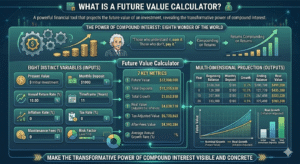
A Future Value Calculator is a financial planning tool that projects the value of an investment at a specified point in the future, accounting for compound interest, regular contributions, inflation, taxation, fees, and risk. It takes a snapshot of your current financial position and extrapolates it forward using mathematical models to show you what disciplined saving and investing can produce over time.
The core concept behind a Future Value Calculator is compound interest — the process by which returns are earned not just on your original investment but on the accumulated returns from all previous periods. Albert Einstein reportedly called compound interest the eighth wonder of the world, and the Future Value Calculator makes its transformative power concrete and visible.
Unlike basic savings estimators that only account for a single interest rate, our comprehensive Future Value Calculator processes eight distinct variables: present value (initial investment), monthly deposit amount, annual return rate, investment timeframe in years, inflation rate, tax rate, maintenance fees, and risk factor. Together, these inputs produce a realistic, multi-dimensional projection rather than an overly optimistic single-variable estimate.
The result is a detailed financial summary — seven key metrics plus a full year-by-year amortization table and growth line chart — that gives you the most complete picture available of your investment’s future potential.
Why Every Investor Needs a Future Value Calculator
Most people significantly underestimate how much wealth consistent investing can build over time — and equally underestimate the devastating long-term impact of delaying the start of their investment journey. A Future Value Calculator corrects both misconceptions with objective data.
Here is why using a Future Value Calculator is essential for anyone serious about their financial future:
Quantifies the Cost of Waiting: Starting to invest five years later does not reduce your future wealth by 5 years’ worth of contributions. Due to compounding, it can reduce your final value by 30% to 50% or more. A Future Value Calculator makes this penalty explicit and urgent.
Sets Realistic Goals: Knowing that your planned saving rate will produce $X in 20 years either confirms your strategy is on track or reveals that adjustments are needed — either more contributions, higher returns, or a longer time horizon. Without a Future Value Calculator, these goal-setting conversations happen in the dark.
Compares Investment Scenarios: Should you invest $10,000 now with no monthly additions, or start with $5,000 and add $300 per month? A Future Value Calculator lets you model both scenarios and compare results instantly, making the optimal choice obvious.
Accounts for Real-World Costs: Inflation, taxes, and fees silently erode investment returns. A naive projection that ignores these factors produces dangerously optimistic results. Our Future Value Calculator incorporates all three, giving you a realistic, adjusted projection rather than a best-case fantasy.
Motivates Consistent Contribution: Seeing in concrete dollar terms what an extra $50 or $100 per month will produce over 20 or 30 years is one of the most powerful motivators for financial discipline. The Future Value Calculator transforms abstract saving habits into visible, tangible wealth outcomes.
The Power of Compound Interest Explained
Compound interest is the engine that drives every projection in a Future Value Calculator. Understanding how it works is essential for appreciating why the tool’s results sometimes seem surprisingly large — or why small differences in rate produce dramatically different outcomes over long periods.
Simple interest applies only to your original principal. If you invest $10,000 at 7% simple interest, you earn $700 per year regardless of how large your balance grows.
Compound interest applies to your growing balance. In year one, you earn $700 on your $10,000. In year two, you earn 7% on $10,700 — which is $749. In year three, 7% on $11,449 — and so on. Each year’s return becomes part of the base for next year’s calculation, and the growth accelerates exponentially over time.
The Future Value Calculator applies compound interest annually to your entire balance — including both your original investment and all accumulated monthly deposits and prior returns. This means the longer you hold the investment, the more dramatic the compounding effect becomes.
The Rule of 72 offers a quick intuitive check: divide 72 by your annual return rate to find approximately how many years it takes to double your money. At 7%, your investment doubles roughly every 10.3 years. At 10%, every 7.2 years. Use the Future Value Calculator to model these doubling timelines with your specific deposit amounts and see exactly how many doublings you can achieve within your investment horizon.
Key Inputs in a Future Value Calculator
The accuracy of any Future Value Calculator depends entirely on the quality of the inputs provided. Our calculator uses eight carefully chosen fields that capture every financially significant variable in an investment projection:
Present Value ($): Your initial lump sum investment — the amount you are starting with today. This is the seed from which your investment portfolio will grow. Even a modest initial investment, when combined with consistent monthly deposits and a long time horizon, can produce remarkable results.
Monthly Deposit ($): The fixed amount you contribute to your investment account every month. Regular monthly contributions are one of the most powerful variables in any Future Value Calculator — they harness the benefit of dollar-cost averaging and dramatically accelerate portfolio growth compared to a lump sum alone.
Annual Rate (%): The expected average annual return on your investment. Historical averages vary by asset class: diversified stock market index funds have historically returned approximately 7% to 10% annually over long periods, bond portfolios typically 3% to 5%, and savings accounts 1% to 3%. Enter a conservative, realistic rate rather than an optimistic estimate to ensure your projections remain credible.
Years: The number of years you plan to hold the investment. This is the most powerful lever in any Future Value Calculator — time is the primary driver of compounding. An extra 5 or 10 years can more than double the final value due to the exponential nature of compound growth.
Inflation (%): The expected average annual inflation rate over your investment horizon. Inflation erodes the purchasing power of your future wealth — $500,000 in 25 years will buy significantly less than $500,000 today. The Future Value Calculator adjusts your final value for inflation, showing you both the nominal value and the inflation-adjusted real value of your investment.
Tax Rate (%): The rate at which your investment gains are taxed. In the United States, long-term capital gains are taxed at 0%, 15%, or 20% depending on income level. Short-term gains are taxed as ordinary income. The Future Value Calculator subtracts the tax impact annually, giving you a post-tax projection that reflects your actual take-home return rather than an idealized pre-tax figure.
Maintenance Fee ($): Annual fees charged by investment platforms, fund managers, or financial advisers. Even small annual fees have a significant compounding impact over long periods — a 1% annual fee on a growing portfolio can reduce total returns by 20% or more over 30 years. Always enter your actual fee structure into the Future Value Calculator to see the true long-term cost of your investment vehicle.
Risk Factor (%): A percentage reduction applied to account for investment risk — the possibility of underperformance, losses, or economic disruptions that prevent you from achieving the expected return consistently. Entering a conservative risk factor produces a more realistic, stress-tested projection rather than assuming perfect performance every year.
Understanding Your Financial Results
Our Future Value Calculator produces seven distinct result metrics, each providing a different lens through which to understand your investment’s performance:
Initial Investment: Your starting present value — the baseline figure that confirms the calculator has correctly captured your opening position.
Total Savings: The cumulative total of all your monthly deposits over the full investment period. This is the actual cash you will contribute from your income, excluding any investment returns.
Tax Impact: The total tax liability associated with your investment returns over the full period. This figure represents the portion of your gains that will flow to the government rather than to your portfolio.
Maintenance Cost: The total accumulated fees paid to your investment platform or manager over the full period. Seeing this figure as a total rather than an annual amount often motivates investors to seek lower-cost investment vehicles — a powerful insight the Future Value Calculator makes possible.
Inflation Adjusted Value: Your projected final balance expressed in today’s purchasing power terms. This is arguably the most honest measure of your investment’s success — it answers the question “how much will my wealth actually be worth in real terms?” rather than just the nominal dollar figure.
Final Future Value: The total nominal value of your investment portfolio at the end of the projection period, after accounting for compound growth, deposits, taxes, and fees. This is the headline number — the culmination of your entire investment journey.
Total Net Gain: The difference between your Final Future Value and the total amount you invested (initial investment plus all deposits). This figure represents the pure return on your investment — the wealth created by compounding and market returns above and beyond the capital you contributed.
How Inflation Erodes Your Future Value
Inflation is the silent destroyer of long-term investment returns, and no Future Value Calculator worth using ignores it. Understanding inflation’s impact is crucial for setting realistic financial goals.
Inflation reduces purchasing power over time. At a 2% annual inflation rate — the typical central bank target — prices double approximately every 36 years. This means that $1,000,000 in 36 years will have the same purchasing power as approximately $500,000 today.
For long-term investors, this has profound implications. A Future Value Calculator projection showing a final value of $800,000 after 25 years at 7% annual growth looks impressive in nominal terms. But at 2% annual inflation, the inflation-adjusted real value of that $800,000 is approximately $481,000 in today’s purchasing power — a significant difference.
Our Future Value Calculator computes the inflation-adjusted figure automatically, using the compound deflation formula: Real Value = Nominal Value ÷ (1 + Inflation Rate)^Years. This gives you both the headline nominal figure and the realistic real-terms equivalent.
Key implications for investment planning:
- Your target retirement figure should be expressed in today’s dollars, then inflated to a future nominal target using the Future Value Calculator’s inflation input.
- Real returns (after inflation) matter more than nominal returns. A 7% nominal return in a 3% inflation environment produces a 4% real return — the true measure of wealth creation.
- Fixed-rate savings accounts are particularly vulnerable to inflation — a 2% savings rate in a 3% inflation environment actually destroys real wealth over time.
Tax Impact on Investment Growth
Taxation is one of the most significant — and most frequently overlooked — costs in investment planning. Our Future Value Calculator incorporates your personal tax rate into every year’s calculation, producing a post-tax projection that reflects your actual financial position.
How tax affects compound growth: Without tax, a $10,000 investment at 7% over 30 years grows to approximately $76,123. With a 15% tax rate applied annually to returns, the effective growth rate becomes 5.95%, and the 30-year value drops to approximately $57,000 — a difference of nearly $19,000. The Future Value Calculator makes this tax drag immediately visible.
Tax-advantaged accounts change the picture dramatically. Investments held in tax-sheltered accounts — 401(k), IRA, Roth IRA, ISA (UK), TFSA (Canada) — grow without annual tax friction. By entering 0% tax rate in the Future Value Calculator and comparing results against your taxable rate, you can immediately quantify the advantage of maximising tax-sheltered contributions before investing in taxable accounts.
Different tax treatments apply to different investment types:
- Long-term capital gains: Taxed at 0%, 15%, or 20% in the US (applies to assets held more than one year)
- Short-term capital gains: Taxed as ordinary income — up to 37%
- Dividend income: Qualified dividends taxed at capital gains rates; ordinary dividends at income tax rates
- Interest income: Taxed as ordinary income
Enter your blended effective tax rate into the Future Value Calculator to produce the most accurate post-tax projection for your specific investment mix and tax situation.
Maintenance Fees and Risk Factor – The Hidden Reducers
Two inputs in our Future Value Calculator — Maintenance Fee and Risk Factor — capture the realistic costs and uncertainties that pure mathematical models ignore. Together, they ensure your projections remain grounded in real-world investing rather than theoretical perfection.
Maintenance Fees: Investment platforms, mutual funds, ETFs, and financial advisers all charge fees for their services. These fees are typically expressed as annual percentages of assets under management (expense ratios) or as fixed dollar amounts. Even seemingly small fees compound into significant wealth reduction over time.
A fund with a 1% annual expense ratio on a $100,000 portfolio charges $1,000 in year one. But as the portfolio grows to $200,000 and $300,000, the annual fee grows proportionally — potentially totalling tens of thousands of dollars over a 30-year period. Enter your expected annual maintenance cost into the Future Value Calculator to see the true long-term fee impact.
Risk Factor: No investment delivers its expected return consistently every year. Markets fluctuate, economic conditions change, and even the most diversified portfolios experience periods of underperformance. The Risk Factor field allows you to apply a conservative downward adjustment to your expected annual return, stress-testing your projection against realistic market variability.
For example, if you expect a 7% annual return but enter a 1% risk factor, the calculator applies an effective 6% return — reflecting a more conservative, risk-adjusted growth scenario. This produces a more honest floor estimate of your future value rather than an optimistic best-case projection.
The Amortization Table – Watching Your Wealth Grow Year by Year
The year-by-year amortization table is one of the most valuable outputs of our Future Value Calculator. It shows exactly how your investment portfolio grows from year to year, breaking down each year into three key components:
Deposits: The total annual contribution from your monthly deposits (monthly deposit × 12). This is the consistent capital you add each year from your income — the fuel that sustains your investment growth.
Interest (Net Return): The net annual return on your portfolio after tax and fee deductions. This is the money your money makes — the reward for putting your capital to work in the market.
Balance: Your total portfolio value at the end of each year. Watching this column grow year by year in the amortization table is one of the most motivating experiences in personal finance. The slow early growth gives way to increasingly dramatic annual jumps as compounding accelerates in later years.
Key insights from the amortization table:
- The compound acceleration point: Identify the year when annual interest income exceeds your annual deposits. At this point, your money is generating more wealth than you are actively contributing — the financial independence milestone.
- The breakeven horizon: The point at which your total portfolio value exceeds twice your total invested capital, confirming that compounding has meaningfully amplified your wealth.
- The impact of each additional year: Each row of the table represents a choice — the choice between cashing out and staying invested. Seeing what that choice is worth in dollar terms makes the decision to stay invested considerably easier.
The Growth Chart – Visualising Your Financial Future
Our Future Value Calculator generates a line chart that plots your portfolio balance against time — one of the most powerful visualisations in personal finance.
The characteristic upward curve of a compound growth chart starts relatively flat in the early years and sweeps dramatically upward in the later years. This shape — the compound interest curve — visually captures why time is the most valuable input in any investment equation.
The shaded area under the growth line represents the total accumulated wealth above your initial investment — the pure return generated by compounding. Watching this area grow as you extend the investment horizon in the Future Value Calculator is a compelling argument for long-term investing over short-term speculation.
Use the growth chart to visualise scenario comparisons:
- Compare a 10-year versus a 20-year horizon to see the dramatic difference in final value
- Compare a 5% annual return versus a 7% return to visualise how rate differences compound over time
- Compare monthly deposit amounts to see how consistent contributions steepen the growth curve
The visual impact of the growth chart often motivates more meaningful financial changes than any table of numbers alone — making it one of the most practically useful features of our Future Value Calculator.
Investment Strategies That Maximise Future Value
Understanding the mathematics of future value is powerful — but applying that understanding through consistent, disciplined strategies is what actually builds wealth. Here are the most effective approaches for maximising the results you see in your Future Value Calculator:
Start as Early as Possible: The single most impactful variable in any Future Value Calculator is time. Starting at age 25 versus age 35 can more than double your final retirement portfolio value even with identical monthly contributions, thanks to the additional decade of compounding. There is no strategy that compensates for lost time.
Maximise Tax-Advantaged Accounts First: Before investing in taxable accounts, fully utilise any available tax-sheltered vehicles — 401(k), Roth IRA, HSA, or equivalent. The tax friction savings compound just as powerfully as the investment returns themselves.
Reinvest All Returns: The Future Value Calculator assumes full reinvestment of all returns. In practice, resist the temptation to withdraw dividends or interest payments — reinvest them to maintain the full compounding effect.
Minimise Fees Ruthlessly: Every dollar of annual fees is a dollar that does not compound. Low-cost index funds (with expense ratios of 0.03% to 0.20%) outperform the vast majority of actively managed funds over long periods — not because they generate higher gross returns, but because they take less of them in fees. Use the Maintenance Fee field in the Future Value Calculator to model the difference between a 0.1% and a 1% fee structure over 30 years — the result is eye-opening.
Increase Monthly Contributions Over Time: As your income grows, increase your monthly deposit proportionally. Even modest annual contribution increases — $25 or $50 per month per year — dramatically improve long-term outcomes. Model different contribution growth scenarios in the Future Value Calculator to find the minimum annual increase needed to reach your goal.
Stay Invested During Market Downturns: Volatility is the price of long-term returns. Investors who exit the market during downturns and miss even a few of the market’s best days significantly underperform those who stay invested through full market cycles.
How to Use Our Future Value Calculator Step-by-Step
Our free Future Value Calculator is intuitive and produces comprehensive results instantly. Here is the complete guide:
Step One – Enter Your Present Value: Input the amount you are investing today. This can be any starting figure — from $500 to $500,000 — depending on your current savings position.
Step Two – Set Your Monthly Deposit: Enter the fixed monthly amount you plan to contribute to your investment account. Be realistic — enter an amount you can sustain consistently, not an aspirational figure you may not maintain.
Step Three – Enter Your Annual Rate: Input your expected average annual return. Use historical averages as a guide but err on the conservative side — 6% to 7% for a diversified stock portfolio is a reasonable long-term estimate.
Step Four – Select Your Time Horizon: Enter the number of years you plan to hold the investment. Try both your target horizon and extended horizons — the difference in final value from adding 5 or 10 extra years is often startling.
Step Five – Enter Inflation Rate: Use a current estimate or the long-term central bank target (typically 2%). This adjusts your final value to reflect real purchasing power.
Step Six – Enter Tax Rate: Input your effective tax rate on investment gains. For tax-sheltered accounts, enter 0% to see the impact of tax-free compounding.
Step Seven – Enter Maintenance Fee and Risk Factor: Input your annual fee amount and a conservative risk percentage to stress-test your projection against real-world costs and variability.
Step Eight – Click Calculate: Instantly view all seven result metrics, the full year-by-year amortization table, and the growth line chart.
Step Nine – Model Scenarios: Adjust inputs and recalculate to compare scenarios — different contribution levels, time horizons, return rates, or fee structures. The Future Value Calculator makes this iterative scenario modelling fast and revealing.

Common Investment Mistakes That Reduce Future Value
Even disciplined savers make costly errors that reduce their long-term wealth. Here is what to watch for — and how the Future Value Calculator helps identify and avoid each mistake:
Starting Too Late: Every year of delay is permanently lost compounding. The Future Value Calculator quantifies this cost exactly — enter your current age and retirement age to see what starting now versus in five years costs in final portfolio value.
Withdrawing Contributions Early: Interrupting the compounding process — even temporarily — has a disproportionate impact on final value. Funds withdrawn in year 5 of a 30-year investment do not just cost the $5,000 withdrawn — they cost all the compounding that $5,000 would have generated over the remaining 25 years.
Ignoring Inflation in Goal-Setting: Setting a retirement target of $1,000,000 without adjusting for inflation means setting a goal in today’s dollars while living in tomorrow’s prices. Always use the inflation-adjusted value from the Future Value Calculator as your planning benchmark.
Accepting High Fees Without Question: High-fee investment products persistently underperform low-cost alternatives on a net basis. Run your current fee structure through the Future Value Calculator and compare it against a low-cost alternative to see the fee differential in real dollar terms.
Being Too Conservative Too Early: Holding primarily cash or low-yield bonds during your wealth-building years sacrifices decades of higher-return compounding for the sake of short-term stability. Use the Future Value Calculator to compare the long-term difference between a 3% conservative return and a 7% growth-oriented return — the difference is often the difference between financial security and financial freedom.
Frequently Asked Questions (FAQs)
What is a Future Value Calculator? A Future Value Calculator is a financial planning tool that projects the value of an investment at a future date, accounting for compound interest, regular contributions, inflation, taxes, fees, and risk. It helps investors set realistic goals and understand the long-term impact of their saving and investment decisions.
Is the Future Value Calculator free to use? Yes. Our Future Value Calculator is completely free with no account or registration required. Enter your investment details and receive instant, comprehensive projections including a result summary, amortization table, and growth chart.
What annual return rate should I use? For a diversified equity portfolio, historical long-term average returns have been approximately 7% to 10% in the US market (before inflation). For more conservative projections, use 5% to 6%. Enter your realistic expected rate into the Future Value Calculator, erring on the conservative side for planning purposes.
How does the Future Value Calculator account for inflation? The calculator divides your final nominal balance by the compound inflation factor (1 + inflation rate)^years to produce the inflation-adjusted real value — showing your future wealth in today’s purchasing power terms.
What is the impact of monthly contributions versus a lump sum? Regular monthly contributions harness dollar-cost averaging and dramatically compound over time. Use the Future Value Calculator to compare a large lump sum with no monthly contributions against a smaller initial amount with consistent monthly deposits — the results often reveal that regular contributions outperform lump sum timing strategies over long periods.
How do fees affect future value? Annual fees reduce the effective return rate and compound over time. Even a 1% annual fee reduces final portfolio value by 20% to 30% over a 30-year period. Use the Maintenance Fee field in the Future Value Calculator to quantify the exact cost of your current fee structure.
Can I use the Future Value Calculator for retirement planning? Absolutely. The Future Value Calculator is one of the most effective retirement planning tools available. Enter your current savings, planned monthly contribution, expected retirement date, and a conservative return rate to see whether your current strategy is on track to meet your retirement goal.
What does the Risk Factor do in the calculator? The Risk Factor applies a downward adjustment to your annual return to account for investment uncertainty and potential underperformance. Entering a 1% to 2% risk factor produces a more conservative, stress-tested Future Value Calculator projection than assuming perfect annual returns.
How often should I recalculate using the Future Value Calculator? Recalculate at least annually, or whenever your financial situation changes significantly — income increase, new investment account, change in fees or contribution amount. Regular use of the Future Value Calculator keeps your financial planning current and your goals grounded in accurate projections.
Does the Future Value Calculator account for additional one-time contributions? The current version models a fixed monthly contribution. For one-time additional contributions, you can model their impact by adjusting the present value to include the lump sum amount and re-running the calculation.
Conclusion
Time is the most valuable financial asset you possess — and a Future Value Calculator is the tool that makes its value visible and quantifiable. Every year you invest, every dollar you contribute, and every basis point of return you earn compounds into a future that either delivers financial freedom or falls short of your goals.
Our free Future Value Calculator gives you the complete picture: initial investment, monthly deposits, annual return rate, time horizon, inflation adjustment, tax impact, maintenance fees, and risk factor all processed into seven clear result metrics, a year-by-year amortization table, and a growth chart that visualises your wealth trajectory with remarkable clarity.
Whether you are 25 and starting your first investment account, 40 and accelerating your retirement savings, or 55 and pressure-testing your retirement readiness, the Future Value Calculator provides the objective, data-driven foundation every sound financial plan requires. It shows you the cost of waiting, the reward of consistency, the drag of fees and taxes, and the transformative power of compound interest — all in one free, instant, comprehensive tool.
Do not leave your financial future to guesswork or optimism. Use our Future Value Calculator today, enter your real numbers, model your best and conservative scenarios, and take control of the most powerful financial force available to any investor: time, working in your favour through the relentless mathematics of compound growth.
Your wealthiest future self starts with the decision you make right now — and it starts with a Future Value Calculator.