Debt to Home Ratio Calculator
Calculate discounts, savings, and final sale prices instantly with our Discount Calculator
Table of Contents
- Introduction
- What Is a Debt-to-Income Ratio Calculator?
- Why Your DTI Ratio Matters More Than Your Credit Score
- Why You Need a Debt-to-Income Ratio Calculator
- Key Inputs in a Debt-to-Income Ratio Calculator — Income Section
- Key Inputs in a Debt-to-Income Ratio Calculator — Debts and Expenses Section
- How to Use a Debt-to-Income Ratio Calculator Step by Step
- Understanding Your Debt-to-Income Ratio Calculator Results
- What Is a Good DTI Ratio? The Benchmarks Lenders Use
- How Lenders Use Your DTI Ratio in Loan Decisions
- Smart Strategies to Improve Your DTI Ratio
- Common Mistakes to Avoid When Using a Debt-to-Income Ratio Calculator
- Frequently Asked Questions (FAQs)
- Conclusion
Introduction
Your debt-to-income ratio is one of the most important numbers in your entire financial life — and most people have no idea what theirs is.
Lenders check it before approving mortgages. Banks review it before offering personal loans. Credit card companies factor it into limit decisions. And financial planners use it to assess whether your overall money management is healthy or heading toward trouble.
A Debt-to-Income Ratio Calculator gives you this number instantly — by comparing your total monthly debt payments and expenses against your total monthly income from all sources.
Knowing your DTI ratio is not just useful for loan applications. It is a clear, honest snapshot of your financial health — telling you whether you have room to take on more financial obligations or whether you are already stretched too thin.
This complete guide covers everything about the Debt-to-Income Ratio Calculator — from understanding every input to reading every result, from knowing the benchmarks lenders use to applying proven strategies that bring your ratio into healthy territory.
What Is a Debt-to-Income Ratio Calculator?
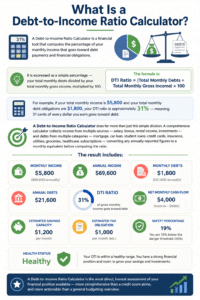
A Debt-to-Income Ratio Calculator is a financial tool that computes the percentage of your monthly income that goes toward debt payments and financial obligations.
It is expressed as a simple percentage — your total monthly debts divided by your total monthly gross income, multiplied by 100.
The formula is:
DTI Ratio = (Total Monthly Debts ÷ Total Monthly Gross Income) × 100
For example, if your total monthly income is $5,800 and your total monthly debt obligations are $1,800, your DTI ratio is approximately 31% — meaning 31 cents of every dollar you earn goes toward debt.
A Debt-to-Income Ratio Calculator does far more than just this simple division. A comprehensive calculator collects income from multiple sources — salary, bonus, rental income, investments — and debts from multiple categories — mortgage, car loan, student loans, credit cards, insurance, utilities, groceries, healthcare, subscriptions — converting any annually-reported figures to a monthly equivalent before computing the ratio.
The result includes:
- Monthly and annual income totals
- Monthly and annual debt totals
- Your DTI ratio percentage
- Net monthly cash flow after debts
- Estimated savings capacity
- Estimated tax obligation
- A “Safety” percentage showing how far below the danger threshold you are
- A health status — Healthy or Critical
A Debt-to-Income Ratio Calculator is the most direct, honest assessment of your financial position available — more comprehensive than a credit score alone, and more actionable than a general budgeting overview.
Why Your DTI Ratio Matters More Than Your Credit Score
Most people focus obsessively on their credit score — and almost entirely ignore their DTI ratio.
This is a mistake. Here is why.
A credit score measures your history — how reliably you have repaid debts in the past. It is backward-looking.
Your DTI ratio measures your current capacity — how much financial breathing room you have right now, today, with your current income and obligations. It is forward-looking.
A lender who sees a high credit score paired with a high DTI ratio knows something important: you may have managed debt well in the past, but you are currently stretched close to your limit. Taking on additional debt could tip you into financial distress.
Conversely, a moderate credit score with a low DTI ratio tells a lender that you have significant income capacity above your current obligations — making you a lower risk despite a less-than-perfect payment history.
This is why running your numbers through a Debt-to-Income Ratio Calculator is critical — it shows you what lenders actually see when they make approval decisions, beyond what your credit score alone reveals.
Why You Need a Debt-to-Income Ratio Calculator
Here is exactly why using a Debt-to-Income Ratio Calculator regularly is essential for everyone managing personal finances:
It shows your true financial position. Not your credit score. Not your account balance. Your real ratio of debt to earning power — the number that most accurately reflects how financially flexible or financially constrained you are.
It tells you whether you qualify for a mortgage. Before applying for a home loan, run your numbers through a Debt-to-Income Ratio Calculator. Most conventional mortgage lenders want to see a DTI below 36% to 43%. Knowing your ratio before you apply saves you from a rejection that damages your credit score and wastes your time.
It reveals hidden financial stress before it becomes a crisis. A DTI ratio creeping upward month by month is an early warning system. A Debt-to-Income Ratio Calculator makes this trend visible — so you can make adjustments before your financial situation becomes genuinely difficult.
It quantifies the impact of financial decisions. Considering taking on a new car loan? Run your numbers through the Debt-to-Income Ratio Calculator with and without the new payment. You will immediately see whether the new obligation pushes your ratio into unhealthy territory — and by exactly how much.
It motivates debt reduction with real numbers. Knowing abstractly that you “have too much debt” is not motivating. Seeing that your DTI ratio is 48% — and that paying off your credit card would drop it to 41% — is actionable. A Debt-to-Income Ratio Calculator makes debt reduction goals concrete and achievable.
Key Inputs in a Debt-to-Income Ratio Calculator — Income Section
The income section of the Debt-to-Income Ratio Calculator collects all sources of gross income — before taxes — and allows you to specify whether each amount is monthly or annual.
Salary ($)
Your primary employment income — the largest and most stable component of your gross income.
Always enter your pre-tax gross salary, not your net take-home pay. Lenders calculate DTI ratios using gross income — the full amount before any deductions. Entering your net income will artificially inflate your DTI ratio and produce an inaccurate result.
For annual salary: enter the annual amount and select “Annually” — the Debt-to-Income Ratio Calculator will automatically divide it by 12 to compute the monthly equivalent.
Bonus ($)
Additional compensation from annual performance bonuses, quarterly incentives, or seasonal payments.
Bonus income can be included in your DTI calculation if it is regular and verifiable. Lenders typically average bonus income over two years and may apply a haircut — accepting only 50% to 75% of regular bonus income in their DTI calculations. Use a conservative bonus estimate in your Debt-to-Income Ratio Calculator to reflect what a lender will actually credit.
Rental Income ($)
Monthly or annual income from residential or commercial rental properties you own.
Rental income is a legitimate and commonly used income source in DTI calculations. Enter your actual collected rental income — not the potential market rent. Lenders typically credit 75% of gross rental income to account for vacancies and maintenance costs, so consider using 75% of your actual rental income for a lender-realistic Debt-to-Income Ratio Calculator result.
Investment Income ($)
Dividends, interest payments, capital distributions, or returns from investment accounts.
Investment income is included in DTI calculations when it is regular, documented, and expected to continue. One-time capital gains are typically not included. Enter your average monthly or annual investment income from verifiable sources like dividend payments or bond interest distributions.
Other Income ($)
Freelance income, side business revenue, alimony, child support received, pension payments, Social Security benefits, or any other documented income source.
Include all verifiable income sources — every dollar of documented income improves your DTI ratio by expanding your income base. Use the Debt-to-Income Ratio Calculator to see exactly how much each additional income source reduces your DTI percentage.
Key Inputs in a Debt-to-Income Ratio Calculator — Debts and Expenses Section
The debt and expenses section of the Debt-to-Income Ratio Calculator collects every financial obligation — from fixed loan payments to variable monthly living costs — to build a complete picture of your monthly outflow.
Mortgage ($)
Your monthly mortgage payment — including principal, interest, property taxes, and homeowner’s insurance if escrowed.
Mortgage payment is typically the largest single item in the DTI calculation and the most scrutinized by lenders. If you are applying for a new mortgage, enter your projected new mortgage payment — not your current rent — to see whether the new payment keeps your DTI within qualifying range.
Car Loan ($)
Your monthly auto loan payment or lease payment.
Car loan payments are a fixed, verifiable debt obligation included in all standard DTI calculations. If you are considering purchasing a new vehicle, enter the projected new car payment into the Debt-to-Income Ratio Calculator to see its impact on your DTI before committing to the purchase.
Student Loan ($)
Monthly student loan payments — whether federal, private, or income-driven repayment plan amounts.
Student loans are a major DTI factor for younger borrowers. Lenders include the full required monthly payment in the DTI calculation — even for deferred or income-driven loans, many lenders use 1% of the outstanding balance as the assumed monthly payment when no active payment is being made.
Credit Card Payments ($)
The minimum required monthly payment on all credit card balances.
Most DTI calculations use the minimum required payment — not the full balance or what you actually choose to pay. Using minimum payments in the Debt-to-Income Ratio Calculator reflects the lender’s standard approach and gives you the most realistic DTI comparison.
Insurance ($)
Health insurance premiums, life insurance premiums, or other insurance costs paid directly (not deducted through payroll).
Utilities ($)
Monthly utilities including electricity, gas, water, internet, and phone.
Front-end DTI ratios used for mortgage qualification typically do not include utilities — but back-end DTI ratios and comprehensive financial health assessments do. The Debt-to-Income Ratio Calculator includes utilities to show your complete cash flow picture beyond just the loan-qualifying metrics.
Groceries ($)
Monthly spending on food and household essentials.
Grocery spending is a non-debt expense but a significant cash flow commitment. Including it in the Debt-to-Income Ratio Calculator produces a more complete and honest picture of your actual financial flexibility — beyond what the pure loan-qualifying DTI shows.
Healthcare ($)
Out-of-pocket medical expenses, prescription costs, dental, and vision care not covered by insurance.
Child Support / Childcare ($)
Court-ordered child support payments or regular childcare expenses.
Child support payments are always included in lender DTI calculations — they are a legally mandated fixed obligation. Childcare is included in comprehensive personal finance DTI assessments even if not always counted by mortgage lenders specifically.
Subscriptions ($)
Streaming services, gym memberships, software subscriptions, and other recurring monthly charges.
Subscriptions are small individually but collectively represent meaningful recurring costs. Enter your total monthly subscription spend to get an accurate cash flow picture from the Debt-to-Income Ratio Calculator.
How to Use a Debt-to-Income Ratio Calculator Step by Step
Follow these steps for the most accurate and useful DTI calculation:
Step 1 — Gather all income documentation. Collect your most recent pay stubs, tax returns, bank statements showing rental or investment deposits, and any other income records. Use verified, documented figures — not estimates — for the most accurate Debt-to-Income Ratio Calculator results.
Step 2 — Enter every income source with the correct frequency. Input each income source and select whether the amount is monthly or annual. The Debt-to-Income Ratio Calculator automatically converts annual figures to monthly equivalents. Include every legitimate income source — each one reduces your DTI ratio by expanding the income denominator.
Step 3 — Enter every debt and expense honestly. The most common mistake people make is leaving out small debts or rounding down monthly expenses. Include every obligation — no matter how small. A $50 streaming bundle and a $25 gym membership add up. Inaccurate inputs produce inaccurate DTI ratios — which means false confidence in your financial position.
Step 4 — Select the correct frequency for each debt item. Some debts are paid monthly, others annually or quarterly. Use the frequency selector in the Debt-to-Income Ratio Calculator to enter each debt in its natural billing cycle — the calculator converts everything to a monthly basis automatically.
Step 5 — Click Calculate and review every result. The Debt-to-Income Ratio Calculator will display your monthly income, monthly debts, DTI ratio, annual figures, net monthly cash flow, savings capacity, tax estimate, and your overall financial status. Read every line — not just the DTI percentage — to get the complete picture of your financial health.
Step 6 — Run scenario comparisons. What happens to your DTI if you pay off the credit card? What if you add a new car payment? What if your salary increases by $500 per month? The Debt-to-Income Ratio Calculator makes every scenario instantly testable — giving you the data to make major financial decisions with confidence.
Understanding Your Debt-to-Income Ratio Calculator Results
Each result from the Debt-to-Income Ratio Calculator tells a specific story about your financial position:
Monthly Income is the total of all your income sources converted to a monthly figure. This is your gross monthly income — the denominator in the DTI calculation.
Monthly Debts is the total of all debt payments and expenses converted to a monthly figure. This is the numerator in the DTI calculation — the amount being compared against your income.
DTI Ratio is the core output — your total monthly debts as a percentage of your total monthly gross income. This single number summarizes your entire financial leverage position. Under 36% is generally considered healthy. Above 43% is typically where lenders begin to decline mortgage applications. Above 50% signals significant financial stress.
Annual Income and Annual Debt provide the full-year perspective — useful for tax planning and understanding your annual financial commitment versus annual earning power.
Net Monthly Cash Flow is your monthly income minus your monthly debts — the money left over each month after all obligations are met. This is your actual financial breathing room. A positive number is essential; a negative number means you are spending more than you earn — a critical warning the Debt-to-Income Ratio Calculator makes immediately visible.
Savings estimates 20% of your monthly income as a recommended savings target — the widely cited “pay yourself first” benchmark.
Tax Estimate approximates 15% of monthly income as a rough tax provision — useful for understanding net cash flow after taxes.
Cash Flow combines debt obligations and tax estimates against income to show your true discretionary cash position after all commitments.
Safety % shows how much margin exists between your current DTI ratio and 100% — your buffer before your debts consume your entire income. A higher safety percentage means more financial flexibility.
Status — Healthy or Critical — is the bottom-line verdict. Below 36% DTI is Healthy. Above 36% moves toward Critical. This is the most immediately actionable output of the Debt-to-Income Ratio Calculator — it tells you in plain language whether your current financial structure is sustainable.
What Is a Good DTI Ratio? The Benchmarks Lenders Use
Different lenders and financial products use different DTI benchmarks. Understanding these thresholds makes the Debt-to-Income Ratio Calculator result immediately interpretable in real-world lending terms.
Below 20% — Excellent. You have very low debt relative to income. You will qualify for virtually any loan product at the best available interest rates. This is the financial freedom zone — maximum flexibility, minimum lender risk, and strong capacity to take on additional obligations if needed.
20% to 35% — Healthy. The ideal range for most financial situations. You have manageable debt, comfortable cash flow, and will qualify for mortgage loans, auto loans, and personal loans with favorable terms. Most financial planners target this range for their clients as the optimal balance of leverage and financial security.
36% to 43% — Caution Zone. You are approaching the upper limit of comfortable debt levels. Conventional mortgage lenders typically allow a maximum DTI of 43%, and some will decline applications above 36%. You may still qualify for loans but at higher interest rates and with stricter documentation requirements. The Debt-to-Income Ratio Calculator will display a status approaching Critical in this range.
44% to 50% — High Risk. Debt is consuming nearly half your gross income. Significant lenders will decline applications in this range. FHA loans allow up to 50% DTI in some circumstances, but options narrow considerably. Financial stress is a real and present risk. Immediate debt reduction action is advisable.
Above 50% — Critical. More than half your gross income is going toward debt. This is a financial emergency zone — most lenders will not extend new credit, and existing obligations represent severe risk. The Debt-to-Income Ratio Calculator will display Critical status and the data will show negative or near-zero net cash flow. Urgent financial restructuring is necessary.
How Lenders Use Your DTI Ratio in Loan Decisions
Understanding exactly how lenders apply DTI ratios helps you use the Debt-to-Income Ratio Calculator more strategically.
Lenders typically calculate two versions of DTI:
Front-End DTI (Housing Ratio): Only includes housing costs — mortgage principal, interest, property taxes, and homeowner’s insurance — divided by gross monthly income. Most lenders want this below 28%.
Back-End DTI (Total DTI): Includes all housing costs plus all other monthly debt obligations — car loans, student loans, credit cards, child support — divided by gross monthly income. This is what the Debt-to-Income Ratio Calculator computes. Most lenders want this below 36% to 43%.
Different loan types have different DTI limits:
- Conventional loans: Maximum back-end DTI of 43% (some lenders allow up to 50% with compensating factors)
- FHA loans: Maximum back-end DTI of 43%, with some flexibility up to 50% for strong borrowers
- VA loans: No official maximum DTI, but lenders typically prefer below 41%
- USDA loans: Maximum DTI of 41%
- Jumbo loans: Typically require DTI below 38% to 43%
The Debt-to-Income Ratio Calculator gives you your back-end DTI — the most comprehensive and commonly used figure in loan underwriting. Know this number before you apply — it determines not just whether you qualify but what interest rate you are offered.
Smart Strategies to Improve Your DTI Ratio
Once the Debt-to-Income Ratio Calculator reveals your current DTI, use these proven strategies to improve it:
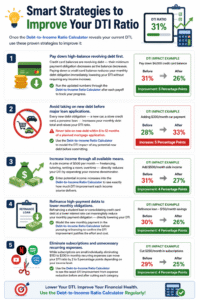
Pay down high-balance revolving debt first. Credit card balances are revolving debt — their minimum payment obligation decreases as the balance decreases. Paying down a credit card balance reduces your monthly debt obligation immediately, lowering your DTI without requiring any income increase. Run the updated numbers through the Debt-to-Income Ratio Calculator after each payoff to track your progress.
Avoid taking on new debt before major loan applications. Every new debt obligation — a new car, a store credit card, a personal loan — increases your monthly debt total and raises your DTI ratio. Never take on new debt within 6 to 12 months of a planned mortgage application. Use the Debt-to-Income Ratio Calculator to model the DTI impact of any potential new debt before committing.
Increase income through all available means. A side income of $500 per month — freelancing, tutoring, renting a room, overtime — directly reduces your DTI by expanding your income denominator. Enter potential income increases into the Debt-to-Income Ratio Calculator to see exactly how much DTI improvement each income source delivers.
Refinance high-payment debts to lower monthly obligations. Refinancing a student loan or consolidating credit card debt at a lower interest rate can meaningfully reduce your monthly payment obligation — directly lowering your DTI. Model the new monthly payment in the Debt-to-Income Ratio Calculator before pursuing refinancing to confirm the DTI improvement justifies the effort and cost.
Eliminate subscriptions and unnecessary recurring expenses. While subscriptions are small individually, eliminating $150 to $300 in monthly recurring expenses can move your DTI ratio by 2 to 5 percentage points depending on your income level. Use the Debt-to-Income Ratio Calculator to see the exact DTI improvement from expense reduction before and after cutting each category.
Common Mistakes to Avoid When Using a Debt-to-Income Ratio Calculator
Avoid these frequent errors that lead to inaccurate DTI calculations:
Mistake 1 — Using net income instead of gross income. DTI ratios are always calculated using gross income — before taxes. Entering your take-home pay instead of your pre-tax income will significantly overstate your DTI ratio. Always enter gross salary, gross rental income, and gross investment income — before any tax deductions.
Mistake 2 — Omitting small debts and subscriptions. Every omitted debt makes your DTI look better than it actually is — creating false confidence in your financial position. Enter every recurring financial obligation, no matter how small, into the Debt-to-Income Ratio Calculator for an honest, accurate result.
Mistake 3 — Using actual credit card payments instead of minimum payments. When calculating DTI for loan qualification purposes, lenders use the minimum required monthly payment on credit cards — not the amount you choose to pay. Enter the minimum required payment for credit cards in your Debt-to-Income Ratio Calculator to match the methodology lenders actually use.
Mistake 4 — Forgetting to include irregular income at its correct average. Bonus and commission income should be averaged — typically over 24 months — rather than entered at a peak amount. Using an unusually high bonus year will understate your typical DTI. Use a conservative, realistic average for variable income sources in the Debt-to-Income Ratio Calculator.
Mistake 5 — Running the calculation only once. Your DTI ratio changes every time your income or debt obligations change. Run the Debt-to-Income Ratio Calculator whenever a major financial change occurs — new job, new loan, paid-off debt, salary increase, rental income change. Monthly or quarterly recalculation keeps your financial picture current and your planning accurate.
Frequently Asked Questions (FAQs)
Q1: What does a Debt-to-Income Ratio Calculator calculate?
A Debt-to-Income Ratio Calculator computes your total monthly debt and expense obligations as a percentage of your total monthly gross income. It collects income from all sources — salary, bonuses, rental income, investments — and debt obligations from all categories — mortgage, car loans, student loans, credit cards, insurance, utilities, and living expenses — to produce your DTI ratio, net monthly cash flow, savings estimate, and overall financial health status.
Q2: What is a good debt-to-income ratio?
Below 36% is generally considered healthy, and most financial advisors target 20% to 35% as the ideal range. Conventional mortgage lenders typically allow a maximum DTI of 43%, with some flexibility up to 50% depending on the loan type and compensating factors. Above 50% is considered financially critical — indicating that debt obligations consume more than half of gross income, severely limiting financial flexibility. Use a Debt-to-Income Ratio Calculator to find your exact ratio and compare it against these benchmarks.
Q3: Should I use gross or net income in the Debt-to-Income Ratio Calculator?
Always use gross income — your income before taxes. This is the standard methodology used by all lenders when calculating DTI ratios. Entering your after-tax take-home pay will overstate your DTI ratio and produce a result that does not match what lenders will calculate. Enter your full pre-tax salary, pre-tax rental income, and pre-tax investment income into the Debt-to-Income Ratio Calculator for an accurate, lender-comparable result.
Q4: How does the Debt-to-Income Ratio Calculator affect mortgage approval?
DTI ratio is one of the most critical factors in mortgage underwriting. Most conventional lenders require a back-end DTI (total debt including housing costs) of 43% or below. FHA loans allow up to 50% in some cases. VA and USDA loans have their own DTI limits. Run your numbers through the Debt-to-Income Ratio Calculator before applying for a mortgage — if your DTI is above the threshold, you will know to pay down debt or increase income before submitting your application.
Q5: What is the difference between front-end and back-end DTI ratio?
Front-end DTI (also called housing ratio) includes only housing costs — mortgage principal, interest, taxes, and insurance — divided by gross income. Most lenders want this below 28%.
Back-end DTI includes all housing costs plus all other monthly debt obligations — car loans, student loans, credit cards, child support. This is what the Debt-to-Income Ratio Calculator computes. Most lenders want this below 36% to 43%. Back-end DTI is the more comprehensive and universally used measure in lending decisions.
Q6: How can I quickly improve my DTI ratio?
The two fastest levers are increasing income and reducing monthly debt payments. Paying off revolving credit card balances immediately reduces your minimum monthly payment obligation. Adding a verified side income stream expands your income denominator. Both changes show up instantly in the Debt-to-Income Ratio Calculator — run the numbers after each debt payoff or income increase to track your improvement and stay motivated.
Q7: Does the Debt-to-Income Ratio Calculator account for taxes?
The Debt-to-Income Ratio Calculator uses gross income (before taxes) for the DTI ratio calculation — which matches lender methodology. However, the results section also includes a tax estimate (approximately 15% of monthly income) as a separate line item in the cash flow analysis, helping you understand your true disposable income after both debt obligations and taxes. The DTI ratio itself is always calculated on gross income.
Q8: How often should I run a Debt-to-Income Ratio Calculator?
At a minimum, recalculate your DTI ratio whenever a major financial change occurs — a salary increase, a new loan, a paid-off debt, a new rental income source, or a significant change in monthly expenses. For active financial management, running the Debt-to-Income Ratio Calculator quarterly gives you a current, accurate view of your financial position and helps you track whether your DTI ratio is trending in the right direction over time. Always run it at least six months before any planned mortgage or major loan application.
Conclusion
Your debt-to-income ratio is not just a number lenders check — it is a direct measure of your financial health, your borrowing capacity, and your ability to withstand financial shocks.
A healthy DTI ratio means financial flexibility — the freedom to take on a new loan when needed, to weather unexpected expenses without crisis, and to build wealth rather than just service debt.
A high DTI ratio means financial constraint — fewer options, higher borrowing costs, and vulnerability to any disruption in income or unexpected increase in expenses.
The Debt-to-Income Ratio Calculator gives you complete clarity on which side of that line you currently stand — and exactly what actions will move you toward the healthy zone.
It shows you every income source, every debt obligation, your net cash flow, your financial status, and your complete debt picture in one unified calculation. It transforms an abstract concept into a precise, actionable number.
Whether you are planning a mortgage application, evaluating your overall financial health, preparing for a major financial decision, or simply trying to understand where your money goes each month — the Debt-to-Income Ratio Calculator is the tool that provides the honest, complete answer.
Know your DTI ratio. Understand what it means. And use the Debt-to-Income Ratio Calculator to track your progress as you work toward the financial flexibility that a healthy ratio delivers.