| Age | Total Invested | Wealth Earned | End Balance |
|---|
| Year | Total Deposits | Interest Growth | Accumulated Portfolio |
|---|
| Age | Salary Trend | Total Contributed | Corpus Value |
|---|
| Age | Yearly Savings | Tax Paid | End Year Balance |
|---|
Calculate interest instantly with our fast, accurate, and easy-to-use Interest Calculator
Table of Contents
- Introduction
- What Is a Retirement Calculator?
- Why You Must Use a Retirement Calculator
- How a Retirement Calculator Works
- Key Features of an Advanced Retirement Calculator
- Understanding Nest-Egg Growth
- Fixed Pension Goal Planning
- Withdrawal Phase and Monthly Income Planning
- Safe Withdrawal Rate (SWR) Analysis
- How to Use the Retirement Calculator Effectively
- Expert Tips for Retirement Savings
- Common Retirement Planning Mistakes to Avoid
- Benefits of Starting Early
- FAQs
- Conclusion
Introduction
Planning for retirement is one of the most important financial decisions you will ever make. Whether you are 25 or 55, understanding how much money you need to retire comfortably is critical. A Retirement Calculator is the single most powerful free tool available to help you estimate your retirement savings, set realistic goals, and build a rock-solid financial plan. In this comprehensive guide, we will walk you through everything you need to know — from how a Retirement Calculator works, to the smartest strategies for building your nest egg, to the common mistakes that could cost you thousands of dollars. Read this guide carefully, apply the insights, and take control of your financial future starting today.
What Is a Retirement Calculator?
A Retirement Calculator is a digital financial tool that helps individuals estimate how much money they will accumulate by the time they retire, based on variables such as current savings, monthly contributions, expected rate of return, and retirement age. It uses compound interest formulas and time-value-of-money principles to project how your wealth will grow over decades.
Unlike guesswork or rough estimates, a Retirement Calculator gives you precise, data-driven projections that allow you to make informed decisions. You can instantly see the impact of increasing your monthly contributions by even $50, or what happens if your investment returns drop from 8% to 6%. This kind of real-time financial modeling was once available only to wealthy clients working with private financial advisors. Today, a free online Retirement Calculator puts that same power in your hands.
At its core, every reliable Retirement Calculator answers three fundamental questions:
- How much money will I have when I retire?
- Am I saving enough to meet my retirement income goal?
- How long will my retirement savings last?
Whether you are planning for early retirement at 50 or a traditional retirement at 65, using a Retirement Calculator regularly is a habit that separates financially confident retirees from those who struggle in their later years.

Why You Must Use a Retirement Calculator
Most people dramatically underestimate how much money they need to retire comfortably. Studies show that the average American has less than $100,000 saved for retirement by the time they reach 55 — a figure that falls dangerously short of what most financial experts recommend. This gap exists largely because people never run the numbers. They assume “things will work out” without ever quantifying what “working out” actually requires.
A Retirement Calculator closes that gap. It forces you to confront the reality of your financial situation while there is still time to act. Here is why using one is non-negotiable:
- Clarity over confusion: Retirement planning can feel overwhelming. A Retirement Calculator breaks it down into simple inputs and clear outputs.
- Motivation through visualization: Seeing your projected nest egg grow year by year provides powerful motivation to stay consistent with savings.
- Scenario planning: What if you retire 5 years earlier? What if you increase contributions by $200/month? A Retirement Calculator answers these “what if” questions instantly.
- Goal alignment: It aligns your daily financial behavior with your long-term retirement goals.
- Accountability: Running the numbers regularly keeps you accountable and on track.
The bottom line is simple: you cannot manage what you do not measure. A Retirement Calculator gives you the measurement tool your financial future depends on.
How a Retirement Calculator Works
Understanding the mechanics behind a Retirement Calculator helps you use it more intelligently and interpret its results with confidence. At the heart of every calculation lies one powerful concept: compound interest.
Compound interest means that your money earns returns not just on your original principal, but also on all the accumulated returns from previous periods. Albert Einstein allegedly called compound interest “the eighth wonder of the world” — and for good reason. Over long time horizons, compound growth transforms modest monthly savings into extraordinary wealth.
A standard Retirement Calculator uses the Future Value of a growing annuity formula:
FV = PV × (1 + r)ⁿ + PMT × [((1 + r)ⁿ − 1) / r]
Where:
- FV = Future Value (your retirement nest egg)
- PV = Present Value (your current savings)
- r = Monthly interest rate (annual rate ÷ 12)
- n = Total number of months until retirement
- PMT = Monthly contribution amount
The Retirement Calculator runs this formula automatically in the background — you simply enter your data, click Calculate, and receive a detailed breakdown of your projected wealth, including a year-by-year table showing how your balance grows over time.
Key Features of an Advanced Retirement Calculator
Not all retirement calculators are built equal. A truly powerful Retirement Calculator offers multiple modules that address different phases and dimensions of retirement planning. Here are the essential features to look for:
A comprehensive Retirement Calculator should cover at least four distinct planning scenarios: nest-egg accumulation, goal-based corpus planning, post-retirement withdrawal planning, and safe withdrawal rate analysis. Each scenario serves a different planning need and together they provide a complete 360-degree view of your retirement finances.
Numbers alone can be difficult to interpret. The best calculators include visual bar graphs that compare your total invested principal against your total compound wealth. This visual representation immediately communicates the power of compounding — and the dramatic difference it makes over time.
A detailed table showing your age, total amount invested, wealth earned, and ending balance for each year is invaluable. This level of detail allows you to identify critical milestones, spot potential shortfalls early, and make timely adjustments.
The ability to change one variable and immediately see the updated result is what makes an online Retirement Calculator so much more useful than a static spreadsheet. Instant feedback accelerates learning and planning.
Understanding Nest-Egg Growth
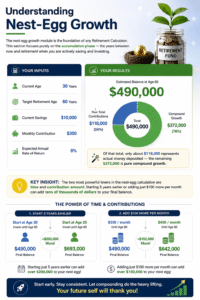
The nest-egg growth module is the foundation of any Retirement Calculator. This section focuses purely on the accumulation phase — the years between now and retirement when you are actively saving and investing. You input your current age, your target retirement age, your existing savings balance, your planned monthly contribution, and your expected annual rate of return.
The results are often surprising — and inspiring. For example, a 30-year-old with $10,000 in savings who contributes $300 per month at an 8% annual return will accumulate approximately $490,000 by age 60. Of that total, only about $118,000 represents actual money deposited — the remaining $372,000 is pure compound growth. This is the magic that a Retirement Calculator makes visible.
Key insight: The two most powerful levers in the nest-egg calculation are time and contribution amount. Starting 5 years earlier or adding just $100 more per month can add tens of thousands of dollars to your final balance.
Fixed Pension Goal Planning
Many people have a specific financial target in mind — perhaps $500,000 or $1,000,000 — and want to know whether their current savings plan will get them there. The goal-mapping feature is designed precisely for this purpose.
In this module, you enter your target corpus (the total amount you want at retirement), your years to retirement, your initial savings balance, your monthly savings amount, and your expected annual return. The Retirement Calculator compares your projected balance against your goal and tells you clearly whether you are on track, ahead, or behind — and by how much.
This gap analysis is enormously valuable. If you discover you are projected to fall $200,000 short of your goal, you now know exactly how much additional monthly savings or investment return is needed to close that gap. Knowledge is power, and a Retirement Calculator gives you both.
A widely used rule of thumb is the 25x Rule — multiply your expected annual retirement expenses by 25. If you plan to spend $40,000 per year in retirement, your target corpus should be $1,000,000. This rule is based on the assumption that a 4% annual withdrawal from your portfolio is sustainable for a 30-year retirement. Enter this figure into your Retirement Calculator to see if you are on pace to reach it.
Withdrawal Phase and Monthly Income Planning
Accumulating wealth is only half the retirement planning story. The other half is figuring out how to convert your nest egg into a reliable monthly income stream that lasts for the rest of your life. This is where the withdrawal planning module becomes essential.
In this section, you enter your retirement savings balance, the monthly income you need, your expected investment return during retirement, and how many years your savings need to last. The tool then determines whether your savings are sufficient to provide that income for the full duration.
Critical factors to consider in withdrawal planning include:
- Inflation: The purchasing power of money decreases over time. A Retirement Calculator that accounts for inflation gives more accurate real-world projections.
- Healthcare costs: Medical expenses typically increase with age. Build a buffer into your monthly income requirement.
- Longevity risk: People are living longer. Plan for at least 25–30 years of retirement, not 15–20.
- Market volatility: Investment returns during retirement may be lower or more volatile than during accumulation years.
Safe Withdrawal Rate (SWR) Analysis
The Safe Withdrawal Rate (SWR) analysis is the most sophisticated feature of an advanced Retirement Calculator. It directly addresses the question that every retiree fears: “Will I outlive my money?”
The concept of a safe withdrawal rate comes from extensive historical research into portfolio performance. The most famous study — the “Trinity Study” — found that a 4% annual withdrawal rate from a diversified portfolio of stocks and bonds has historically survived 30-year retirement periods with a high probability of success.
The SWR module takes this concept further. You enter your total retirement savings, your desired withdrawal rate, and your investment return during retirement. The calculator then projects your annual and monthly income, your portfolio balance year by year, and the exact year your money runs out if the withdrawal rate is too aggressive.
This analysis removes the guesswork from one of the most important financial decisions of your life. It allows you to test different withdrawal scenarios safely, on paper, before you commit to a retirement spending plan.
How to Use the Retirement Calculator Effectively
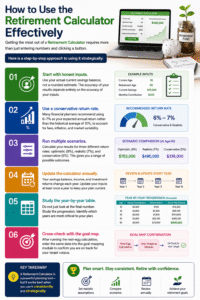
Getting the most out of a Retirement Calculator requires more than just entering numbers and clicking a button. Here is a step-by-step approach to using it strategically:
- Start with honest inputs. Use your actual current savings balance, not a rounded estimate. The accuracy of your results depends entirely on the accuracy of your inputs.
- Use a conservative return rate. Many financial planners recommend using 6–7% as your expected annual return rather than the historical average of 10%, to account for fees, inflation, and market variability.
- Run multiple scenarios. Calculate your results for three different return rates: optimistic (9%), realistic (7%), and conservative (5%). This gives you a range of possible outcomes.
- Update the calculator annually. Your savings balance, income, and investment returns change each year. Update your inputs at least once a year to keep your plan current.
- Study the year-by-year table. Do not just look at the final number. Study the progression. Identify which years are most critical to your plan.
- Cross-check with the goal map. After running the nest-egg calculation, enter the same data into the goal-mapping module to confirm you are on track for your target corpus.

Expert Tips for Retirement Savings
The numbers produced by your Retirement Calculator are only as good as the savings habits behind them. Here are proven expert strategies to maximize your retirement wealth:
Set up automatic transfers to your retirement account on every payday. When savings happen automatically before you see the money, you are far less likely to skip a contribution. Consistency is the single most important factor in long-term wealth building.
Every time your income increases, direct at least 50% of the raise toward your retirement savings. If you contribute $300/month today and receive a raise that allows you to contribute $400/month, you will barely notice the lifestyle difference — but your Retirement Calculator will show a dramatically larger projected balance.
Always max out your 401(k), IRA, Roth IRA, or equivalent tax-sheltered retirement accounts before investing in taxable accounts. The tax savings alone can add hundreds of thousands of dollars to your retirement wealth over a 30-year period.
Do not put all your retirement savings in one asset class. A diversified portfolio of index funds, bonds, and real estate investment trusts (REITs) reduces risk and smooths out volatility, helping ensure that the return rate you enter into your Retirement Calculator remains achievable.
Withdrawing from your retirement account early is one of the most damaging financial mistakes you can make. Not only do you pay penalties and taxes, but you also permanently destroy the compound growth that money would have generated. Run the numbers in your Retirement Calculator to see exactly how much a single early withdrawal costs you in long-term wealth.
Common Retirement Planning Mistakes to Avoid
Even well-intentioned savers make costly errors. Being aware of these mistakes is the first step toward avoiding them.
Time is the most valuable input in any Retirement Calculator. Every year you delay starting your retirement savings costs you far more than the dollars you fail to deposit. A 25-year-old who saves $200/month will accumulate far more wealth by 65 than a 35-year-old who saves $400/month — simply because of the extra 10 years of compound growth. Start immediately, no matter how small the amount.
Many people assume their expenses will drop significantly in retirement. In reality, healthcare, travel, and leisure expenses often increase. Use a realistic estimate of your monthly expenses when planning your withdrawal strategy.
If inflation runs at 3% per year, the purchasing power of $1,000 today will be worth only about $412 in 30 years. Always factor inflation into your retirement planning. A $3,000 monthly income might feel adequate today but may feel tight in 25 years.
Using an overly optimistic return rate in your Retirement Calculator creates a dangerous false sense of security. Be conservative with your assumptions — it is far better to arrive at retirement with more money than expected than to arrive with less.
A number in your head is not a plan. A written retirement plan with specific savings targets, contribution amounts, and investment allocations is significantly more likely to be followed and achieved. Use your Retirement Calculator results to create and document a concrete written plan.
Benefits of Starting Early
If there is one message that every financial expert agrees on, it is this: start saving for retirement as early as possible. The mathematics of compound interest make early starters nearly impossible to catch up with, even by more aggressive savers who start later. Let us illustrate this with a concrete example.
Person A starts saving at age 22, contributing $250/month at a 7% annual return. By age 65, they accumulate approximately $879,000.
Person B waits until age 32 to start, contributing $500/month at the same 7% return. By age 65, they accumulate approximately $681,000 — despite contributing twice as much each month.
Person A ends up with $200,000 more despite contributing half as much per month — because they started 10 years earlier. Enter these numbers yourself into a Retirement Calculator to see this dramatic difference firsthand.
The three greatest benefits of starting early are:
- Maximum compound growth: More time means more compounding cycles and exponentially larger final balances.
- Lower monthly commitment: Reaching the same retirement goal requires smaller monthly contributions when you start early.
- Financial flexibility: Earlier retirement becomes a realistic option, giving you more control over your life and career choices.
- Reduced financial stress: Knowing your retirement is funded gives you incredible peace of mind throughout your working years.
Frequently Asked Questions (FAQs)
1. What does this tool help me with?
It helps you estimate your future savings and financial growth based on your income, contributions, and time period.
2. How does the calculation work?
It uses your inputs like age, savings, monthly deposits, and return rate to project long-term financial outcomes.
3. Can inflation be included in the results?
Yes, it can adjust results based on inflation to show the real value of money in the future.
4. Why are monthly contributions important?
Regular contributions increase your total savings significantly due to long-term compounding.
5. What is the return rate used for?
It represents the expected yearly growth of your investments or savings.
6. Can I set a financial target?
Yes, you can enter a goal amount and check whether your plan is sufficient to reach it.
7. Are the results exact or estimated?
The results are projections based on inputs and should be used for planning purposes only.
8. Is this useful for long-term planning?
Yes, it helps you understand how your money can grow over time and supports future planning.
9. Can I test different financial scenarios?
Yes, you can change inputs like savings, age, and growth rate to compare different outcomes.
10. Is this tool free to use?
Yes, it is completely free and designed for easy financial planning.
Conclusion
Retirement planning is not a task to be postponed, minimized, or left to chance. The single most important step you can take today is to run your numbers through a Retirement Calculator and understand exactly where you stand. Whether your projections fill you with confidence or reveal a gap that needs urgent attention, knowledge is always better than ignorance — especially when your financial future is at stake.
A high-quality Retirement Calculator gives you the tools to model nest-egg growth, track goal attainment, plan your withdrawal strategy, and analyze sustainable income rates — all in one place, all for free. There is no excuse not to use it.
Remember the core principles: start early, contribute consistently, invest wisely, avoid early withdrawals, and revisit your plan at least once a year. Each time you return to your Retirement Calculator, you reinforce the habits and awareness that lead to financial security.
Your retired self is counting on the decisions your current self makes today. Run the numbers. Build the plan. Stay the course. The retirement you want is entirely within reach — and it all starts with one click on the Retirement Calculator