| Year | Total Deposits | Interest Earned | End Balance |
|---|
Calculate your monthly loan payments instantly with our fast and accurate loan calculator
Table of Contents
- Introduction
- What Is a Compound Interest Calculator?
- How Does a Compound Interest Calculator Work?
- The Magic of Compounding — Why It Matters
- Key Terms You Must Understand
- How to Use the Compound Interest Calculator Step by Step
- Compounding Frequencies Explained
- The Role of Regular Contributions
- Inflation and Tax — The Real Return on Investment
- Compound Interest vs. Simple Interest
- Real-World Examples Using the Calculator
- Benefits of Using a Compound Interest Calculator
- Investment Strategies to Maximize Compound Growth
- Common Mistakes Investors Make
- Frequently Asked Questions
- Conclusion
Introduction
Money grows — but how fast it grows depends entirely on how it is invested. One of the most powerful forces in personal finance is compounding, and understanding it can be the difference between financial freedom and missed opportunity. Whether you are saving for retirement, building an emergency fund, growing a college education fund, or simply trying to make your money work harder, using a Compound Interest Calculator is the first step toward making informed, confident financial decisions. A Compound Interest Calculator removes all the guesswork from investment planning by showing you exactly how your money will grow over time — accounting for your initial investment, regular contributions, interest rate, compounding frequency, inflation, and even taxes. In this comprehensive guide, we will walk you through everything you need to know to use a Compound Interest Calculator effectively and build real, lasting wealth.
What Is a Compound Interest Calculator?
A Compound Interest Calculator is a digital financial tool that calculates the future value of an investment by applying compound interest over a specified period. Unlike simple interest — which only earns returns on the original principal — compound interest earns returns on both the principal and the accumulated interest from previous periods. This seemingly small difference has an enormous impact on long-term wealth building.
The Compound Interest Calculator takes several inputs and produces a detailed projection of your investment growth, including:
- Total principal invested over the full term
- Total interest accumulated through compounding
- Gross future value before taxes
- Net future value after taxes and inflation adjustments
- Year-by-year growth breakdown in a complete schedule
A good Compound Interest Calculator is not just a number cruncher — it is a financial planning companion that helps you visualize the future and set realistic, achievable goals. Whether you are a first-time investor or an experienced wealth builder, this tool provides clarity and confidence at every stage of your financial journey.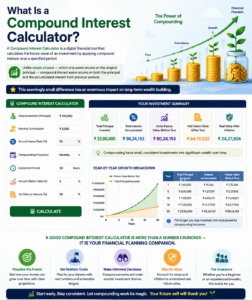
How Does a Compound Interest Calculator Work?
At its core, the Compound Interest Calculator applies the compound interest formula to your inputs. The standard formula for compound interest is:
A = P × (1 + r/n)^(n×t)
Where:
- A = Final amount (future value)
- P = Principal (initial investment)
- r = Annual interest rate (as a decimal)
- n = Number of times interest compounds per year
- t = Investment term in years
For example, if you invest $5,000 at 8.5% APR, compounded monthly for 5 years:
- r = 0.085, n = 12, t = 5
- A = 5000 × (1 + 0.085/12)^(12×5)
- A ≈ $7,518
That means your $5,000 grew by $2,518 through compounding alone — without adding a single dollar more.
When regular contributions are added to the equation, the Compound Interest Calculator applies a more complex formula that accounts for the timing and frequency of deposits. This is where the real power of consistent investing becomes clear. Adding even modest regular contributions dramatically accelerates the compounding effect.
The Magic of Compounding — Why It Matters
Albert Einstein is widely (if informally) credited with calling compound interest “the eighth wonder of the world.” Whether or not he said it, the sentiment is entirely accurate. Compounding creates a snowball effect — the larger your accumulated balance, the more interest it generates, which in turn creates an even larger balance.
Consider two investors:
- Investor A invests $5,000 once and never adds more. At 8% annually for 30 years, they end up with approximately $50,313.
- Investor B invests $5,000 and adds $200 every month for 30 years at the same rate. They end up with approximately $312,000+.
The difference is staggering — and it is all driven by the compounding effect of regular contributions. The Compound Interest Calculator lets you model both scenarios instantly, helping you understand just how powerful consistent investing really is.
The key insight is that time is the single greatest multiplier in compounding. Starting even a few years earlier can result in tens of thousands of dollars more in final wealth. This is why financial advisors universally recommend starting to invest as early as possible — the earlier you start, the longer compounding has to work in your favor.
Key Terms You Must Understand
Before you get the most out of a Compound Interest Calculator, it is important to understand the financial terms involved. Here are the most essential concepts:
The starting amount of money you invest. This is the base from which all future growth originates. A larger principal means more interest is generated from day one.
The rate at which your investment grows each year, expressed as a percentage. A higher APR means faster growth. When comparing investment vehicles, always compare APRs to make a fair assessment.
How often interest is calculated and added to your balance. The more frequently interest compounds — daily, monthly, quarterly — the faster your money grows. Monthly compounding is the most common for savings and investment accounts.
The additional amount you invest at regular intervals — monthly, weekly, bi-weekly, or annually. Regular contributions are one of the most powerful levers for building wealth through compounding.
Whether you make your contribution at the beginning or end of each period. Beginning-of-period contributions (annuity due) earn slightly more interest because the money is invested for the full period before the next contribution arrives.
The total duration of the investment — expressed in years or months. Longer terms allow compounding to work more powerfully.
The estimated percentage of interest income taken by taxes. The Compound Interest Calculator can calculate both gross and after-tax returns so you understand your real net gain.
The annual rate at which the purchasing power of money decreases. Accounting for inflation gives you the real return on your investment — what your money is actually worth in today’s dollars at the end of the investment period.
How to Use the Compound Interest Calculator Step by Step
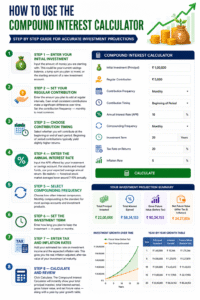
Using the Compound Interest Calculator is straightforward. Follow these steps to get an accurate projection:
Step 1 — Enter Your Initial Investment
Input the amount of money you are starting with. This could be your current savings balance, a lump sum you plan to invest, or the starting amount of a new investment account.
Step 2 — Set Your Regular Contribution
Enter the amount you plan to add at regular intervals. Even small consistent contributions make a significant difference over time. Set the contribution frequency — monthly is most common.
Step 3 — Choose Contribution Timing
Select whether you will contribute at the beginning or end of each period. Beginning of period contributions typically yield slightly higher returns.
Step 4 — Enter the Annual Interest Rate
Input the APR offered by your investment or savings account. For stocks and mutual funds, use your expected average annual return. Be realistic — historical stock market averages hover around 7–10% annually.
Step 5 — Select Compounding Frequency
Choose how often interest compounds. Monthly compounding is the standard for most savings accounts and investment products.
Step 6 — Set the Investment Term
Enter how long you plan to keep the investment — in years or months.
Step 7 — Enter Tax and Inflation Rates
Add your estimated tax rate on investment income and the expected inflation rate. This gives you the real, inflation-adjusted, after-tax value of your investment at maturity.
Step 8 — Calculate and Review
Click Calculate. The Compound Interest Calculator will instantly show your total principal invested, total interest earned, gross future value, and net future value — along with a year-by-year growth table.
Compounding Frequencies Explained
The frequency at which interest compounds has a direct impact on how much you earn. Here is how different compounding frequencies compare for a $10,000 investment at 8% APR over 10 years:
| Compounding Frequency | Final Value |
|---|---|
| Annually | $21,589 |
| Quarterly | $22,080 |
| Monthly | $22,196 |
| Daily | $22,255 |
The difference between annual and daily compounding on $10,000 is over $666 — without investing a single dollar more. For larger investments and longer time horizons, the gap grows significantly. This is why choosing an account with more frequent compounding always works in your favor.
The Compound Interest Calculator supports all standard compounding frequencies — annually, semi-annually, quarterly, and monthly — so you can model the exact product you are comparing.
The Role of Regular Contributions
One of the most transformative features of the Compound Interest Calculator is its ability to model the impact of regular contributions. Many people underestimate how much difference a modest monthly contribution makes.
Consider this example using the Compound Interest Calculator:
- Scenario A: $5,000 initial investment, no additional contributions, 8% APR, 20 years → Final Value: ~$23,305
- Scenario B: $5,000 initial investment, $200/month contributions, 8% APR, 20 years → Final Value: ~$136,000+
The regular contributions in Scenario B increased the final value by nearly 6 times compared to a lump sum alone. This is the power of consistent, disciplined investing — and the Compound Interest Calculator makes it immediately visible.
The key takeaway: start with whatever you can, and contribute regularly. Even $50 or $100 per month, invested consistently over decades, can build substantial wealth through the compounding effect.
Inflation and Tax — The Real Return on Investment
Gross returns are exciting. Real returns are what actually matter. The Compound Interest Calculator addresses this by incorporating both inflation and tax into its projections.
If your investment earns 8.5% but you are taxed at 15% on the gains, your effective after-tax return is approximately 7.2%. Over 20–30 years, this difference compounds into a significant reduction in final wealth. Always plan using after-tax figures to avoid overestimating your investment outcome.
If inflation averages 3% annually and your investment earns 8.5%, your real return is approximately 5.5%. This means the purchasing power of your final balance — what you can actually buy with it — is growing at 5.5%, not 8.5%.
The Compound Interest Calculator accounts for both of these factors, giving you a realistic net future value that reflects what your money will actually be worth in today’s purchasing terms. This is crucial for retirement planning, where the real value of your savings is what determines your quality of life.
Compound Interest vs. Simple Interest
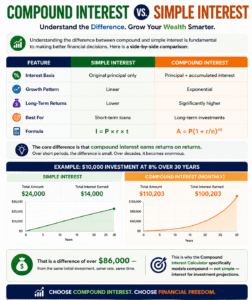
Understanding the difference between compound and simple interest is fundamental to making better financial decisions. Here is a side-by-side comparison:
| Feature | Simple Interest | Compound Interest |
|---|---|---|
| Interest Basis | Original principal only | Principal + accumulated interest |
| Growth Pattern | Linear | Exponential |
| Long-Term Returns | Lower | Significantly higher |
| Best For | Short-term loans | Long-term investments |
| Formula | I = P × r × t | A = P(1 + r/n)^(nt) |
The core difference is that compound interest earns returns on returns. Over short periods, the difference is small. Over decades, it becomes enormous. For a $10,000 investment at 8% over 30 years:
- Simple interest: $24,000 total ($14,000 in interest)
- Compound interest (monthly): $110,203 total ($100,203 in interest)
That is a difference of over $86,000 — from the same initial investment, same rate, same time. This is why the Compound Interest Calculator specifically models compound — not simple — interest for investment projections.
Real-World Examples Using the Calculator
Let us look at practical scenarios where the Compound Interest Calculator delivers immediate, actionable value:
A 30-year-old invests $10,000 with $300 monthly contributions at 7% APR, compounded monthly, for 35 years. The Compound Interest Calculator reveals a final balance of over $580,000 — with only $136,000 of actual contributions. The rest is all compounding.
Parents invest $2,000 for a newborn with $150 monthly contributions at 6% APR, compounded monthly, for 18 years. The projected balance: approximately $64,000 — more than enough to fund a significant portion of a college education.
Rather than keeping $15,000 in a zero-interest checking account, investing it in a high-yield savings account at 4.5% APR, compounded daily, for 5 years yields approximately $18,680. Doing nothing costs you $3,680 in potential growth.
Benefits of Using a Compound Interest Calculator
Here are the most important reasons to use a Compound Interest Calculator regularly:
Seeing your projected final balance helps you set concrete, realistic financial goals. Instead of vague intentions to “save more,” you have specific targets to work toward.
Run multiple scenarios instantly — higher contributions, longer terms, different interest rates — to find the strategy that best fits your goals and budget. The Compound Interest Calculator makes this exploration fast and effortless.
Watching your projected balance grow as you adjust inputs is genuinely motivating. Seeing that an extra $50 per month produces tens of thousands more over 20 years is one of the most powerful motivators for consistent investing.
When evaluating investment products — savings accounts, bonds, index funds, fixed deposits — the Compound Interest Calculator lets you compare them on an equal footing using real numbers.
Using the calculator regularly builds genuine financial literacy. You begin to intuitively understand how rate, time, and contributions interact — making you a smarter, more confident investor.
Investment Strategies to Maximize Compound Growth
Here are time-tested strategies to maximize the power of compounding:
- Start Early: Every year you delay costs you exponentially in the future. A 25-year-old investing the same amount as a 35-year-old will accumulate roughly twice as much by retirement.
- Increase Contributions Over Time: As your income grows, increase your regular contributions — even by small amounts. The Compound Interest Calculator will show you how dramatically this accelerates growth.
- Reinvest All Returns: Never withdraw interest or dividends early. Allow every return to compound on itself.
- Choose Higher-Frequency Compounding: When choosing between financial products, prefer those with more frequent compounding — monthly over quarterly, daily over monthly.
- Minimize Tax Drag: Use tax-advantaged accounts (IRAs, 401(k)s, ISAs) wherever possible to prevent taxes from eroding your compound growth.
- Stay Consistent: Market volatility is temporary. Consistent contributions through market ups and downs averages your cost and maximizes the compounding effect over time.
Common Mistakes Investors Make
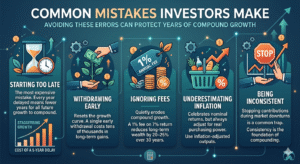
Avoiding these errors can protect years of compound growth:
The most expensive mistake in investing is waiting. Every year of delay is not just one year of missed growth — it is one fewer year for all future growth to compound. Use the Compound Interest Calculator to see the real cost of a 5-year delay — it is typically staggering.
Pulling money out of a compounding investment before maturity resets the growth curve. Even one early withdrawal can cost you tens of thousands in long-term gains.
Investment management fees, platform fees, and fund expense ratios quietly erode compound growth. A 1% annual fee on a 7% return investment reduces your effective rate to 6% — and over 30 years, this difference can cost you 20–25% of your final wealth.
Many investors celebrate nominal returns without adjusting for inflation. Always use the Compound Interest Calculator’s inflation-adjusted output to understand the real purchasing power of your future wealth.
Stopping contributions during market downturns is a common psychological trap that significantly undermines long-term results. Consistency is the foundation of compounding.
Frequently Asked Questions
A Compound Interest Calculator is mathematically precise for the inputs you provide. However, actual investment returns vary — no calculator can predict market fluctuations. Use it for planning and goal-setting, not as a guaranteed forecast.
Daily compounding produces the highest returns, but the difference between daily and monthly is very small for typical investment amounts. Monthly compounding is the most commonly available and practical option.
Yes — always. Inflation silently erodes the purchasing power of your savings. The Compound Interest Calculator‘s inflation-adjusted result tells you what your future balance is really worth in today’s money.
Contribute as much as you comfortably can without straining your budget. Even small amounts — $50, $100, $200 per month — have a dramatic impact over long time horizons. Use the calculator to find the contribution amount that aligns with your goals.
Absolutely. The Compound Interest Calculator is one of the most useful tools for retirement planning. Input your current savings, expected monthly contributions, estimated return rate, tax rate, and your retirement horizon to see a realistic projection of your retirement fund.
Conclusion
Wealth is not built overnight — it is built through the quiet, relentless power of compounding, sustained over time. A Compound Interest Calculator is the most practical tool available to help you harness that power with clarity and confidence. Whether you are planning your retirement, saving for a major life goal, or simply trying to make your money work harder, this calculator gives you the full picture — principal, interest, contributions, taxes, and inflation — all in one place.
The most important action you can take right now is to start. Input your numbers, see your projected growth, and commit to a consistent investment plan. The earlier you begin, the more time compounding has to multiply your wealth. Use our Compound Interest Calculator above — it is free, instant, and built to give you the financial clarity that turns goals into reality. Take control of your financial future today, because every day you wait is a day of compounding you can never get back.